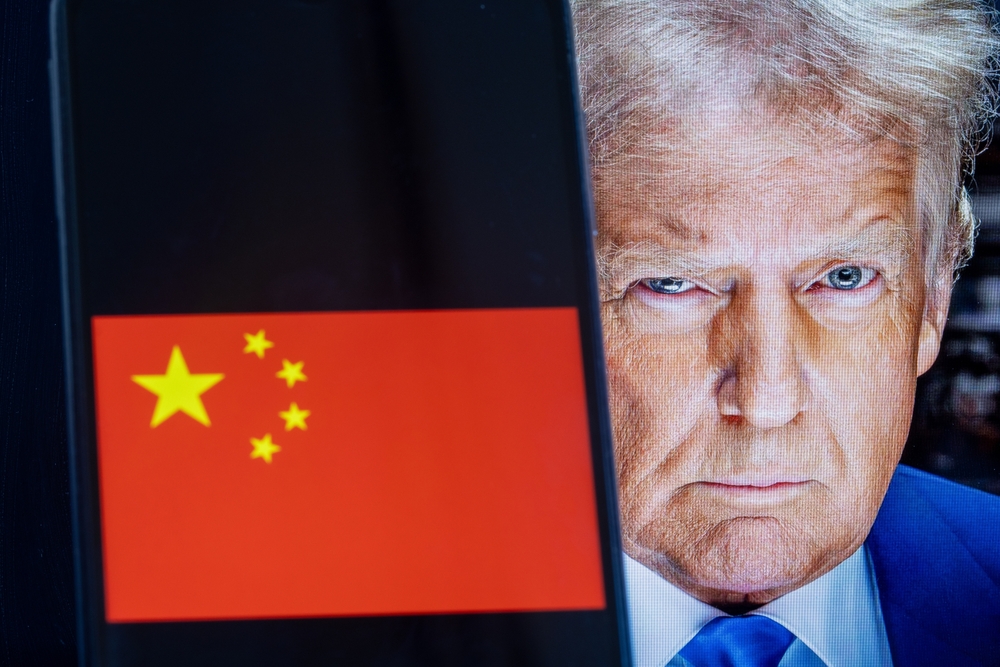

When Trump’s plane touched down in Beijing last week, the Chinese internet was ready for him. While state television rolled out the ceremonial welcome, something else entirely was trending on Weibo, China’s dominant social platform: a nickname. Not a flattering one. Not a neutral one. A nickname that captured, in two words, exactly what a lot of people in China believe Trump has accidentally done for their country.
The name was “Chuan Jianguo.” And if you know a little Mandarin, or you spend any time around people who do, the joke lands hard. “Jianguo” means “country builder.” Put it together with “Chuan,” the abbreviated transliteration of Trump, and you get a name that sounds, on the surface, almost complimentary. Almost. The joke is that the country being built isn’t America.
That’s the cut. The nickname implies Trump is an honorary Chinese patriot, a man so committed to his own brand of economic confrontation that he has spent years handing Beijing a strategic gift while thinking he was delivering a blow. It’s the kind of insult that doesn’t need to raise its voice. It just sits there smiling.
What the Nickname Actually Means
Trump’s Chinese nickname “Chuan Jianguo” has been circulating on Chinese social media. It literally translates to “Trump the Country Builder” – but according to users, it’s a mocking suggestion that the U.S. leader’s aggressive foreign policy has helped Beijing overtake Washington on the global stage.
The sardonic nickname implies that Trump is effectively a “patriotic son” of China, serving Beijing’s interests rather than those of his own nation. The name ridicules the gap between intent and outcome: a man who set out to weaken a rival and, by many accounts, did the opposite.
The Chinese government and state media refer to Trump as “telangpu,” though he’s also frequently called “chuanpu,” a slightly alternative transliteration. “Telangpu” is the most widely used name for him in mainland China. “Chuan Jianguo” exists outside official channels entirely. It’s the name ordinary people use when they’re not being formal – which, on Weibo, is pretty much always.
Despite the online trolling, the hashtag #WelcomeTrumpToChina was the top trending topic on China’s Weibo platform as Trump and his delegation arrived. The two things existed simultaneously without contradiction: genuine curiosity about the visit, and a sharp-edged joke about what it represented. That’s a particular kind of sophisticated mockery, the sort that welcomes someone warmly while making it clear you find the whole situation privately hilarious.
The Tariff Paradox
The nickname has a real-world argument behind it, and it’s not a weak one. Among the most visible of Trump’s moves have been the steep and unpredictable tariffs slapped on China, along with brokering a deal to curb fentanyl precursors. Paradoxically, U.S. tariffs have driven China toward greater self-sufficiency than ever before, compelling it to accelerate domestic innovation across sectors including technology, energy, and food security.
Since the beginning of Trump’s second term, U.S. tariff policy has changed more than 50 times. The applied tariff rate peaked in April 2025, shortly after the “Liberation Day” tariffs, and has fluctuated significantly since then. According to the Tax Foundation, the Trump tariffs represent the largest U.S. tax increase as a percentage of GDP since 1993, amounting to an average tax increase per U.S. household of $1,500 in 2026.
The intended logic was straightforward: make Chinese exports more expensive, hurt Chinese manufacturers, and force Beijing to the table on fairer terms. What happened instead was more complicated. The continued push to cut off China’s access to advanced technology is making it more self-sufficient out of necessity. The trade war, even if it leads to a deal, will push China to invest in its tech sector even more.
Beijing isn’t trying to out-compete U.S. innovation in AI infrastructure. Instead, it’s leveraging its manufacturing expertise and doubling down on physical AI, like robotics and AI-enabled EVs. China’s chip industry still lags the cutting edge – but it’s far more self-sufficient today than it was five years ago, when the U.S. first started tightening the screws on chip exports.
In 2025 alone, the pressure produced results that looked nothing like what Washington had planned. China intensified subsidy programs to accelerate self-reliance in high technologies, using a combination of direct public investment, tax incentives, and industrial guidance funds. Government funding accounted for approximately 400 billion yuan of the nation’s projected 600 – 700 billion yuan in AI capital expenditure that year alone, reflecting Beijing’s drive to narrow the technological gap with the U.S.
You could argue about whether that kind of state-directed spending is sustainable. You could debate whether it will produce genuine innovation or just expensively replicate what already exists elsewhere. But you can’t argue that the tariffs stopped it. China’s Communist Party Central Committee has now announced its economic and industrial priorities for 2026 – 2030, pledging to build a “modern industrial system” and accelerate technological self-reliance. The tariffs were meant to be a ceiling. Beijing is treating them as a floor.
Finding New Customers
The technology story is only part of what the nickname is pointing at. The other part is markets.
China is pursuing its own diversification strategy. While its exports to the U.S. have shrunk amid trade wars – dropping 20% last year alone – its overall exports have climbed robustly, with its trade surplus topping $1.2 trillion for the first time last year. So far in 2026, Chinese exports are running nearly 15% ahead of the same period last year. Beijing accomplished this by boosting exports to rapidly growing markets in Southeast Asia, Africa, and Latin America, according to official customs data.
That’s a remarkable number. A country loses its biggest customer and responds by growing its total exports anyway. The 11-nation ASEAN bloc has become a bigger trading partner with China than either the United States or the EU. That shift didn’t happen by accident, and it didn’t start last year. China has been building toward this for years, but the urgency created by American tariffs compressed the timeline considerably.
According to S&P Global, China now exports over 50% more to Global South regions ($1.6 trillion) than to the U.S. and Western Europe combined ($1 trillion). Chinese firms aren’t just redirecting existing goods through alternative ports to dodge duties. They are building factories, signing infrastructure deals, and locking in supply relationships across countries that were barely on the radar a decade ago.
China extended zero tariffs to 100% of products from 53 African countries beginning May 1, 2026 – a move that deepened ties across a continent the U.S. has largely left to its own devices. China remains Africa’s largest trading partner, with bilateral trade reaching approximately $348 billion in 2025. That’s not a relationship that reverses quickly, regardless of what gets agreed to at any summit.
The Summit and Its Limits
Trump arrived in Beijing calling it “an incredible visit” and touting what he described as “fantastic trade deals.” Chinese officials opened the door to new areas of cooperation while Trump characterized the trip positively – but analysts noted both sides were still waiting for specifics, with no clear statement of details emerging.
One confirmed headline was that China agreed to order at least 200 Boeing aircraft – a win Trump was eager to announce. But economists noted that the deals Trump touted remain only verbal commitments, with no guarantee they will materialize. This has happened before: Trump’s 2017 trip to China led to an agreement for a state-owned Chinese corporation to invest nearly $84 billion in shale gas and chemical manufacturing projects in West Virginia, but the plans dissolved as U.S.-China tensions grew.
The trade skirmishing has extended beyond traditional tariffs. The United States blocked shipments of the most advanced computer chips to China, and China responded by periodically cutting off supplies of rare earth minerals crucial for electronics. China controls about 80% of the world’s tungsten, a super-strong metal used in defense, aerospace, and medical device production.
U.S. soybean exports to China dropped 75% in 2025. Rural American farmers, many of them Trump supporters, felt that one directly. It’s a reminder that in a trade war of this scale, the collateral damage rarely falls where the architects intended.
Read More: 9 American Cities You Should Never Visit
The Quiet Part Out Loud
What makes “Chuan Jianguo” stick isn’t just that it’s clever. It’s that it voices something a lot of serious analysts have been saying in careful, hedged language for years: that economic pressure campaigns can backfire, and that trying to contain a competitor through sustained confrontation sometimes produces a more determined competitor.
The nickname doesn’t require you to like China’s government, or to think the trade war was wrong in principle. It just requires you to look at the scoreboard and notice something. A decade of conflict between the world’s two biggest economies has left U.S.-China trade greatly reduced from the boom times of the 2000s and 2010s, forcing companies to regroup. Both sides have paid a price. But Beijing’s strategic position – its technology development, its share of Global South trade, its reduced reliance on American markets – looks meaningfully stronger than it did when the first round of tariffs landed.
That’s the joke. The man who came to weaken China ends up in Beijing being welcomed with a hashtag, signing verbal trade deals that experts are already qualifying, while Chinese internet users quietly swap a nickname that translates to “Country Builder” – and everybody knows which country they mean.
None of this means Trump’s visit was a failure in every sense. According to a 2026 analysis from CNBC, Justin Feng, Asia economist at HSBC, described the summit as a “defining test” for the G2 power dynamic, noting that it built on a meeting between Trump and Xi late last year in South Korea that led to a thaw in the trade war, with Trump referring to them as a “G2” and sparking hopes of an extended truce. Stabilization between the world’s two biggest economies matters, even if it doesn’t resolve anything. The alternative – an unchecked spiral – is genuinely worse.
But stabilization and winning are different things. And the nickname, with its particular brand of deadpan irony, knows exactly which one it’s describing.
What Doesn’t Change at the Summit Table
Deals get announced. Hashtags trend. Planes land and take off. What tends to stay the same is the underlying architecture: China’s push toward self-reliance in technology, its deepening trade relationships across the Global South, and its patience for the long game. None of that pauses during a summit week, and none of it gets dismantled by a photo opportunity.
The nickname “Chuan Jianguo” will keep circulating long after the Beijing optics fade. Not because Chinese internet users are especially interested in scoring points, but because the joke captures something real: that the outcome of a decade’s worth of economic confrontation looks a lot different depending on which side of the table you’re sitting on. The people who coined that nickname aren’t predicting the future. They’re describing what they think has already happened. Whether you agree with them or not, that’s a more serious argument than a two-word joke has any right to be.
AI Disclaimer: This article was created with the assistance of AI tools and reviewed by a human editor.