
Most American cities are worth visiting. A handful are worth reconsidering before you book. That’s not a comfortable thing to say, and it’s not the kind of claim most travel writing is willing to make plainly. But some cities carry real, documented crime challenges that don’t resolve themselves by staying in a nicer hotel or dodging one bad block. The gap between the safest and most dangerous places in this country is wider than most people realize, and it stays wide year after year. A little homework before you go is just good sense.
To be clear about what this is and isn’t: every city on this list has safe neighborhoods, local residents who love where they live, and genuine things to see and do. None of them are uniformly dangerous. The issue is that as a visitor without local knowledge, you don’t have the mental map that tells you which blocks change character after dark, which parking structures are watched and which aren’t, or which neighborhoods look rough but are fine and which look fine but aren’t. That knowledge gap is where visitors run into trouble.
1. Memphis, Tennessee
Memphis sits at the top of nearly every crime ranking for large American cities, and has for years. According to USAFacts, which compiles FBI Uniform Crime Report data, Memphis recorded 2,501 violent crimes per 100,000 residents in 2024, the highest rate of any U.S. city with a population over 100,000. The national average that same year was 359. Memphis is operating on a completely different scale. Oakland came in second at 1,925 per 100,000, with Detroit third at 1,781. On property crime, Oakland led with 7,230 per 100,000, followed by Memphis at 6,899 and St. Louis at 5,707.
Aggravated assault accounts for roughly three-quarters of all violent offenses in Memphis, with gun involvement reaching 72.4% of assault cases. The city has drawn federal attention, and there are genuine improvements to acknowledge. Memphis saw a 30% decrease in homicides by the end of 2024, with overall crime dropping to a 25-year low across major categories. But the baseline from which those improvements are measured was so high that the city still leads the nation’s largest cities in violent crime by a significant margin.
Crime in Memphis concentrates in specific neighborhoods, including Frayser, Parkway Village-Oakhaven, and Whitehaven. The tourist corridor around Beale Street is lively and relatively policed, but it sits inside a city where situational awareness is non-negotiable. Music lovers and history buffs have real reasons to go. Just go with your eyes open.
2. Detroit, Michigan
Detroit’s reputation has become almost unfair to the city it describes today. Significant revitalization has happened in the downtown core. New restaurants, renovated neighborhoods, a genuine arts scene. But the crime data hasn’t caught up with the marketing yet. Detroit recorded 1,781 violent crimes per 100,000 residents in 2024, and property crime rates exceed national averages with burglary, car theft, and break-ins occurring at a rate of around 3,000 per 100,000 residents, significantly higher than the U.S. average.
Detroit has the third-highest violent crime rate among large American cities, a position tied to decades of economic decline, population loss, and inadequate resources following the city’s 2013 bankruptcy. Detroit recorded its lowest murder count through November 2025 since 1964, which is genuinely encouraging. But a visitor who accidentally books a hotel in the wrong zip code won’t feel the benefit of that trend.
The downtown revival is real, but it covers a relatively small footprint. Venture beyond it without local knowledge and the risk changes fast.
3. Baltimore, Maryland
Baltimore is the kind of city that seems like it should have solved its crime problem by now. It has a functioning harbor, genuine historic districts, a major university hospital system, and proximity to Washington D.C. that should drive economic spillover. And yet it has spent years near the top of national murder rankings.
The city has been working at this seriously, and there are real signs of progress. According to the office of Mayor Brandon Scott, Baltimore recorded 68 homicides in the first six months of 2025, the fewest in over 50 years, compared to 88 in the first half of 2024. Homicides were down 22.7% year-over-year, and nonfatal shootings dropped 19.6% over the same period. Robberies and auto thefts have also declined.
That progress is meaningful. It is also progress from a very high starting point. Baltimore remains a city where the tourist areas around the Inner Harbor are generally fine, but the geography makes it easy to walk in the wrong direction. The French Quarter of American cities, it is not. Know where you’re going before you go.
4. St. Louis, Missouri
St. Louis carries a particular kind of infamy. The city has posted one of the highest homicide rates per capita in the nation for years, often exceeding 60 per 100,000 residents, a figure that dwarfs the national average. The numbers are compounded by the city’s small size: St. Louis City has a population of around 300,000, compared to St. Louis County at over a million, which means the crime statistics aren’t diluted by suburban populations the way other cities’ numbers are.
The more recent picture offers some optimism. Homicide rates fell approximately 22% in the first half of 2025, the lowest mid-year murder numbers in more than a decade. That’s real progress, and the people who live there deserve credit for it. St. Louis still maintains one of the highest violent crime rates in the country, at around 2,082 per 100,000. The city’s north side concentrates the most serious violence, while the zones around the Gateway Arch and Forest Park are meaningfully safer. But the gap between those two realities is wide enough that any traveler who wanders off the main circuit should know exactly where they’re going.
5. Oakland, California

Oakland sits directly across the bay from San Francisco, one of the most photographed cities in the world. The contrast is jarring. Oakland ranked at or near the top in multiple property crime categories among large American cities in 2024, leading in aggravated assault, robbery, larceny-theft, and motor vehicle theft. Its property crime rate of 7,230 per 100,000 residents put it in a category almost by itself.
Car theft became a defining feature of life in Oakland in recent years. Over 11,000 vehicles were stolen in 2024, roughly one car every 47 minutes. For visitors, that’s not an abstract statistic. Leave a bag visible in a parked car and you’re inviting a window smash. Homicides fell from 156 in 2023 to 129 in 2024, and robberies dropped nearly 30%. The direction is right. The baseline is still shockingly high.
Oakland has genuine cultural energy, a deep music history, and neighborhoods that are genuinely thriving. Travelers who know it well navigate it confidently. Travelers who don’t often come home with a story they didn’t want to tell.
6. Albuquerque, New Mexico
Breaking Bad was filmed here partly because the landscape is spectacular. The show also, somewhat accidentally, captured something true about the city’s relationship with methamphetamine and organized crime. Albuquerque has one of the most persistent violent crime problems of any mid-sized American city, driven by a combination of poverty, methamphetamine, a fragmented mental health system, and a car theft crisis that at various points put the city at or near number one nationally.
With a crime rate of 58 per 1,000 residents, Albuquerque has one of the highest in the country across communities of all sizes. The city’s own police department publishes quarterly crime snapshots showing some improvements: in the first quarter of 2025, aggravated assaults were down 18%, and both shootings and homicides were down by nearly 50% compared to the first quarter of 2024. That movement is real.
The International District, east of Louisiana Boulevard and south of Central Avenue and nicknamed “The War Zone” by locals, has high concentrations of poverty, drug activity, and violent crime. Visitors to New Mexico often pass through Albuquerque on the way to Santa Fe or Taos, which is a smart approach. The city’s Old Town and the Balloon Fiesta site are generally fine. Lingering without a plan is where the risk goes up.
7. Cleveland, Ohio
Cleveland often gets written off as a punchline, which does a disservice to a city with a genuinely excellent art museum, a world-class medical cluster, and a waterfront that has been improving steadily for a decade. But civic pride doesn’t bend crime numbers. Violent crime in Cleveland runs at approximately 1,703 incidents per 100,000 residents, far above the state average of 287 and the national average of 364. That’s nearly six times Ohio’s statewide figure.
Among mid-sized U.S. cities, Cleveland has one of the highest burglary rates in the country. The east side, including Hough, Glenville, and parts of East Cleveland, concentrates the highest levels of violence. These are long-standing, structurally embedded challenges that didn’t appear overnight and won’t disappear quickly.
The west side tells a different story, and the neighborhoods around University Circle and the lakefront are worth visiting. Cleveland isn’t uniformly dangerous. It’s unevenly dangerous, and visitors who don’t know those lines are the ones most likely to end up on the wrong side of them.
8. New Orleans, Louisiana
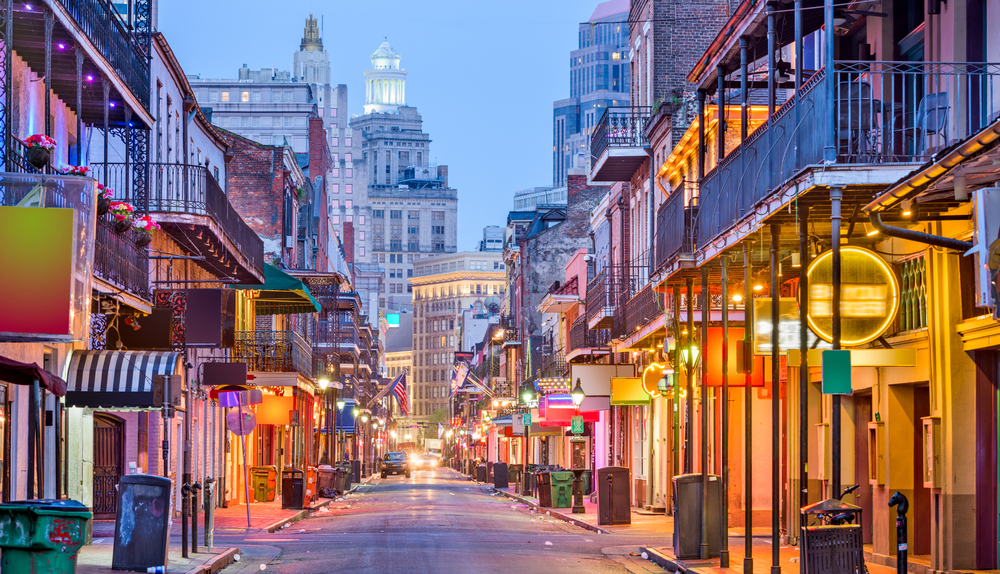
New Orleans is genuinely one of the most distinctive cities in the United States. The food, the music, the architecture, the particular atmosphere of the French Quarter at dusk, there’s nothing quite like it. The city also has a crime problem documented so extensively that ignoring it requires active effort. New Orleans reports one of the highest homicide rates among major U.S. cities, at around 46 deaths per 100,000 people, against a national average that sits at roughly 5 per 100,000.
New Orleans faces challenges unique to its character: high tourism volume, an active nightlife economy, and transient populations that create both opportunity and cover for crime. The tourist corridor, Bourbon Street, the Garden District, Magazine Street, draws significant police presence and is considerably safer than the broader statistics suggest. But the French Quarter is famous for a reason. It also draws pickpockets, predatory scammers, and enough alcohol-fueled chaos that your judgment can erode before you realize it has.
Go to New Orleans. It’s worth it. But go with a plan, stay in well-trafficked areas after midnight, and park in a staffed garage.
9. Anchorage, Alaska

Anchorage is the gateway to some of the most breathtaking wilderness in North America, which is why most visitors go there. The city itself is another matter. In 2024, Anchorage recorded 3,289 violent crimes, translating to 1,151 per 100,000 people, which is more than three times the national average. Property crime ran at 2,764 per 100,000 residents, roughly 41% above average.
Alaska has struggled with a violent crime rate that consistently exceeds the national figure, particularly in cases of assault. The state’s crime rate has run three to four times the national average since 2013. In Anchorage specifically, mugging is the most common form of theft affecting visitors, and armed robberies occur regularly in certain parts of the city.
The neighborhoods most travelers move through, near the airport, the convention center, and the main hotel corridor, are not where the highest concentrations of crime sit. The rougher areas include Mountainview, Fairview, and Airport Heights. Most visitors heading to Denali or a fishing lodge won’t encounter any of this. But Anchorage is not a city to wander at night without knowing where you’re going, and the numbers back that up.
Read More: 15+ All-Inclusive Resort Mistakes Every Traveler Should Avoid
What the Data Actually Tells You
The national picture on crime is, genuinely, improving. The FBI’s 2024 crime report confirmed that national violent crime fell 4.5% from 2023 to 2024, with murder down 14.9% and property crime dropping 8.1%, reaching levels not seen since the 1960s. And more recently, the Council on Criminal Justice found that homicides across 35 study cities fell 21% from 2024 to 2025, putting the U.S. on track for what could be the lowest homicide rate ever recorded going back to 1900. That trajectory is worth acknowledging.
None of that changes what a visitor faces in practice. Every city on this list has neighborhoods that are genuinely fine and residents who navigate them without incident every day. The problem is that local knowledge takes years to build, and you’re showing up for three days. You don’t know which blocks shift after dark, which parking situation is actually fine and which isn’t, or which restaurant on the edge of a neighborhood puts you a ten-minute walk from somewhere you really shouldn’t be walking. That gap between what a local knows and what a visitor assumes is where trips go sideways. Check recent local news before you go, stay in well-trafficked areas after dark, and travel with the same common sense you’d bring anywhere unfamiliar.
AI Disclaimer: This article was created with the assistance of AI tools and reviewed by a human editor.