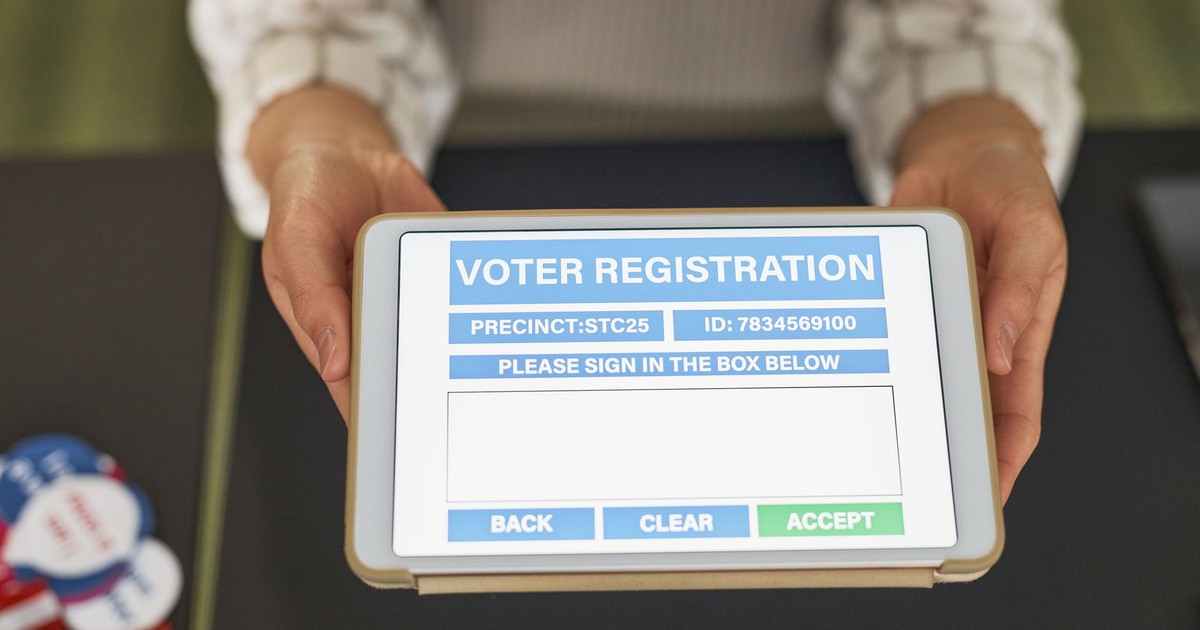

New Jersey residents who walked into a Motor Vehicle Commission office to get a driver’s license or state ID between June 2023 and June 2024 did exactly what they were supposed to do. When a keypad prompt asked whether they were U.S. citizens, the ones who weren’t clicked “no.” The system registered them to vote anyway.
That revelation, delivered by Gov. Mikie Sherrill at a press conference in Trenton on July 21, 2026, is the kind of story that travels fast and reads differently depending on which direction you’re already looking. For election security advocates, it’s confirmation of a vulnerability. For election experts who’ve spent years explaining how voter rolls work, it’s a familiar story told at an unfamiliar scale. For the roughly 6,600 people whose names ended up on voter rolls without their knowledge or consent, it’s something more uncomfortable still: they may now be at the center of a federal investigation.
The whole episode raises a set of questions that don’t resolve cleanly. How does a software system designed to prevent non-citizens from registering end up doing precisely that for more than a year? Who bears responsibility when it does? And what does the scale of the error tell us about the broader debate over election integrity in the United States?
What Went Wrong Inside the Motor Vehicle System

According to NBC News reporting on the July 21 press conference, a software error in New Jersey’s Motor Vehicle System led to around 6,600 non-U.S. citizens being registered to vote. The errors happened between June 2023 and June 2024, while Sherrill’s predecessor, Democratic Gov. Phil Murphy, was in office. Sherrill herself took office in January 2026, meaning the error had been sitting undetected and unreported for well over a year by the time she learned about it.
“This entire situation is unacceptable,” Sherrill told reporters at the Trenton press conference. “It’s unacceptable that the vendor released software with such a glaring error.”
The vendor in question is IDEMIA, a Virginia-based company that administered the software interface connecting the MVC’s application process to the state’s voter registration system. The software was supposed to prevent non-U.S. citizens from becoming registered. It did the opposite. Applicants for driver’s licenses and state identification cards correctly indicated they were not U.S. citizens but were registered to vote because of what Sherrill described as a “serious” software failure.
IDEMIA sent an unsigned statement defending its work with the Motor Vehicle Commission and placing blame for any voter registration mistakes with state officials. “Idemia’s role is to transmit information through the motor vehicle system,” the statement read. “The voter registration information is transmitted to the New Jersey Department of State, Division of Elections, which is ultimately responsible for verifying eligibility to vote. Information submitted by Idemia must still be validated and adjudicated by the Division of Elections.”
Two parties are pointing at each other across a system that failed everyone caught in the middle. Sherrill’s Motor Vehicle Commission has since begun the process of replacing IDEMIA as the vendor administering the system, with a new vendor’s system expected to launch next year.
The Scale of the Problem – and What It Actually Means

New Jersey has 6.6 million registered voters. The 6,600 non-citizens added to the rolls represent a small fraction of that total. The number sounds large in isolation and nearly invisible in context, and the political conversation around this story has largely depended on which of those two frames gets applied.
Fewer than 400 people who were registered due to the error actually voted in New Jersey. The individuals were registered as Democrats, Republicans, and unaffiliated voters and were scattered across the state. The distribution across party lines directly undercuts claims that non-citizen registration systematically benefits one party over another.
Axios reported that Sherrill found no evidence at this time that any elections were swayed. Given that fewer than 400 votes were spread across the entire state and multiple party registrations, the arithmetic makes it difficult to construct a scenario in which the outcome of any specific race was affected.
After learning about the error the prior week, Sherrill immediately ordered her chief counsel to launch an investigation and directed that any residents who were mistakenly added to New Jersey voter rolls between June 2023 and June 2024 be removed.
This Has Happened Before
New Jersey’s case is large by recent standards, but it isn’t unique. The error follows a recognizable pattern that has surfaced in multiple states since automatic voter registration at DMV offices became more widespread.
In 2024, Oregon officials announced they had uncovered an administrative error that put more than 1,200 noncitizens on the state’s voter rolls. And in 2018, California officials said they may have registered 1,500 noncitizens accidentally. The number of mistaken registrants who cast ballots is typically quite small: in Oregon, officials confirmed that a small number of those mistakenly registered had cast a ballot.
Oregon’s story has continued to develop. A 2025 review by the state’s DMV found that clerical and policy errors regarding citizenship status had resulted in roughly 1,800 people being mistakenly registered to vote, with errors stretching back as far as 2010. Oregon’s DMV administrator blamed errors in part on a drop-down menu in a DMV computer program that allowed noncitizens to be incorrectly labeled as citizens more easily. Different technical cause, same structural result.
Colorado officials said in 2022 that they had mistakenly sent postcards to 30,000 noncitizens to encourage them to register. The state said none would be allowed to do so if they tried.
Across all of these cases, the errors share a cause: licensing, identification, immigration status, and voter registration were built as separate systems that were never designed to talk to each other cleanly and often still don’t.
The Political Dimension

Sherrill’s announcement landed just days after President Trump used a prime-time address to allege widespread vulnerabilities in the U.S. election system, and after his administration accused New Jersey of having more than 35,000 non-citizens registered to vote. Sherrill downplayed those claims and questioned the accuracy of the administration’s statistics, saying her office asked for evidence and did not hear back.
Assistant Attorney General Harmeet Dhillon announced that the Department of Justice is also launching an investigation into what happened. The federal response arrived quickly and publicly, framed around the idea that American votes had been diluted by illegal ballots.
The White House leaned into the New Jersey news as evidence for legislation it has been pushing for months. The Safeguard American Voter Eligibility (SAVE America) Act requires voters to provide documentary proof of citizenship at the time of registration and a photo ID at the time of voting. The SAVE America Act was passed by the U.S. House of Representatives in February 2026. Congress is now weighing a scaled-back version through the budget reconciliation process.
Critics of the legislation argue that it addresses a problem that is genuinely rare with a remedy that would affect millions of eligible voters. Several states currently require newly registering voters to provide documentary proof of citizenship, and 27 states don’t require photo IDs to vote, so the bill would suddenly impose new requirements on millions of Americans. Voting rights experts and advocacy organizations have detailed how the legislation could suppress voting, saying it would particularly create barriers in low-income and minority communities, where people often lack the forms of ID acceptable under the SAVE America Act.
The tension between making the system harder to game accidentally and making it harder for eligible citizens to participate sits at the center of every conversation that follows a story like New Jersey’s.
Read More: Trump Biographer Says ‘Demented’ President Will Go Down as ‘Worst in History’
The People Caught in the Middle

One detail that has received less attention than it deserves is the situation of the non-citizens who were registered without their knowledge. They said no. The system said yes. And now some of them may face federal scrutiny for something they had no part in choosing.
A similar situation played out in Alaska, where a DMV error wrongly registered a couple to vote in 2022 even though they were not U.S. citizens and had opted out. When they updated their driver’s licenses online, the DMV system automatically created voter registration forms using their digital signatures and falsely listed them as citizens without their knowledge or consent. The error surfaced during their citizenship applications, causing U.S. Citizenship and Immigration Services to delay their approval and warn that falsely claiming citizenship could lead to deportation.
That case illustrates just how serious the downstream consequences can be for individuals caught in a government software failure. A registration error, entirely of the state’s making, became a mark on a citizenship record. In New Jersey, with a DOJ investigation now open and immigration enforcement operating at its current intensity, the roughly 400 people who actually voted face a genuinely uncertain situation, even though the registration itself was the state’s error.
Errors of this kind are rare relative to the size of the country’s voter rolls, but the scale of the mistake in New Jersey goes beyond recent examples in other states. The category of error is familiar; the number of people affected is not.
What Happens Now

Sherrill has been clear about the immediate steps: the names are being removed from the voter rolls and the noncitizens had been registered through no fault of their own. The state’s investigation, led by Sherrill’s chief counsel, is ongoing. IDEMIA’s contract is being wound down, with French technology company Thales set to take over the system.
The harder questions take longer to answer. New Jersey’s automatic voter registration system, which links DMV transactions to voter registration, has been cited as a model for expanding access to democracy. The same architecture that made it easier for eligible citizens to register made it possible for ineligible people to be registered by mistake. Building more redundancy into the citizenship verification step before registration is completed, rather than discovering errors afterward, is the obvious corrective that neither political camp seems eager to fund.
Although instances of noncitizen registration and voting are rare, the SAVE America Act’s goal of ensuring that only citizens can register to vote is important. But there are easier, more cost-effective ways to improve citizenship verification that don’t create new barriers for eligible voters. That observation from the Bipartisan Policy Center captures the policy challenge without pretending it doesn’t exist: the goal is shared; the argument is about method.
The Part Nobody Wants to Sit With

The New Jersey story is being used as evidence for several contradictory conclusions simultaneously, and the honest answer is that it partly supports all of them.
Yes, the system failed. Yes, the failure was accidental. Yes, some people who were not eligible to vote did vote. Yes, there is no evidence any election result was changed. Yes, the people registered were spread across both major parties. Yes, the individuals responsible for the error were state-employed and vendor-side administrators, not the non-citizens who got registered. All of these things are true at once.
What the story actually shows is that large-scale voter registration systems are complex, that complexity produces errors, and that the consequences of those errors fall unevenly. Eligible citizens who lack a passport or birth certificate bear the cost of stricter documentation requirements. Non-citizens who followed every rule at the DMV window bear the cost of a software bug. Neither group asked for any of this. The political conversation tends to erase both of them in favor of the argument each side was already having.
Some of these patterns go back further than any single software vendor or gubernatorial administration. The New Jersey case didn’t start with IDEMIA and it won’t end with IDEMIA’s replacement. Until the systems that handle licensing, immigration status, and voter registration are actually designed to share reliable data with each other, errors like this one will keep surfacing, in different states, at different scales, feeding the same argument on repeat. Naming that isn’t a fix. But it’s where any serious conversation about the problem has to start.
Disclaimer: This information is not intended to be a substitute for professional medical advice, diagnosis, or treatment and is for information only. Always seek the advice of your physician or another qualified health provider with any questions about your medical condition and/or current medication. Do not disregard professional medical advice or delay seeking advice or treatment because of something you have read here.
AI Disclaimer: This article was created with the assistance of AI tools and reviewed by a human editor.