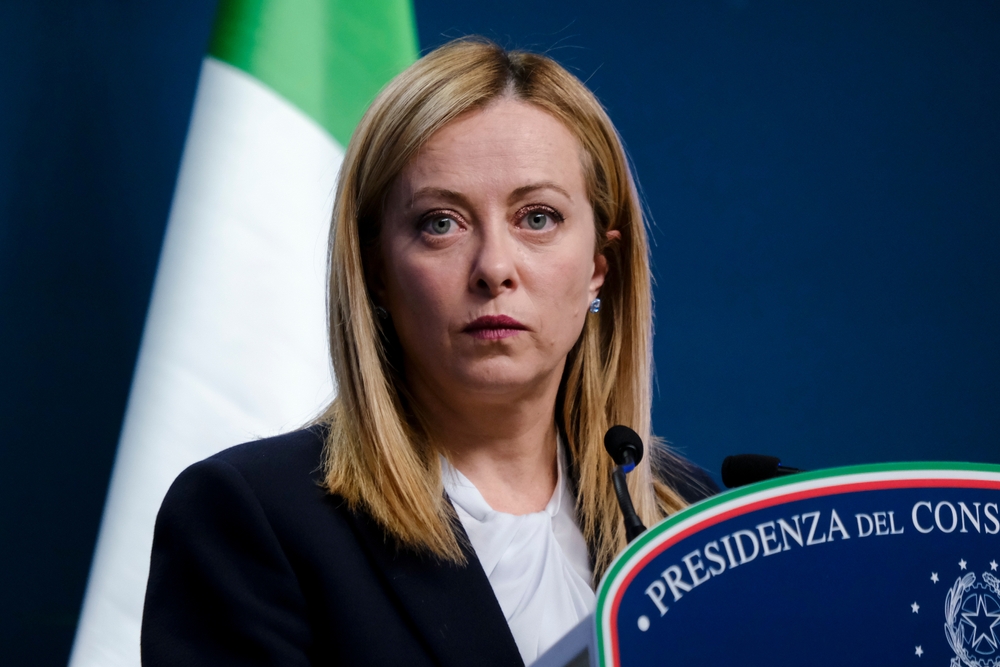

The Italian government’s response to Donald Trump’s claim that Giorgia Meloni had “begged” him for a photograph at the G7 summit was swift and unambiguous: the foreign minister cancelled his trip to the United States, calling Trump’s remarks “serious and offensive,” while Meloni herself posted a video calling them “completely fabricated.”
That reaction alone tells you something. Politicians from rival parties don’t usually close ranks around an incumbent prime minister. Italy’s political opposition doesn’t typically find itself defending the woman it’s been trying to unseat. When it does, the insult in question has landed somewhere deeper than policy.
This was not a spat about tariffs or troop deployments. Trump’s comments didn’t criticize Meloni’s governance or question her strategic alignment with Washington. He described her, on Italian television, as someone who needed his charity. A world leader who begged. Who he felt sorry for. That is a different kind of attack entirely, and what happened next said everything about how it was received.
What Trump Said, and What the Record Shows
Trump made the comments in an interview broadcast Friday morning on Italy’s La7 network. The La7 correspondent had asked Trump about Ukraine, but Trump raised Meloni himself, and the conversation turned to their meeting during the just-concluded G7 summit in Evian-les-Bains, France. La7 put only a dubbed version of the interview online, and the original English audio was not released by the broadcaster.
According to La7, Trump said Meloni had “begged” him for a photo-op, that he wasn’t obliged to do it, but that he felt sorry for her and agreed. The broadcaster has a dubbed version of the conversation online, not the original English audio.
He went further than that. Trump also said “She’s probably happy I talked to her. I didn’t have to talk to her,” remarks he made after raising the subject of the Italian prime minister himself during the interview.
The claim sits in awkward tension with the visual record. Video footage from the G7 appeared to show Meloni and Trump engaged in an extended one-on-one conversation while seated together on a small sofa, but Trump portrayed the interaction as something he had granted rather than sought out.
Meloni, once regarded as one of Trump’s closest political allies in Europe, said she was “stunned” by his remarks. In her response, she took direct aim at Trump’s broader approach to international relations, suggesting he treats longtime Western allies with less respect than he shows their adversaries. “I don’t know why the president of the United States behaves this way with his own allies,” she said. “It’s not, after all, the first time this has happened.”
A Diplomatic Break That Had Been Building
As recently as October 2025, Trump had been heaping praise on Meloni, telling her how “beautiful” she was. But what once looked like a political relationship built on equal parts ideological alignment and strategic convenience had been reading, for some months, like a classic breakup story.
Meloni had initially sought to build on longstanding U.S.-Italian ties when Trump began his second mandate, positioning herself as a “bridge” between Washington and the European Union. She was the lone EU head of state to attend his inauguration. But relations frayed over the U.S. war in Iran, which Meloni has said was illegal, and Trump’s position on Ukraine, which Italy strongly supports.
Her government denied the United States permission to use the Sigonella air base in Sicily for military operations linked to the Iran conflict, a move widely interpreted as an effort to avoid deeper involvement. Trump rebuked Meloni for refusing to provide Italian air bases for U.S. use and for declining to send forces to help secure the Strait of Hormuz.
The faultline then moved somewhere more personal. Their relationship started to fracture in April, when Trump began attacking Pope Leo XIV on social media after the pontiff condemned U.S. military action in Iran. Meloni jumped to the Pope’s defense, prompting Trump to accuse her of lacking courage. For Italians, criticizing the pope is not a routine political disagreement. Trump said, “I’m shocked at her. I thought she had courage, but I was wrong,” in an interview with Italian daily Corriere della Sera. Meloni did not respond publicly at the time.
Then came Evian-les-Bains, a summit that had seemed, briefly, to offer a reset. Meloni said, on Wednesday after the G7 wrapped up, that there had been a “very positive climate” and “no friction” between Trump and other leaders at the gathering. Whatever ground was recovered at the summit was gone within 48 hours.
Italy’s Response: Rare, Unified, and Pointed
The Italian government closed ranks on Friday to slam Trump over his claim, a pushback that suggested America’s longtime European ally had had enough. Italian Foreign Minister Antonio Tajani abruptly cancelled a planned trip to the United States, calling Trump’s claims “serious and offensive” toward Meloni and all of Italy.
Tajani had been due to travel to the U.S. on Sunday to take part in an Italy-U.S. business forum in Miami during which he was to have met with U.S. Secretary of State Marco Rubio, according to a U.S. State Department announcement of the meeting. That forum was also cancelled later on Friday.
The condemnations spread beyond the foreign ministry. Justice Minister Carlo Nordio invoked the sacrifice of American troops in World War II, writing on X: “The thousands of crosses marking the graves of American soldiers who died to free us from Nazi-Fascist dictatorship did not deserve such a painful blow to our fraternal ties.” Giovanbattista Fazzolari, undersecretary to the prime minister’s office, said it was “unclear whether out of intent or ineptitude, Trump is wrecking the historic relations between the United States and Europe,” adding: “With his inappropriate outbursts, he has managed no easy feat – to make the United States unpopular across the entire European continent, damaging not only Europe but above all the United States.”
By Friday afternoon, solidarity with Meloni had poured in from across the Italian government and political spectrum, including a call from President Sergio Mattarella, Italy’s widely respected head of state. Transport Minister Matteo Salvini posted on social media: “Whoever attacks Giorgia Meloni attacks all of us.”
Even Meloni’s political opponents found themselves defending her. Matteo Renzi, a center-left former prime minister, called Trump’s statements “horrifying, as always,” adding a pointed jab at the far-right Meloni, that she had “finally” noticed too. In a lengthy post on X, Renzi called on Meloni to abandon her ties to Trump and declared “the global right has failed.” The solidarity was real, but the subtext of Renzi’s remarks was plain: he was not offering unconditional support so much as noting, with some satisfaction, that the alliance Meloni had built her European credibility on had turned on her.
Meloni also received support from beyond Italy. Italian Foreign Minister Antonio Tajani announced Friday that he was canceling a planned trip to the United States, where he was slated to meet with Secretary of State Marco Rubio, in response to Trump’s reported remarks, calling them “offensive.” CNN described it as “the latest dip in the deteriorating relationship between the once-close leaders and a further fracture between the US and its European allies, coming after signs of repair at the G7 summit this week in France.” Spain’s Socialist Prime Minister Pedro Sánchez, asked about the dispute on the sidelines of a European Council meeting, told reporters: “About Meloni, first and foremost, all my solidarity.”
The Trump Meloni Feud and the Video That Keeps Circulating
One of the more revealing elements of the Trump Meloni feud is what the footage from the summit actually shows. Meloni and Trump were filmed speaking at several moments during the Evian summit, including alone on a small sofa. Neither leader appeared to be waiting for the other to approach. Trump suggested he had merely indulged her by chatting with her, but video circulating from the event told a more ambiguous story.
In an interview later on Friday, Trump redoubled his criticism of Meloni, saying “I don’t want her as a fan because she was not there – along with the NATO group – having to do with the Strait,” a direct reference to a perceived lack of Italian support during the Iran conflict. The personal humiliation and the policy grievance, it turns out, were always the same complaint dressed differently.
The Bigger Picture for US-European Relations
The row landed while the broader relationship between Washington and its European allies was already under strain. After a year of tariff threats, insults, and diplomatic clashes, Trump had been left to wage the war in Iran with only Israel by his side. Italy was not the only country that had refused access to its military bases for the conflict. UK Prime Minister Keir Starmer refused to allow the U.S. to use British bases as part of the initial strikes, and Spain barred U.S. military planes from its jointly operated bases in Andalusia, prompting Trump to threaten to cut off all trade with Spain.
What made the Trump-Meloni split different was who Meloni was supposed to be in this picture. She had been the one European leader willing to sit with Trump at Mar-a-Lago before his inauguration. She attended the inauguration itself, the only EU head of state to do so. Weeks earlier, she had described the Mar-a-Lago visit as going “beyond expectations,” calling it “an opportunity to confirm a relationship that promises to be very solid.” She had widely been regarded as Trump’s staunchest western European ally, precisely because she shared his political instincts, his skepticism of liberal orthodoxy, his willingness to be blunt.
That the relationship fell apart over Iran and a pope is not entirely surprising in retrospect. Meloni leads a government that is, among other things, deeply Catholic in its cultural framing. The Brothers of Italy party, which she co-founded, carries within it a strong strand of Italian national identity. And Italian national identity is, in ways that are hard to separate out, tied to Rome and the Vatican. When Trump went after Pope Leo XIV, he was not just criticizing a religious leader. He was, for many Italians regardless of their personal faith, criticizing something foundational.
Disputes over the Iran war, threats to acquire Greenland, and the use of tariffs against European allies have driven an unusual wedge between Washington and some of its ideologically closest partners abroad. Analysts say the shift reflects both substantive policy disagreements and mounting political risk for European leaders seen as too closely tied to Trump. For Meloni, who built her political reputation partly on that closeness, the risk is not abstract anymore.
You can read more about the strain on US-Europe relations for broader context on how this moment fits the pattern of the past eighteen months.
What Comes Next for Both Leaders
Meloni’s immediate political position inside Italy may, paradoxically, have strengthened. Public humiliation by an American president, followed by a swift and unambiguous rebuttal and a national closing of ranks, is not the worst news for a leader who has staked her identity on Italian sovereignty and strength. One of Meloni’s closest political allies, who usually avoids the media spotlight, struck out at Trump in a tone that would have been unthinkable beforehand – a signal of how significantly the calculation inside Rome’s political circles has shifted.
For Trump, the incident fits a now-established pattern with European allies: the warmth of the early months curdling into grievance once the ally in question fails to fall in line on a specific demand. The Iran war has been the sharpest test of that pattern. Meloni passed the test Rome expected of her. She failed the one Washington had been setting.
The question now is whether the Trump Meloni feud represents a pause in a relationship that can still be repaired, or whether it marks the point at which Italy’s role as Washington’s most useful European interlocutor effectively ends. Trump’s tariffs, his strong backing of Israel over its war in Gaza, and his open contempt for European leaders who won’t follow his lead on Iran are not small differences to paper over with a photo.
Read More: Trump’s $600M White House Ballroom is Costing Taxpayers Half and They Never Agreed
The Part Nobody Mentioned
There is something worth sitting with in the specific nature of Trump’s slight. He did not criticize Meloni’s policy positions. He did not accuse her of betrayal or call her weak – not in this particular interview. He described a powerful world leader as someone who needed a favor from him, who begged, who could only be grateful for his attention. The insult was not political. It was social. It was the kind of diminishment that says: whatever role you think you play in the world, I decide the terms.
Meloni’s response understood exactly what was being done. Her rebuttal was not a policy disagreement. It was a flat refusal to accept the role being assigned to her, and to Italy. “Neither I nor Italy ever beg” is not a foreign policy statement. It’s a statement about dignity.
The video from the G7 sofa will keep circulating. Two leaders, deep in conversation, whatever the actual dynamic between them was. The gap between what the camera shows and what Trump described says something about how he understands these relationships – and why, at this point in his presidency, he has fewer genuine allies in Europe than almost anyone expected him to have. Some of these fractures go back further than any single interview. The photo was just the moment they became impossible to ignore.
AI Disclaimer: This article was created with the assistance of AI tools and reviewed by a human editor.