
Trump initially told the public his new White House ballroom would cost nothing. “It’s going to cost nothing,” he said at a White House East Room event in early 2025. “I will spend the whole thing myself.” That line, or some version of it, became a fixture of how the administration described the project for the better part of a year. Internal contractor documents, obtained by the Washington Post and published on June 16, 2026, tell a different story entirely.
The documents show that Clark Construction, the Maryland-based firm overseeing the project, delivered a $600 million cost estimate to the White House in early March 2026, roughly three weeks before Trump stood before reporters and declared the project “taxpayer-free.” Of that $600 million, the contractor projected that approximately $307 million, just over half, would come from federal agencies funded by taxpayer dollars. The original public figure was $200 million, all private. The gap between what the White House knew and what it said is not narrow.
The project has generated legal battles, congressional unease, and a separate controversy over whether the corporations donating to the ballroom are purchasing favorable treatment from the federal government. All three threads pull at the same underlying question: who is this project actually for, and who is actually paying for it?
How the Trump Ballroom Taxpayers’ Bill Grew From $200 Million to $600 Million

When the White House formally announced the project on July 31, 2025, it stated that Trump and other “patriot donors” had “generously committed to donating the funds necessary to build this approximately $200 million dollar structure.” Trump reinforced that personally. Asked by a reporter whether the $200 million would be covered by himself and private donations, he confirmed: “By me, yeah… It’s a private thing, yeah, I’ll do it.”
Those numbers did not hold for long. According to a Washington Post investigation published June 16, 2026, six cost estimates produced before March by Clark Construction show that internal projections have always run significantly higher than Trump’s public claims, and have consistently included a substantial taxpayer contribution. In the earliest estimate, dated July 2025 and predating even the public announcement, Clark had already projected that over $100 million in federal funding would be required.
By July 11, 2025, a contractor estimate put the ballroom at $270 million, with over $100 million from public sources. A separate project summary issued two days earlier showed a projected cost of $478 million, again split roughly half-and-half. By December 2025, Trump had revised his number upward to $400 million, still insisting donors would cover it. “We’re donating a building that’s approximately $400 million,” he told reporters that month. In late March 2026, he said it again, called it “taxpayer-free,” and added: “We have no taxpayer putting up 10 cents.” The March 5 contractor estimate sitting in the administration’s files at that moment read $600 million.
The Breakdown: Where the $307 Million Comes From
Records show that officials planned to derive $293 million from private sources, while $155 million would come from Secret Service funds, $149 million from the White House Military Office, and $3 million from the Executive Residence. The latter three are all taxpayer-funded agencies.
The White House has pointed to national security as the justification for the government’s share, arguing that the Secret Service and White House Military Office routinely fund security infrastructure. Procurement specialists who reviewed the documents drew a sharp distinction: public money appears to flow into the ballroom structure itself, not just perimeter security. Upwards of $1.6 million in Secret Service dollars was budgeted to help pay for demolishing the East Wing to make room for the ballroom. Anthony Costa, a former official at the General Services Administration who handled government real estate projects, put it bluntly: “How is that something Secret Service should do and fund?”
The Office of Management and Budget released $351.6 million to the Secret Service in June for what it described as “White House Security Measures,” drawn from a $1.17 billion appropriation contained in last year’s reconciliation package. That law specifies those funds “may only be used for” additional Secret Service resources including personnel, training, and technology. The timing, given the contractor’s $600 million estimate, raised immediate questions on Capitol Hill about whether security-earmarked money is being used to subsidize ballroom construction. The White House did not address the discrepancies. Clark Construction declined to comment, calling all project details confidential.
The Scope of the Project: What Is Actually Being Built
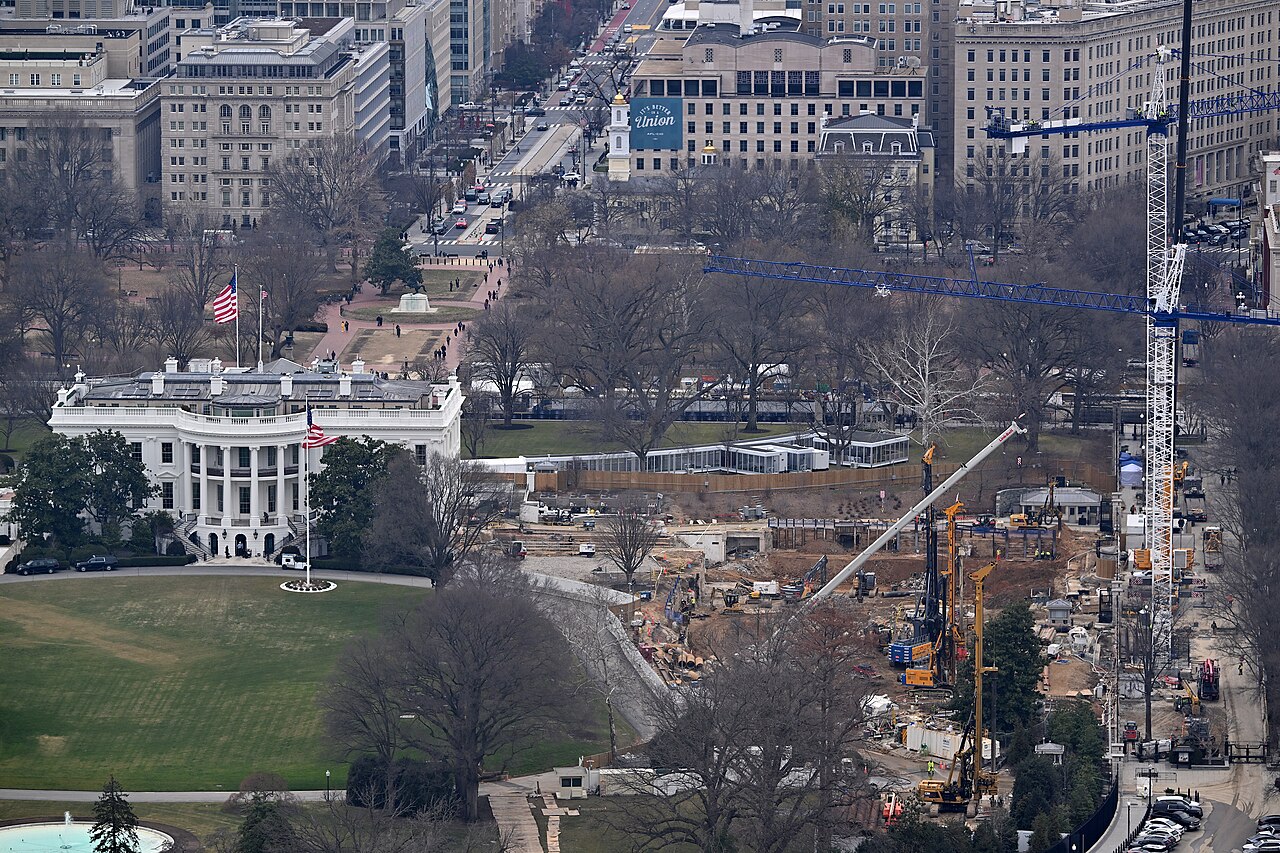
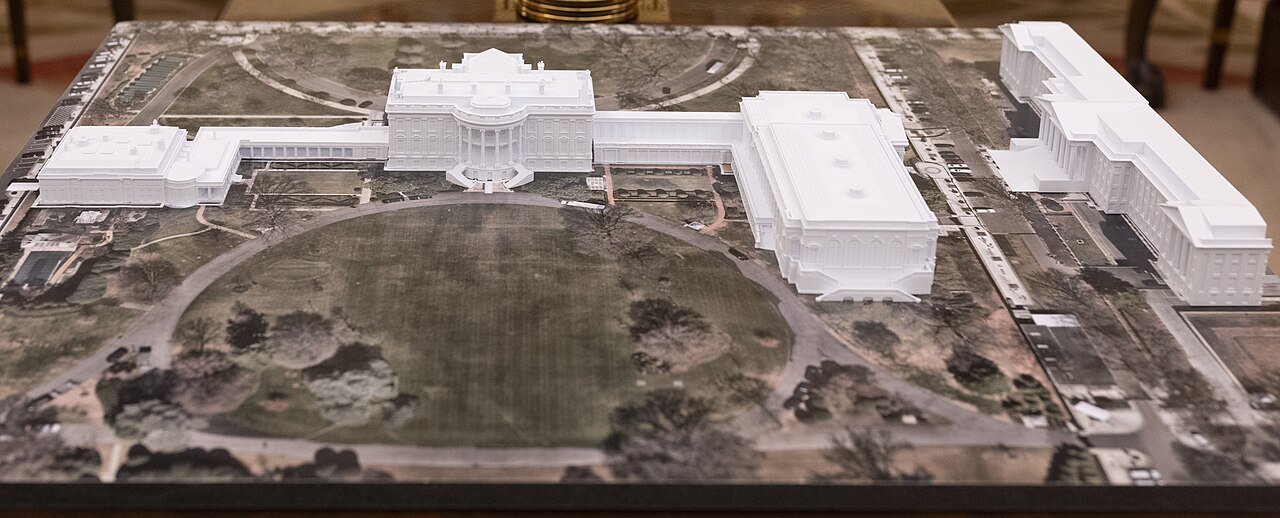
The proposed 90,000-square-foot ballroom is planned for the site where the East Wing stood. It would significantly exceed the main White House building itself, which is 55,000 square feet. The scope has grown well beyond a reception hall: Trump has described the military constructing a “massive complex” beneath the structure, calling it a dual-purpose build tied to what is going underground. The administration has cited bulletproof glass, a drone-proof roof, and a secure military bunker in the underground portion among the project’s specifications.
Clark Construction, ranked 19th on the 2025 ENR Top 400 Contractors list with $7.2 billion in revenue, is leading the team. The ballroom is expected to be completed by 2028. The White House announced the project on July 31, 2025, and demolition of the East Wing began in late October, when workers were spotted tearing down the wing that had housed the first lady’s offices. It began without prior public notice and without the historic review processes that federal law requires.
Trump has discussed additional expansions of the project since the original announcement, including enlarging seating capacity from 650 to 999 guests, which the administration says has contributed to cost growth.
The East Wing’s Demolition and the Historic Preservation Battle
The East Wing’s sudden demolition drew immediate criticism from historians and preservationists. The National Trust for Historic Preservation filed suit in December 2025, arguing that the Trump administration had demolished the historic wing and begun construction without obtaining congressional authorization, completing an environmental review under NEPA, or submitting plans to the National Capital Planning Commission as required by law.
U.S. District Court Judge Richard Leon granted the Trust’s request for a preliminary injunction halting above-ground construction in April 2026, concluding that the organization was likely to succeed on its core argument: that “no statute comes close to giving the President the authority he claims to have.” Trump pushed back publicly, telling reporters: “We built many things at the White House over the years. They don’t get congressional approval.”
The administration had argued that a statute permitting routine White House maintenance and repairs provided legal cover for the demolition and rebuild. Congress had appropriated roughly $2.5 million for such repairs. Congressional Democrats countered in an amicus brief that Congress “does not fund large-scale construction projects with drop-in-the-bucket funding.” A three-judge panel of the U.S. Court of Appeals for the D.C. Circuit subsequently allowed construction to continue while the litigation proceeds, and heard oral arguments on June 5, 2026. The panel appeared skeptical of the administration’s national security framing as a basis for bypassing congressional authorization. The underlying question of whether a sitting president can unilaterally demolish and rebuild part of the White House without legislative approval has not been resolved.
The Corporate Donors and the Conflict-of-Interest Question

The private half of the ballroom’s funding has generated its own controversy. In October 2025, a slate of private companies including Microsoft, Amazon, Meta, Apple, Google, Coinbase, Comcast, T-Mobile, the Adelson Family Foundation, and crypto investors Tyler and Cameron Winklevoss agreed to back the project through donations to the Trust for the National Mall, a 501(c)(3) group formally receiving the contributions.
Google’s parent company, Alphabet, agreed to pay $24.5 million to settle a dispute with Trump over his YouTube ban following the January 6 Capitol riots, pledging $22 million of that settlement toward ballroom construction. Defense contractor Lockheed Martin, which received $33.4 billion in federal contract awards in 2025, is reportedly contributing more than $10 million to the ballroom.
A June 4, 2026 report titled Ballroom Billions, published by the consumer advocacy nonprofit Public Citizen, analyzed contract data and federal enforcement records for all 27 known corporate donors. Using federal spending data as of May 26, 2026, it found that 14 of those 27 donors received new or increased government contracts in the six months following the East Wing demolition, totaling over $50 billion. The single largest recipient was Lockheed Martin, which collected $43.8 billion in new or expanded contract funding in that period. Booz Allen Hamilton collected a further $4.2 billion and Palantir $1.03 billion.
Sixteen of the 27 corporate donors are facing federal enforcement actions that have been suspended, dropped, or scaled back under the Trump administration, including major antitrust reviews involving Amazon, Apple, Meta, and Nvidia; labor rights cases involving Google, Lockheed, and Meta; and securities matters involving Coinbase and Ripple. Nothing in the funding contract prevents contributions from donors with active business before the federal government. The donor list may also be incomplete: a funding agreement obtained by Public Citizen through a Freedom of Information Act lawsuit permits anonymous donations, leaving the full scope of the arrangement unknown.
The White House has rejected the pay-to-play framing, with a spokesman arguing that the same critics alleging conflicts of interest would complain equally if taxpayers were footing the bill entirely. As of June 16, 2026, taxpayers are covering approximately $307 million of it regardless.
Congressional Response and Political Fallout
Senator Susan Collins of Maine told reporters that Trump’s original pledge to donors should be honored: “President Trump indicated that the ballroom was going to be built with private donations. I think that’s the commitment that should be kept.” Republican senators confronted with the Washington Post’s reporting reacted with a mixture of skepticism and deflection. Senator John Kennedy of Louisiana scoffed at the findings, claiming the reporting relied on anonymous sources. It did not, and the White House itself did not dispute the story. Senator Rick Scott of Florida, asked whether he supported using taxpayer money for the project, answered: “I support protecting the president,” and referenced funding for “more Secret Service agents, something like that.”
Democratic Representative Greg Casar was more direct: “They cut your healthcare while spending taxpayer dollars on a golden ballroom for Donald Trump. And they lied about it.”
Earlier in June 2026, seven Republicans sided with Democrats to block a Senate proposal that would have allocated $1 billion in federal funding for security upgrades at the White House and the ballroom site. The bipartisan resistance has not produced any formal action to halt the project, but it has created a political problem for an administration that staked its public credibility on the promise that the ballroom would not cost the country a cent.
Read More: Why Trump Is Threatening 100% Tariffs on French Wine Right Now
What the Records Actually Show
The most striking aspect of the documents is not the $600 million number itself. It is the timeline. Every public statement Trump made about the cost and the funding model was made while contractor documents in the administration’s possession told a different story. When he said $200 million, internal estimates already showed a figure north of $270 million with over $100 million from federal sources. When he revised to $400 million in March 2026 and declared the project “taxpayer-free,” the contractor had already delivered a $600 million estimate with a $307 million public contribution directly to the White House.
The White House’s position has been that the government’s share covers legitimate security infrastructure, not the ballroom itself. That distinction is difficult to sustain when $1.6 million in Secret Service funds is allocated toward demolishing the East Wing to make room for the ballroom structure. The line between security expenditure and construction subsidy effectively disappears at that point.
The donor picture adds a separate layer the administration has not credibly addressed. A project that relies on corporations with pending federal enforcement actions and billions in government contracts, routed through a funding agreement that permits anonymous contributions and waives conflict-of-interest safeguards, is not easily described as private philanthropy. The legal proceedings remain active. The appellate court has allowed construction to continue for now, but the core constitutional question has not been settled.
The Gap Between the Promise and the Price

There is a version of this story where a president builds something extravagant, the cost overruns, and the public shrugs. This is not quite that story. The cost projections showing taxpayer contributions were present in contractor documents from before the project was announced, before the first shovel went into the East Wing. The administration did not stumble into a higher price tag. It received estimates showing a public subsidy from the start, made public statements that directly contradicted those estimates, and kept making them as the gap widened.
For the people who donated to the ballroom project, the $307 million taxpayer contribution raises a different question: they were told their money was privately funding a gift to the nation. Some of the country’s largest corporations put their names to that story. What they and the public are now looking at is a construction project that was always going to draw on federal funds, anchored by a promise that the documents show was not accurate when it was made. Whether the courts ultimately halt the above-ground construction or let it proceed, that gap between the promise and the price tag is not going away.
AI Disclaimer: This article was created with the assistance of AI tools and reviewed by a human editor.