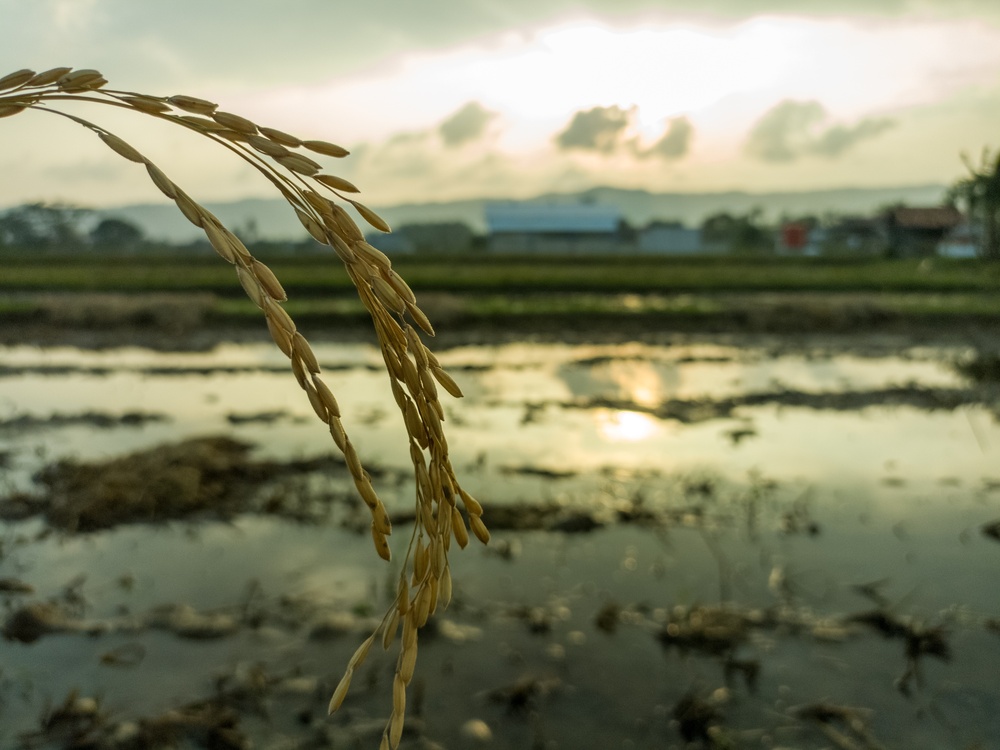

Few things in human history have mattered as much as rice. Not wheat, not corn, not any other crop comes close to what a single grain has meant to the survival and organization of human civilization across thousands of years. Rice didn’t just feed people. It structured societies, shaped landscapes, determined the location of cities, and made entire cultures possible. The fact that half the world still gets a fifth of its calories from rice isn’t a curiosity – it’s the baseline condition of human life on this planet.
Which is why a new study published this spring deserves more attention than it has gotten outside of scientific circles. The findings are not speculative. They are not worst-case projections designed to alarm. They are the result of a careful reconstruction of rice’s entire thermal history – every climate it has ever been grown in, across 9,000 years of human agriculture – compared against where temperatures are heading. The conclusion is stark: for the first time in recorded agricultural history, rice is running out of climate.
The people who stand to lose the most aren’t abstract statistics. They are subsistence farmers in Indonesia and Malaysia, smallholders in Bangladesh, families across South and Southeast Asia for whom a failed rice crop isn’t a market problem but a hunger problem. The science describes a timeline. What it can’t describe is what happens to the billion-plus people caught inside it.
A Grain That Built the World
The wild ancestor of cultivated rice once grew primarily on the sweltering, rain-swept Malay and Indochina peninsulas. It wasn’t until Earth’s climate warmed after the last ice age that wild rice spread substantially into central China and South Asia, where it was independently domesticated by humans in two events that arguably rank among the most consequential in the history of our species.
Rice was initially domesticated in the Yangtze River basin in central China between 7,000 and 9,000 years ago, when balmy temperatures and frequent rain made it possible for humans to develop agricultural societies. From there, the grain moved along trade routes, fed growing populations, and made possible the kind of sedentary surplus economy that allows civilizations to exist in the first place. No rice, no paddy field. No paddy field, no village. No village, no city.
Rice fueled many of the earliest civilizations and remains a virtually indispensable source of food in the modern world. Today, half of all humans get 20% of their calories from rice, and more than a billion people are reliant on the production and distribution of rice for their livelihoods. It is hard to overstate that number. A billion livelihoods. Not a billion people who prefer rice – a billion people whose economic survival depends on growing and distributing it.
Domesticated Asian rice serves as a primary food source for over half the global population, and more than 90% of the world’s rice is grown in Asia. The crop is not evenly distributed across the planet’s food systems. It is concentrated, which means its vulnerability is concentrated too.
The Number That Should Alarm Everyone
The new research, led by Nicolas Gauthier, curator of artificial intelligence at the Florida Museum of Natural History and an anthropologist and geographer at the University of Florida, is unusual in what it actually measures. Most climate-agriculture studies look forward: they model what warming will do to yields, to water availability, to pest pressure. Gauthier’s team looked backward first.
Gauthier wanted to know the upper temperature threshold beyond which modern rice varieties are unable to extend. Working with colleagues from New York University and the University of Washington, he combined archaeological and botanical records, including satellite imagery, agricultural records, and herbarium data, to figure out where rice was grown historically. The result is a kind of thermal fingerprint of the crop – the full range of climates rice has inhabited since it was first cultivated, assembled from archaeology, genetics, and contemporary agricultural data.
What that fingerprint reveals is a clear ceiling. Published in a 2026 study in Communications Earth & Environment, the research found that over the past 9,000 years, domesticated Asian rice has rarely thrived where mean annual temperature exceeds 28°C or where the warm-season maximum temperature exceeds 33°C. By the end of this century, projections estimate that the land area exceeding these thermal thresholds could expand by ten to thirty times in Asia’s major rice-producing nations.
Ten to thirty times. That is not a gradual adjustment. That is a wholesale transformation of the geography of rice farming, compressed into roughly 75 years.
Why Heat Is Different From Cold
One thing the research makes clear is that rice has adapted before – just not in this direction. As the Florida Museum of Natural History explains, rice farmers in China historically adapted by cultivating new varieties that could tolerate colder temperatures. The existence of these cold-tolerant varieties eventually allowed rice production to spread to regions with more temperate climates, such as Korea and Japan. That northward expansion over centuries represents one of the great quiet success stories of agricultural adaptation. Farmers bred their way into colder territory, one generation at a time.
But adapting to excess heat is a fundamentally different biological problem. As Gauthier explained, “you don’t see that kind of flexibility on the hot end because at some point, the plant will physically stop working.” Cold stress slows a plant down. Extreme heat shuts it off. The biochemical processes that allow a rice plant to flower, fill its grains, and complete its reproductive cycle require temperatures within a certain window. Push past that window and the machinery breaks.
By 2070, temperatures are projected to rise at a rate 5,000 times faster than what most varieties of the grass family – including rice – have experienced throughout their entire evolution. Evolution works on timescales of thousands to millions of years. Climate change, on the timescale of a human lifetime. Rice is not going to adapt its way out of this.
The Geography of Who Gets Left Behind
The scientific picture is grim enough on its own. The human picture is grimmer. When the research team modeled which regions face the most severe exposure to temperatures beyond rice’s known thermal limits, southern nations came out worst. As Gauthier put it: “Regions in the south, such as Indonesia and Malaysia, are the ones that are going to be most heavily impacted, and the process of adapting is going to leave a lot of people out of the loop. Those who depend on rice for their subsistence today aren’t necessarily the ones who are going to be able to access the new genetic varieties that are developed.”
That last sentence is the one worth sitting with. The adaptation pathway – breeding heat-tolerant varieties, using CRISPR gene editing to modify thermotolerance genes, shifting cultivation into cooler northern latitudes – exists, in principle. According to a 2026 review covering work published in Trends in Plant Science, rising day and night temperatures are threatening rice, wheat, and maize production by disrupting plant growth, grain filling, and grain quality – and precision breeding and genome editing offer ways to reprogram plant clocks, optimize flowering time, and improve grain quality under heat stress. Scientists are actively working on engineering heat-tolerant, high-yield rice varieties for exactly this scenario.
But accessing those varieties requires functioning seed distribution systems, government agricultural programs, and the financial resources to adopt new farming practices. A smallholder farmer growing rice on the same land her family has worked for three generations in rural Bangladesh or Sumatra doesn’t automatically gain access to a heat-tolerant cultivar developed in a university laboratory. The gap between what science can produce and what reaches the farmer who needs it is not a technical problem – it’s a political and economic one.
There is also the infrastructure problem. Climate change might warm regions where it is currently too cool to grow rice, enabling a geographical shift in cultivation – but rice paddies have been built up over centuries, and it’s not easy to simply pick up and move. The terraced fields of Vietnam and the irrigated paddies of India’s river deltas represent accumulated generations of labor and engineering. You cannot simply redraw the rice map.
The Scale of the Problem
It helps to put this into context beyond rice itself. As EurekAlert notes in its coverage of the research, the threat to food security posed by global warming is multifaceted – and in the case of rice, it involves a long history of adaptation in exactly the wrong thermal direction for what is coming. Members of the grass family, which includes staples such as rice, maize, wheat, and barley, provide a majority of the global human caloric intake, and these crops face a looming threat as the rate of anticipated climate change eclipses that of historical niche adaptations in grasses. Rice is the sharpest case study, but it is not the only one. The underlying problem – that crops evolved in a climate that is changing faster than they can follow – applies across the food system.
What makes rice particular is its concentration. Wheat failures can be partially offset by global grain markets. Rice failures in Asia cannot be absorbed the same way, because the affected populations are also the ones who consume the most rice and have the least financial buffer against price shocks. When rice prices spike, food insecurity in the region rises in direct proportion – a dynamic that has played out visibly every time a major producing country restricts exports or suffers a weather-related harvest shortfall.
The 9,000-year timeline in Gauthier’s research isn’t just a scientific framing device. It is a way of saying that rice has survived ice ages, the spread of civilizations, the rise and fall of empires, and every major climate fluctuation of the Holocene. It has been continuously cultivated by human beings through all of it. What it has never faced is the specific combination of speed and magnitude that the coming decades represent.
What Comes Next
Gauthier is direct about what adaptation will require: “These changes are going to be disruptive, and the process of adaptation doesn’t come for free. It has to be done with intention and might not be pleasant.”
That framing is important. The question is not whether rice can be saved – with enough investment in breeding programs, gene editing, and agricultural extension networks, some version of rice cultivation will continue. The question is whether the adaptation will happen equitably, and at the pace the climate requires. Both of those remain wide open.
Read More: 115,000-Year-Old Human Footprints Found in a Place They Were Never Supposed to Exist
The research doesn’t offer a verdict. It offers a timeline and a warning: the thermal safety net that rice has operated within for its entire cultivated history is shrinking, and it is shrinking faster than anything in the evolutionary record of the plant. Every decade of delay in cutting greenhouse gas emissions makes the adaptation more expensive, more technically demanding, and less accessible to the people who need it most.
The Part That Isn’t a Science Problem
The gap between “rice can survive with human help” and “rice farmers in southern Indonesia can access the tools they need” is not a gap that any laboratory can close. It is a distribution problem, a funding problem, a political will problem. Seed companies develop heat-tolerant cultivars for markets that can pay. International agricultural programs move slowly and cover unevenly. The farmers who are most exposed to thermal stress are, almost without exception, the ones with the least capacity to absorb it.
None of this means the situation is hopeless. It means the situation requires honesty about where the actual constraints are. The science is clear, the timeline is set, and the biology is not negotiable. What is negotiable – still, for now – is whether the systems that distribute food, seed, water, and support will move fast enough to reach the people standing in the path of it. That is not a question researchers can answer. It is one that the rest of us have to decide to take seriously.
AI Disclaimer: This article was created with the assistance of AI tools and reviewed by a human editor.