
Long before modern skyscrapers and sprawling suburbs defined the American skyline, early indigenous communities and European settlers crafted homes designed to withstand harsh elements, shifting landscapes, and the passage of centuries. Across the United States, a remarkable selection of these ancient structures still stands today, serving as living monuments to early human ingenuity and resourcefulness. From thousand-year-old Native American adobe pueblos in the Southwest to 17th-century timber-frame saltboxes in New England, these enduring homes provide a fascinating window into how early Americans lived, adapted, and built communities.
While thousands of historical buildings have succumbed to urban expansion, natural disasters, or time, these fifteen surviving residences tell extraordinary stories of architectural endurance and cultural heritage. Each structure carries centuries of human history within its walls, showcasing local materials—from sun-dried clay and hand-cut timber to heavy fieldstone—and the distinct architectural styles of their respective eras. Whether continuously inhabited for generations or preserved as national landmarks, these houses connect us directly to our past. Here are 15 of the oldest houses in the United States that are still standing today.
1. Taos Pueblo (between 1000 and 1450 CE)
The multistory adobe buildings of Taos Pueblo have been continuously inhabited for over 1,000 years, with the main part of the present buildings most likely constructed between 1000 and 1450 CE. Located about three miles northeast of Taos Plaza, Taos Pueblo is the only living Native American community designated both a World Heritage Site by UNESCO and a National Historic Landmark.
Taos Pueblo displays the traditional method of adobe construction. The two clusters of houses are built from sun-dried mud brick, with walls ranging from 28 inches thick at the bottom to approximately 14 inches at the top. Each year, the walls are still refinished with a new coat of adobe plaster as part of a village ceremony. The two structures called Hlauuma (North House) and Hlaukwima (South House) are considered to be the oldest continuously inhabited communities in the United States.
There is no electricity or running water inside the Pueblo. According to Taos Pueblo, around 150 people still live in the ancient structures full time, maintaining the same way of life their ancestors built here more than a thousand years ago. Guided tours are available and run by tribal members.
2. Acoma Pueblo, New Mexico (Since at Least 1150 AD)
The adobe houses, plazas, and walkways on the 367-foot tall mesa have been used for nearly one thousand years. According to the National Trust for Historic Preservation, Acoma Pueblo was the 28th Historic Site designated by the National Trust for Historic Preservation.
Known as Acoma Rock, the craggy, flat-topped mountain is home to Acoma, a National Historic Landmark. The pueblo’s lofty, isolated location made it virtually impenetrable throughout the precontact period. The houses were built from sandstone blocks, mortar, and timber hauled up the steep mesa walls by hand.
Many Acoma people still live in Sky City and nearby villages. While most don’t live in the ancient pueblo full time, they return for special cultural occasions. Sky City tours depart from the Haak’u Museum at the base of the mesa and are led exclusively by Acoma guides.
3. Cliff Palace, Mesa Verde National Park, Colorado (c. 1190 – 1260)
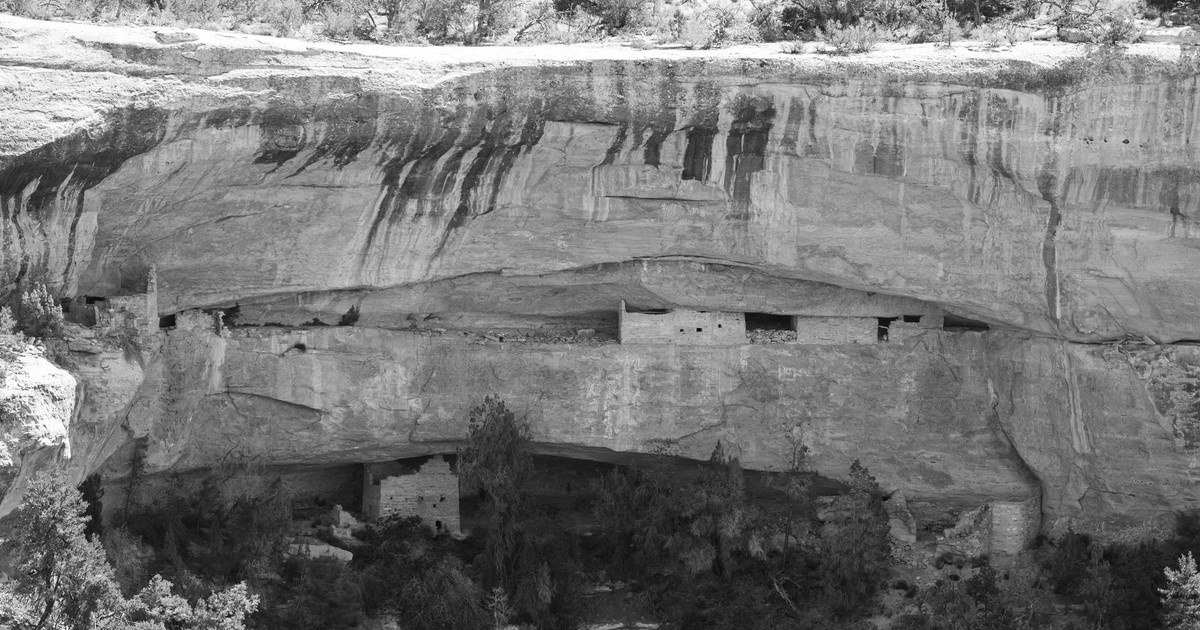
Made up of 150 rooms and 23 ceremonial kivas, Cliff Palace is the largest cliff dwelling in Mesa Verde National Park, Colorado. Built between 1190 and 1260, it was inhabited by the Ancestral Puebloans and would have housed around 200 people. The buildings were made from wooden beams, mortar, and sandstone, which the Puebloans shaped into blocks using harder stones collected from riverbeds.
Cliff Palace was constructed inside a natural alcove carved into the canyon wall by erosion and freeze-thaw cycles over millions of years. The Ancestral Puebloans recognized that the overhang would provide shade in summer and shelter in winter, and they built a multi-room, multi-story community inside it. By the late 1200s, it was abandoned, likely due to prolonged drought. The site was rediscovered in 1888 by two ranchers looking for stray cattle.
Mesa Verde National Park remains one of the best-preserved archaeological sites in North America. Cliff Palace is accessible only on ranger-led tours, which require a short ladder climb to reach the alcove level. Tickets sell out months in advance during peak summer months.
4. John Bray House, Kittery Point, Maine (c. 1622)
The John Bray House in Kittery Point, Maine, is the oldest home in the state and dates back to 1622. That makes it older than nearly every other European-built structure still standing in New England, built barely two years after the first Pilgrims arrived in a coastal settlement that predated many of the colonies that would later become famous.
After Jonathan King and Jim Stott decided to buy the historic property in 2015, they found an architect who could make the John Bray House a modern home. The result was a modern farmhouse equipped with wood floors and a traditional color palette. Unlike most properties on this list, the John Bray House is a privately owned residence. The current owners undertook a careful restoration to preserve the original structure while making it livable.
The house sits on Kittery Point Road near the water, a reminder that Maine’s coast was among the first places European settlers put down roots.
5. C.A. Nothnagle Log House, Gibbstown, New Jersey (c. 1638 – 1643)
The C.A. Nothnagle Log House, also known as the Braman-Nothnagle Log House, is one of the oldest surviving log cabins in the United States. The house was built by Finnish settlers in the New Sweden colony of what is now New Jersey, sometime between 1638 and 1643.
The cabin is made of oak logs with two removable pieces for ventilation in the summer. The exact builder and family are unknown. The house was dated by dendrochronology, the scientific method of dating trees by counting their rings to determine when a tree was cut down. The center beam, the first logs to be installed, dates back to 1638, while the beams installed last are dated to 1643.
During the 18th century, a large addition was built onto the house and a wooden floor was installed around 1730. The log house is privately owned and open for tours by private appointment only. Nearly all of the cabin’s original logs remain intact. One had to be replaced after damage from ivy, but the rest are the same wood the Finnish settlers cut and stacked nearly four centuries ago.
6. Henry Whitfield House, Guilford, Connecticut (1639)
Built in 1639, the Henry Whitfield House was constructed for Henry Whitfield, a Puritan minister who had come to the New World to flee religious persecution and was one of the founders of the town of Guilford. It is the oldest stone house in New England and the oldest surviving house in Connecticut.
The house was used as a home for Henry and his family and also served as a place of worship before an official church was built in Guilford. The granite walls are nearly three feet thick in places, built to last and to protect. The house served multiple functions simultaneously: dwelling, community meeting place, and in early years, something close to a fortress for the new settlement.
The Henry Whitfield House was remodeled in 1868, and since 1899 it has been open to the public as the Henry Whitfield State Museum, owned and operated by the State of Connecticut. The museum offers virtual tours as well.
7. Fairbanks House, Dedham, Massachusetts (c. 1637)
The Fairbanks House in Dedham, MA, is the oldest known timber frame house still standing in North America, built circa 1637 for Jonathan and Grace Fairbanks and their six children. According to the Fairbanks House, the Fairbanks Family in America, Inc. seeks to conserve, promote, and interpret the house and its collections through the experience of the Fairbanks family in America and their contributions to the American story, from 1637 through the early 20th century.
In 2001, dendrochronological testing by the Oxford Dendrochronology Laboratory confirmed that the timbers from the earliest section of the house were felled between 1637 and 1641. The house was not built all at once. It is certain that Jonathan owned a house on the same lot by 1648. Subsequently, perhaps as late as 1654, a large addition called the “new house” was made to the original building, purportedly built for his son John after his marriage.
The house was declared a National Historic Landmark in 1961 and is listed on the National Register of Historic Places. The Fairbanks Family in America organization, a nonprofit, continues to own and operate the property today.
8. Hoxie House, Sandwich, Massachusetts (c. 1637)
The Hoxie House, located in Sandwich, Massachusetts, is one of the oldest surviving houses on Cape Cod, dating to the mid-17th century. Its saltbox design, with low ceilings and small windows, reflects the practical architecture of the period.
The saltbox style gets its name from a specific roof shape: a long, sloping rear roofline that extends much lower than the front, giving the house an asymmetrical silhouette that looks like the wooden boxes colonists used to store salt. It was a practical way to add more living space under an extended roofline without the expense of a full second structure. The Hoxie House interior retains original features including wide-plank floors and period-appropriate furnishings.
The house is owned by the Town of Sandwich and operated as a museum. Sandwich, founded in 1639, is the oldest town on Cape Cod.
9. Richard Sparrow House, Plymouth, Massachusetts (c. 1640)
The Richard Sparrow House dates back to around 1640 and is the oldest surviving house in Plymouth, Massachusetts. The house was built by Richard Sparrow as a home for his family after he was granted a house tract of six acres in 1636, which required him to build a home within a set number of years.
Plymouth’s oldest surviving wooden-frame home, the original two-story house was described as a “grand” one, with large rooms, leaded glass windows, and paneled walls. For the period, these were genuine luxuries. Leaded glass windows meant Sparrow had both the means and the ambition to build something more substantial than the bare-bones shelters most early colonists managed.
The house was added to the U.S. National Register of Historic Places in 1974 and is currently operated as a museum and art gallery.
10. Loomis Homestead, Windsor, Connecticut (c. 1640)
The Loomis Homestead was constructed by Joseph Loomis, an original settler of Windsor, Connecticut. In the 17th century the house was significantly enlarged from its original frame. The original house was home to the Loomis family, who emigrated from Braintree, England in 1638. Upon their arrival in the New World, Joseph and his wife Mary had eight children while living in the colony.
The house was passed down through eight Loomis generations, until one childless daughter willed the house to the Loomis Institute, a private school started by other relatives. In 1940 the house saw many renovations to continue its use as a school. The Loomis Chaffee School, as it’s now known, still owns the property. The homestead sits on the school’s campus in Windsor.
The building remains in the school’s possession, representing the Loomis family history in Windsor.
11. Pieter Claesen Wyckoff House, Brooklyn, New York (c. 1652)
New York’s oldest structure is this Dutch frame house in the Flatbush neighborhood of Brooklyn. It was constructed around 1652 by a farm laborer named Pieter Claesen Wyckoff, who arrived in New Netherland (now New York) as a teenager in 1637. Following a period of indentured servitude, he settled in what’s now the landmark home and became a successful magistrate and farmer.
He and his wife had 11 children, establishing a family line that’s grown to more than 50,000 descendants, according to the Historic House Trust. The house stayed in the Wyckoff family through generations of Dutch-American life in Brooklyn, watching the neighborhood around it transform from rural farmland into one of the most densely populated urban areas in the country.
While most of the home open to visitors consists of additions built in the 19th century, a small section of the original house still stands and is available for public viewing. Guided house tours are available by donation from mid-February to mid-December on Saturdays and select Sundays.
12. Paul Revere House, Boston, Massachusetts (c. 1680)
The Paul Revere House, built around 1680, is the oldest remaining structure in downtown Boston. This modest wooden house was once home to the legendary patriot Paul Revere.
Revere purchased the house in 1770, nearly 90 years after it was built, and lived here with his family until 1800. The midnight ride of April 18, 1775, the one immortalized in Longfellow’s poem, began from this neighborhood. Revere set out from near this house, rowed across the Charles River, and borrowed a horse to warn colonial militias in Lexington and Concord that British troops were marching. The house survived his departure and every decade that followed.
The Paul Revere House opened to the public in 1908 and is now operated by the Paul Revere Memorial Association. It’s one of the few surviving examples of 17th-century wooden architecture still standing in what is now a major American city, and it sits on the Freedom Trail, Boston’s 2.5-mile walking route connecting 16 historically significant sites. The house is open for self-guided tours year-round.
Read More: 30 Dark Kennedy Family Secrets and Tragedies That Shocked the World
13. Parson Capen House, Topsfield, Massachusetts (1683)
The Parson Capen House in Topsfield, Massachusetts, was built in 1683 for Joseph Capen, the town’s Puritan minister, and stands as one of the best-preserved examples of 17th-century New England architecture anywhere in the country. It’s held its National Historic Landmark designation since 1960, and unlike many colonial structures that have been restored, meaning rebuilt to approximate their original form, the Parson Capen House retains a high percentage of its original fabric.
The house is a classic Second Period colonial design: steep gabled roof, massive central chimney, overhanging upper story, and a distinctive facade. Topsfield is five miles from Salem, and the two communities shared the anxieties and accusations of 1692. Capen was the minister during those years. The house he built and lived in still stands on land next to the Topsfield town green, owned and maintained by the Topsfield Historical Society. Tours run seasonally.
14. González-Álvarez House, St. Augustine, Florida (c. 1723)
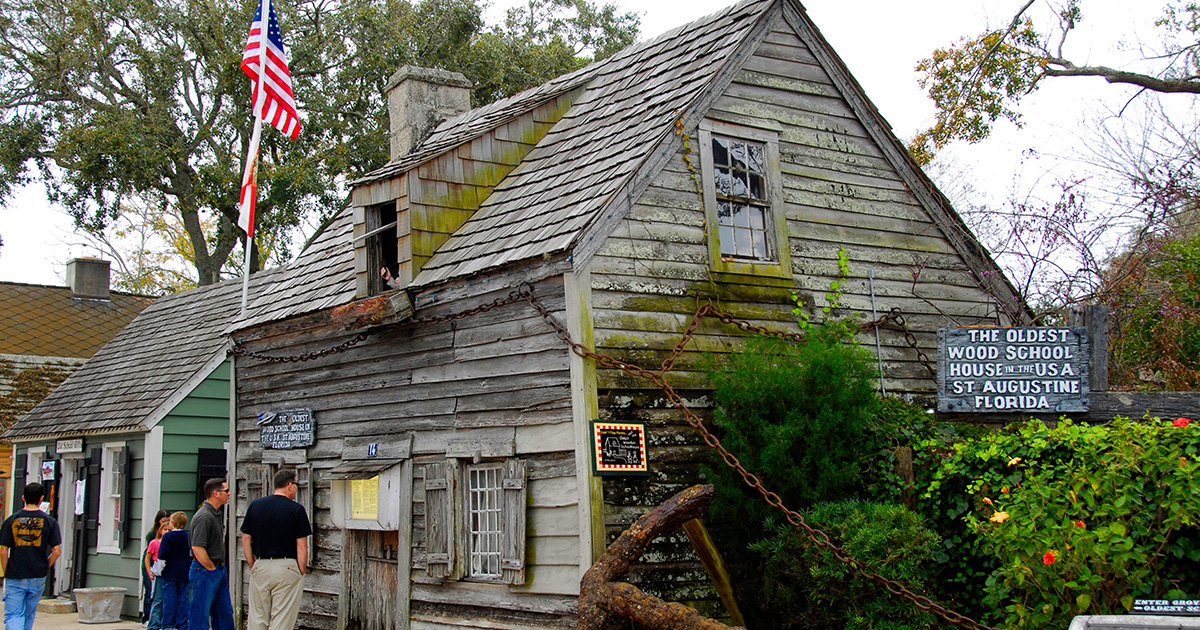
The González-Álvarez House, also known as The Oldest House, is a historic house museum at 14 St. Francis Street in St. Augustine, Florida. With a construction history dating to about 1723, it is believed to be the oldest surviving house in St. Augustine, and an important example of the city’s Spanish colonial architectural style, with later modifications by English owners.
The design of this house is one that was adopted by Spanish colonial settlers to deal with local living conditions and available building materials. It was built of readily available coquina limestone, with its main thick walls oriented east-west, and has an open covered loggia on the east side. The loggia allows prevailing southeasterly winds to cool the structure, while the thick walls provide insulation from hot weather. The interior floors are made of tabby concrete.
After the British took over Florida in 1763, the González family left for Cuba. In 1774 the house was purchased by Major Joseph Peavett, an Englishman, who added the wood-frame second story and put glass windows into openings previously only enclosed by wooden shutters. It was further enlarged by the third owner, Geronimo Alvarez, who added a two-story wing built of coquina. The house was designated a U.S. National Historic Landmark in 1970 and is now owned by the St. Augustine Historical Society, open for public tours as part of the Oldest House Museum Complex. Its walls contain the physical evidence of three colonial empires, Spanish, British, and American, in a single building.
15. Old Stone House, Washington, D.C. (1765)
The Old Stone House on M Street in Georgetown, Washington, D.C., holds the distinction of being the oldest structure still standing in its original location in the district. Built in 1765 by a Pennsylvania cabinetmaker named Christopher Layman, the house is a simple two-and-a-half-story fieldstone structure that predates the founding of the United States by eleven years. Georgetown was a thriving tobacco trading port at the time, and the house sat on what is now one of DC’s busiest commercial streets.
The house is managed today by the National Park Service and is open to the public at no cost. It survived the burning of Washington by British forces in 1814, the Civil War, and a century of commercial development on M Street that replaced nearly everything around it.
What These Houses Tell Us
A thousand-year-old adobe pueblo in New Mexico has nothing structurally in common with a 17th-century granite Puritan stronghold in Connecticut, or a coquina colonial in Florida that has been renovated by three different colonial powers. What they share is that they weren’t supposed to last this long. The Finnish settlers who built the Nothnagle Log House in New Jersey weren’t trying to leave a monument. The Puebloans at Taos didn’t build for posterity. They built because they needed a home that worked. And yet here these buildings are, outlasting every expectation placed on them.
Preservation is partly intentional: historical societies, National Historic Landmark designations, restoration projects funded by donors and grants. But it’s also partly luck. The Wyckoff House survived because Brooklyn’s real estate developers didn’t get to it in time. The Paul Revere House survived because the neighborhood around it happened to fall out of fashion before demolition became fashionable. Some of these buildings made it because people cared. Others made it almost by accident.
The ones that didn’t survive, and there are thousands that didn’t, were just as old once. What sets the houses on this list apart isn’t that they were built better or mattered more. It’s that the particular combination of materials, location, ownership, and chance came together just right, across dozens of generations and hundreds of years, to keep them standing.
Disclaimer: This information is not intended to be a substitute for professional medical advice, diagnosis, or treatment and is for information only. Always seek the advice of your physician or another qualified health provider with any questions about your medical condition and/or current medication. Do not disregard professional medical advice or delay seeking advice or treatment because of something you have read here.
AI Disclaimer: This article was created with the assistance of AI tools and reviewed by a human editor.