

When a city gets a low score on a national education list, the reaction is predictable. Local officials often question the report, while residents go online to defend their hometown. Soon after, the conversation dies down, and no one asks the harder questions: Why do the same cities always end up at the bottom, and what does that actually mean for the families who live there?
The answer has very little to do with how hard people are willing to work. It’s almost always about bigger, more complicated issues. These include the type of economy the city was built around, how its schools are funded, and the gap between what college costs and what local families can afford. These are not simple problems; they are challenges that have been built up over generations and cannot be solved overnight.
1. Visalia, California (Ranked #150)
A recent WalletHub study compared education levels across 150 of the most populated U.S. cities. The analysis focused on two key areas: the percentage of adults who hold degrees and the overall quality of the local school system, including how fairly education is distributed.
Out of all the cities measured, Visalia, California, finished last. The city ranked near the bottom for both the number of residents with higher education and the quality of its schools.
The gap between the highest and lowest-ranking cities is staggering. For example, the Ann Arbor, Michigan area has almost four times as many residents with a bachelor’s degree as Visalia. This is a massive difference that directly impacts a region’s economy, influencing everything from local tax revenue to the types of companies willing to invest there.
While the study noted some positive signs regarding educational equity among different groups in Visalia, these points could not overcome the larger challenges. The city contends with deeply under-resourced schools and an economy historically built around agriculture, an industry that has not always required a credentialed workforce.
2. Brownsville-Harlingen, Texas (Ranked #149)
Brownsville sits on the Texas-Mexico border, and its educational profile reflects the pressures of a border economy. The metro area lands near the very bottom of this 150-city ranking, and it does so consistently year after year.
The city is home to a predominantly Hispanic population, many of whom are first-generation Americans navigating systems that weren’t built with bilingual learners in mind. The national racial education gap adds important context here: according to KHOU, only 15.66% of Black adults hold a bachelor’s degree nationally, compared to 23.89% of white adults. For Hispanic adults in border communities like Brownsville, the numbers tell a similar story, and the gaps run deep at a local level.
The headline figures rarely acknowledge the economic role these communities play. Brownsville is a major trade corridor. The people keeping that economy running are often doing so without the credentialing that a WalletHub score rewards. That’s a practical reality of the regional economy, not a reflection of the community’s values.
3. McAllen-Edinburg-Mission, Texas (Ranked #148)
McAllen is Brownsville’s neighbor up the Rio Grande, and its educational profile is nearly identical. The gap between McAllen and the top of the rankings is stark enough to illustrate the full spread: college-experienced adults in Ann Arbor outnumber those in McAllen by a ratio of two to one.
The McAllen metro area has one of the highest poverty rates among large U.S. cities, and poverty and educational attainment are deeply intertwined. When families are focused on immediate economic survival, staying in school past the point where you could be earning wages is a trade-off the household budget may not accommodate. That’s not a cultural failing – it’s the math of financial pressure applied to a family’s decisions every single day.
As WalletHub analyst Chip Lupo noted in the study: “The most educated cities provide good learning opportunities from childhood all the way through the graduate level. In addition to overall education, it’s also important to look at how well cities promote educational equality when it comes to race and gender.” In McAllen, all three of those dimensions show significant strain.
4. Bakersfield, California (Ranked #147)
Bakersfield is Kern County’s biggest city, an oil-and-agriculture hub that for decades operated on an economy that didn’t require college degrees. It ranked 147th out of 150, landing in the bottom five across multiple categories – some of the lowest percentages of high school diplomas, associate degrees or college experience, bachelor’s degrees, and professional or graduate degrees among all 150 cities measured.
That sweep across every credential level tells you something. A city that’s low in bachelor’s degrees but high in trade certifications is a different story from one that’s low across all of them. Bakersfield falls into the latter category, which suggests the problem reaches back to high school completion rates and the pipeline well before university.
The oil sector, historically one of Bakersfield’s major employers, has faced significant volatility in recent years. Pivoting toward industries that reward higher credentials is a harder shift to make when a metro area never built the educational infrastructure to support it.
5. Modesto, California (Ranked #146)
Modesto, in Stanislaus County, is another Central Valley agricultural hub that makes this list. The extra credit its residents earned for having the largest racial education gap favoring Black residents – the same type of credit Visalia received – doesn’t offset an overall attainment picture that places it firmly in the bottom 10.
The irony in Modesto’s situation is that it sits within driving distance of the University of California system, Cal State campuses, and some of the most prestigious higher-education institutions in the world. Geography isn’t the barrier. Cost, family economic pressure, and the absence of a strong college-going culture in local high schools are far more significant obstacles than proximity to a campus. When a family is weighing whether a teenager should go to college or start contributing to household income, a university two hours away can feel like a different world entirely.
The lifetime earnings stakes of that decision are substantial. According to GV Wire, college graduates are expected to earn an average of $2.8 million each during their working careers, drawing on Georgetown University research, compared to $1.6 million for high school graduates. That gap compounds across an entire lifetime – and across the entire local workforce. In an economy like Modesto’s, where a large share of adults fall into the lower-credential category, the compounding effect on community prosperity is hard to overstate.
6. Fresno, California (Ranked #145)
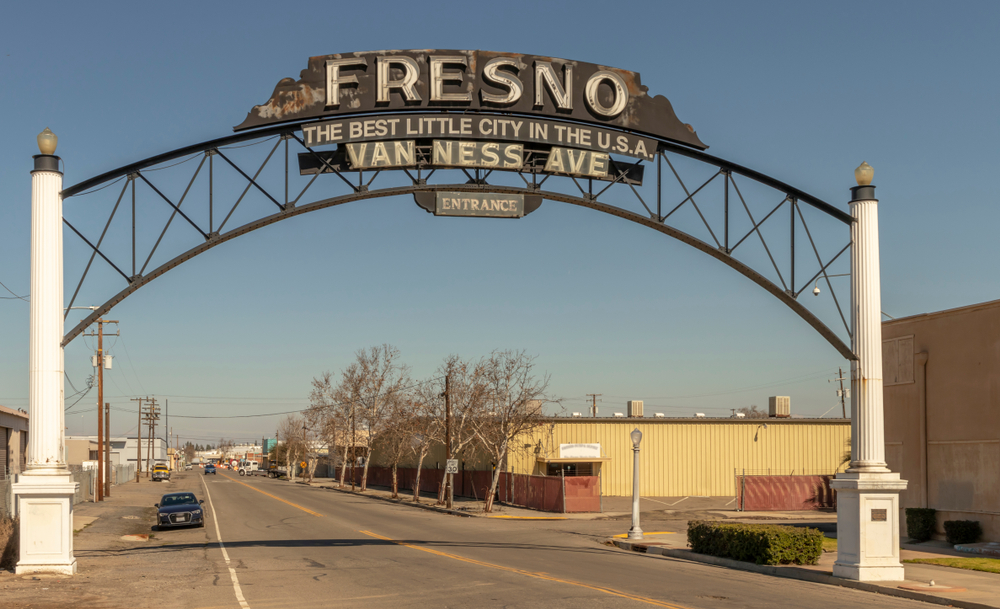
Fresno is the largest city on this list and one of the more significant agricultural metros in the entire country. Its ranking at 145 out of 150 is consistent across annual studies, not a one-time dip.
The pandemic made things measurably worse. WalletHub’s experts noted that school test scores dropped during COVID-19, widening the gap between low-poverty and high-poverty districts. Chronic absenteeism played a significant role. A visiting professor of economics and education at Columbia University, Joydeep Roy, noted that nearly a third of California public school students were found to be chronically absent in the 2021-2022 school year, compared to only 14% before the pandemic. That’s a staggering drop in classroom engagement at exactly the age when foundational skills are built.
Fresno feels that particularly hard. A city where a third of students are regularly missing school isn’t going to shift its college attainment rates quickly. The attendance gaps in high-poverty districts predated COVID and have persisted since, and recovery has been uneven.
7. Stockton, California (Ranked #144)
Stockton made national news in recent years for a different reason – it was the site of one of the first major guaranteed income pilot programs in the U.S., an experiment in whether cash transfers to low-income residents could improve quality of life and broader outcomes. Educational attainment was one of the metrics being tracked.
The city ranks 144th out of 150. What makes Stockton’s position on this list particularly striking is its geography. Sitting south of the state capital Sacramento and east of the Bay Area, Stockton is forty miles from some of the highest concentrations of advanced-degree holders in the world. The economic spillover from the Bay Area, when it arrives, tends to raise housing prices in adjacent communities well before it raises graduation rates.
For families in Stockton, the proximity to opportunity and the difficulty of accessing it is a tension that shows up in the data year after year.
8. Salinas, California (Ranked #143)
Salinas is the agricultural capital of California’s Monterey County, famous for its lettuce fields and its connection to John Steinbeck, who grew up there and wrote about its working poor with more accuracy than most journalists manage today. Its appearance on this list would not have surprised him.
The city ranked 143rd in the study, sitting alongside its Central Valley counterparts in an economy historically built on physical labor rather than credentialed work, combined with large immigrant and first-generation populations navigating a higher-education system that doesn’t always meet them where they are.
The income data helps explain why this pattern is so persistent. According to the U.S. Census Bureau, the median income of households headed by someone with a bachelor’s degree or higher was $132,700 in 2024 – more than double the $58,410 median income of those headed by a high school graduate with no college. Between 2004 and 2024, earnings of high school graduates rose just 3.2%, while earnings of bachelor’s degree holders went up 6.3%. In a city like Salinas, where the majority of residents fall into the lower category, that compounding income gap reshapes the community’s long-term economic trajectory in ways that no single policy fix can quickly reverse.
9. Hickory-Lenoir-Morganton, North Carolina (Ranked #142)
Hickory is the one non-California, non-Texas entry in this bottom 10, and it tells a different story from the Central Valley and border communities. Western North Carolina’s furniture and textile manufacturing industries dominated the region for most of the twentieth century – industries that valued skilled labor but didn’t require college degrees.
Those industries contracted dramatically through the 1990s and 2000s as manufacturing moved offshore. What they left behind was a workforce that had organized its expectations and educational trajectories around jobs that no longer exist in the same volume. Building a college-going culture from scratch, after decades of not needing one, is a longer process than most economic development plans acknowledge.
Education remains one of the most powerful drivers of economic opportunity and social mobility. In Hickory, the argument for investing in that pipeline is perhaps easier to make now than it was thirty years ago, when the factories were still running. The hard part is building the institutional capacity to deliver on it.
10. Beaumont-Port Arthur, Texas (Ranked #141)
Beaumont rounds out the bottom 10 as another Texas petrochemical hub whose historical identity was built around refineries and oil rather than universities. The city ranked 141st, one spot ahead of Hickory, NC, with Salinas, Stockton, Fresno, Modesto, Bakersfield, McAllen, Brownsville, and Visalia filling out the rest of the list below it.
Beaumont’s profile echoes Bakersfield’s in some ways – an economy built on extractive industries that pay decent wages without requiring degrees, combined with limited investment in higher education infrastructure. The difference is that Texas’s energy sector has faced significant boom-and-bust cycles, and cities that didn’t build their educational base during the boom years find themselves exposed during contractions.
The fact that Texas has four cities in the bottom 10 points to a pattern no single city can address alone. State-level investment in K-12 funding equity, college access programs, and workforce transition pathways would move the needle in ways that local leadership, working in isolation, simply cannot.
Read More: Why More Women Are Marrying Men With Less Education
What the Rankings Don’t Say

While city rankings grab headlines, they often miss the bigger picture. The communities at the bottom of these lists aren’t there because of simple or easily correctable failures. Instead, they often face complex, long-term challenges. Many of these areas have economies that were historically built around industries that did not require college degrees, and their public schools have struggled with persistent funding gaps. Furthermore, many students are the first in their families to navigate the college application process, often without a clear roadmap.
In places with a high cost of living, the need for an immediate paycheck can easily outweigh the long-term benefit of staying in school. This is an understandable choice for many families, but it can limit opportunities down the road.
This issue is becoming more urgent as the income gap between those with and without a degree continues to grow. This doesn’t mean these are bad places to live. Many have strong communities and a more affordable cost of living. However, the data should be a call to action for residents, encouraging them to ask hard questions about the priorities of their local school boards and city leaders. Starting those conversations is far more valuable than any ranking.
AI Disclaimer: This article was created with the assistance of AI tools and reviewed by a human editor.