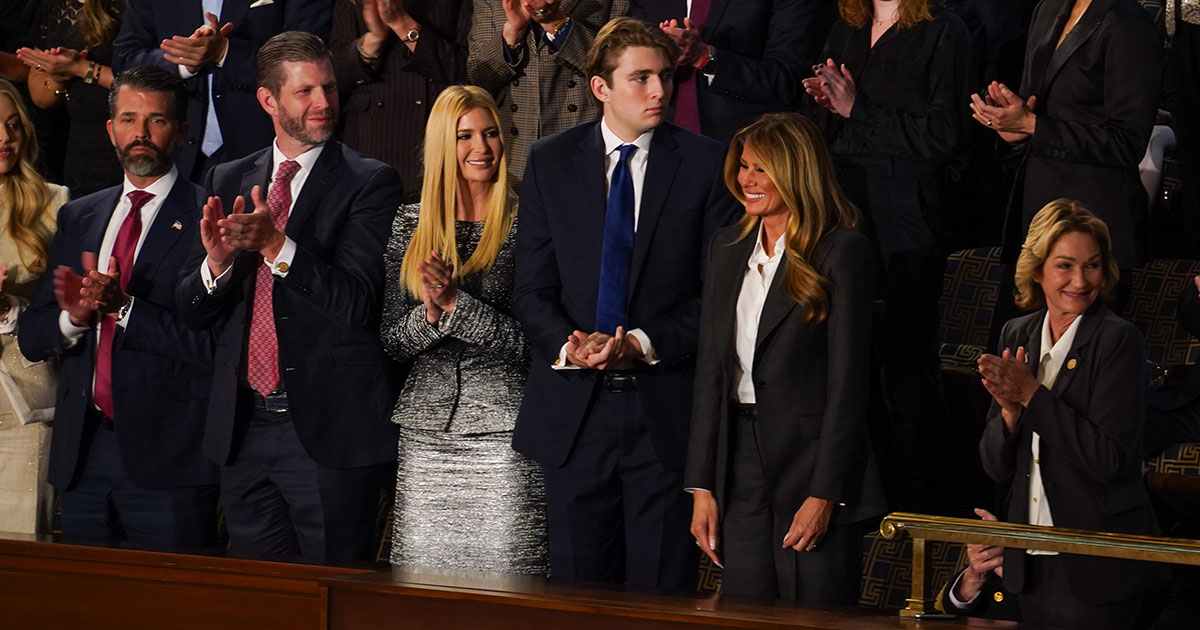

There’s a version of a political argument that has played out in every American war since the country started fighting them: whose kid has to go? It doesn’t get politer with time. And right now, with U.S. and Israeli forces engaged in military operations against Iran, that question has found a very specific target. His name is Barron Trump. He just turned 20. And the question of Barron Trump draft eligibility, specifically whether the Army’s 6-foot-8 height limit could be what stands between the president’s youngest son and potential military service, has set off a debate that is equal parts legal, political, and deeply personal.
The timing is not coincidental. Operation Epic Fury was launched on February 28, 2026, as a joint U.S.-Israeli air campaign against Iran. Within days, a hashtag was trending. A website went up. And a former Navy SEAL was on television calling out the president’s son by name. None of it happened in a vacuum. It happened because of a new military registration law, a height rule most people had never heard of, and the very long shadow of Donald Trump’s own draft history.
To understand why any of this matters, you have to start with what actually changed on the legal front, because the conversation around selective service has shifted considerably in the past few months.
The New Draft Registration Rules
On December 18, 2025, the President signed the FY 2026 NDAA into law, mandating automatic Selective Service registration. This statutory change transfers responsibility for registration from individual men to the Selective Service System itself, through integration with federal data sources, and the agency’s implementation timeline.
What that means in plain terms: young men will no longer need to remember to sign up within 30 days of their 18th birthday, as current law requires. The government will do it for them, pulling names from existing federal databases. According to the National Defense Authorization Act, the automatic registration will apply to male U.S. citizens and “every other male person” in the country between the ages of 18 and 26. The mandatory registration applies to green-card holders, refugees, asylum seekers, and undocumented men, though those on nonimmigrant visas are exempt.
It’s worth being clear about what this does and doesn’t do. The automatic registration policy does not activate a draft, which would require separate congressional authorization that has not been sought. Trump alone cannot bring back the draft through executive action, as Congress would need to pass legislation to amend the Military Selective Service Act to authorize the president to induct personnel. But failing to register carries serious federal penalties.
The policy change itself, passed with bipartisan support, had been in the works long before anyone was bombing Iran. The nationwide measure has no connection to the ongoing war with Iran and was passed with bipartisan support months before the current conflict with the country. But the timing of its implementation, landing squarely in the middle of an active military conflict, gave it a charged context it might not otherwise have had. And in that context, one name kept coming up.
Is Barron Trump Eligible for the Draft?
Barron Trump is 20 years old, which puts him squarely in the age range that would matter most if a draft were ever authorized. Under the lottery system that would be used in any future draft, people whose 20th birthdays fall in the year of the draft would be the first to get induction orders, followed in order by those aged 21, 22, 23, 24, 25, 19, and those more than six months past their 18th birthday. In other words, if a draft were called in 2026, Barron Trump would be at the front of the line, at least in theory.
But here is where the US Army maximum height limit of 6 feet 8 inches enters the picture. The youngest Trump stands at 6-foot-9, and right now, the US Army has a 6-foot-8 maximum height requirement. That’s not a rumor or a social media claim. The official Army enlistment requirements list the accepted height range for enlistment as 58 to 80 inches, confirming the 6-foot-8 (80-inch) maximum height ceiling for male recruits. The U.S. Army’s published enlistment requirements state that for men aged 17 to 20, the accepted height range is 58 to 80 inches, with 80 inches being 6 feet 8 inches.
So the question of whether Barron Trump is eligible for the draft under current Army rules has a straightforward technical answer: at his reported height, he would fall outside the Army’s enlistment height ceiling. The reason the limit exists is practical. Taller individuals have problems fitting comfortably in standard military vehicles. In environments where equipment, tanks, aircraft, armored personnel carriers, is designed around a specific physical range, those dimensions have direct safety implications.
However, the situation is more complicated than a simple yes or no. The Selective Service System specifies that even men with conditions likely to disqualify them from serving are still required to register, because the agency does not pre-classify men for service when there is no active draft. Registration and actually being inducted are two different things. A height disqualification would be determined at the physical evaluation stage, after a lottery draw, not at the point of registration.
There was also a viral claim in early March 2026 that the White House had officially announced Barron could not serve due to his height. Snopes debunked the White House claim, finding no evidence the White House issued any such statement; the White House archive of briefings and statements contained no announcement regarding Barron Trump’s height or potential military enlistment, verified March 4, 2026. The story spread widely regardless.
Can Someone Over 6-Foot-8 Serve in the Military?
The short answer is: yes, potentially, but it requires a waiver, and the precedent is thin. The most famous example is David Robinson, the NBA Hall of Famer known as “The Admiral,” and his story is instructive for exactly this debate.
At the time Robinson entered the Naval Academy, it had a height restriction of 6 feet 6 inches for all midshipmen, but he had grown to 6 feet 7 inches. The academy’s superintendent granted him a waiver, but Robinson continued growing, and by the start of his second year he had nearly reached his adult height of 7 feet 1 inch, which later prevented him from serving on any U.S. Navy ships. As a compromise, Secretary of the Navy John Lehman allowed Robinson to train for and receive a commission as a staff officer in the Civil Engineer Corps, and Robinson was commissioned in the Naval Reserve and required to serve only an initial active-duty obligation of two years. He went on to fulfill that obligation before joining the San Antonio Spurs in 1989.
Jesse Ventura, the former Minnesota governor and decorated Navy SEAL veteran, cited Robinson directly when dismissing the height argument as an excuse. Ventura called on Barron to enlist, saying, “Do something your father didn’t have the courage to do, do something your father didn’t have the patriotism to do.” Ventura acknowledged having heard the height argument: “I heard the excuse that Barron might be too tall. David Robinson served on active duty. He was seven feet tall before he ever went to the San Antonio Spurs basketball team.”
The Robinson comparison has limits, though. He was already enrolled at the Naval Academy when his height became an issue, and his case required high-level political intervention to resolve. An extensive review of available reporting finds only one clear, named example of a documented height waiver for U.S. military service: David Robinson, the future NBA Hall-of-Famer, who needed and received an exception to attend the U.S. Naval Academy because he exceeded the service’s then-height limit. Waivers are possible, but they are not routine, and they are granted at the discretion of military leadership, not the applicant.
The Calls to Draft Barron, and What They’re Really About
Social media users demanded that President Trump send Barron to fight in the war due to the possible deployment of ground forces, and earlier in March, the hashtag #SendBarron was trending on X. A website, DraftBarronTrump.com, went up the same day the strikes on Iran began, created by “South Park” writer Toby Morton. The site’s stated mission leaned heavily on ironic reverence, with text declaring “Strength is inherited” and “When power is projected abroad, it is only right that strength exists at home.”
The online movement around Barron’s potential service might look like trolling, and partly it is, but it draws on something more substantive than mere provocation. When White House Press Secretary Karoline Leavitt appeared on Fox News in early March, she said President Trump “wisely does not remove options off of the table,” and while a draft is “not part of the current plan right now,” the president “wisely keeps his options on the table.” That non-denial landed hard. The question of whose children bear the cost of an administration’s military decisions is never really a joke, even when it looks like one.
Ventura, who served on an elite Navy SEALs unit during the Vietnam War, slammed President Trump’s war with Iran, which has claimed the lives of 13 U.S. service members and injured hundreds more. His argument was simple: “A war is justified if you’re willing to send your kids. Because how can you send somebody else’s kids to a war if you won’t send your own?”
That framing connects directly to the history that keeps getting raised in this debate, and the reason it stings.
The Father’s Draft, and the Son’s Position
Donald Trump avoided military service in Vietnam through a combination of student deferments and a medical exemption. The president avoided the draft on no fewer than five separate occasions, four times using a student deferment, and a fifth time for medical reasons. In 1968, after receiving four deferments due to education, Donald Trump was diagnosed with bone spurs in his heels at the age of 22.
The legitimacy of that diagnosis has been disputed for years. Dr. Larry Braunstein, a podiatrist who died in 2007, often told the story of providing Donald Trump with the diagnosis of bone spurs so he could be exempt from military service. His two daughters told the New York Times that the diagnosis was provided as a “favor” to Trump’s father, Fred Trump. In return, the doctor received access to Fred Trump, Trump’s father and owner of the Queens building in which Braunstein’s practice operated. No contemporaneous medical documentation has been produced to corroborate the daughters’ account, and the claim remains disputed.
The irony sharpening the current debate is that Barron’s potential reason for avoiding service, his height, is, by most measures, more legitimate than his father’s was. A measurement is a measurement. It doesn’t require a favor, a podiatrist, or a building lease.
None of the president’s children, Don Jr., Eric, Ivanka, Tiffany, and Barron, have served in uniform, and neither did his father, Fred Trump. Whether that constitutes a pattern worth interrogating, or simply a family’s exercise of the same rights available to every American, depends entirely on the lens through which you’re viewing it, and the wars that are currently being fought.
Read More: What America’s Military History Tells Us About Who Actually Serves
What This Means, For the Debate and for Everyone Else
The debate over Barron Trump’s draft eligibility is unlikely to be resolved by a rule or a ruling. No draft has been authorized. The U.S. hasn’t implemented a military draft since 1973. Any future draft would require an act of Congress, a lottery, and then a medical and physical evaluation process in which height would actually be assessed. For now, it’s all hypothetical.
But the hypothetical is doing real work. It’s forcing a conversation about the mechanics of who registers, who qualifies, who gets exemptions, and who ends up serving when things turn serious. Rep. Houlahan told CNN that making registration automatic “not only saves taxpayer dollars by eliminating the need to advertise but finally ensures that young men are not unknowingly penalized.” The practical aim of the new law is equity, making sure the registration burden doesn’t fall disproportionately on those who know the rules and remember to follow them.
What the Barron Trump conversation adds is a different kind of equity question: not who registers, but who could ever be called, and whether the rules that determine eligibility are applied the same way regardless of whose son you are. The Army’s height ceiling is not designed with the children of presidents in mind. It exists because military equipment has physical constraints, and the people who operate that equipment need to fit inside it safely. That’s a practical rule, not a political one. But it lands in a political moment, and in a family with a specific history of finding reasons not to serve.
Whether Barron Trump ever faces a draft notice is, for now, a question with no real answer. What the debate has already done is make the answer matter to people who are watching very closely.
A.I. Disclaimer: This article was created with AI assistance and edited by a human for accuracy and clarity.