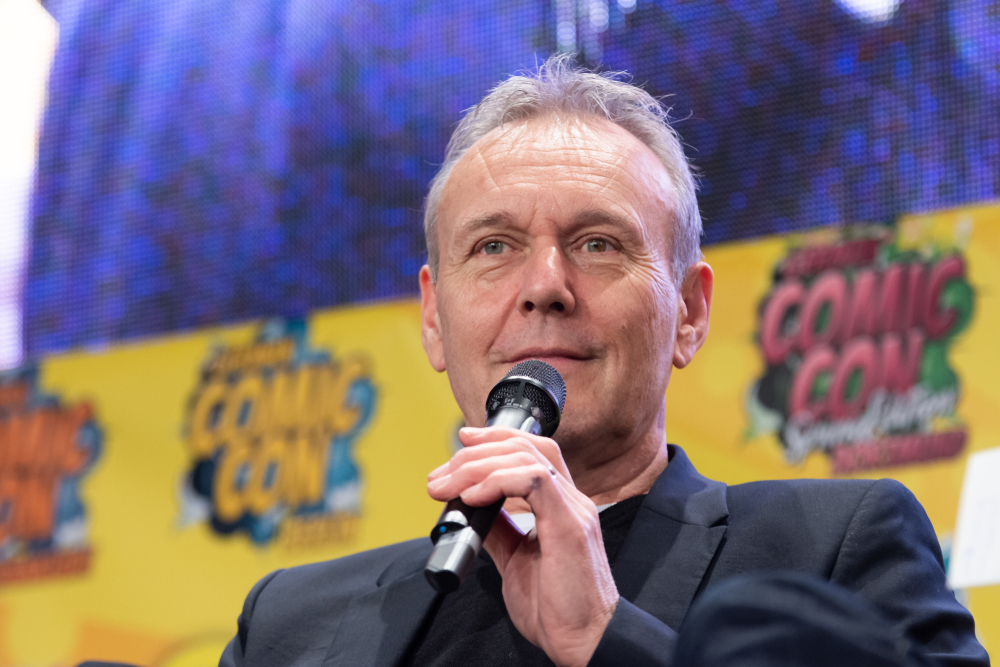

Anthony Head’s daughters Emily and Daisy confirmed their father’s death in a statement, saying he “passed away peacefully of complications due to pneumonia, surrounded by his family.” He was 72. The news arrived on June 5, 2026, and within hours the grief pouring in from former co-stars, fans, and colleagues said something about what kind of man he had been – not just what kind of actor.
Anthony Stewart Head was born on February 20, 1954, and was primarily a performer in musical theatre before he rose to fame in the UK in the 1980s. He built a career that stretched across five decades and enough different roles – librarian, king, prime minister, villain – that it would be easy to miss what tied them together. The thread was a particular quality of warmth and authority that made audiences trust him in every room he walked into, fictional or otherwise. When James Marsters, who played Spike on Buffy the Vampire Slayer, posted on Instagram after the news broke, he didn’t reach for a polished tribute. “There’s a hole in the World,” Marsters wrote. “Anthony Head has passed on from us. He was an unflaggingly kind and steady presence on the set of Buffy, and the best actor in the cast. He was the best of us.” That’s the kind of thing people say at funerals that isn’t always true. In Head’s case, it appears to have been unanimous.
Born Into It
Head was born in London on February 20, 1954, to Seafield Head, a documentary filmmaker, and Helen Shingler, an actor. His brother is “One Night in Bangkok” singer Murray Head. Acting wasn’t something Anthony stumbled into or chose against the wishes of a practical-minded family – it was the air of the household. He trained at the London Academy of Music and Dramatic Art before launching into his long stage and screen career. In a 2013 interview, he explained his choice of career by saying that “when it’s in your family, it’s a choice, it’s there. It’s not a jump to say: ‘I want to act.’ When I was six I was in a little show my mother’s friends organised, playing the Emperor in The Emperor’s New Clothes. I remember thinking: ‘This is the business, this is what I want to do.'”
One of his earlier roles was in the musical Godspell in 1978, the same year he made his television debut in the London Weekend Television series Enemy at the Door. Stage work dominated his early career, and he developed the kind of versatility that only comes from years of live performance – the ability to fill a room, to hold an audience’s attention without the buffer of camera angles and editing.
The Coffee Ads That Made Britain Notice
Before Sunnydale, before Camelot, before AFC Richmond, there was a jar of instant coffee and a slow-burning romance that the entire country apparently watched twice a year like it was a sporting event.
The Gold Blend couple was a British television advertising campaign for Nescafé Gold Blend instant coffee, developed by McCann Erickson and which ran from 1987 to 1993. The original campaign ran for twelve 45-second instalments. It starred Anthony Head and Sharon Maughan as a couple who begin a slow-burning romance over a cup of the advertised coffee. The ads were in a serial format, with each ending with a cliffhanger. The commercials were extremely popular, and as time went on, the appearance of a new installment gained considerable media attention.
The much-hyped campaign, with its “will they won’t they?” subtext, played out in the manner of a soap opera. For Head, it was both a gift and a trap. The ads made him recognizable on every high street in Britain, but that recognition came with a ceiling. He was the coffee man. Getting taken seriously for something else would take time – and, eventually, a move to California.
Head quit the Gold Blend campaign after ten years and would refer to it groaningly as “the advert.” It gave him “huge profile,” he remembered, but thereafter “things got a bit contracted.” He waited it out in America, becoming a star of the cult television series Buffy the Vampire Slayer, effectively driven out of Britain because of the success of the ads. The irony wasn’t lost on him.
Rupert Giles and the Role of a Lifetime
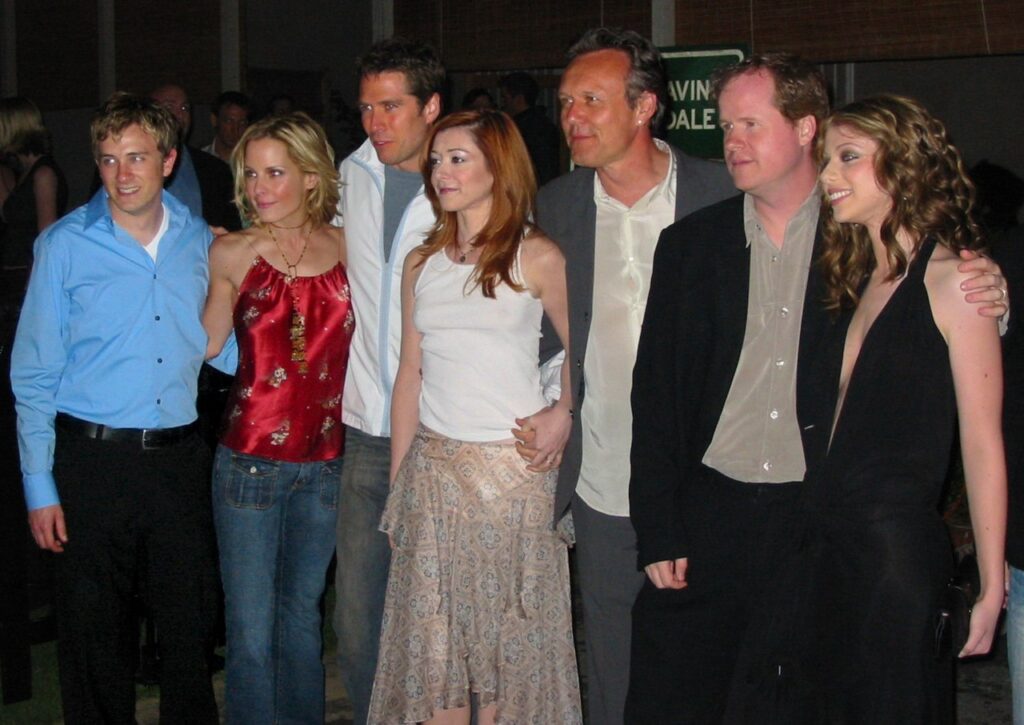
Head played Rupert Giles – the Watcher and father figure of the Slayer Buffy Summers – on all seven seasons of Buffy alongside Sarah Michelle Gellar. Head starred on the cult-beloved series across all seven seasons and became a fan favorite, to the point that a spin-off series featuring the character was considered, though conflicts over rights issues meant it ultimately never made it to air. On paper, it sounds like a supporting role. In practice, Giles was the emotional anchor of a show that ran for seven seasons, earned a devoted global following, and changed what television looked like in the late 1990s.
Only Gellar, Hannigan, and Nicholas Brendon appeared in more Buffy episodes than Head between 1997 and 2003. His performance was remarkable, as he toggled between fussy British archetypes and something wilder and more unhinged – references to his past, when he was referred to as “Ripper,” suggested a more dangerous backstory than the fussy librarian act he adopted later. That tension was what made Giles interesting: a man who’d clearly done something sharp and reckless in his youth and spent adulthood channeling all of it into books, duty, and a teenage girl with a destiny. Head played both versions of the man, and made you believe they were the same person.
In many interviews, Head said he left the show to spend more time with his family, having realised he had spent most of the year outside England for more than half his younger daughter’s life. It’s the kind of decision that sounds straightforward until you’ve spent years in a job that defines you. Leaving Buffy voluntarily, while the show was still running, was a choice about what mattered more.
Head reprised his role as Giles in the Audible exclusive audio series Slayers: A Buffyverse Story alongside former co-stars James Marsters, Charisma Carpenter, Amber Benson, Juliet Landau, Emma Caulfield Ford, James Charles Leary, and Danny Strong. The drama, released in 2023, is set ten years after the original finale and introduces a new Slayer, Indira, played by Laya DeLeon Hayes. Giles, it turned out, was a character he never really put down.
Beyond Sunnydale: A Career That Refused to Plateau
The decade after Buffy might have been a slow drift into nostalgia appearances and convention circuits. Instead, Head kept working, kept choosing well, and kept finding roles that used what he actually had rather than coasting on what audiences already knew.
He appeared on the sketch comedy series Little Britain (as the Prime Minister), the BBC’s Merlin (as Arthur’s father, Uther Pendragon), and most recently on Apple TV sports comedy-drama Ted Lasso (as the recurring character Rupert Mannion). Three very different registers: absurdist comedy, heavyweight drama, and prestige television. He was convincing in all of them.
On Ted Lasso, he played Rupert Mannion, the grumpy former owner of AFC Richmond who cedes ownership of the club to his wife during their divorce. The role was written as a villain, and Head brought to it exactly what he’d brought to Giles – the sense of a history behind the behavior, a man shaped by something other than pure malice. His Ted Lasso co-star Brett Goldstein paid tribute to the actor, reflecting on the contrast between Head’s villainous on-screen persona and his real-life personality. “Anthony Head was a brilliant actor who played the worst person in the world which was an incredible skill because he was the best person,” Goldstein wrote on Instagram. “Infinitely charming and kind and fun and a joy. He will be sorely missed.”
Other notable roles included playing Geoffrey Howe, deputy to Prime Minister Margaret Thatcher, in the Oscar-winning film The Iron Lady. He also appeared in Motherland, Manchild, and Silent Witness, as well as acting in many plays and musicals and recording music as a singer.
His musical ability was genuine, not decorative. He was known for his distinctive baritone voice, which he used in advertising and voice roles. In addition to the songs he performed in the Buffy musical episode “Once More, with Feeling,” Head sang in the episode “Restless” and recorded a track for the episode “Passion.” The musical episode became one of the most celebrated hours of television that show ever produced – and Head’s voice was a significant reason why it worked.
The Last Year
Head’s long-time partner, animal welfare campaigner Sarah Fisher, died in December 2025 at the age of 61. The couple had been together for 37 years. His death came just six months after the loss of Fisher, who died of thyroid cancer. Their daughters, Emily and Daisy, are both actresses.
The timing of the two deaths – a 37-year relationship ending in December, followed by Head’s own death the following June – is the kind of thing that people talk around carefully, not wanting to draw a line between them without permission. What can be said is that he had six months without her, and that his daughters were with him when he died.
The actor had expressed enthusiasm about joining the canceled Buffy reboot, telling the New York Post: “Yes. I wouldn’t know what as, because Giles has aged a little bit. Maybe I’m the head of the Watchers’ council now. But to be honest, of course I would. It was so formative.” A reboot of the popular 90s horror series was in the works at Hulu with Oscar-winning director Chloé Zhao at the helm, but was scrapped after a pilot was produced. He would have come back. He always would have come back.
The Tributes Kept Coming
Following the news of his death, Gellar took to Instagram to share a tribute. “‘Tell Giles I figured it out and I’m OK.’ Well I don’t have it figured out and I’m not OK. But I know I’m the lucky one because I knew you,” she wrote alongside a carousel of photos. “Thank you to Daisy and Emily who not only shared their dad with me, but with the world.” The specificity of that scene choice – that particular question, the one about whether life gets any easier – said everything.
Emma Caulfield, who played former demon Anya Jenkins, shared a photo taken on the London Underground in 2011. “I went to visit my friend Tony on the set of The Iron Lady. We had lunch, hit up a record store, had dinner and drinks and laughed until our sides hurt. It was a perfect day. There were many of these moments with this amazing human who I was lucky enough to call my friend for 27 years. He was kind and wise and a guide in troubled times.”
Matt Lucas, who starred alongside Head in Little Britain, said he was “very sad indeed” to learn of Head’s passing, recalling that when casting the show, the team were originally “looking for a ‘Tony Head-type’, because we never imagined for a moment that the man himself would be interested, but he was.”
Head also worked alongside Russell T Davies on Merlin. Davies remembered Head as “an absolute delight,” writing: “He spoke always about his daughters with such love and joy, what a wonderful dad. Love and sympathy to Emily, Daisy, family and friends, he’ll be missed and remembered across the world.”
The same note kept appearing in tribute after tribute: he talked about his daughters constantly. The man who built a career playing fathers turned out to be genuinely consumed by fatherhood. Some things aren’t a performance.
Read More: Celebrities Whose Deaths Took Everyone By Surprise
What Gets Left Behind
Anthony Head had a 50-year career, and the breadth of it resists reduction. The Gold Blend adverts that preceded him everywhere in Britain. The seven seasons of a show that shaped an entire generation’s understanding of what genre television could be. The BBC historical dramas. The comedy work. The voice roles. The music. And then, finally, the villain’s chair at AFC Richmond, inhabited with such warmth that even the villain felt like a person.
What’s harder to measure is the thing his co-stars kept circling around in their tributes – the quality of his presence on a set, the generosity toward other actors, the consistency between the man on screen and the man off it. People who worked with him weren’t mourning the performances. They were mourning the person. His daughters said it was “an honour and a privilege” to be his daughters, and “to have witnessed firsthand the impact both he and his work have had on so many.” That double accounting – the work and the man – is the part that doesn’t get archived anywhere.
His daughters said their grief “is far greater than the hole he has left behind,” but that they know “his legacy will live on, in the shows he was a part of, and in the audiences that love them,” adding: “How lucky we are to know we are able to watch him doing what he loved, even when he is no longer with us.” The shows stay. That’s the easier part. The harder part is the specific weight of a person – the one who talked about his daughters in every interview, who made Brett Goldstein describe playing the world’s worst person as easy, because the man beside him on set was so genuinely the opposite. The laughter over dinner in London doesn’t make it into the archive. But that’s the part people are grieving. They’ve said so clearly enough.
AI Disclaimer: This article was created with the assistance of AI tools and reviewed by a human editor.