

You want to stand at the foot of something genuinely ancient, something on the scale of Stonehenge or Machu Picchu, but you don’t want to spend two weeks and four flight connections getting there. The good news is you probably don’t have to. The ancient wonders the US holds within its own borders are staggering in scale and age, and most Americans drive right past them without a second glance.
A city in Illinois that, at its peak, outpopulated London. A road network in New Mexico engineered with a precision that still puzzles researchers. A giant serpent in Ohio coiled across more than a quarter of a mile of carefully shaped earth. These places didn’t need a different continent to be extraordinary. They are here, and they have been here for a very long time.
If you’ve been meaning to explore the ancient wonders the US has tucked into its own backyard, this is where to start.
1. Cahokia Mounds, Illinois
Cahokia Mounds is the site of a Native American city that flourished around 1050 to 1350 CE, located directly across the Mississippi River from present-day St. Louis. It is, by most measures, the most important pre-Columbian archaeological site north of Mexico, and it tends to stop people cold when they actually understand what they’re looking at.
At its apex around 1100 CE, the city covered about six square miles, included roughly 120 earthworks in a wide range of sizes, shapes, and functions, and had a population of between 15,000 and 20,000 people. To put that in perspective: at that point in history, most European cities were smaller. The city was laid out with clearly defined zones for administrative and ceremonial functions, elite compounds, and residential neighborhoods, all oriented on the cardinal directions. Among its largest features was an enormous central plaza encompassing nearly 40 acres, and the pyramidal Monks Mound – the largest prehistoric earthen structure in the Western Hemisphere – which rises 100 feet, covers more than 14 acres, and contains more than 25 million cubic feet of earth.
The site also included an astronomical observatory called “Woodhenge,” consisting of a circle of wooden posts used, researchers believe, to track the changing seasons and ceremonial dates. The original name of the civilization is lost entirely. The inhabitants apparently never used writing, and the name Cahokia itself belongs to an unrelated tribe that was living in the area when French explorers arrived in the late 17th century. Designated a UNESCO World Heritage Site in 1982, Cahokia is one of the most compelling and under-visited ancient sites anywhere in the Americas.
2. Cliff Palace, Mesa Verde, Colorado
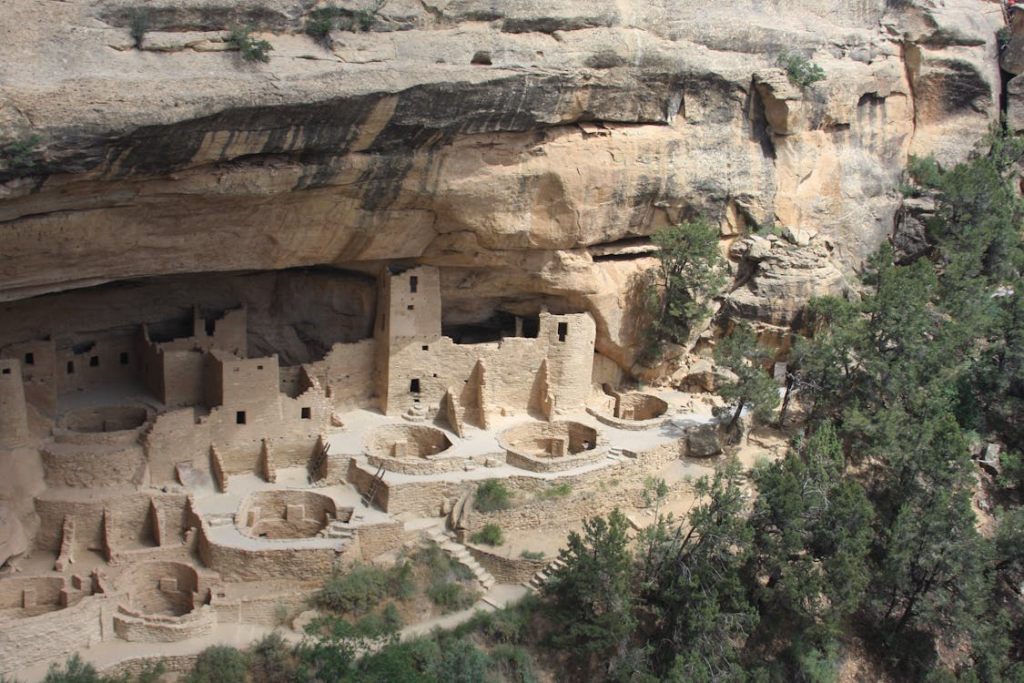
Mesa Verde is best known for a large number of well-preserved cliff dwellings, houses built in alcoves or rock overhangs along the canyon walls. The effect, when you first see them from across the canyon, is genuinely difficult to process. These are not ruins in the conventional sense. They look like a city that someone pressed into the face of a cliff and left there.
With 23 kivas and 150 rooms, Cliff Palace is the largest cliff dwelling in Mesa Verde National Park. The buildings ranged from one to four stories, and some reached the natural stone ceiling. To build these structures, people used stone and mud mortar, along with wooden beams adapted to the natural clefts in the cliff face. Cliff Palace was home to approximately 125 people, but was likely an important part of a larger community of sixty nearby pueblos, housing a combined six hundred or more people.
According to Smarthistory, Mesa Verde was built and occupied by the Ancestral Puebloans from around 450 CE to 1300 CE, and with over 4,700 archaeological sites, it is one of the most significant cultural heritage areas in North America. The reason for its abandonment has not been conclusively answered, though droughts occurred from 1276 to 1299 and likely pushed communities to migrate. Most archaeologists agree that prolonged drought and food scarcity forced communities to leave, and far from disappearing, their descendants live today in the pueblos of New Mexico, such as Taos, Laguna, and Ohkay Owingeh.
3. Pueblo Bonito, Chaco Canyon, New Mexico
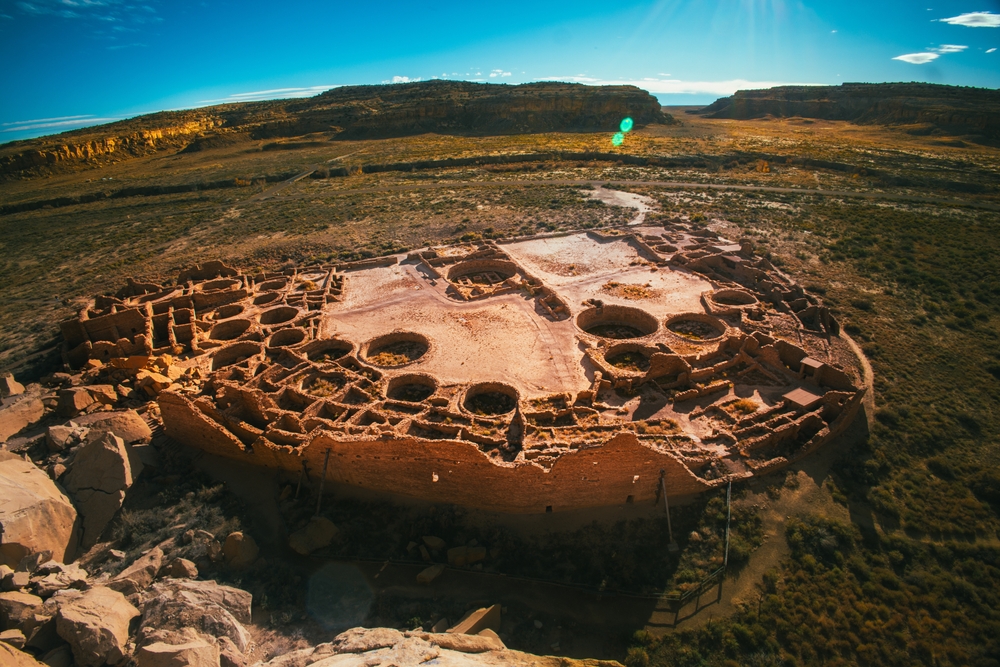
Chaco Canyon, located in northwestern New Mexico, was a major center of culture for the Ancestral Puebloans between 850 and 1250 AD. The canyon features massive stone buildings, ceremonial kivas, and an extensive network of ancient roads. At its heart sits Pueblo Bonito, described by anthropologist Brian Fagan as “an archeological icon, as famous as England’s Stonehenge, Mexico’s Teotihuacan, or Peru’s Machu Picchu.”
According to the National Park Service, Pueblo Bonito is “the most thoroughly investigated and celebrated cultural site in Chaco Canyon. Planned and constructed in stages between AD 850 to AD 1150 by ancestral Puebloan peoples, this was the center of the Chacoan world.” The great house, a massive multi-story structure with over 600 rooms, is one of the most significant buildings in North America built before the 19th century.
The site shows the Puebloans’ comprehension of solar and lunar cycles, both of which are marked in the petroglyphs of the surrounding cliff area as well as in the architecture of Pueblo Bonito itself. Testing of the trees used to construct these massive buildings has demonstrated that the wood came from two distinct areas more than 50 miles away: one in the San Mateo Mountains and the other in the Chuska Mountains. About 240,000 trees would have been used for one of the larger Great Houses. The logistics of that alone, with no wheels and no draft animals, remain staggering.
4. Serpent Mound, Ohio
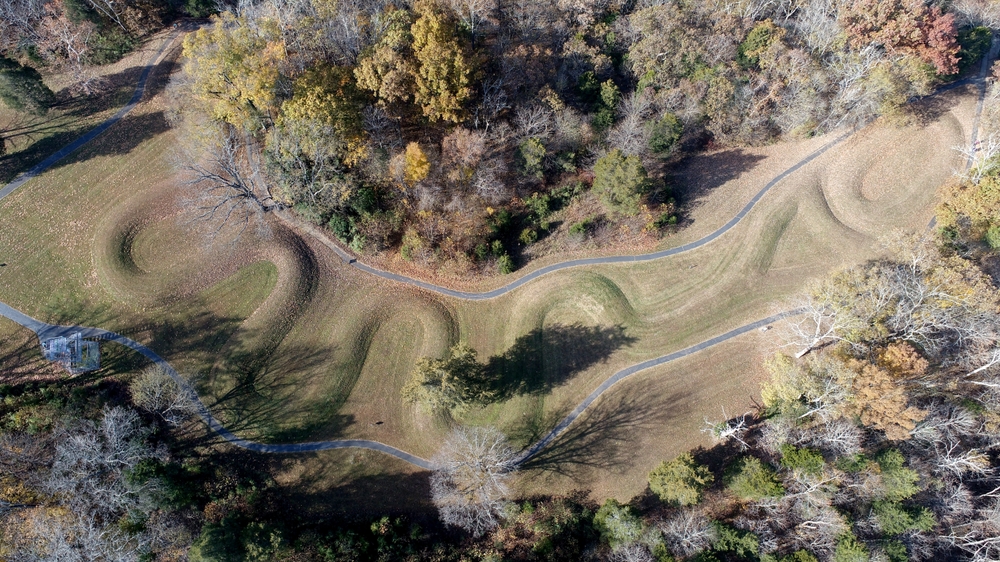
The Great Serpent Mound is a 1,348-foot-long, four-foot-high prehistoric effigy mound located in Peebles, Ohio, built on what is known as the Serpent Mound crater plateau, running along the Ohio Brush Creek in Adams County. Standing at the observation tower and looking out over the full coil of the creature below, its mouth open wide and its body winding in seven distinct curves, is one of the genuinely strange experiences available in North America.
In the late 19th century, Harvard archaeologist Frederic Ward Putnam excavated Serpent Mound but found no artifacts that could assign it to a particular culture. Based largely on nearby Adena burial mounds, later archaeologists attributed it to the Adena culture that flourished from 800 BC to AD 100. That theory held until a 1991 excavation used radiocarbon dating to determine the mound was approximately 900 years old, suggesting it belonged to the Fort Ancient culture of AD 1000 to 1550. Then in 2014, another team presented radiocarbon dates suggesting it was built by the Adena culture around 300 BC. The debate continues.
Researchers do agree that the mound contains no artifacts, which is unusual, as both the Fort Ancient and Adena groups typically buried objects inside their mounds. Archaeological evidence does not support a burial purpose for the Great Serpent Mound. Whatever it was built for, whether astronomical alignment, spiritual practice, or a marker of cosmic significance, nobody fully knows. The Ohio History Connection, which manages the site, describes it as the world’s most spectacular effigy mound – a fair assessment, given that nothing else quite like it exists.
5. Poverty Point, Louisiana
Poverty Point, located in northeastern Louisiana, is a prehistoric earthwork complex constructed by the Poverty Point culture between 1700 and 1100 BCE. The site features concentric semicircular ridges and massive mounds, including Mound A, which stands 72 feet tall. Serving as a center for trade and community life, Poverty Point was part of an extensive network that spanned hundreds of miles, and in 2014 it was designated a UNESCO World Heritage Site.
Age is what makes Poverty Point so striking. At its peak 3,000 years ago, it sat at the center of an enormous trading network stretching for hundreds of miles across the continent. A society that had no agriculture, no metal tools, and no beasts of burden moved nearly 2 million cubic yards of earth to create something that still covers 910 acres, the product of an estimated five million hours of labor.
Artifacts found at the site indicate trade networks reaching as far as the Great Lakes and the Appalachian foothills, which means the people who built Poverty Point were connected to a world far larger than the Louisiana bayou. Researchers are still working out exactly what it was used for and who, ultimately, these people were.
6. Hopewell Ceremonial Earthworks, Ohio
Eight sites in central and southern Ohio comprise the Hopewell Ceremonial Earthworks, sprawling embankments built by little-known Indigenous tribes. UNESCO placed them on its World Heritage list as the Hopewell Ceremonial Earthworks, the first World Heritage site recognized in Ohio and the 25th in the United States. These structures are the largest geometrically shaped earthworks on the planet, now ranked alongside Stonehenge, Machu Picchu, and the Great Wall of China.
Those geometric earthworks, squares, circles, and octagons spanning up to 1,000 feet across, have consistently astonished surveyors since the 18th century. Constructed between 200 BCE and 500 CE, these massive ceremonial complexes required extraordinary mathematical precision, given the absence of modern tools.
All the more striking given that scholars believe the Hopewells had no written language and no centralized form of government. Despite having no leader decreeing the building of such structures, the Hopewells periodically gathered from tiny villages scattered across great distances to erect these elaborate structures, one basketful of dirt at a time. The Hopewell Ceremonial Earthworks are best accessed at Newark, where the Great Circle, 1,200 feet in diameter, offers the most complete visitor experience.
7. Taos Pueblo, New Mexico
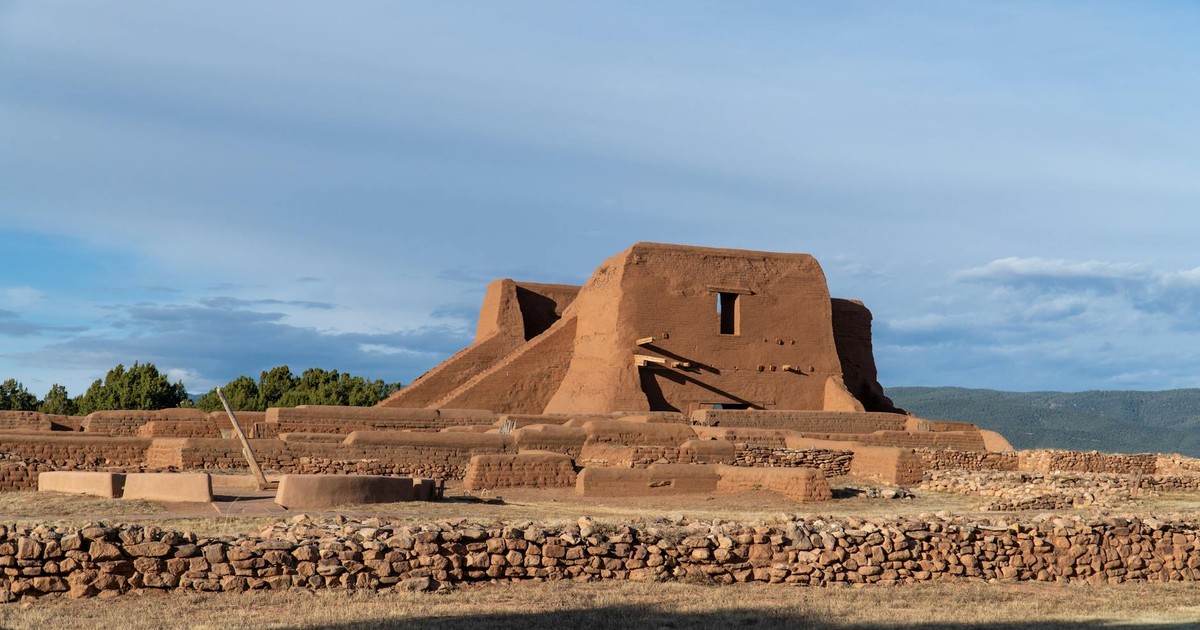
Taos Pueblo, located in northern New Mexico, is a multi-storied adobe settlement that has been continuously inhabited for over 1,000 years. Constructed by the Taos-speaking Tiwa Native American tribe, the pueblo features terraced adobe dwellings rising up to five stories, representing traditional Puebloan architecture at its most enduring.
People still live there. Taos Pueblo is not a preserved ruin or a reconstructed village. Families have occupied the same adobe structures, built without nails or metal fasteners, for a millennium. It holds status as both a UNESCO World Heritage Site and a living community, which means visitors are guests and are treated accordingly. Access is regulated, and certain areas of the pueblo are closed to the public out of respect for the residents.
The North House and South House of Taos Pueblo are among the oldest continuously inhabited structures in the United States. The community draws water from the Rio Pueblo de Taos, the same source it has used for centuries. The walls are replastered by hand every generation. That kind of continuity is rare anywhere on earth.
8. Canyon de Chelly, Arizona
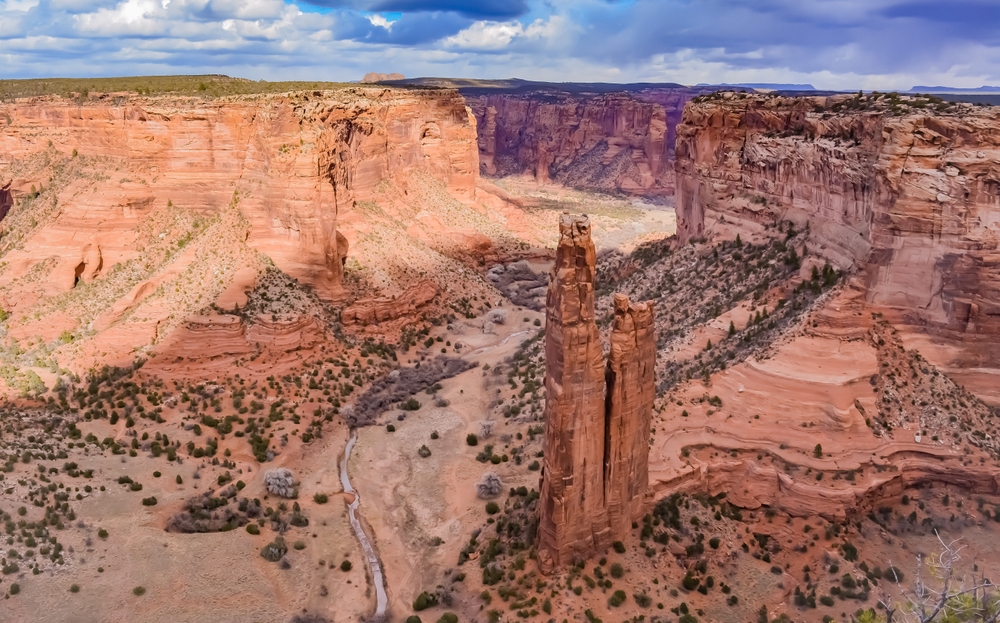
Red sandstone cliffs rising 1,000 feet shelter some of the best-preserved ancient dwellings in the Southwest. Canyon de Chelly’s archaeological significance lies not only in its Ancestral Puebloan ruins, such as White House, but also in its status as one of North America’s longest continuously inhabited areas.
Canyon de Chelly (pronounced “de Shay,” from the Navajo word Tséyi’, meaning “rock canyon”) sits within the Navajo Nation in northeastern Arizona. Unlike most national monuments, it is still home to Navajo families who farm and raise livestock on the canyon floor, making it one of the few active cultural landscapes in the US park system. Visitors are not permitted to enter the canyon independently; tours are conducted with Navajo guides, which means the experience of being there is shaped, deliberately, by the people whose ancestors have lived in this place for thousands of years.
The White House Ruins are the most iconic structure in the canyon, a two-story dwelling pressed into a recess in the sandstone wall hundreds of feet above the canyon floor. The trail to the White House is the only self-guided hiking option, and the view from the canyon rim alone justifies the stop.
9. Montezuma Castle, Arizona
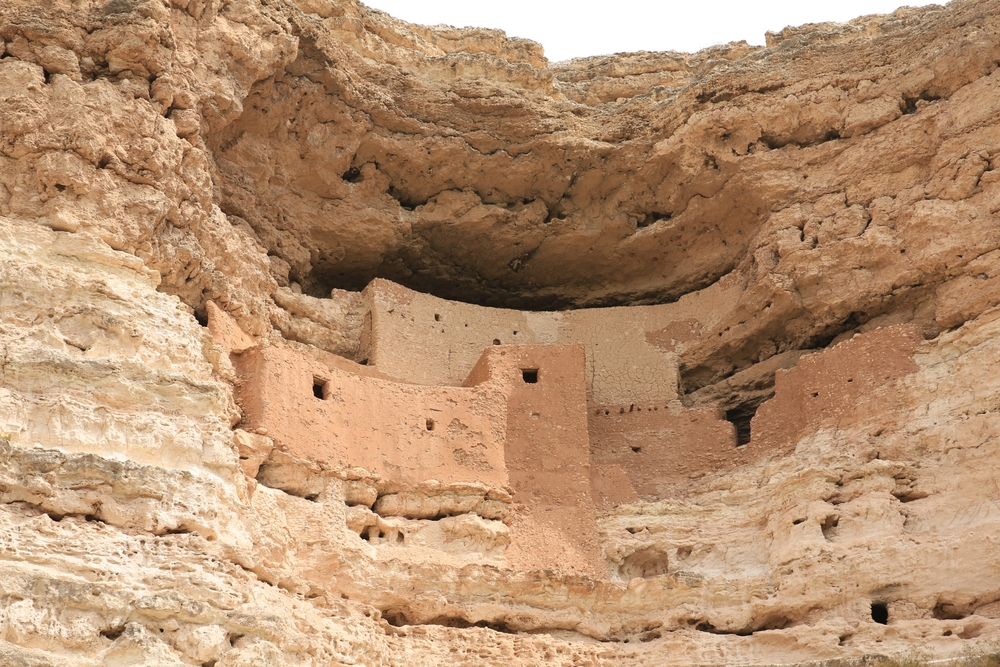
Tucked into limestone cliffs in the desert of Camp Verde, Arizona, Montezuma Castle was built and occupied by the Sinagua people, believed to have lived here from AD 1100 to 1425, and used as a residential structure with 20 rooms.
Despite its name, Montezuma Castle has nothing to do with the Aztec ruler Montezuma. Early European settlers assumed any impressive structure in the region must be connected to the Aztec empire, and the misidentification stuck. A five-story, 20-room dwelling carved into a natural alcove 90 feet above Beaver Creek, it is genuinely one of the best-preserved structures of its kind in North America.
It was among the first four sites given the designation “National Monument” in 1906, and for decades visitors could access it via a series of cliffside ladders. Climbing access is no longer permitted, but the view from the path below, the perfectly preserved plaster walls and the timber beams still in place, is striking enough that the ladders don’t feel like a loss.
10. Ocmulgee Mounds, Georgia
Spanning an astonishing 17,000 years of continuous human habitation, Ocmulgee contains traces of Ice Age hunters, Woodland period mound-builders, and Mississippian temple complexes. The site’s reconstructed earthlodge has a bird-shaped clay floor and 47 seats arranged around a central fire pit.
Located in Macon, Georgia, Ocmulgee Mounds National Historical Park is one of the most layered archaeological sites in the eastern United States. The fact that people used this particular stretch of land continuously for 17,000 years isn’t an archaeological footnote. It’s the entire point. Every era of North American prehistory left something here.
The earthlodge is the site’s most extraordinary feature. Buried under a later mound and excavated in the 1930s, it dates to around 1000 CE and contains the original clay floor. The bird-shaped platform at the center, its wings spread and facing east, is thought to have been a ceremonial seat. Forty-seven low clay seats circle it, each one a place where a person sat during rituals we can only partially reconstruct. The Ocmulgee Mounds museum includes archaeological finds, exhibits about Native cultures, and interactive displays.
11. Gila Cliff Dwellings, New Mexico
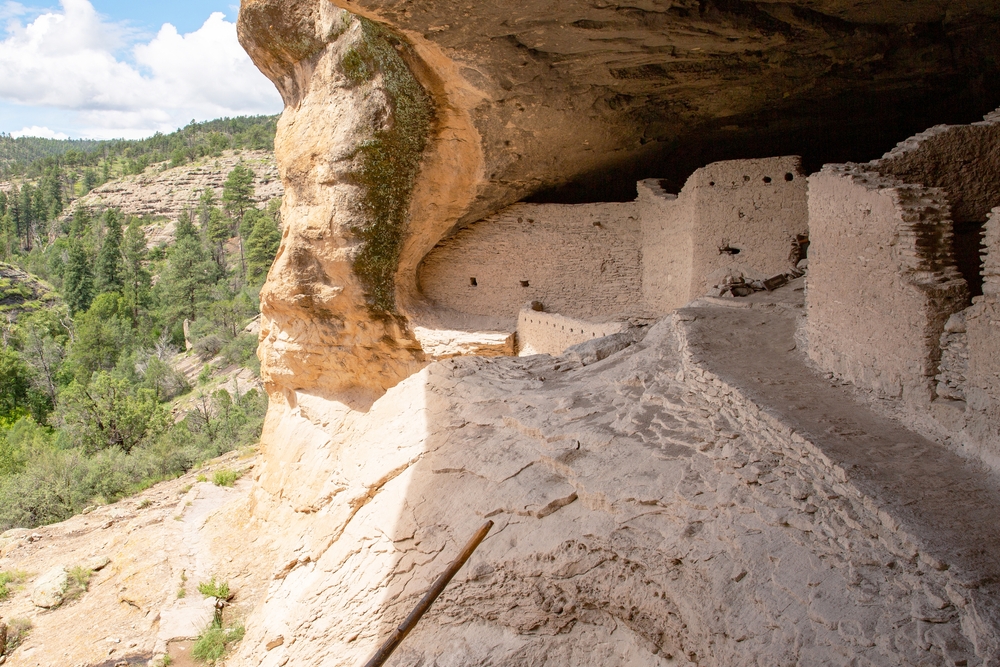
Situated within five natural caves carved into the canyon walls of southwestern New Mexico, the Gila Cliff Dwellings offer a glimpse into Mogollon culture and adaptation. Built around 1280 CE, these 42-room structures feature distinctive T-shaped doorways suggesting cultural exchange with northern Ancestral Puebloans.
Gila Cliff Dwellings National Monument sits at the end of a 44-mile mountain road in the Gila Wilderness, which means getting there requires real effort, and the crowds found at Mesa Verde or Chaco Canyon are largely absent. The Mogollon people who built these dwellings occupied them for only about 20 to 30 years before moving on; the reasons remain unclear. What they left behind are rooms still bearing the soot marks of their fires, hand-pressed mud walls, and ceilings darkened by smoke from hearths that haven’t been lit for 700 years.
The trail into the cliff dwellings involves a short, steep hike and then a walk directly through the cave rooms themselves. Standing inside a 700-year-old structure that still smells faintly of earth and time, it’s difficult to think of it as a museum piece. It feels like someone’s home, which, once, it was.
12. White Sands Human Footprints, New Mexico
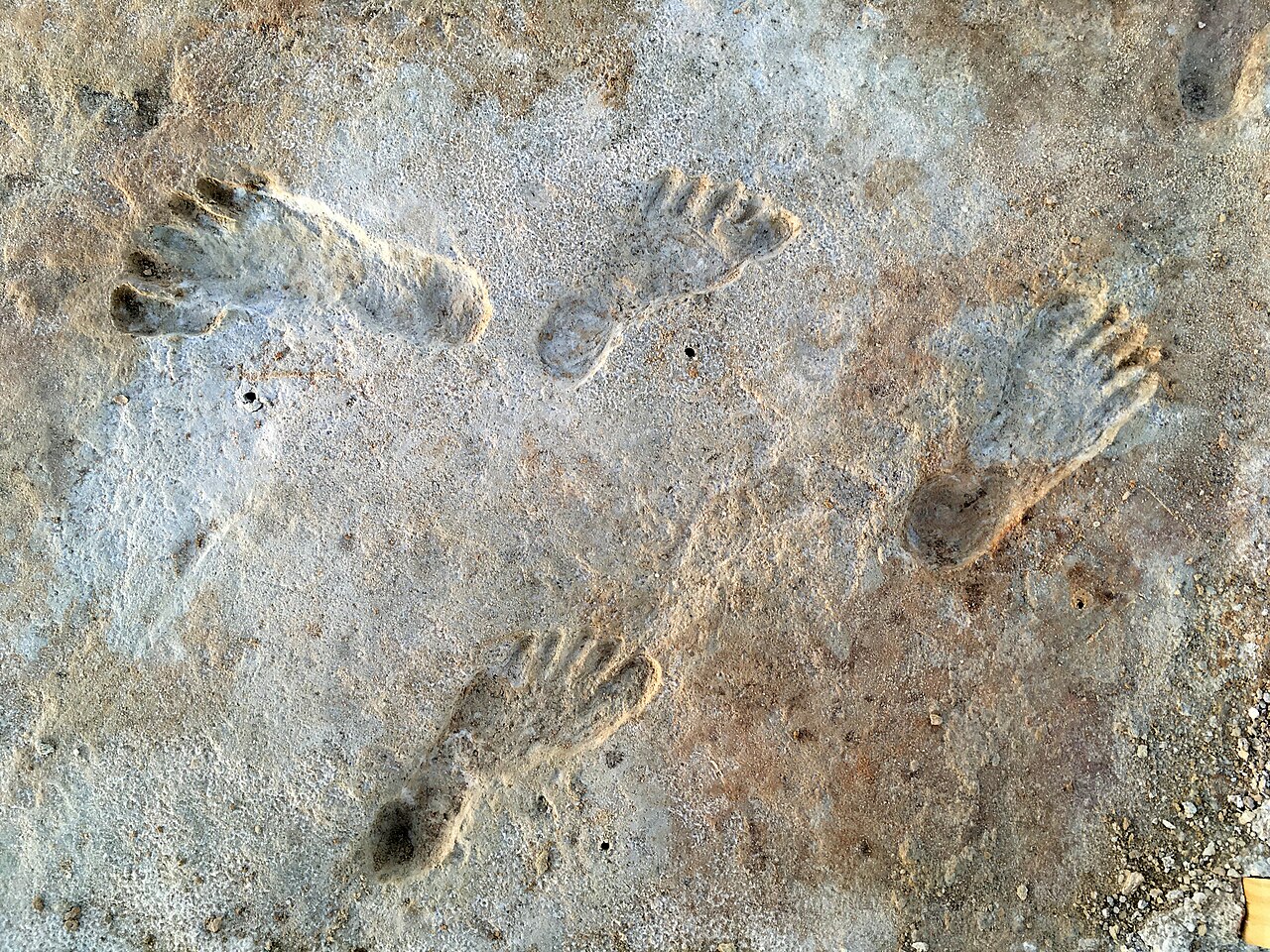
White Sands National Park contains fossils and fossilized footprints of creatures dating back up to 30,000 years, including mammoths and saber-toothed cats. In late 2020, archaeologists unearthed a set of human footprints around the shore of the ancient, now-evaporated Lake Otero. Research revealed them to be 21,000 to 23,000 years old, making them the oldest known human footprints in North America. Covering around a mile, it’s also the longest track of fossilized human footprints ever discovered, and they were made mostly by children and teenagers, including one child under three, whose prints show that these people crossed paths with mammoths and giant sloths.
The significance here is hard to overstate. Before this discovery, the dominant theory held that humans arrived in the Americas around 13,000 years ago. These footprints are nearly twice that age. They place humans in New Mexico at a time when the last ice age was still in full effect, and glaciers covered much of the continent’s northern half.
The footprints themselves are not visible to casual visitors – they are protected and studied by researchers – but White Sands is one of the most otherworldly places in the US, and knowing what lies preserved beneath that ancient gypsum is enough to change how you walk across it.
13. Moundville, Alabama
Moundville Archaeological Park, on the Black Warrior River near Tuscaloosa, preserves 326 acres of grounds. Visitors can follow a nature trail that weaves around the mounds, which were once topped with the homes of the local nobility and ceremonial structures.
Moundville was the second-largest Mississippian settlement in North America after Cahokia, and it was connected to Cahokia in ways that archaeologists are still documenting. Finely crafted artifacts from Cahokia, such as copper repoussé plates and engraved shell, appear in powerful polities such as Moundville and Etowah only after 1250 CE, evidence of a genuine exchange network spanning hundreds of miles.
At its peak around 1200 to 1450 CE, Moundville was home to several thousand people, with 29 platform mounds arranged around a central plaza. The Jones Archaeological Museum at the site houses some of the finest Mississippian-era artifacts in the country, including elaborate pottery and the iconic “Rattlesnake Disc,” a carved stone disc depicting a pair of rattlesnakes. The Black Warrior River still runs alongside the mounds, and the site is peaceful in a way that makes its former complexity easy to underestimate.
14. Etowah Indian Mounds, Georgia
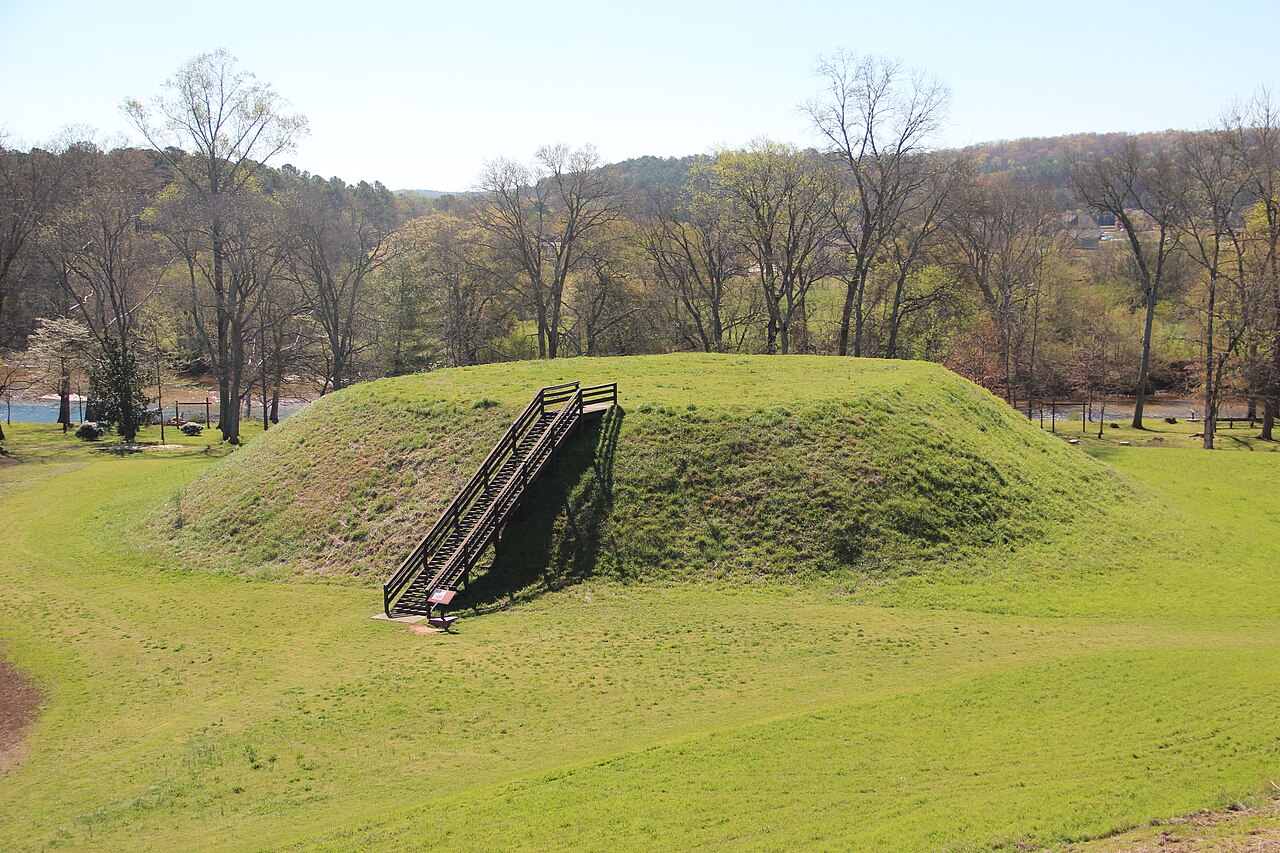
The Etowah Indian Mounds in Cartersville, Georgia, in the northwest of the state, are some of the best-preserved Mississippian culture sites in the Southeast. Three platform mounds rise over the Etowah River, the largest standing 63 feet high, with a ramp that visitors can still climb to the summit.
Etowah was occupied from roughly 1000 to 1550 CE, with periods of abandonment in between. Like Moundville and Cahokia, it was part of the broader Mississippian cultural network, one that archaeologists increasingly describe less as a collection of separate settlements and more as an interconnected civilization with shared religious iconography, trade goods, and architectural language.
The site’s museum holds one of the most extraordinary collections of Mississippian art anywhere in the US, including two marble human figures discovered in a burial mound in the 1950s. These figures, a man and a woman, both seated, their faces weathered but still composed, are among the most compelling objects in American archaeology. They were buried with their owners. That detail alone says something about how this culture understood the relationship between the living and the dead.
15. Lapakahi State Historical Park, Hawaii
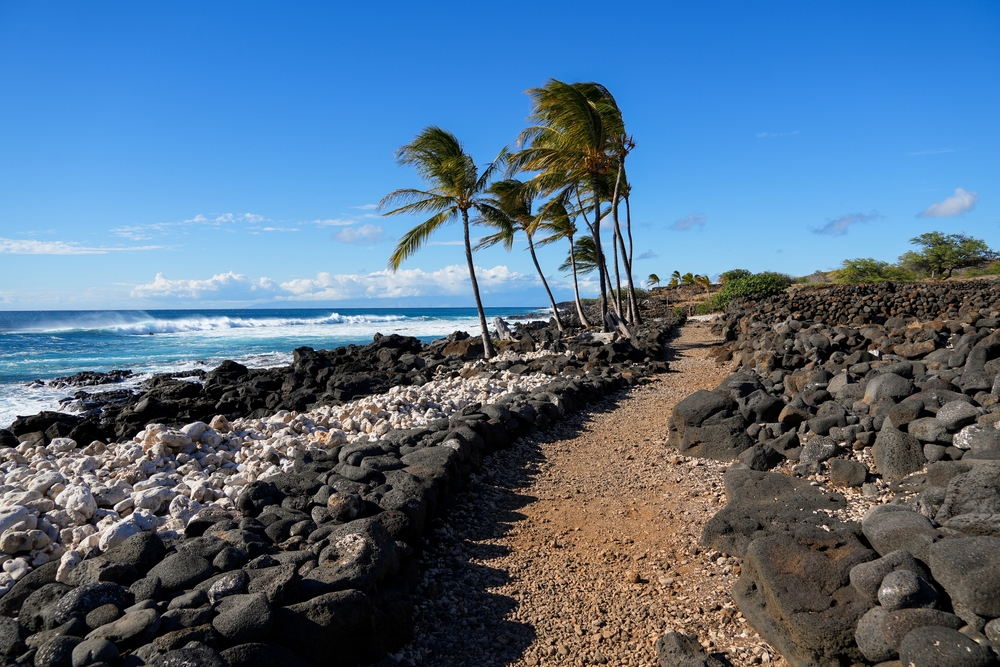
Archaeological sites are rarely more scenic than Lapakahi State Historical Park on the island of Hawaii’s North Kohala coast. The ancient fishing settlement is set against a backdrop of palm trees and shimmering blue waters and fringed by a striking beach with black and white stones.
Lapakahi was established around 1300 CE by Hawaiian settlers and occupied for approximately 500 years before being abandoned, likely due to a declining water supply. The settlement covered about one square mile and included housing, fishing shrines, canoe storage houses, game courts, and salt pans. It is one of the best-preserved examples of an ancient Hawaiian coastal community anywhere in the islands.
Visitors can follow a series of trails with information panels explaining the significance of structures like canoe storage houses, religious shrines, and an ancient burial site. The site is managed as a working cultural preserve, and fishing in the adjacent marine sanctuary is regulated to protect the area’s ecological and cultural integrity. Standing on the black stone path while the Pacific presses up against the shore a few feet away, Lapakahi makes a convincing case that the ancient wonders of the US don’t end at the continental shoreline.
Read More: 9 Travel Spots Where the Extreme Weather Is More Dangerous Than the Wildlife
The Deeper Story
The standard narrative of American history starts with European arrival. It’s a persistent habit of framing that makes everything before 1492 feel like prologue, background material, context, prelude. What these 15 sites push back against, collectively, is that framing. Cahokia was a metropolis when most European cities were still figuring out basic sanitation. The Ancestral Puebloans built apartment complexes, road networks, and astronomical observatories centuries before Columbus was born. The footprints at White Sands tell a story that begins not in the 15th century but 20,000 years before it.
None of this requires a flight to the other side of the world. Most of these sites are within a day’s drive of a major American city, many are free or nearly so to visit, and several are active living communities rather than frozen exhibits. That last part matters more than it might seem. Taos Pueblo isn’t a reconstruction. Canyon de Chelly still has families farming the canyon floor. The ancient wonders of the US are as real and as astonishing as anything else on earth. They’ve simply been underestimated, which is, in its own way, a continuing kind of erasure. Knowing they exist, and actually going to stand in them, is a small but genuine corrective.
AI Disclaimer: This article was created with the assistance of AI tools and reviewed by a human editor.