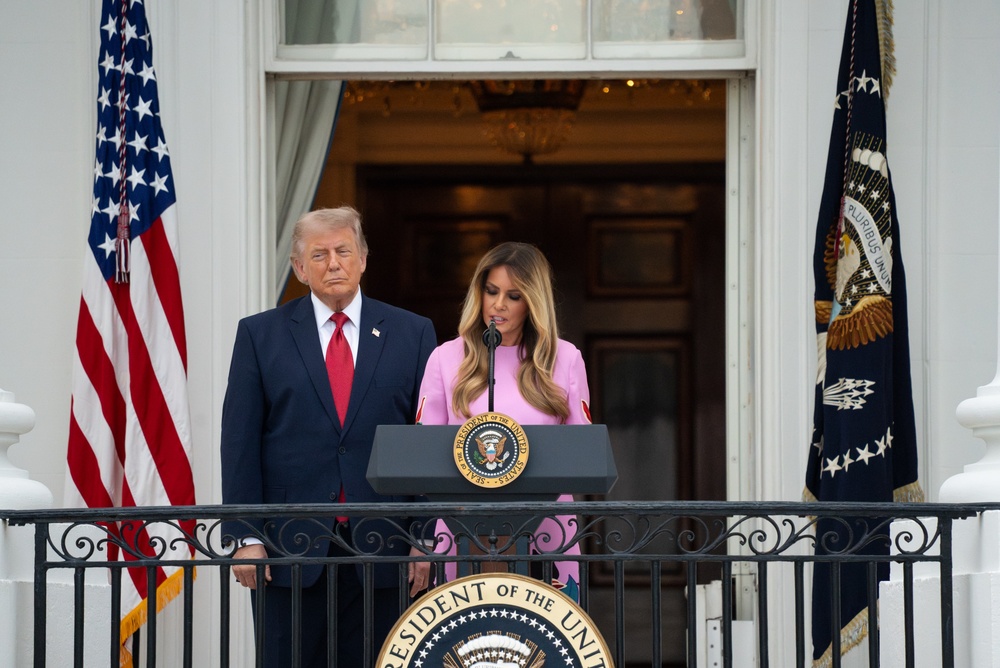

The email had been sitting in a federal archive for months, unremarked and unread, until it wasn’t. An October 2002 note, opening with “Dear G!” and closing “Love, Melania,” sent from a woman who would become First Lady to a woman who would later be convicted of trafficking. When that email surfaced on social media in early spring 2026, the resulting storm was swift enough to pull the most notoriously private First Lady in recent memory in front of the cameras for a rare statement that caught her own husband off guard.
It was an unusual moment by any measure. The First Lady walked to a podium in the Grand Foyer of the White House, read a prepared statement that apparently no one in the West Wing had been warned about, spoke for five minutes, and left without taking questions. The subject was Jeffrey Epstein. In an administration where public communications are typically coordinated to the minute, it was a striking departure.
The timing made it stranger. The Epstein story had been churning through the American news cycle for over a year at that point, fueled by one of the largest government document releases in recent history. The email itself wasn’t new. But for Melania Trump, that apparently was no reason to stay silent.
The Files That Started It
The Epstein Files Transparency Act is a law passed by the 119th United States Congress and signed by President Donald Trump on November 19, 2025. It requires the U.S. Attorney General to make all files pertaining to the prosecution of Jeffrey Epstein publicly available in a searchable and downloadable format, and to give the Judiciary Committees in both the House and Senate an unredacted list of all government officials and politically exposed persons named in the files.
On January 30, 2026, the Justice Department published over 3 million additional pages responsive to the Act, including more than 2,000 videos and 180,000 images, bringing the total production to nearly 3.5 million pages. The release was vast enough that the DOJ set up an age-gated online library just to host it. Notable individuals and politicians were not redacted in the release of any files.
Buried inside that archive, under the file designation EFTA02332411, was the Melania email. In early 2026, social media users identified an image that authentically showed an October 2002 email sent from Melania Trump, then going by Melania Knauss, to Ghislaine Maxwell. The message showed the future First Lady praising Maxwell and Epstein for appearing in New York magazine, telling Maxwell “you look great on the picture,” and expressing interest in traveling to Palm Beach, asking Maxwell to call her when back in New York. Snopes verified the email was authentic.
The files included a friendly email exchange between the two women where Melania Trump signed her message “Love, Melania,” and Maxwell responded, calling her “sweet pea.” Neither woman has faced any accusations of wrongdoing from law enforcement in connection with Epstein’s crimes.
The email alone might not have caused much of a stir, given how much material was in the archive and how many prominent names appeared across it. The escalation came from a combination of the email’s warm tone and social media accounts that framed it in ways Melania Trump considered misleading. The X account of Headquarters, a progressive content hub former Vice President Kamala Harris founded in February 2026, reposted the decades-old email on April 9, 2026. Other users shared it across Facebook, Threads, and X, often without context.
A Statement Nobody Expected
According to CNN’s reporting, the extraordinary remarks distancing herself from the late criminal offender were driven by her monthslong fixation on press coverage and internet speculation about her ties to Epstein. The First Lady’s dismay over the issue prompted her seemingly abrupt decision to publicly address it despite little apparent need to do so. “She was seeing these stories being amplified and wanted to respond,” one White House official said. Her lawyers also believed an on-the-record denial could be useful.
In the statement itself, Melania Trump addressed several specific claims directly. She stated: “I am not Epstein’s victim. Epstein did not introduce me to Donald Trump. I met my husband, by chance, at a New York City party in 1998.” She also stated that she is not a witness or named witness in connection with any of Epstein’s crimes, and that her name has never appeared in court documents, depositions, victim statements, or FBI interviews surrounding the Epstein matter.
On the email to Maxwell, her position was firm. Twice in her statement she characterized the email as a “reply,” insisting: “To be clear, I never had a relationship with Epstein or his accomplice, Maxwell. My email reply to Maxwell cannot be categorized as anything more than casual correspondence.” She added that it didn’t amount to anything more than a “trivial note.” The message does not read as a “reply,” and there is no evidence of an initial message from Maxwell preceding it. That discrepancy did not go unnoticed.
Melania Trump said Thursday that she was not friends with Epstein or Maxwell, but was in overlapping social circles in New York and Florida. She stated that the first time she crossed paths with Epstein was in the year 2000, at an event she and Donald attended together, and that at the time she had never met him and had no knowledge of his criminal undertakings.
The statement’s final section shifted tone entirely. Rather than continuing to rebuff claims, she turned the address toward Congress. She called on Congress to provide the women victimized by Epstein with a public hearing centered around the survivors, to give them the opportunity to testify under oath, and to permanently enter their testimony into the Congressional Record.
The Political Ripple
Those remarks immediately reverberated across the Republican Party, upending a news cycle dominated by highly anticipated efforts to negotiate a Middle East peace and dragging a saga her husband had been desperate to escape right back to the fore.
The First Lady’s decision underscored the remarkable independence she enjoys within the administration, where public statements are typically closely coordinated. Melania Trump has long operated largely apart from the rest of the White House, pursuing her own initiatives and only occasionally lending her voice to support the president’s broader agenda.
The call for congressional hearings landed with political force. Members of Congress from both parties rallied behind the call, with California Rep. Robert Garcia, the top Democrat on the House Oversight Committee, agreeing with the proposal for a public hearing and calling on Committee Chairman James Comer to “schedule a public hearing immediately.” On Friday, House Oversight Chairman James Comer committed to hold more hearings. According to Fox News, Comer told Sandra Smith: “I agree with the first lady. We will have hearings.”
Not everyone welcomed the statement, though. A group of Epstein survivors, including Danielle Bensky and Annie Farmer, as well as the late Virginia Giuffre’s relatives, dismissed the First Lady’s call for a survivor-focused public hearing. “Survivors of Jeffrey Epstein have already shown extraordinary courage by coming forward, filing reports, and giving testimony. Asking more of them now is a deflection of responsibility, not justice,” their statement read, adding that the First Lady’s remarks diverted attention from questions about the Trump administration’s handling of the Epstein Files Transparency Act.
A Year-Long Legal Fight
The April 9 statement wasn’t the first move Melania Trump made on this front. In the year prior, she launched legal challenges over claims made about her and Epstein, eventually winning retractions and apologies from The Daily Beast, HarperCollins Publishers, and Democratic strategist James Carville.
During the summer of 2025, Melania Trump and her lawyers began aggressively fighting back against several published claims that Epstein had helped bring the Trumps together. On July 31, The Daily Beast retracted and apologized for a story headlined “Melania Trump ‘Very Involved’ in Epstein Scandal: Author.” The story’s URL was scrubbed from the internet. On August 7, another retraction followed when the same allegation was made on a podcast by James Carville. HarperCollins became the third media enterprise to apologize and remove content related to the Epstein allegation.
The legal pressure was deliberate and methodical. Each retraction came after a letter from the First Lady’s attorneys, and each was treated by her team as vindication. What it didn’t do was stop the conversation online, where the same claims continued circulating on social platforms, unaffected by what traditional publishers had or hadn’t formally retracted. That gap between a legal win and a cultural one appears to be exactly what drove her to April’s White House address.
Read More: Melania Named in Bombshell New Epstein Claims
What to Make of All This
The Melania Trump statement of April 9, 2026 is genuinely hard to categorize. It was an act of self-defense that reopened a story the president had been calling a “hoax” and trying to move past. It was a legal argument delivered in a political format. And it ended with a call for action on behalf of Epstein’s survivors that some survivors immediately rejected as opportunistic.
The factual record is straightforward enough: Melania Trump has not been accused of any wrongdoing in connection with the Epstein investigation. The email is real. The social circle overlap is documented. And nobody has fully explained why a sitting First Lady felt the need to walk to a podium, address it herself, with her husband watching from a distance and her own staff unaware of what she planned to say.
A 2002 email that opens “Dear G!” and ends “Love, Melania” doesn’t prove anything about what she knew or when she knew it. But it was enough to make the First Lady of the United States feel she had no choice but to stand in front of cameras and explain herself in unusually personal terms, for someone known for keeping the world at arm’s length. Some stories don’t end when you think they do. This one, by all appearances, is still going.
AI Disclaimer: This article was created with the assistance of AI tools and reviewed by a human editor.