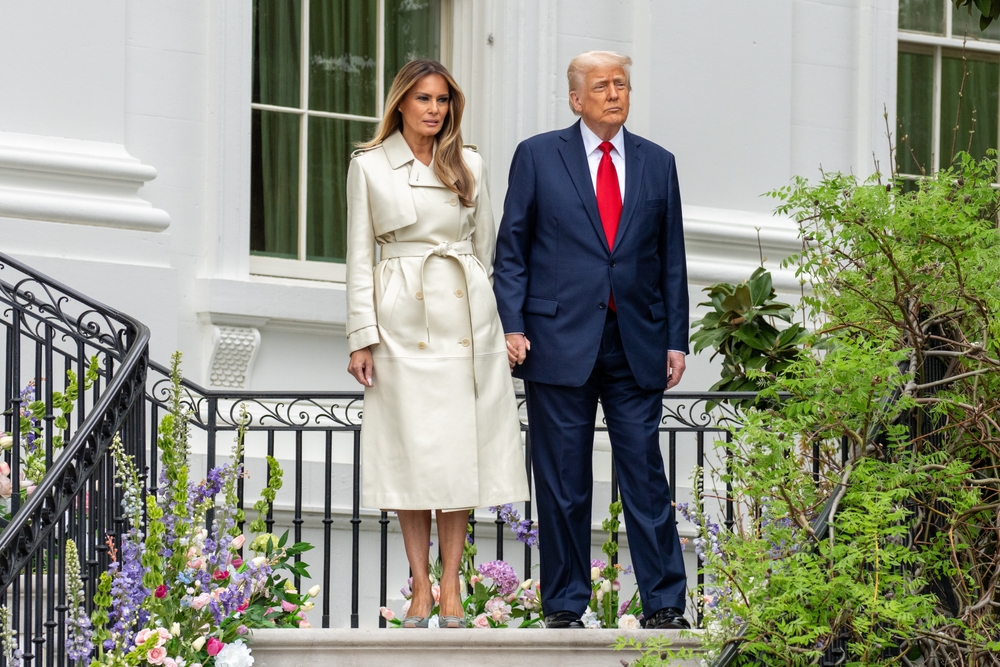

The story of how Melania Trump met her husband has been told the same way for nearly 28 years. A September 1998 party. A Fashion Week crowd. A modeling agent who pulled the two together and stepped aside. It’s the kind of origin story that gets written into memoirs and repeated at campaign rallies, and for most of that time nobody with firsthand knowledge had seriously pushed back on it. Then, on June 1, 2026, a recorded WhatsApp message posted to X by a former Brazilian model changed that.
Former Brazilian model Amanda Ungaro dropped the allegation on a taped recording, accusing her ex-partner, modeling agent-turned-presidential envoy Paolo Zampolli, of lying about introducing Melania and Donald Trump at a party in 1998. In the recording, Ungaro addresses Zampolli directly and makes a claim that, if true, would rewrite one of the most-told stories in American political life: that Jeffrey Epstein, not Zampolli, was the one who introduced the future first lady to the future president, and that Melania was working as Epstein’s escort at the time.
The recording didn’t stay online long. It was later deleted from Ungaro’s X account. But by then it had already spread, screenshot and reshared, and the questions it raised weren’t going anywhere.
What Ungaro Actually Said
The recording is a WhatsApp message, apparently addressed to Zampolli, in which Ungaro lays out her version of events. In the now-deleted video posted on X, Ungaro accused her ex-partner of lying about having introduced Melania and Donald Trump at the party, and alleged the future first lady was an “escort” tied to Jeffrey Epstein who actually met Trump through the late convicted criminal. Her claim rested on something she said Zampolli had told her privately, repeatedly, over the course of their two-decade relationship: that the introduction was never his to claim.
She added that Zampolli had privately told her for years that he was not the one who arranged the introduction. The recording was first published on X by independent journalist Anthony Andrews, who stated he shared the media file at Ungaro’s direct request. Andrews later noted that Ungaro asked him to take it down, but by then copies had already spread across multiple social platforms.
Ungaro’s history with this story goes back years. In 2002, when she was just 17, she arrived in New York on Epstein’s private jet alongside her agent, Jean-Luc Brunel, who was also identified as a recruiter for Epstein. That same year, Ungaro met Zampolli, then 32, at a Manhattan nightclub, where he recruited her as a modeling client, encouraged her to move to the United States, and began a relationship that produced a now-16-year-old son. Over the years, the pair moved in the same social circles as Donald and Melania Trump and were repeatedly photographed alongside the couple at Mar-a-Lago events. During Trump’s first administration, Ungaro served as Grenada’s ambassador to the United Nations, while Zampolli was appointed ambassador to Dominica.
The relationship ended badly. In 2025, Ungaro was arrested in Florida for conducting unlicensed cosmetic surgery procedures and was subsequently deported from the United States, after Zampolli allegedly asked a senior Immigration and Customs Enforcement official to detain her, in an effort to gain sole custody of their son. Zampolli and the Department of Homeland Security have denied those allegations. The custody battle is still ongoing.
The FBI Document That Changes the Weight of the Claim
Ungaro’s recording would be easier to dismiss if it existed in a vacuum. It doesn’t. A one-time assistant to Jeffrey Epstein told the FBI, effectively under penalty of perjury, that he introduced Donald Trump to his wife Melania, a newly released document shows. The unnamed woman, a former model who worked as Epstein’s assistant for a year from 2005 to 2006, made the claim in July 2019, three days after her old boss was arrested by the FBI and charged with child trafficking.
The bombshell claim about the couple’s origin story appeared in an FBI record dated November 2019, which details a July interview with a woman whose name was redacted and who was given immunity to speak. An FBI document from 2019 includes an unnamed woman’s claim that “Epstein introduced Melania Trump to Donald Trump.”
The same witness said Zampolli and Epstein had been trying to buy French modelling agency Elite Models together and that Epstein visited Zampolli’s agency during casting auditions to review model portfolios. The 11-page document was released as part of the Department of Justice’s Epstein disclosures earlier this year.
The White House pointed to a previous warning from the Justice Department that the Epstein files may contain untrue information. “This production may include fake or falsely submitted images, documents or videos,” the department’s January press release stated. “Some of the documents contain untrue and sensationalist claims against President Trump that were submitted to the FBI right before the 2020 election. To be clear, the claims are unfounded and false.”
That caveat matters. The FBI document is a proffer interview, meaning the witness was given immunity in exchange for cooperation. It is not a verified finding of fact. It is one person’s account, given under conditions designed to encourage candor, but not independently corroborated. The document itself is heavily redacted, and the Epstein files as a whole contain a significant amount of unverified material submitted by members of the public.
Zampolli’s Position, and the Complicated Overlap With Epstein
For its part, Zampolli’s response to the recording was swift and unambiguous. Zampolli told reporters the claims were “a disgrace” and said he was “truly concerned for her health,” adding that he thought Ungaro “truly needs some therapy.” On X, he claimed that “most of the content coming from Amanda is AI-manipulated” and stated that his legal team was monitoring the situation.
Zampolli’s own account of the 1998 meeting has been consistent for decades. On a scouting trip to Milan in 1995, he met model Melania Knauss. In 1996, he sponsored her immigration to the United States via an H-1B visa, having by then founded his own modeling agency, ID Model Management. Knauss moved into Zampolli’s building at Zeckendorf Towers, and Zampolli introduced her to Trump at a September 1998 party. He has offered to repeat that version of events under oath. “Even without an attorney, I’m volunteering to go to Congress to testify about this, because we have seen enough nonsense,” he told reporters. “I said: ‘Melania meet Donald, Donald meet Melania,’ and then I left the table because I had 300 guests.”
Reading Ungaro’s claim as straightforward fabrication by a disgruntled ex is hard to square with one fact: Zampolli’s own connection to Epstein is a matter of public record. Epstein patronized Zampolli’s ID Model Management and was a partner in Zampolli’s 2004 bid to purchase Elite Model Management. Zampolli’s name also appears in the Epstein files multiple times, including one document from 2020 that contains an FBI interview with an alleged Epstein victim who used to be one of the models at his agency.
In 2020, Trump named Zampolli to the Kennedy Center’s board of trustees. In March 2025, during the second Trump administration, Zampolli was named special envoy for global partnerships, in which capacity he has represented the United States in varied settings. Ungaro alleged that Zampolli had been “covering” for Melania Trump, and vice versa, after he was appointed to a government position.
Melania’s April Statement, and What It Did and Didn’t Explain
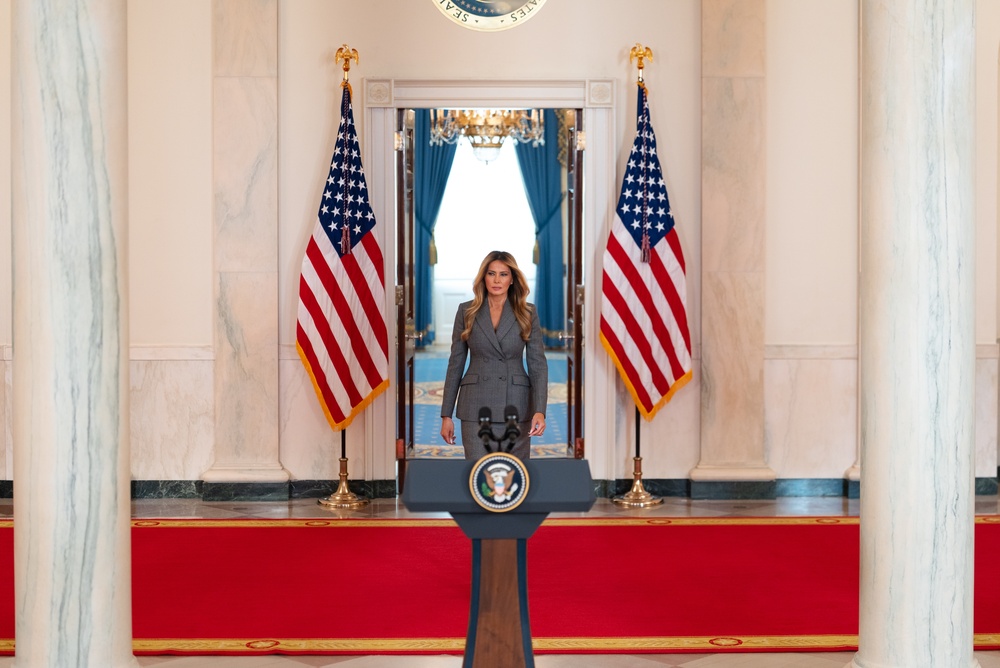
Weeks before Ungaro’s recording went public, the first lady had already stepped, unusually, into the middle of this story herself.
Melania Trump made the public statement from the White House in front of cameras on April 9 and did not take any questions from reporters. In that rare public address, she denied “lies linking me to the disgraceful Jeffrey Epstein,” said she was not a “victim” of the convicted trafficker, and denied having any knowledge of crimes committed by Epstein and his accomplice Ghislaine Maxwell.
Her statement was specific on one point in particular: “I am not Epstein’s victim. Epstein did not introduce me to Donald Trump. I met my husband, by chance, at a New York City party in 1998. This initial encounter with my husband is documented in detail in my book, ‘Melania.'”
It was not clear at the time what had prompted the first lady to make her statement, which even seemed to catch the president by surprise. According to CNN’s reporting, the extraordinary remarks were driven by her monthslong fixation on press coverage and internet speculation about her ties to Epstein, with even her husband saying later that day he hadn’t known about them in advance. The first lady asked Congress “to act” and hold public hearings allowing Epstein victims to testify. “Epstein was not alone,” she said. “I call on Congress to provide the women who have been victimized by Epstein with a public hearing specifically centered around the survivors. Give these victims their opportunity to testify under oath in front of Congress.”
That call prompted a mixed response from Epstein survivors themselves. Some welcomed the sentiment, while others pushed back. A group of 15 survivors of Epstein’s abuse released a statement saying that the first lady was “shifting the burden” onto survivors to protect people with power, including the Department of Justice and law enforcement.
The Epstein Files and the Limits of What We Actually Know
On January 30, 2026, the DOJ published over 3 million additional pages of Epstein documents, along with 180,000 images and 2,000 videos, under the Epstein Files Transparency Act, which President Trump had signed into law on November 19, 2025. Combined with prior releases, that brought the total production to nearly 3.5 million pages. The House had passed the Act, the Senate unanimously approved it, and Deputy Attorney General Todd Blanche stated the January release marked full compliance. The following month, the DOJ released a relatively small number of files initially, drawing criticism from both major parties. Faulty redaction techniques in the December 2025 release allowed members of the public to recover blacked-out content, revealing information officials had intended to withhold. Social media users discovered that blacked-out text in certain documents could be revealed by copying and pasting it into another application.
The files are voluminous and, by the Justice Department’s own admission, uneven in reliability. No single, independently corroborated contemporaneous document in the released archive settles the contradiction between Zampolli’s long-standing account and the FBI proffer interview that names Epstein as the one who made the introduction. The files include statements and emails touching on the question, but none that closes it.
Ungaro’s own credibility comes with its own complications. She is currently in a bitter legal dispute with Zampolli, has been deported from the United States, and is fighting for custody of her son. Her claims, though currently unverified, dispute Melania’s account that she met Donald Trump at a party at the Kit Kat Club in 1998. The recording has since been deleted, and the White House has not issued a response directly addressing Ungaro’s allegations.
The allegations in the recording have not been confirmed by any official investigation. The White House has not expanded on its earlier position, while Zampolli has indicated legal action may follow against those repeating the claims.
Read More: Prison Guards Bombshell Testimony Deepens Epstein Mystery
The Part That Doesn’t Resolve Neatly
Two competing accounts of a single moment in 1998, and the people who were allegedly present are contradicting each other in ways that are unlikely to be settled by more social media posts.
What gives the Epstein claims Melania denies a different weight than ordinary political mud is the combination of factors: a witness who gave her account to the FBI under a proffer agreement in 2019, a former modeling industry insider with two decades of proximity to the same social world, and a government figure now inside the Trump administration whose ties to Epstein are documented in the same files he says exonerate everyone involved.
None of that is proof. It’s also not nothing. Multiple contemporaneous accounts and later profiles repeat Zampolli’s role as the one who made the introduction, but the newly surfaced FBI document sits alongside them without being resolved by them. The most reliable path to any resolution would be formal testimony under oath, with subpoenas or congressional hearings and contemporaneous witnesses needed to move the question from competing narratives to verified history.
Zampolli has volunteered to testify. Melania has called for congressional hearings. The two accounts of that 1998 party have been sitting next to each other for months now, and neither has moved. Some contradictions in documented history don’t get resolved because everyone with direct knowledge has a reason to tell a particular version. That’s not a satisfying place to land, but it’s where this one actually sits.
AI Disclaimer: This article was created with the assistance of AI tools and reviewed by a human editor.