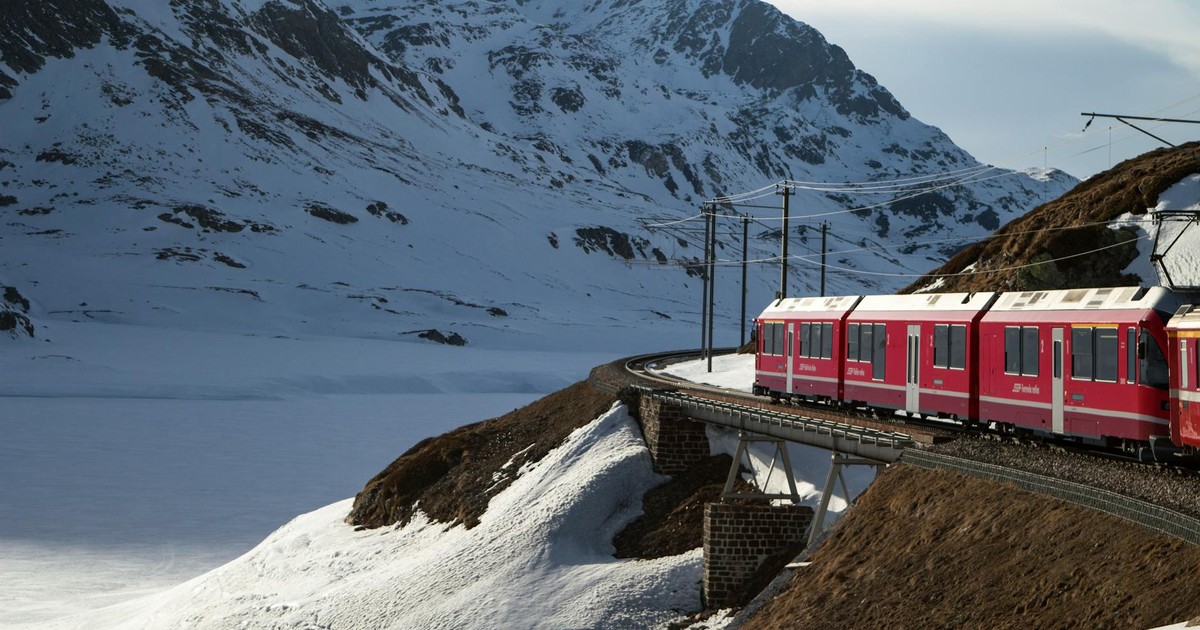

Flying has its conveniences, but anyone who has sat in a middle seat at 35,000 feet, squinting at a tiny oval of sky, knows what gets lost in the transaction. You see nothing. You arrive somewhere without having traveled anywhere. The train is the antidote to that. It puts the country back in front of you, one river bend, one mountain pass, and one canyon wall at a time.
Rail travel in the United States is having a genuine moment right now. Amtrak welcomed 32.8 million passengers in fiscal year 2024, the highest ridership in the service’s history and a 15 percent increase from the year before. That’s not a blip. People have been quietly working something out: that the journey itself can be the point. And when the journey takes you through Glenwood Canyon at dawn, or along the Pacific Coast with nothing but ocean outside your window, or up into the Rockies on a 140-year-old steam locomotive, the destination almost becomes secondary.
This is a guide to the ten scenic train rides in the US that are worth planning a trip around. Some are Amtrak long-hauls where you’ll want to book a sleeper car and settle in for days. Others are short excursion railways where a few hours in an open-air car will leave you more stunned than a week at a resort. All of them will make you put your phone down.
1. The California Zephyr (Chicago to San Francisco)
If you only ever take one long train ride in America, this should be it. The California Zephyr is widely considered the most scenic Amtrak route, offering Rocky Mountain, Sierra Nevada, and Colorado River views. It’s the kind of train where passengers gather in the observation car at sunrise and nobody speaks for twenty minutes because there’s nothing to say.
The California Zephyr covers over 2,400 miles from Chicago to Emeryville, California, taking approximately 52 hours. That sounds like a long time until you’re watching the train claw its way through Glenwood Canyon with the Colorado River thundering below, and you realize you’ve barely moved for an hour because you can’t stop looking.
In those 52 hours, you cross Iowa’s rolling hills, Nebraska’s endless plains, Colorado’s mountains, Utah’s red-rock canyons, Nevada’s pristine deserts, and finally California’s alpine lakes. The stretch of track between Reno and Sacramento is part of the original transcontinental railroad, constructed during the Civil War. Book a roomette if the budget allows. The glass-dome observation car is magnificent during the day, but falling asleep to the Sierra Nevada and waking up in Sacramento is an experience that’s hard to put a price on.
2. The Coast Starlight (Seattle to Los Angeles)
The Coast Starlight has been shuttling riders along the Pacific since Amtrak launched in 1971, and it remains one of the railroad’s most beloved trains. The observation car offers panoramic views of waves crashing along the Pacific Ocean coastline, San Francisco’s Golden Gate Bridge blanketed in fog, lush vineyards in the Willamette Valley, and the snow-capped Cascades.
Running from Seattle to Los Angeles via Portland and the San Francisco Bay Area, the Coast Starlight passes through towering redwood forests and the Cascade Range. Mount Shasta makes a brief, dramatic appearance, and the stretch through coastal Oregon is particularly striking, with the train edging so close to the ocean that the windows mist with salt air.
The sheer variety of what you pass through in a single journey is what sets this route apart even among great train routes. In the space of one trip, you go from Pacific Northwest rainforest to California wine country to high desert. It’s also one of the better options for overnight travel, requiring just one night on the train. That’s a useful detail for anyone who loves the idea of a sleeper train but isn’t quite ready for a three-night commitment. If you’re curious how long-haul train travel compares to road trips for seeing the country, the Starlight makes a strong case for the rails.
3. The Empire Builder (Chicago to Seattle/Portland)
The Empire Builder is Amtrak’s most popular long-distance train. Anyone who has taken the northern route out of Chicago and watched the landscape transform from the flatlands of Wisconsin into the dramatic river country of Minnesota, then into the vast open skies of North Dakota, can tell you why it keeps drawing people back.
The Empire Builder connects Chicago to the Pacific Northwest, splitting at Spokane to serve either Portland, Oregon, or Seattle. It moves across the Northern Plains before entering Montana, where the mountains begin to rise without warning. The passage through Glacier National Park is something most passengers remember for years: narrow valleys, river crossings, and ridgelines that look like they were drawn by hand. Heading west to Portland, passengers pass sights like Bad Rock Canyon near Columbia Falls, Montana.
The Empire Builder runs year-round, and each season changes the experience completely. Fall turns the Montana forests copper and gold. Winter covers everything in white and empties the observation car, which is your gain. Spring brings the thaw and the rivers run loud and fast. This is one of those routes where regulars say they’ve ridden it six times and still see something new.
4. The Cumbres & Toltec Scenic Railroad (Antonito, CO to Chama, NM)
The Cumbres & Toltec is a National Historic Landmark that moves, a completely authentic steam railroad that has run through the Rocky Mountains since 1880. This railroad was built to haul silver ore out of the Colorado mountains, and it still runs on the same narrow-gauge tracks, through some of the same wilderness, with the same coal-black smoke billowing into the same sky.
At 64 miles in length, it is the longest, highest, and most authentic steam railroad in North America, traveling through some of the most spectacular scenery in the Rocky Mountain West. Owned jointly by the states of Colorado and New Mexico, the train crosses state borders 11 times, zigzagging along canyon walls, burrowing through two tunnels, and steaming over the 137-foot Cascade Trestle.
The route climbs to over 10,000 feet at Cumbres Pass, and from there the views stretch for what genuinely feels like forever. This is high-altitude western wilderness that most people have never seen, and the train is the only practical way in. Note for 2026 planning: due to severe drought conditions and elevated wildfire danger, the Cumbres & Toltec postponed the start of its 2026 operating season until June 9. Check current conditions before booking, and pack a layer regardless of the summer date, because at 10,000 feet, the weather has its own schedule.
5. The Durango & Silverton Narrow Gauge Railroad (Durango to Silverton, CO)
Voted the No. 1 scenic train in North America by USA Today readers in both 2021 and 2022, this 1880s coal-fired, steam-powered locomotive runs 200 feet above the blue-green waters of the Animas River. As the train snakes along the river’s banks and high canyon walls, expect views of majestic peaks, rushing waterfalls, and remote natural areas like the Animas Gorge and San Juan National Forest.
The Durango & Silverton Narrow Gauge Railroad uses the same tracks miners, cowboys, and settlers used more than 100 years ago in southwestern Colorado. The train hugs ledges above the Animas River that would make a nervous driver sweat, and the canyon walls close in tight enough that you feel the spray from the river below. It’s one of the few train rides in America where the word “thrilling” is actually the right word.
The 9.25-hour round trip includes a two-hour stop in the town of Silverton, or there’s an express option at 5.25 hours if you’re short on time. The train runs year-round. During summer months, the railroad also offers a rare bonus: backpackers, day hikers, and anglers can get on and off mid-route to access the San Juan National Forest and Weminuche Wilderness, turning the train into a trailhead shuttle for some of the most remote terrain in the Rockies.
6. The Alaska Railroad Denali Star (Anchorage to Fairbanks)
Most scenic train rides involve competing for views with the highway running alongside you. The Denali Star doesn’t have that problem, because for much of its journey, there is no highway. Between the birch forests, rushing rivers, caribou and bear spotting, and a stint through Denali National Park, the Alaska Railroad’s flagship route covers over 350 miles from Anchorage to Fairbanks in about 12 hours. If you can swing it, splurge on a GoldStar upgrade, which puts you in a glass-dome car with an outdoor upper-level viewing platform, the only one of its kind in the world, with absolutely nothing between you and the wild.
Denali itself is 20,310 feet tall, and on a clear day you can see it from well over 100 miles away. The GoldStar dome cars have glass ceilings as well as the outdoor platform, which turns the whole journey into something close to a moving nature documentary. If you’re planning a trip to Alaska, this should be on the itinerary before almost anything else.
7. The Grand Canyon Railway (Williams to Grand Canyon, AZ)
Amtrak’s Southwest Chief runs its cross-country route from Chicago to Flagstaff, and from there passengers can board the 120-year-old Grand Canyon Railway on its route to the South Rim. That combination, cross-country train to historic railway to one of the most dramatic geological formations on earth, is a two-stage journey that deserves serious consideration.
The Grand Canyon Railway runs 65 miles from the small town of Williams, Arizona to the South Rim of the Grand Canyon. What starts as high desert scrubland gradually opens into a landscape that has stopped visitors cold for centuries. The train deposits you at the Grand Canyon Village on the South Rim, where you can walk the rim trail, peer over the edge, and spend however long you need before the return trip. The whole round trip takes about four hours on the train plus your time at the canyon, making this one of the more manageable excursion railways on this list.
The railway has operated continuously since 1901, which makes it one of the oldest tourist railroads still running in the country. The coaches range from standard to first-class dome cars with 360-degree views, and the train includes live entertainment on board.
8. The White Pass & Yukon Route (Skagway, AK)
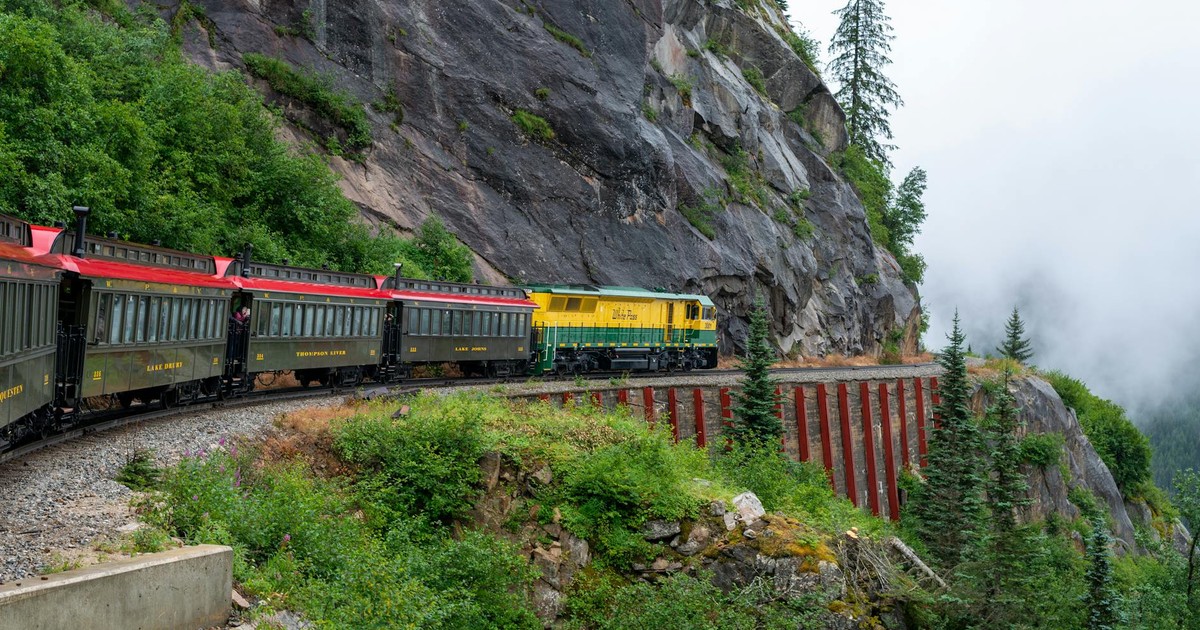
Steep cliffs, wildflowers, and a Gold Rush backstory make this narrow-gauge railway Alaska’s most dramatic rail ride. According to Travel Alaska, the White Pass & Yukon Route was built in 1898 during the Klondike Gold Rush to serve as a transportation route into the Yukon Territory, and it remains one of the most audacious pieces of railway engineering in North American history. Departures start in Skagway, with the railway hugging the steepest edges of the Coast Mountains.
The route climbs nearly 2,900 feet in just 20 miles, which means the views change with a speed that is almost disorienting. One moment you’re in the narrow streets of Skagway; 45 minutes later you’re on an exposed ledge above a mountain gorge with a sheer drop to your left and a granite wall to your right. The best seats are on the left side of the train heading north, but the views are so relentless that it’s hard to look at the wrong thing. For those arriving by cruise ship in Skagway, this is the excursion worth booking before everything else on the shore excursion list.
A trip that pairs well with solo travel through Alaska or the American West – the train does the work, and all you have to do is look.
9. The Napa Valley Wine Train (Napa to St. Helena, CA)
Not every great scenic train ride requires mountain passes or wilderness. The Napa Valley Wine Train lets you wine-taste your way through California’s famous vineyards against a backdrop of rolling hills, with daily lunch and dinner departures from a restored vintage train.
The train runs a 36-mile round trip through Napa and Sonoma wine country. The scenery is rows of vines, weathered barn wood, oak trees, and the long, golden light that makes this part of California look like a painting regardless of the season. Picture-perfect wineries and hills carpeted in lush rows of vines make this one of those routes where the scenery alone earns the ticket price.
The restored 1915 Pullman cars have been converted into dining cars with white tablecloths and windows wide enough to take in the full vineyard panorama. Wine pairings, multi-course meals, and a pace slow enough to actually taste what’s in your glass make this a very different kind of train day than the wilderness excursions above. It’s the one to book when you want all the pleasure of scenery without the gear list.
10. The Great Smoky Mountains Railroad (Bryson City, NC)
The departure point, Bryson City, is rich with local gems like barbecue joints, a soda fountain, and breweries. The Great Smoky Mountains Railroad’s 4.5-hour Nantahala Gorge excursion snakes along the forested Nantahala River and crosses Fontana Lake by bridge.
The Smokies have a particular quality to their light: misty in the morning, deep green in the afternoon, golden at the edges of the trees at dusk. The railroad runs right through the middle of it, following the Nantahala River through a gorge where the rapids run white and the tree canopy closes over the tracks in summer. It’s a route that feels more intimate than the western epics on this list, less about scale and more about the specific texture of southern Appalachia.
The train operates year-round, and the fall color run (typically October through early November) sells out well in advance. The railroad also offers themed rides, including an autumn leaf excursion with a riverside stop, a murder mystery dinner train, and a raft-and-rail combination trip that puts you on the Nantahala River by water before returning by rail. This is an easy recommendation for anyone planning a trip to western North Carolina or the Great Smoky Mountains National Park.
Read More: 25 Must-Visit Travel Destinations for 2025
The Case for Going Slower
Train travel in the United States is drawing more passengers than ever, with Amtrak’s record 32.8 million riders in fiscal year 2024 confirming what people who love trains have known for a long time. But numbers only tell part of it. What they don’t capture is the specific quality of attention that train travel encourages. You’re not driving, so you’re not watching the road. You’re not at 35,000 feet where there’s nothing below but cloud. You’re at ground level, at human speed, watching the country go past in real time.
The ten routes on this list cover an enormous range: two-hour excursions on century-old steam engines, two-night cross-country marathons, luxury wine country lunch trains, and wilderness railways that go places no road reaches. What they share is the thing that made train travel compelling in the first place: the experience of being somewhere between where you started and where you’re going, and finding that in-between worth something on its own.
Some trips are worth taking for the destination. These are worth taking for the window. And if that sounds like a small thing, wait until you’re watching the sun come up over the Colorado Rockies from a glass-domed car with a coffee in your hand. It doesn’t feel small then.
AI Disclaimer: This article was created with the assistance of AI tools and reviewed by a human editor.