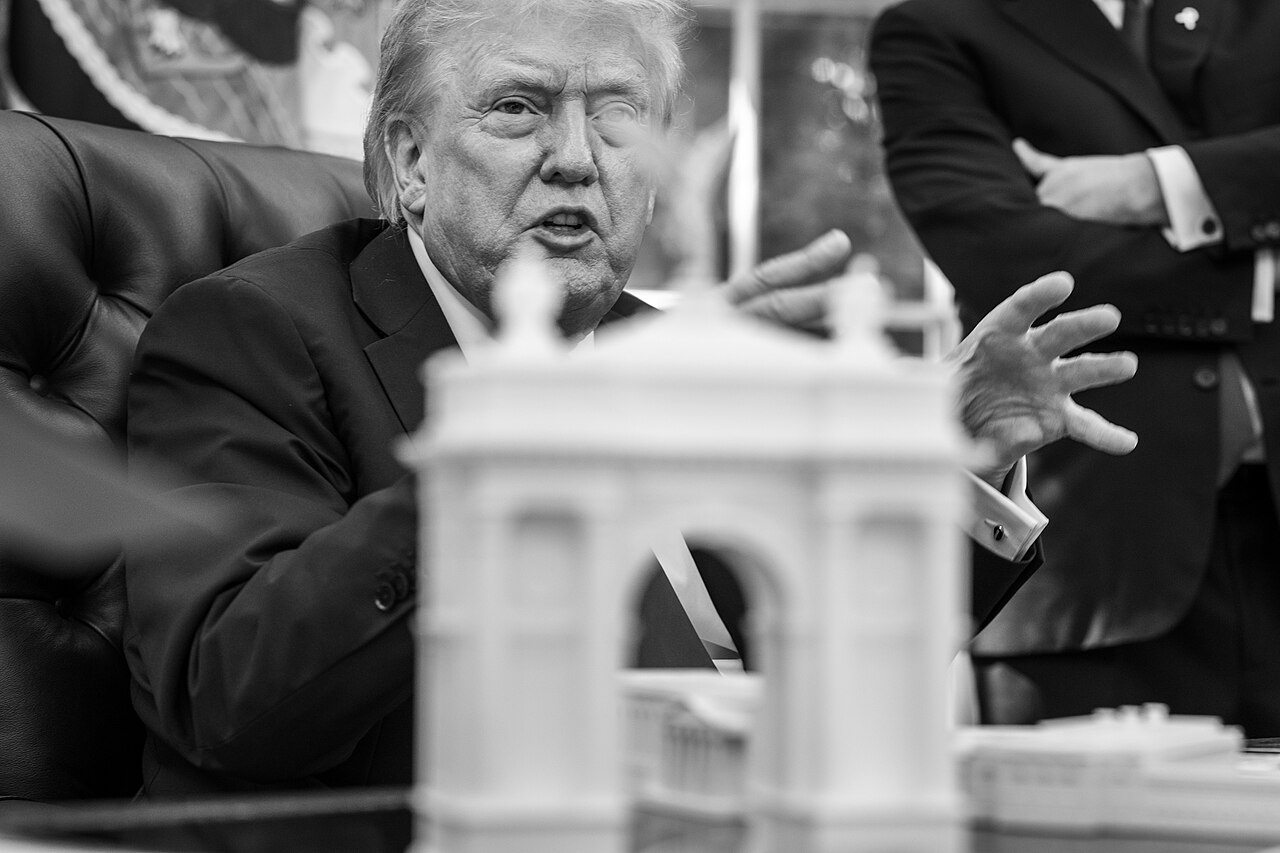

When President Trump placed a small-scale model of a triumphal arch on the Resolute Desk in October 2025, it read like a prop from a West Wing fever dream. A few months later, that model has become a 250-foot construction project that has lawyers, veterans, preservationists, and now House Democrats all lined up against it. The arch is real, the funding is real, and if you’ve been following the story, you already know that “arc de Trump” is not a joke invented by late-night writers. It’s what people are actually calling it.
The speed at which this has moved is part of what makes it so jarring. From a fundraising dinner centerpiece to approved architectural drawings to survey crews staking pink flags in the grass at Memorial Circle, the whole thing has happened in barely seven months. And now, with a Democratic bill formally introduced in Congress and a federal lawsuit working its way through the courts, the Trump triumphal arch has become one of the more genuinely contested political fights of 2026.
Here is where things stand, and why the argument over one monument has pulled in questions about federal law, congressional authority, and what exactly the president is allowed to build on public land without asking anyone.
What the Trump Triumphal Arch Actually Is
The project, formally dubbed the Triumphal Arch, is designed to stand 250 feet tall and is modeled after the Arc de Triomphe in Paris, with its height chosen to honor America’s 250th anniversary. Trump has his eye on Memorial Circle, a traffic roundabout near Arlington National Cemetery, where he says the structure will serve as an entrance to the nation’s capital.
The structure would rise at Memorial Circle on Columbia Island between the Lincoln Memorial and Arlington National Cemetery. At 250 feet tall, the arch would dwarf the Lincoln Memorial at 99 feet, the White House at 70 feet, and even Paris’s Arc de Triomphe at 164 feet. When a CBS News reporter asked Trump who the arch is for, he said: “Me.”
The proposed arch is topped with two golden eagles and a winged, crowned figure reminiscent of the Statue of Liberty, with the words “One nation under God” on one side and “Liberty and justice for all” on the other. The design has been through several revisions already. Architects removed four large gold lion statues that had previously flanked the base of the structure, after critics pointed out that lions are not native to the United States, and simplified portions of the surrounding plaza while stripping away several layers of exterior ornamentation. What they did not remove, despite at least one commissioner’s recommendation: three golden statues atop the arch that add more than 80 feet to its overall height, which Trump personally rejected cutting. Removing them would have brought the arch down from 250 feet to 166 feet.
The Commission That Said Yes, Over Objections From Nearly Everyone Else
The U.S. Commission of Fine Arts voted to approve the design for the triumphal arch, a key step in the project’s process. Commissioners, all appointed by Trump, acted despite overwhelming public opposition to the 250-foot arch.
The fine-arts commission received about 1,600 public comments on the planned arch ahead of the hearing, with more than “99.5 percent” of them opposed to the project, according to a staff review presented by the commission’s secretary. The commission approved it anyway, voting 4-0. Commissioners said they wanted to see more details on potential sculptures added to the arch before voting to approve the project, and it was just enough to maintain a quorum for the seven-member commission.
Trump has packed both the Commission of Fine Arts and the National Capital Planning Commission with allies, putting his executive assistant and other political appointees on the fine-arts commission and installing his staff secretary as leader of the planning commission. Outside experts criticized the commission’s process, noting that reviews of major projects traditionally stretched months or years and involved more intense feedback from the commission’s experts, a precedent broken by the speedy approval of Trump’s planned White House ballroom earlier this year.
The National Capital Planning Commission is next in line to review the proposed design, with its session scheduled for June 4. The Commission of Fine Arts only oversees designs and has no role in the actual construction or funding of the arch or any other project it considers.
The Democrats’ Bill and the Legal Battle
House Democrats are planning to introduce a bill in an attempt to block Trump’s planned 250-foot triumphal arch project. The Arlington National Cemetery Viewshed Protection Act seeks to permanently prohibit the use of federal funds for the arch and other similar projects both within Lady Bird Johnson Park near Arlington National Cemetery and on any other National Park Service lands within the National Capital Region without approval from Congress.
The measure, led by Democratic Reps. Don Beyer of Virginia and Dina Titus of Nevada, comes after the Commission of Fine Arts approved a modified design for the arch. Beyer and Titus say the project violates the Commemorative Works Act, which requires congressional approval for memorials on federal land in or near Washington, D.C. The bill would also prohibit the construction of any triumphal arch exceeding 50 feet on any National Park Service lands within the capital region “except by express authorization of Congress.”
D.C. Delegate Eleanor Holmes Norton and Virginia Representatives Suhas Subramanyam and Bobby Scott are set to be additional co-sponsors. Beyer, whose parents, grandparents, and sister are buried at the cemetery, has been among the most outspoken critics. In a statement, Beyer said that “Trump’s vanity project would waste taxpayer money, brazenly violate existing law, and become yet another vehicle for his corruption,” adding that “the Administration has also given no consideration to potential harmful effects on the region including impacts on air safety and traffic on major roadways.” Alongside Rep. Dina Titus of Nevada, Beyer plans to introduce what has been tentatively titled the Arlington National Cemetery Viewshed Protection Act, just days after the designs were approved by the U.S. Commission of Fine Arts, a panel made up of Trump appointees.
Rep. Titus said Trump was spending money on his arch while stripping away safety nets from Americans “who are struggling to afford their basic needs like groceries and healthcare.” Meanwhile, a separate legal challenge has been working through the courts since February. Three Vietnam War veterans filed a lawsuit against the Trump administration to bar it from constructing the proposed triumphal arch in Washington’s Memorial Circle, arguing that it does not have congressional approval. The veterans, along with an architectural historian, argue the construction of the structure would be unlawful without Congress’s approval. The plaintiffs, represented by Public Citizen Litigation Group, call the proposed plan a “vanity project” that would disrupt one of Washington’s most symbolically charged sightlines between the Lincoln Memorial and Arlington House, a view designed to evoke national unity after the Civil War.
The Trump administration maintains that it does not need congressional approval for the arch on land owned by the Department of Interior. The Department of Justice has argued that it is building on a project that Congress authorized a century ago to build columns on the island, and Trump’s arch contains these columns too. Engineering and surveying work has already begun at the site.
No Republicans have signed on to the bill, and with Republicans in control of Congress, it faces long odds of passage.
The Money, and What It Actually Came From
One of the more telling turns in this story came when the project’s funding picture clarified in ways that directly contradicted how Trump had first described it. Both Beyer and Titus in April joined other lawmakers in raising concerns over National Endowment for the Humanities funds potentially being directed toward the project. As part of its 2026 spending plan, the NEH had allocated $13 million in matching funds reserved for the arch. It represented the first public acknowledgment of federal financing for a monument Trump had previously described to donors as privately funded.
Democrats were quick to press that point. In a statement, lawmakers argued that a construction project of this nature, especially one previously described by the president as privately funded, fell well outside the intended use of NEH program funding, and that allocating money to a project with no legal basis to proceed was an abuse of taxpayer dollars.
Organizations including the National Trust for Historic Preservation have voiced opposition to the design approval, arguing it “disregards the hundreds of public comments opposing the arch.” Not everyone is opposed. Republican Sen. Jim Banks of Indiana is among those defending the project, describing it as “a hopeful sign of the Trump Administration’s continued commitment to reviving classical architecture.”
The Other Washington Construction Fight
The arch isn’t the only Trump-era construction project drawing fire. The White House ballroom has become its own political flashpoint, and the two fights are increasingly being waged together.
An ABC News/Washington Post/Ipsos poll found that more than half of Americans, 56%, oppose tearing down the East Wing to make way for a 90,000-square-foot ballroom, with 28% in support and 15% unsure. By an over 2-to-1 margin, Americans also oppose the arch at 52% to 21% support. Another 26% are unsure, and strong opposition to the arch, at 41%, outweighs strong support at 9% by more than 4-to-1.
Even some Republican senators have expressed discomfort over the ballroom’s ballooning price tag. Senate Minority Leader Chuck Schumer has called the ballroom “a disgrace,” condemning it on the Senate floor and framing both it and the arch as pieces of the same argument Democrats plan to take into November’s midterms. Democrats appear to be positioning Trump’s proposed arch and other beautification projects, along with high oil prices, as central issues heading into the 2026 midterm elections.
Beyond the arch and the ballroom, Trump has announced a National Garden of American Heroes to be built in West Potomac Park, a plan to repaint the Lincoln Memorial Reflecting Pool in a shade called “American flag blue” at a reported cost of $13.1 million, and a Donald J. Trump Presidential Library and Museum in Miami.
Read More: Chinese gave Trump a brutal nickname behind his back
Who Gets to Shape the Skyline
At its surface, this fight is procedural: does the Commemorative Works Act apply here? Does existing war monument legislation give the administration enough cover to bypass Congress? These are real legal questions, and the courts will eventually have to answer them.
But the louder argument is the one both sides are having in plain language. When a reporter asked Trump directly who the arch was for and he said “Me,” that wasn’t a gaffe. It was an answer. And when Rep. Beyer, whose parents and sister are buried at Arlington, says it’s “unthinkable” to build a monument to Trump’s ego on land that holds the graves of the nation’s war dead, that’s not a procedural objection either. It’s a different kind of argument about what that ground is for.
Critics have been specific about what would be lost. The sightline from the Lincoln Memorial to Arlington House was deliberately designed to represent the national unity that came after the Civil War. Blocking that view isn’t incidental to the arch’s construction. It’s one of the direct consequences of it.
Whether the Arlington National Cemetery Viewshed Protection Act goes anywhere in a Republican-controlled Congress is almost beside the point, at least for now. The bill is a statement. The lawsuit is a constraint. And the 99.5% of public commenters who opposed this project are still out there. The arch may get built. It may not. But the fight over who gets to shape the skyline of the American capital, and under what authority, isn’t something a 4-0 commission vote settles. Survey crews showing up doesn’t settle it either. What’s actually being argued is whether a president can build a monument to himself on public land because he wants to, and that argument has a long way to run.
The 250th birthday is July 4. Washington is watching.
AI Disclaimer: This article was created with the assistance of AI tools and reviewed by a human editor.