
Something strange is glowing at the bottom of Mars. It’s a bright white smear stretching more than 430 miles across the planet’s south pole, and for decades it has resisted a clean scientific explanation. Scientists know it contains water ice. They know it’s also wrapped in a layer of frozen carbon dioxide that behaves differently from anything observed at the north pole. What they’re still piecing together is exactly what lies beneath, how stable it is, and what it might tell us about a planet that once had rivers and lakes and may still, somewhere deep below that icy surface, hold more surprises. On May 15, 2026, a NASA spacecraft flying past Mars at close range captured the most detailed images of that polar feature ever taken from a passing probe – images that have set the planetary science community buzzing, and that arrived as something of a bonus on a mission headed somewhere else entirely.
That spacecraft is Psyche, and Mars was never its final destination. The flyby was a calculated detour, a gravitational slingshot designed to send the probe hurtling deeper into the solar system toward a metallic asteroid that may be unlike anything humanity has ever visited. But as Psyche swung past the Red Planet at close range, its cameras were running, and what came back to Earth is giving researchers a new vantage point on one of the most studied yet still poorly understood features in our solar system.
The images are striking on their own terms. They also land in the middle of an ongoing scientific conversation about Mars’s south pole, its ice, its history of liquid water, and its potential relevance to questions about whether life ever found a foothold there. The Mars mystery NASA has been circling for years just got a sharper picture.
The Flyby: What Psyche Did on May 15, 2026
NASA’s Psyche spacecraft completed its close approach of Mars on May 15, coming within 2,864 miles (4,609 kilometers) of the planet’s surface. That distance sounds vast, but in the context of interplanetary travel, it’s a razor-thin margin – close enough to harness the planet’s gravity as a propulsive force, and close enough to photograph features on the surface with real resolution.
The flyby used a gravity assist from Mars to provide a critical boost in speed and to adjust the spacecraft’s orbital plane without using any onboard propellant, sending it on its way toward the metal-rich asteroid Psyche. This is the kind of maneuver that engineers plan years in advance, threading a spacecraft through a gravitational corridor with extraordinary precision. Don Han, Psyche’s navigation lead at NASA’s Jet Propulsion Laboratory, confirmed: “We’ve confirmed that Mars gave the spacecraft a 1,000 mile-per-hour boost and shifted its orbital plane by about 1 degree relative to the Sun.”
In the days running up to and during close approach, all of Psyche’s instruments were powered up for calibration efforts, including its imagers, magnetometers, and gamma-ray and neutron spectrometer. The planetary encounter provided the mission a valuable practice run for when it reaches the asteroid Psyche; as a bonus, it captured Mars images from a rare perspective.
Essentially, as Jim Bell, the Psyche imager instrument lead at Arizona State University, described it: “We are approaching Mars at a very high phase angle, which means we are catching up with the planet from its night side with only a sliver of sunlight creating a thin crescent.” The result was a sequence of crescent images unlike anything previously captured of Mars from a passing spacecraft.
In observations from the spacecraft’s multispectral imager, the crescent appeared brighter and extended farther around the planet’s disk than anticipated because of the strong scattering of sunlight through the planet’s dusty atmosphere. That unexpected optical effect is already giving the team calibration data about how light behaves through a dusty Martian atmosphere – information that will directly inform how Psyche’s instruments are tuned when the spacecraft finally reaches its asteroid target.
The South Polar Ice Cap: Why It Matters
The headline image from the flyby – the one that has attracted most attention – is the view of Mars’s south polar cap shot at close range. This is the highest-resolution view of the water ice-rich south polar cap of Mars captured by NASA’s Psyche mission. The image scale is around 0.7 miles per pixel (1.14 kilometers per pixel), and the cap itself extends across more than 430 miles (700 kilometers).
That cap is the focal point of one of Mars science’s longer-running debates. For much of the twentieth century, scientists assumed the south polar feature was composed primarily of frozen carbon dioxide – dry ice – sitting on top of a water ice base. The north polar cap was better understood as predominantly water ice. The south was different, and that difference was puzzling.
Radar observations have since demonstrated that the ice in the polar deposits is nearly pure water ice, containing generally low amounts of dust. A thin layer of CO2 ice is also seasonally deposited on the surface of both the north and south polar caps, though it persists only in the south after winter – a detail that sets the two poles apart and has driven significant research effort to explain why.
The seasonal CO2 layer in the south isn’t just a cosmetic feature. It acts as a lid on the water ice beneath, influencing Mars’s atmospheric pressure and humidity in ways that researchers are still modeling. A 2025 study published in Geophysical Research Letters used a Martian global climate model to test how the loss of the southern polar cap’s perennial carbon dioxide ice cover affects the atmospheric humidity, finding that the atmospheric water content in the south polar region would more than double during southern summer if that CO2 cover were lost. What that means in practical terms: the southern ice cap is not just frozen scenery. It is an active participant in the Martian climate system, and understanding it better matters for any future attempts to model whether Mars could support life, past or present.
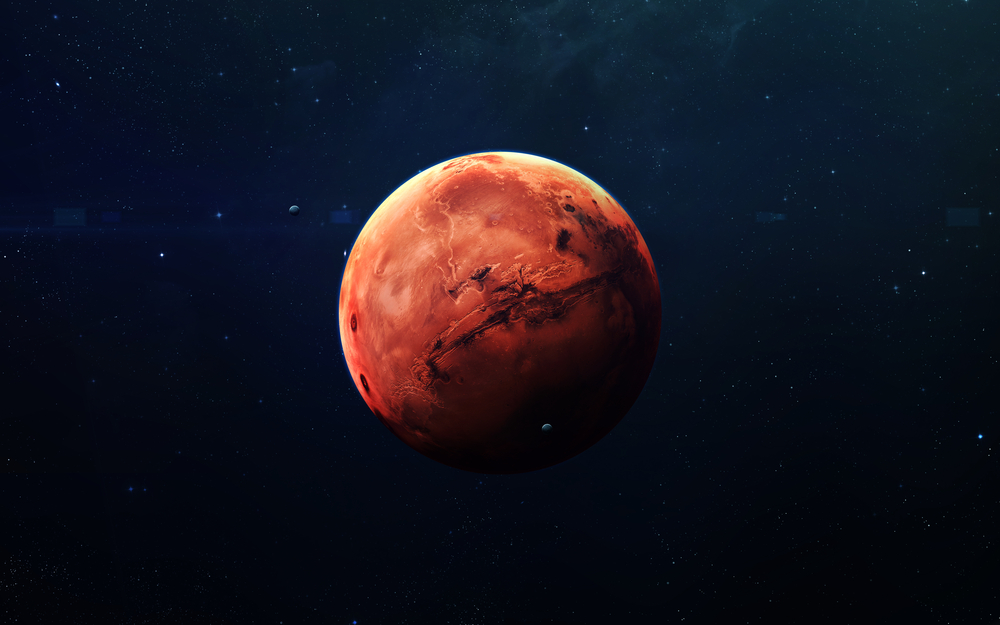
As it left the vicinity of the Red Planet, Psyche captured an image of an almost fully lit Mars, which included its south polar cap and the Valles Marineris canyon. The spacecraft also detected streaks on Mars where wind has blown material off of impact craters. These wind streaks, visible in the new imagery, reveal ongoing surface activity – erosion and redistribution of material driven by Martian winds – on a planet often described as dead that keeps revealing signs of ongoing change.
The Broader Science Haul: Thousands of Images, Multiple Instruments
The team captured thousands of images of the approach to Mars and of the planet’s surface and atmosphere at close approach. As Jim Bell noted, this dataset “provides unique and important opportunities for us to calibrate and characterize the performance of the cameras, as well as test the early versions of our image processing tools being developed for use at the asteroid Psyche.”
The Mars flyby was not designed primarily as a Mars science mission. It was designed to move a spacecraft from one part of the solar system to another. The imaging haul is a scientific dividend on top of a navigation necessity, and it’s already yielding data that will make Psyche a better instrument when it finally reaches its primary target.
The spacecraft’s imager also captured “satellite search” observations of the space surrounding the planet – a practice run for when the team will be searching for any moonlets around the asteroid Psyche. The spacecraft’s magnetometer likely detected the planet’s magnetic field redirecting charged particles from the Sun.
As Psyche flew by Mars, other Martian spacecraft collected data for comparison, so that NASA scientists could see whether Psyche’s data matched and calibrate its instruments if it didn’t. These included NASA’s Curiosity and Perseverance rovers, the Mars Reconnaissance Orbiter, and ESA’s Mars Express. Having multiple active assets measure the same phenomenon simultaneously is a relatively rare opportunity in planetary science, and the cross-referenced data set will take researchers months to fully analyze.
The images captured during the flyby include stunning crescent views of Mars, close-up shots of the Huygens crater, and detailed looks at the planet’s south polar ice cap. The Huygens crater is a double-ring impact structure in Mars’s southern highlands, and the enhanced-color imagery of it gives geologists a fresh look at terrain that tells part of the story of Mars’s violent early history.
Read More: She Immigrated to US with $300; Now Leads NASA Mars Rover Team
The Destination: Asteroid 16 Psyche and What It Could Tell Us
With the Mars flyby complete and the cameras still running calibration shots as the planet recedes, the Psyche spacecraft is now pointing toward its real target: a metal-rich asteroid in the outer part of the main asteroid belt between Mars and Jupiter.
Launched on Oct. 13, 2023, the Psyche spacecraft relies on a solar-electric propulsion system and the inert gas xenon for propellant, gradually gaining speed over the course of its long journey. It has been traveling through deep space for more than two and a half years.
Psyche is likely a mixture of rock and metal, with metal composing somewhere between 30% and 60% of its volume. That ambiguity is precisely what makes the mission scientifically compelling. If the asteroid proves to be a largely metallic remnant of a planetary core, it would be the first such object humanity has ever examined up close.
Humans can’t bore a path to Earth’s metal core – or the cores of the other rocky planets – so visiting Psyche could provide a one-of-a-kind window into the history of violent collisions and accumulation of matter that created planets like our own.
In April 2025, Psyche experienced an unexpected drop in the pressure of its xenon propulsion system. The spacecraft paused its thrusting while engineers considered using a backup redundancy fuel line. Following a switch to the backup line in May, full thruster operation resumed on June 16, 2025. The recovery meant the Mars flyby timeline held, which in turn kept the 2029 asteroid arrival on schedule.
Asteroid Psyche’s gravity will capture the spacecraft in late July 2029, and Psyche will begin its prime mission in August. Through a series of circular orbits that go lower and then higher in altitude around the asteroid, which measures 173 miles (280 kilometers) across at its widest point, the spacecraft will map the asteroid and gather science data.
Deep Space Optical Communications: A Bonus Technology Test
One element of the Psyche mission that has drawn attention beyond the planetary science community is its experimental communications technology. Psyche is testing a new form of spacecraft communications called Deep Space Optical Communications (DSOC), which involves laser-beaming information back to Earth. It has already achieved notable milestones, including transmitting an image of a cat named Taters across 19 million miles (30 million km) of space.
That demonstration matters beyond the novelty of sending a cat video through deep space. The DSOC system can transmit data at rates 10 to 100 times higher than traditional radio wave systems used on most NASA missions, which means future deep-space missions could return vastly more scientific data per transmission window. The first successful test of the system occurred on December 11, 2023, when video was streamed back to Earth from a distance of 31 million kilometers, with the signal taking 101 seconds to arrive, sent at the system’s maximum bit rate of 267 megabits per second.
For context, that’s comparable to a fast home broadband connection – from a spacecraft tens of millions of miles away.
What This Actually Means
The Psyche spacecraft’s Mars flyby on May 15, 2026, was a navigation milestone that delivered an unexpected scientific windfall. The closest and sharpest images yet captured of Mars’s south polar ice cap have arrived at a moment when researchers are actively debating the dynamics of that cap, its CO2 cover, and its role in the planet’s broader climate system. Those images will take time to fully analyze, and the magnetometer data from the bow shock measurement and the satellite search results will take longer still.
As Lindy Elkins-Tanton, principal investigator for Psyche at the University of California, Berkeley, put it: “We can thank the Red Planet for giving our spacecraft a critical gravitational slingshot farther into the solar system.” With Mars now behind it, the spacecraft will spend three years coasting and thrusting toward asteroid 16 Psyche, arriving in August 2029 for what will be the first-ever close examination of a metal-rich asteroid.
What Psyche finds at its destination could rewrite the textbooks on how rocky planets like Earth formed their iron cores. What it found on the way there – a vivid, unsettled picture of Mars’s south pole – adds another chapter to a story that, four decades after the Viking missions first imaged the Martian poles, is still very much being written. The south polar cap of Mars remains a place of genuine scientific uncertainty: rich in ice, wrapped in a seasonal frozen CO2 shell, sitting over layered deposits whose full composition and history are still being decoded. The Psyche flyby didn’t solve that mystery. But it handed researchers a cleaner image of it than they’ve ever had from a passing spacecraft, and in science, sharper pictures almost always lead to sharper questions.
AI Disclaimer: This article was created with the assistance of AI tools and reviewed by a human editor.