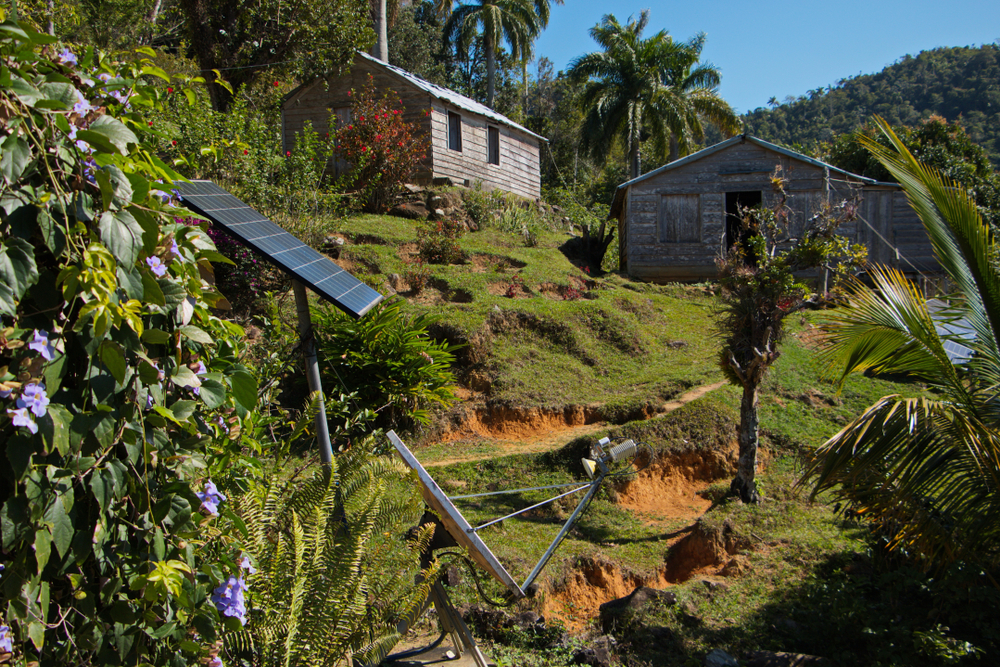

Cuba’s energy situation is, by almost any metric, one of the worst crises the country has faced in decades. Yet right at the center of that same disaster, something unexpected is happening: the island is moving faster than almost any country on earth toward a solar-powered future. That those two facts are simultaneously true is not a coincidence. They are, in a strange way, the same story.
The 2026 Cuban crisis is an oil shortage and economic emergency driven by an American fuel blockade, made effective by the island’s near-total dependence on imported oil, mostly from Venezuela and Mexico. When Venezuelan deliveries halted at the start of 2026 after President Nicolás Maduro’s removal, Mexico suspended shipments shortly after amid growing fear of U.S. reprisals, and a U.S. executive order signed on January 29 threatened tariffs against any country still supplying oil to Cuba. The effect was fast and brutal.
In March alone, Cuba suffered three nationwide blackouts affecting roughly 10 million people. Hospitals limited surgeries, garbage piled up in city streets, and many families were forced to cook using firewood. That’s the background against which Cuba’s solar surge is taking shape. The crisis and the clean energy story are not separate threads to be weighed against each other – they’re the same event, seen from different angles.
How Bad It Got
UN News issued an urgent call for international support as Cuba grappled with a worsening humanitarian crisis, with shortages of electricity, fuel, medicine, and medical supplies severely disrupting emergency care, blood banks, laboratories, immunization programs, and maternal and child health services.
In some areas, blackouts lasting up to 20 hours forced hospitals to suspend non-emergency operations, while fuel shortages limited ambulance services and delayed access to critical care. More than 100,000 patients, including 11,000 children, were waiting for surgeries delayed by power outages and supply shortages. These aren’t abstract statistics. They are the practical reality of what happens when a country loses access to the fuel that holds every basic system together.
Because 84% of Cuba’s water-pumping systems depend on power, clean water and sanitation services were also disrupted, and reliance on water tanker trucks doubled nationwide, from 500,000 people in December 2025 to approximately 1 million by March 2026. Blackouts led to reduced work hours and widespread food spoilage as refrigerators stopped working.
Cuba had been facing increasingly regular blackouts over the previous five years. The country’s oil-run electric power plants are more than 40 years old and have undergone very little capital maintenance, according to Jorge Piñon, director of the Latin America and Caribbean Energy Program at the University of Texas at Austin’s Energy Institute. The blockade didn’t create a fragile grid from nowhere. It snapped one that was already close to breaking.
The Solar Numbers
Against all of that, here is what’s happening on the other side of the ledger.
At the start of 2025, just 4% of Cuba’s energy came from renewables. That number is expected to increase to 17% by the end of 2026, amid plans to add 92 solar fields to the 30 that Cuba had already installed with Chinese support. According to The Energy Mix, citing data from the clean energy think tank Ember, China shipped $117 million of solar panels to Cuba in 2025, up from $48 million in 2024 and just $16.6 million in 2019.
Cuban President Miguel Diaz-Canel opened the first of the new-generation parks in February 2025, and there are now around 50 online, dotted across the island. Cuba has installed around 1 gigawatt of solar in the last 12 months alone, and renewable energy now makes up roughly 10% of the country’s electricity, up from around 3% in 2024. “It’s a really, really rapid boom,” Ember analyst Graham noted.
To put that in perspective: 1 gigawatt is roughly the output of a medium-sized coal-fired power station. Cuba added that capacity in a single year, in a country in the middle of an economic emergency. Cuba received global attention in February 2026 when it announced it had generated more than 800 megawatts of solar power in a single afternoon. The very next day, it broke its own record with 900 megawatts.
A central pillar of the country’s clean energy push is an agreement with China to open 92 solar parks across the country by 2028, projected to bring a total of 2 gigawatts of solar power online, enough to power more than 1.5 million homes. In January 2026, President Xi Jinping personally approved $80 million in emergency financial aid for electrical equipment, alongside a donation of 60,000 tons of emergency rice aid. China’s relationship with Cuba here isn’t simply a matter of trade. It’s a strategic partnership during a political crisis, visible to the rest of Latin America.
Why China, and Why Now
Jorge Piñon, a senior research collaborator at the University of Texas’s Energy Institute, said China’s involvement goes beyond financial interest: it will “build goodwill, not only goodwill within Cuba but goodwill with the rest of Latin America.” The optics of Beijing stepping in while Washington tightens the economic squeeze are not lost on anyone watching in Brasília, Mexico City, or Caracas.
China has been involved in Cuba’s energy sector for years, supplying wind turbines since 2018, providing electric buses through Yutong since 2005, and supporting the assembly of Chinese electric cars, scooters, and bicycles in Cuba through the Caribbean Electric Vehicles program. The solar surge of 2025 and 2026 isn’t a sudden pivot. It’s the latest chapter of a relationship built over two decades.
Beyond the large-scale parks, 5,000 solar kits have been installed in health centers across 168 municipalities, each comprising panels, inverters, and storage batteries. The head of Cuba’s Electric Union described the household-level systems as life-changing, enabling families to run a refrigerator, a fan, and a television, and reducing the rural-to-urban migration that energy poverty drives.
The benefits of solar for Cuba are concrete. Costs of clean technology have fallen sharply in recent years, and solar is relatively fast to install. The infrastructure lasts decades and, once set up, needs only sunshine. That last point matters enormously for a country that can no longer reliably get hold of fuel. Oil is a supply chain. Sunlight isn’t.
The Limits of a Revolution
Solar is still only a daytime solution. In February 2026, solar energy accounted for 38% of electricity generation during daytime hours. But peak demand is from 7 to 8 pm, and Cuba is largely unable to afford battery storage capacity, the most expensive component of a solar energy system.
The national electric system has experienced at least seven total collapses in the last 18 months. Solar energy, although growing rapidly, only meets daytime demand and does not address nighttime peak. Of the 55 solar parks planned for 2025, only four were equipped with battery storage systems. Without sufficient storage, solar parks generate electricity when demand is lowest.
Some experts caution that Cuba’s energy situation is so bleak, its grid so broken, and its economic situation so dire, that renewables can only be a small part of the puzzle right now. Lengthy and disruptive blackouts continue, and most ordinary Cubans have yet to feel the benefit of the solar surge. A clean energy revolution “sounds nice on paper, but you’ve got to have the resources,” said Ricardo Torres, a Cuban economist at American University in Washington, DC.
Cuba produces barely 40% of the fuel it needs to power its economy. The grid itself, built on aging oil-fired thermal plants that have barely been maintained for a generation, would need a fundamental overhaul even if the solar parks delivered everything they’ve promised. Solar panels dotted across a broken grid still go through a broken grid.
The Price of Independence
Researchers have tried to put a number on what genuine energy independence would actually cost. According to the Transition Security Project, Cuba’s electricity and fuel crisis is a humanitarian emergency and a stark demonstration of the risks of dependence on imported fossil fuels for countries facing external coercion, but expanding renewable energy offers a path out of the crisis and away from that dependence.
An April 2026 analysis by Kevin Cashman, an economist with the project, found it would cost $8 billion for Cuba to generate around 93% of its electricity from renewables, at which point it would no longer need to import oil and gas for electricity. A fully renewable electricity system would cost $19 billion. “The first threshold breaks the main external lever of US coercion; the second completes the electricity transition,” the report concluded.
The financing problem is the obvious next question, and nobody has a comfortable answer to it. “The billion-dollar question is who pays for it,” Piñon said. “You have the state that’s broke, doesn’t have any money. You have the Cuban consumer that can’t afford it. So who’s left?” Cashman’s report suggests development finance institutions will be key. But Cuba would need to show it could pay back loans, and this will take time, Piñon noted, “which Cuba does not have.”
Cuba has pledged that renewable energy’s share of its electricity will rise to at least 24% by 2030. Whether that’s achievable, given the grid’s state and the financing gap, is a different question from whether the solar panels themselves are going in the ground. They clearly are.
Read More: Trump Planning New Structure on White House Lawn
What This Actually Means
Cuba’s story is specific to Cuba: its political isolation, its aging infrastructure, its particular dependence on Venezuelan oil, its complicated relationship with China. But the lesson underneath it isn’t unique to Cuba at all – any country that runs its entire economy on imported fuel faces a version of this vulnerability.
Analysts see a wider message in Cuba’s rapid solar deployment for countries in similar situations, as the costs of clean technology keep falling and geopolitical turbulence lays bare the perils of relying on fossil fuel imports. “No matter what happens to Cuba,” Cashman said, “this is a clear signal to other countries that renewables are something that they need to focus on.”
The trap Cuba is caught in right now, where its entire economy can be brought to its knees by a blockade on fuel deliveries, is the same trap any heavily oil-dependent country faces in a world where energy is increasingly used as a political weapon. Cuba’s situation just happens to be the most extreme current illustration of where that dependence leads. The solar parks going up across the island aren’t a triumph to celebrate yet. They’re a race against a clock that is still ticking.
The road between now and 2028, when the 92-park agreement with China is due to be complete, runs through a set of problems the panels themselves can’t fix: storage capacity, grid repair, who finds the money for the infrastructure work underneath everything else. Cuba plans to add approximately 1,200 more megawatts of solar capacity in 2026, aiming for 30 to 35% renewable energy by year’s end. But experts caution that goal won’t resolve the blackouts unless the thermoelectric grid undergoes significant reforms. The solar revolution is real. Whether it arrives fast enough to matter, for the 10 million people living through 20-hour blackouts right now, is still an open question. And that’s the part no headline can resolve.
AI Disclaimer: This article was created with the assistance of AI tools and reviewed by a human editor.