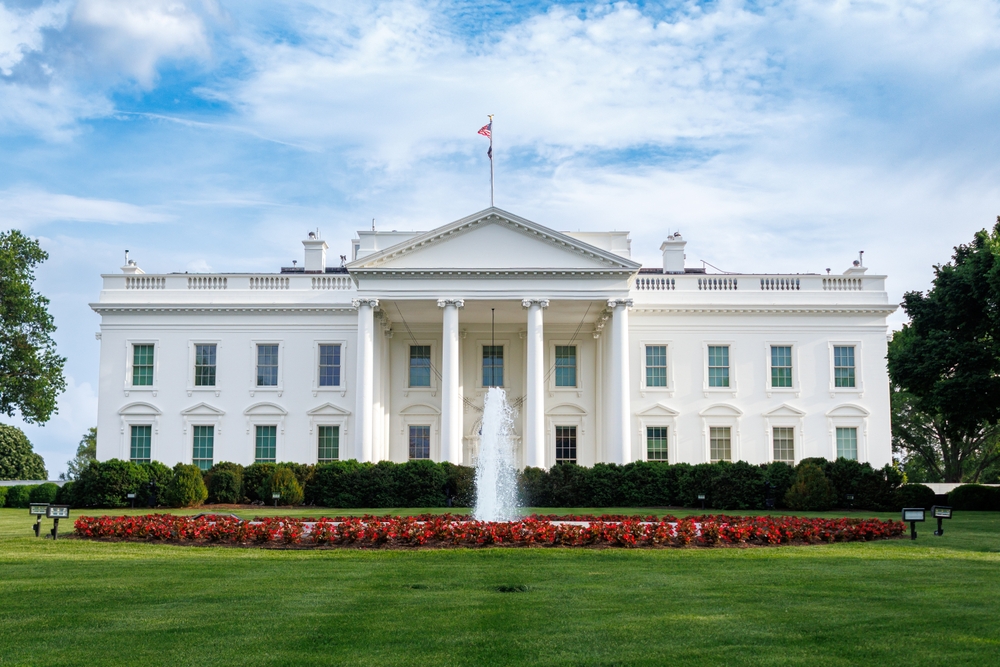

The South Lawn of the White House is one of the most photographed patches of grass in the world. State arrivals, Easter egg rolls, summer barbecues, the familiar sight of a president walking toward a waiting helicopter. It has been, for more than two centuries, a living symbol of the American presidency. Now it may be about to get a concrete makeover.
Reports broke on May 18, 2026 that President Donald Trump is considering installing a permanent helipad on the South Lawn, a move that would turn one of Washington D.C.’s most storied open spaces into something closer to a tarmac. The plan stems from a surprisingly mundane problem: the newest presidential helicopter has a habit of burning the grass. But set against everything else Trump has already done to the White House and its grounds in his second term, a concrete pad on the back lawn is starting to feel like just the latest entry in an extraordinary list.
The Rose Garden paved over. The East Wing demolished. A Presidential Hall of Fame installed in the colonnade. Towering flagpoles planted on the North and South lawns. A 90,000-square-foot ballroom under construction where the East Wing once stood. The pace of transformation at 1600 Pennsylvania Avenue over the past 18 months has been, by any historical measure, remarkable.
The Problem With the New Marine One
The helipad idea stems from the high-velocity heat blasted downward by the VH-92A Patriot, the new model used for presidential transport. It’s a sleek, powerful machine. It’s also, when it touches down on a lawn, something of a blowtorch.
The rotors and engine exhaust from the Sikorsky-manufactured VH-92A Patriot will occasionally burn the grass when it lands, an issue that was initially identified in 2018. That’s not a recent discovery made during a Trump administration test flight. The problem has been known for nearly a decade. Test flights to the White House in 2018 revealed the problems, but it was too late to halt the $5 billion investment.
The result has been a genuinely awkward situation. The burnt-grass problem has prevented use of the new helicopter at the White House for years. While Trump and his predecessor Joe Biden both used the new model outside Washington, an older model that the Pentagon is trying to retire is required to ferry the president from the South Lawn to points afield. In practice, the president boards the aging VH-3D Sea King on the South Lawn, then switches to the newer helicopter elsewhere. It’s the kind of logistical workaround that accumulates quiet frustration over time. Each VH-92A costs around $215 million, according to a 2019 report by the Government Accountability Office, with the Marine Corps spending close to $5 billion in total for a fleet of 23. Spending that kind of money on a helicopter that can’t land at the White House was never a sustainable arrangement.
That same GAO report noted that the program had not yet met a key system capability requirement for landing the helicopter without damaging the landing zone, and that programme officials were studying solutions including “aircraft design changes, lawn-surface treatments and operational procedural changes to minimise landing zone risks.” Six years later, the proposed solution appears to be simpler and more permanent: pour concrete.
Trump is reportedly discussing plans to install a helipad to prevent the new Marine One helicopters from damaging the South Lawn, according to people familiar with the plans. Sources told the Washington Post the permanent helipad on the South Lawn could be installed as soon as this summer.
Not everyone is enthusiastic. A retired colonel who flew on Marine One missions said installing a permanent helipad would ruin the White House, telling the Post it would be “stupid from an aesthetic standpoint.” Ray L’Heureux, who retired in 2011, said the South Lawn is “historic” and the “back yard of the White House” and suggested a temporary landing pad could be used instead. For aesthetic reasons, the lawn has historically not contained a full helipad, but rather three removable aluminum discs which accommodate the helicopter’s individual landing gear. The argument from critics is simple: a temporary fix has worked for decades, and a permanent slab of concrete is not a proportionate solution to a landing problem.
The White House’s response has been characteristically straightforward. White House spokesman Davis Ingle said the helipad plan was “President Trump has continued to make improvements at the White House and all around D.C. to benefit future presidents and Americans.”
A Building That Has Always Been Changing
The instinct to frame Trump’s renovations as uniquely transgressive can obscure something worth keeping in mind: the White House has been modified, sometimes controversially, by nearly every president who has lived there.
There is a marker embedded in the floor of the White House Entrance Hall which includes the dates of four major instances of White House construction: 1792, 1817, 1902, and 1952. The year 1792 represents when the cornerstone was laid. 1817 marks the rebuild after the British burned it on August 24, 1814. 1902 commemorates the Theodore Roosevelt renovation that established the West Wing. And 1952 marks the completion of the Harry S. Truman renovation that completely gutted and rebuilt the White House from the inside.
That Truman project was not without its own controversy. Author Kate Andersen Brower, in her book on the White House, has noted that “The Truman Balcony was something that was really controversial at the time, and now it’s one of the most beloved parts of the White House.” The balcony Truman added to the South Portico, which became a fixture of White House family life and the setting of countless official photographs, was once considered an architectural outrage. Truman funded the balcony himself, using money from his allocated household account.
Other presidents put their own stamps on the grounds in ways that barely registered at the time. In 1975, President Gerald Ford was an avid swimmer who added an outdoor swimming pool to the South Lawn. President Barack Obama adapted a tennis court so it could also be used for basketball, and First Lady Michelle Obama planted the White House Kitchen Garden on the South Lawn. Nixon added a bowling lane. Carter installed solar panels. The list of presidential personalizations is long.
But historians draw a meaningful distinction between those additions and what is happening now. Author Brower says Trump’s ballroom is the biggest renovation since Truman, but is different in key ways: “He wasn’t going to take no for an answer, but he did go through the channels to get approval for this renovation. And we’re not seeing President Trump do the same thing.”
Everything Else That Has Already Changed
The helipad plan is actually the newest item on a list that has been building since Trump’s second term began. He paved over the Rose Garden, installed a black granite walkway along the West Wing Colonnade, redesigned the Oval Office, placed two large American flagpoles on both the North and South lawns, and demolished the East Wing to make way for a 90,000-square-foot ballroom.
In summer 2025, the iconic Rose Garden lawn was replaced with elaborate concrete paving stones, which the president described in a Fox News interview as necessary because the terrain can be wet and soft ground can be an issue, particularly for women wearing high heels. That explanation generated considerable mockery, but the pavement went in regardless.
The ballroom project has grown into something considerably larger and more contentious. The criticism of the garden work paled in comparison to the backlash over the president’s plan to build a massive ballroom. The original cost was put at $200 million but quickly grew to $300 million and then $400 million. As of this week, the political wrangling over how to fund it has gotten messy: the Senate parliamentarian ruled that hundreds of millions of dollars for securing the White House ballroom cannot be included in a Republican spending bill as currently written. The Senate Judiciary Committee’s proposed immigration enforcement bill had included $1 billion for security measures related to what the administration calls the “East Wing Modernization Project.”
Construction crews have already started building the ballroom building’s ground floor, where designers plan a commercial-grade kitchen and offices for the first lady.
Trump has also created his own Presidential Hall of Fame outside the West Wing, covered the walls of the Oval Office in gold, and erected towering flagpoles at the front and rear of the building. And then there are the smaller gestures: a gold sign outside the Oval Office, and a “Hall of Presidents” on the White House colonnade that includes some unflattering remarks about recent Democratic presidents.
In 2025, Trump had an 88-foot tall flagpole installed on the South Lawn. And next month, the lawn will host something entirely new: a 5,000-seat arena is set to be erected on the South Lawn for UFC Freedom 250 in 2026, the first sporting event at the South Lawn.
For those keeping a running tally, the helipad would be the latest in a transformation that has touched almost every corner of the property. And even new Democratic hopefuls have made comments on the state of things at the White House.
The Funding Question Nobody Has Answered
One of the stranger details in the helipad story is how little clarity exists around something as basic as who is paying for it. It is unclear who would fund building the possible addition.
That ambiguity echoes the broader funding debate around the ballroom. Senator Rand Paul introduced a bill to ensure the ballroom would be privately funded, emphasizing that his bill avoids taxpayer expenditure, while Democrats like Senators Chuck Schumer and John Fetterman have debated the $400 million project’s necessity and funding. Schumer has taken to calling it “Trump’s palace” on the floor of the Senate, and even some Republicans have grown visibly uncomfortable with having to defend the ballroom expenditure on the record.
The helipad, at least, has a functional rationale that extends beyond aesthetics. The grass-burning problem is real, documented, and has resisted other solutions for years. Whether concrete on the South Lawn is the right fix, or whether a temporary pad would serve the same purpose, is a different argument. But the underlying problem is not invented.
The timing adds another layer of friction. With the ballroom funding battle still unresolved and the Senate parliamentarian having just blocked one route to financing it, the announcement of yet another major physical change to the White House grounds lands in a politically charged atmosphere.
Read More: Donald Trump Proposes To Add Himself To Mount Rushmore
The Quiet Part
Beyond the politics, the South Lawn has hosted Easter egg rolls since 1878. State arrivals. Children running across it. The silhouette of a president stepping out of a helicopter, waving, walking toward the back door of the most famous house in America. That image is in the muscle memory of anyone who has watched American politics for more than ten minutes. It means something, even to people who couldn’t articulate exactly what.
Every president changes the White House. Theodore Roosevelt modernized it for the 20th century. Truman essentially rebuilt it from the inside out. Each first family redecorates, adds, subtracts, personalizes. The building has always been a living document as much as a monument.
But the pace and the nature of what’s happening now is genuinely different from anything since Truman. The East Wing is gone. The Rose Garden is paved. The Oval Office walls are gold. And now there are reports that a concrete landing pad could be poured on the back lawn as soon as this summer. Whether each individual change is reasonable or even necessary, the cumulative effect is a White House that looks, and feels, quite different from the one that existed 18 months ago. That is either a long-overdue modernization of a building that had grown too precious to touch, or it is something harder to give back once it’s done. Probably both are true at once, and the country is going to spend a long time figuring out which parts it misses.
AI Disclaimer: This article was created with the assistance of AI tools and reviewed by a human editor.