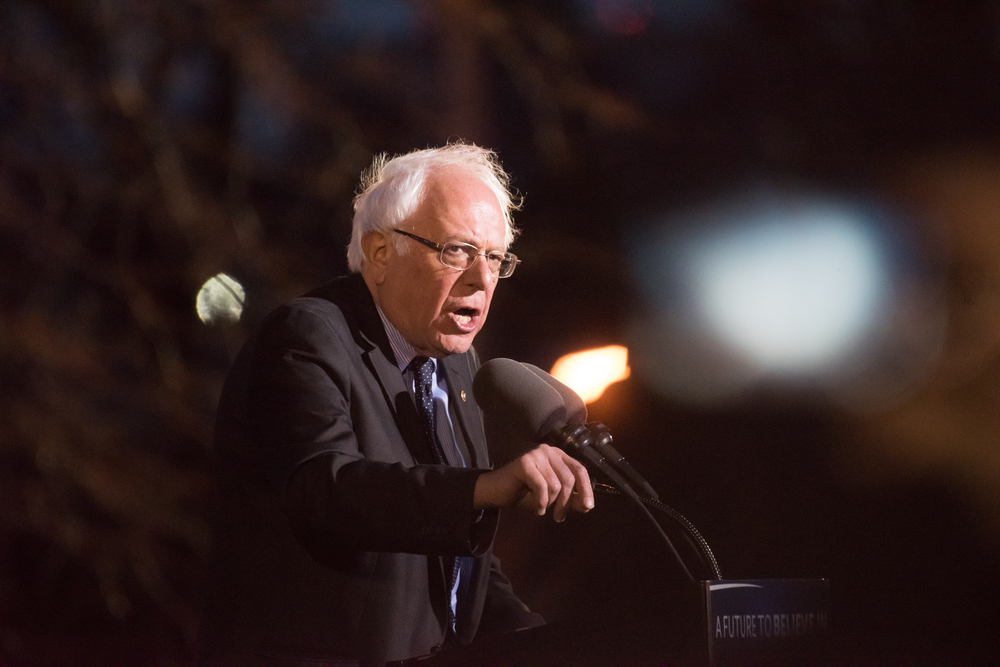

Few politicians in Washington have been as persistent on retirement policy as Bernie Sanders. He’s been making the same core argument for years: that the shift away from traditional pensions has been a catastrophe for working Americans, and that the 401(k) system has made things worse, not better. Most of the time, that argument gets absorbed into the general noise of political debate. But over the past several months, Sanders has pushed these ideas back to the front of the policy agenda with new urgency and new legislation, and the economic data backing him up is harder to dismiss than it used to be.
The timing matters. The share of seniors living in poverty climbed to 15% in 2024, up from 14% a year earlier and the highest rate among all age groups, according to Census data. That figure arrives alongside a labor market in which the average American worker has less than $1,000 saved for retirement – a number that includes the roughly 56 million U.S. workers who lack access to an employer-sponsored retirement plan at all.
Sanders did not invent this problem, and his proposed solutions remain politically contentious. But the gap between the retirement system as designed and the retirement reality most Americans actually face has grown wide enough that even people who disagree with his politics are finding it difficult to argue with the numbers.
The Core Argument: The 401(k) System Is Rigged
Sanders has been sharply critical of the modern 401(k) system, arguing it is “rigged against employees.” His case is that retirement outcomes now depend heavily on market performance and individual investment decisions rather than guaranteed benefits – a structure that creates instability and disproportionately disadvantages lower-income workers.
This is not an abstract complaint. The 401(k) system, introduced in 1978 and expanded through the 1980s and 1990s, replaced a defined-benefit model (the traditional pension, which guarantees a specific monthly income in retirement regardless of market conditions) with a defined-contribution model (in which the employee bears the investment risk, contributes voluntarily, and retires with whatever the market happens to have produced). For high-income workers with surplus earnings, financial literacy, and stable employment, the system can work reasonably well. For everyone else, it places enormous individual responsibility onto people who often can’t exercise it – either because their incomes are too tight to contribute meaningfully, or because they lack the investment knowledge to make sound allocation decisions, or simply because their employer doesn’t offer a plan at all.
Fifty years ago, nearly 50% of American workers had a pension. Today, less than 10% do, and nearly half of older workers have no retirement savings at all. That shift did not happen by accident. Pensions were, for decades, the bedrock of retirement for working-class people, but corporate decisions eroded that foundation. CEOs walk away with golden parachutes while working people walk into retirement with nothing.
The income disparity built into the current system is striking. About six in 10 Americans report having money invested in a retirement savings plan such as a 401(k), 403(b), or individual retirement account (IRA), according to a 2025 Gallup poll. But that average obscures how sharply participation rates split by income: 83% of adults with at least $100,000 in annual household income have a retirement savings plan, compared with just 28% of those in households earning less than $50,000. In other words, the people who most need a safety net are the ones least likely to have one.
How Severe Is the Retirement Savings Gap?
The data on where Americans actually stand financially as they approach retirement is not encouraging.
A 2026 report from the National Institute on Retirement Security found that the median amount saved by workers aged 55 to 64 – on the doorstep of retirement – is just $30,000. Across all working-age Americans, the median savings is $955. And roughly half of all American workers do not participate in any employer-sponsored retirement plan – a figure that has held steady for nearly half a century.
The consequences of that gap are already showing up in behavioral data. More seniors are “unretiring” – returning to the workforce after retirement for financial reasons. A 2026 AARP survey found that 7% of retirees had returned to work in the past six months, with 48% citing a need for money or a poor economic outlook as their primary reason.
The access problem runs deep. As the National Institute on Retirement Security put it directly: “The bottom line is that if Americans are not saving for retirement through their employer, then they are probably not saving at all.” That observation sits at the center of Sanders’ argument – that a system dependent on voluntary individual action, routed through employers who aren’t required to offer it, will always leave the most economically vulnerable workers without protection.
Who Gets Left Out
The access problem is structural. Race and education deepen the divide. According to the same Gallup data, 81% of college graduates have a retirement savings plan, versus 39% of adults without a college degree. Among adults aged 18 to 29, only 39% have any retirement savings account, rising to 63% among those aged 30 to 49 and 70% among those aged 50 to 64.
Hispanic workers and those with lower incomes or lower levels of education are significantly less likely to have access to or participate in an employer plan. And because most IRAs contain rollovers from employer-sponsored 401(k)s rather than independent contributions, the workers who miss out on a workplace plan generally miss out on retirement savings entirely – not just on one vehicle for it.
The Pensions for All Act: Sanders’ Legislative Proposal
In July 2025, Sanders introduced the Pensions for All Act, sweeping legislation that would provide comprehensive retirement coverage to the more than 56 million working-class Americans who currently have no retirement plan through their employer.
The bill would require large corporations to either provide their workers with a pension plan at least as generous as the one enjoyed by members of Congress, or pay into the federal retirement system at a level that ensures all workers receive the same retirement benefits as lawmakers. In other words, if Congress has decided that its own members deserve guaranteed pension income, Sanders argues those same guarantees should extend to the people who build the country.
Beyond Social Security, Sanders proposes requiring employers to provide retirement plans or offer access to a federal pension-style system similar to what government employees receive, pointing to the Federal Employees Retirement System as a model that could be expanded to the private sector.
In his own words on the legislation: “We can no longer tolerate a rigged retirement system that allows the CEOs of large corporations to receive massive golden parachutes for themselves, while denying workers a pension after a lifetime of work.”
The bill has drawn endorsement from the United Auto Workers, the Association of Flight Attendants, and the Alliance for Retired Americans, among other organizations. Whether it advances in the current Congress is another matter. But it establishes a clear counter-position to the direction retirement policy has been moving under the current administration.
Read More: New Bill Would Let Retirees Collect Social Security and Work Without Penalty – Here’s Who Qualifies
The Crypto and Private Equity Fight
Alongside the Pensions for All Act, Sanders has engaged in a separate battle over what gets put inside existing 401(k) plans. In late 2025, the Trump administration issued an executive order that would make it easier to include private equity funds and cryptocurrencies as investment options within 401(k) accounts.
Sanders, together with Senator Elizabeth Warren and five colleagues, sent a letter to Labor Secretary Lori Chavez-DeRemer and SEC Chairman Paul Atkins raising formal concerns about the executive order. The senators wrote that “the Executive Order exposes these hard-earned savings to volatile financial instruments, while attempting to rebrand them as ‘alternative assets,’ although they lack transparency and have exaggerated claims of high returns.”
In communications to the SEC and the Department of Labor, Warren and Sanders called the policy “dangerous,” citing crypto’s volatility and President Trump’s potential conflicts of interest in promoting it.
The senators’ concern goes beyond political positioning. The letter highlighted concerns raised by prior government studies about how crypto differs from other retirement account investments, including a Government Accountability Office finding that because crypto tokens do not produce any cash flow, they can only generate profit when sold at a higher price – a dynamic the office described as appearing “much more like gambling than a productive investment.”
For average 401(k) participants, the risk is not hypothetical. Most people don’t have the financial sophistication to evaluate cryptocurrency as a retirement vehicle. When crypto is presented as a standard option inside an employer-sponsored plan, it carries an implied endorsement it hasn’t earned. Workers who don’t understand what they’re buying may allocate a portion of their retirement savings to assets that can lose 50% or more of their value in a single year.
The Social Security Dimension

Sanders’ retirement agenda doesn’t stop at the 401(k). He has consistently argued that Social Security must be expanded – not cut, not incrementally adjusted, but meaningfully strengthened – to provide a genuine income floor for seniors who have little else.
The case for urgency is growing. The Employee Benefit Research Institute’s 2026 Retirement Confidence Survey found that about four in five workers and seven in 10 retirees are concerned the government will make changes to the U.S. retirement system, with potential reductions in Social Security and Medicare benefits among the top worries. The Congressional Budget Office’s February 2026 budget outlook moved the Social Security trust fund depletion date forward by a year, deepening those concerns.
Confidence in living comfortably in retirement dropped six percentage points among workers to 61%, while confidence among seniors fell five percentage points to 73%, driven by financial strain, rising costs, and mounting concern over the future of Social Security and Medicare, according to the Employee Benefit Research Institute’s Director of Wealth Benefits Research.
The National Council on Aging has noted that 11,000 Americans are turning 65 every single day, and that more than 9.2 million older Americans currently struggle to cover basic expenses like food and medicine. The senior poverty rate of 15% in 2024 is not a blip. It reflects the end point of a decades-long erosion of retirement security – the moment when the people who were supposed to benefit from the defined-contribution era are reaching the finish line and finding out what the system actually delivered.
What This Actually Means
The retirement security debate happening right now in Washington is not a peripheral policy argument. It is a direct confrontation with a structural failure that is already producing real, measurable harm to tens of millions of Americans.
Sanders’ central claim – that the 401(k) system is rigged – rests on a body of evidence that is difficult to argue away. A system that covers 83% of high-income households but only 28% of low-income ones is not neutral. A system in which nearly half of private-sector workers have no retirement account at all is not functioning as designed. A system that leaves the median worker approaching retirement with $30,000 saved is not working.
The specific policy prescriptions Sanders offers are legitimately debatable. Mandating pension coverage for all private-sector workers at the same level as congressional benefits would be enormously expensive and logistically complex. Expanding Social Security significantly would require substantial new revenue. Blocking cryptocurrency from 401(k) plans runs against the financial industry’s commercial interests and the stated preferences of the current administration. None of these are simple fixes.
But the data is unambiguous on one core point: the present system is not working for a large majority of Americans, and the consequences of that failure – more seniors in poverty, more workers unable to retire on schedule, more households making tradeoffs between healthcare and groceries – are compounding every year. Whether Sanders’ specific remedies are the right ones, the retirement crisis he is describing is real.
For individual workers, the practical implication is straightforward. If you have access to an employer-sponsored retirement plan, contribute to it – and if your employer offers a match, capture all of it before doing anything else with that money. If you don’t have access to a workplace plan, an individual retirement account (IRA) is available to anyone with earned income, with a 2026 contribution limit of $7,000 (or $8,000 for those 50 and older). The structural failures Sanders describes are real, but they are not an argument for inaction while policy debates unfold. The gap between what the system provides and what you’ll need is, ultimately, a personal financial problem regardless of whose fault it is.
AI Disclaimer: This article was created with the assistance of AI tools and reviewed by a human editor.