

Most of us don’t realize how gradually stuff takes over. It creeps in, a clearance purchase here, a “just in case” item there, a bag of things you keep meaning to donate that ends up sitting by the back door for three years. One day you look around and the home that was supposed to be your retreat feels more like a storage unit you happen to sleep in.
Recognizing the problem is the first step, and it’s harder than it sounds. Our possessions have a way of becoming invisible to us. We stop seeing the stacks, the overflowing closets, the surfaces buried under layers of miscellaneous things. But certain signs cut through that blindness , and once you know what to look for, you can’t unsee them.
1. Walking Through Your Front Door Feels Like a Burden, Not a Relief
Home should feel like the exhale at the end of a long day. If it doesn’t, your possessions may be why. Psychological research has found that living and working in cluttered spaces causes stress and anxiety and can harm both mental health and productivity. This isn’t about aesthetics. A study published in the Journal of Environmental Psychology found that people who considered their homes more cluttered had lower levels of well-being and life satisfaction, as well as higher levels of negative feelings.
The practical fix: Before you can sort what you own, you need to feel where the tension sits. Walk into your home as if you’re a guest. Notice where your eyes snag on disorder. That’s where to start.
2. Your Closet Is Full and You Still Feel Like You Have Nothing to Wear
This is one of the most common signs you have too much stuff in your house, and one of the most frustrating. The more clothes you have, the harder it becomes to find the ones you actually like. Decision fatigue (the cognitive drain from making too many choices) sets in before you’ve even left the bedroom. A wardrobe packed with items you don’t love creates daily friction. Start a “maybe” pile, anything you haven’t worn in six months. Donate it within two weeks before attachment creeps back in.

3. You Regularly Lose Essential Items
Keys, glasses, your phone, your wallet. If these disappear on a regular basis, clutter is almost certainly the cause. When items are buried in clutter, the brain must sift through noise to retrieve the signal, essentially forcing it to search for what it needs amid competing visual information. Americans spend an estimated 2.5 days per year looking for misplaced items, and over $2.7 billion annually replacing them.
The fix is practical: give every essential item exactly one home and train yourself to return it there. But that system only works if there’s enough clear space to actually use it.
4. Unexpected Guests Cause Panic
When someone texts “I’ll be there in 15 minutes,” do you feel a calm readiness or a spike of dread? If it’s the latter, your space is telling you something. A neat, tidy house feels inviting for the people who live there as well as guests, while a cluttered home can have the opposite effect, and shutting people out can take a toll on relationships and make you feel sad and lonely.
Social withdrawal driven by embarrassment about clutter isn’t trivial. Addressing the clutter directly, even just one room at a time, can restore the confidence to keep your door open.
5. You Can’t Find Flat Surfaces Anymore
If every horizontal surface in your home, counters, tables, the top of the dryer, has become a landing pad for stuff, that’s a clear decluttering sign. Flat surfaces disappear first when accumulation goes unchecked. Research shows that clutter causes anxiety and stress by keeping your brain in a constant low-level state of alertness. Over time, living in chronic low-grade stress can contribute to anxiety, heightened cortisol, inflammation in the body, and even depression.
Pick one surface today and clear it completely. Make a rule: nothing lives there unless it belongs there. Then hold the line.
6. You’re Carrying Consumer Debt from Shopping You’ve Forgotten
This one cuts deep. If you’re paying off purchases you don’t use, wear, or even remember buying, that’s a sign of how to know when you own too much stuff: the financial record is keeping score even if you aren’t. Credit card balances in the US swelled to $1.23 trillion in 2025, with total consumer debt reaching $18.57 trillion, according to Experian (2025). Compulsive buyers typically carry unmanageable amounts of debt, and compulsive buying is viewed as a repetitive, uncontrollable behavior triggered by negative emotional states, where short-term rewards reinforce the pattern resulting in delayed negative consequences.
If you recognize this cycle, a structured spending fast, choosing a defined period where you buy nothing that isn’t a necessity, can break the habit long enough to see it clearly.
7. Decluttering Feels So Overwhelming You Keep Postponing It
Procrastination and clutter are more tightly connected than most people realize. Dr. Joseph Ferrari, a professor of psychology at DePaul University and a leading expert on clutter psychology, has published more than 400 scholarly articles and is a fellow in six professional organizations including the APA, and his research has established a clear link between clutter accumulation and chronic procrastination. The more clutter you have, the more overwhelming the idea of dealing with it becomes, which leads to more avoidance, which leads to more clutter. It’s a cycle. Disorganization can cause anxiety because of the constant visual reminder of things left undone, which in turn makes it harder to muster the energy and focus to clean up.
The antidote is to shrink the task. Set a timer for 20 minutes and commit to one drawer. Not the whole kitchen. One drawer.
8. You Own Duplicates, and More, of Things You Rarely Use
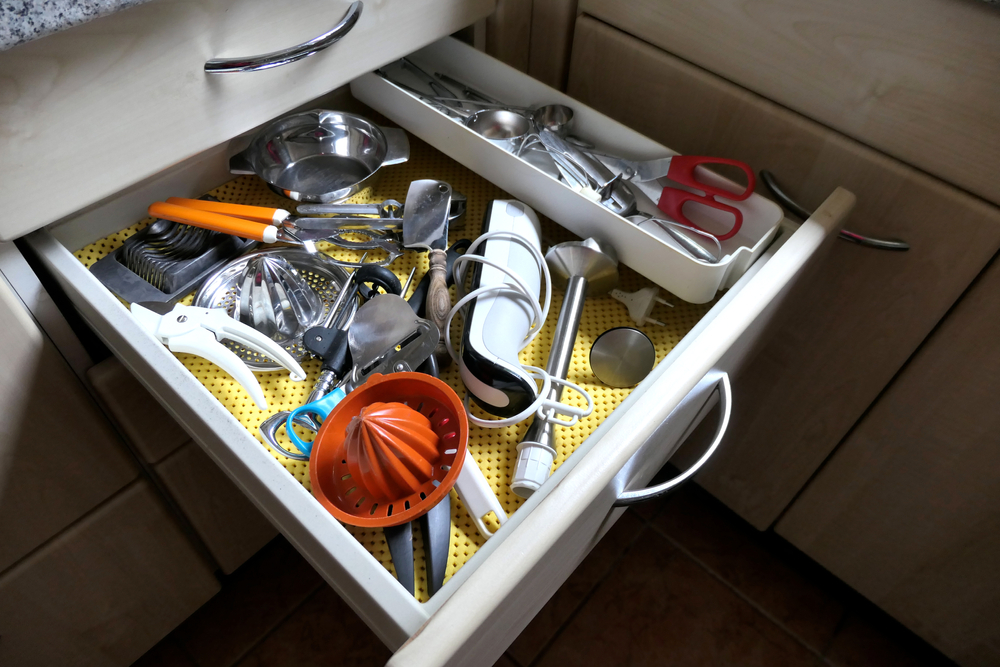
Two blenders. Four sets of measuring cups. Seven spatulas. Three half-used bottles of the same shampoo. When you can’t remember what you own, you buy extras. When extras pile up, storage fills and systems collapse. If you’re finding multiples of things that don’t require backups, that’s a direct sign you’re owning too many possessions and losing track of what you have.
Try a “one-in, one-out” rule: before anything new comes into the home, something comparable goes out. It sounds simple because it is. It works because it addresses the intake problem directly.
9. Your Bedroom Isn’t Helping You Sleep
A cluttered bedroom isn’t just untidy, it may be costing you rest. Your brain needs a calm, safe environment to wind down for sleep, and a cluttered bedroom can disrupt sleep hygiene. Many sleep experts recommend keeping the bedroom clean and minimalist because clutter serves as a visual reminder of unfinished business, provoking anxiety or guilt when you’re trying to relax. Studies have found that people living in cluttered homes are more likely to experience insomnia and poor sleep quality.
Clearing the bedroom, particularly the surfaces nearest where you sleep, is one of the highest-return decluttering moves you can make. Start there if nowhere else.
10. Your Garage, Attic, or Storage Unit Is Maxed Out
When dedicated storage spaces are so full that nothing else fits, it’s not a storage problem, it’s a volume problem. One in 10 households in the US rents a storage unit, spending around $1,000 per year just to store excess belongings. Paying to warehouse things you don’t use is a concrete financial signal that the volume of your possessions has exceeded what your life genuinely needs.
Before renting more space or buying more bins, ask whether the items in storage have earned their keep. If you haven’t looked at something in over a year, it probably doesn’t need a paid home.
11. You Feel a Rush Buying Things But Regret Follows Fast
The high from a purchase that fades within hours is a well-documented psychological pattern. People with compulsive buying tendencies report a preoccupation with shopping, pre-purchase tension or anxiety, and a sense of relief following the purchase, according to research published by NIH. The problem is that the relief is brief, the item adds to the pile, and the cycle repeats. Recognizing this pattern, the anticipation high, the brief satisfaction, the subsequent regret, is the first step to interrupting it.
If this resonates, decluttering your home in 30 days can be a useful reset, but pairing it with an honest look at your purchasing triggers is what makes the change last.
12. Your Concentration and Productivity Have Taken a Hit
Too much clutter at home doesn’t just feel stressful, it measurably impairs how well you think. Neuroscientists have found that when multiple visual stimuli compete for your attention, like a desk covered in books, papers, and random objects, those stimuli compete for neural representation in your visual cortex, forcing your brain to split its attention and making it difficult for your neural networks to focus on one specific thing.
This is why working from home in a cluttered space feels so much harder than it should. Research confirms people think more clearly and become less irritable and more productive in an organized setting. Decluttering frees up mental bandwidth, making even simple decisions easier to process.
13. You Feel Ashamed or Anxious When People See Your Space
Shame about a cluttered home is more common than people admit. More than half of all Americans feel overwhelmed by the amount of clutter in their homes, and two-thirds report feeling ashamed about it. That shame can quietly shape major decisions, who gets invited over, whether you host holidays, how you feel about yourself day to day.
Psychologists have noted that excessive clutter can lead to feelings of frustration, being overwhelmed, and shame, which can zap your motivation to tackle the mess. Naming that shame, and recognizing it as a signal rather than a character flaw, takes some of its power away.
14. Your Home Feels Like a Physical Safety Risk
This is the sign that gets treated most lightly but carries the most serious weight. Living with lots of clutter puts you at real risk of injury. When floors are covered with boxes, heaps of clothing, or too much furniture, tripping becomes more likely, and shelves stuffed to the brim can be hazardous if something falls or overloaded furniture topples. At the more extreme end, an excess of combustible materials such as papers, clothing, and clutter increases fire risk and fire severity in the home, and constitutes especially hazardous conditions for firefighters and emergency responders.
Clear pathways between rooms, especially around exits. That’s not minimalist living tips at work, that’s basic safety.
What These Signs Are Telling You
How do you know if you have too much stuff? You probably already do, or you wouldn’t be reading this. The real question is what you’re going to do with that knowledge.
The signs above aren’t a verdict. They’re information. Clutter builds up for all kinds of reasons: busy seasons of life, emotional attachment, shopping as stress relief, simply not knowing where to start. More often than not, a cluttered home reflects mental overload, grief, anxiety, depression, or perfectionism. Homes become mirrors of our inner world, which is why decluttering can be such an emotional process, letting go of physical items often means confronting the past, facing the future, or releasing old identities.
What the research is consistent about is this: the benefits of simplifying your living space extend well beyond aesthetics. They touch your stress levels, your sleep, your focus, your finances, and your relationships. You don’t need to strip your home down to nothing. You just need to get the volume down to a level where your home is working for you again, not against you. Pick one sign from this list that hit closest to home. Address that one. Then come back for the next.
Start Where You Are, Not Where You Think You Should Be
The most common mistake people make when they decide to declutter is trying to overhaul everything at once. They pull out boxes, drag things from closets, and create a mess bigger than the one they started with, then abandon the project entirely by day two. A more effective approach is to work in small, defined sessions and make decisions about one category or one space before moving to the next. The 20-minute rule is a real strategy, not a platitude: set a timer, focus only on what’s in front of you, and stop when it goes off. Progress made in short, consistent sessions compounds faster than you’d expect.
It also helps to think about what you’re moving toward rather than what you’re giving up. Rather than framing each decision as a loss, ask a different question: does this item serve the life I’m actually living right now, or the life I used to live, or one I imagined I’d have? That shift in framing, from loss to alignment, makes the decisions feel less like sacrifice and more like editing. For a structured path forward, working through a 30-day declutter challenge gives you a daily framework that keeps the process from stalling.
The last thing worth knowing is that decluttering doesn’t have a finish line so much as a new normal. The goal isn’t a perfectly spare home held in a permanent state of order, it’s building habits that keep volume in check so the problem doesn’t quietly rebuild itself over the next few years. One in, one out. A regular pass through each room every season. Pausing before a purchase instead of after. Small disciplines, practiced consistently, are what separate a one-time purge from a genuinely simpler life.
A.I. Disclaimer: This article was created with AI assistance and edited by a human for accuracy and clarity.