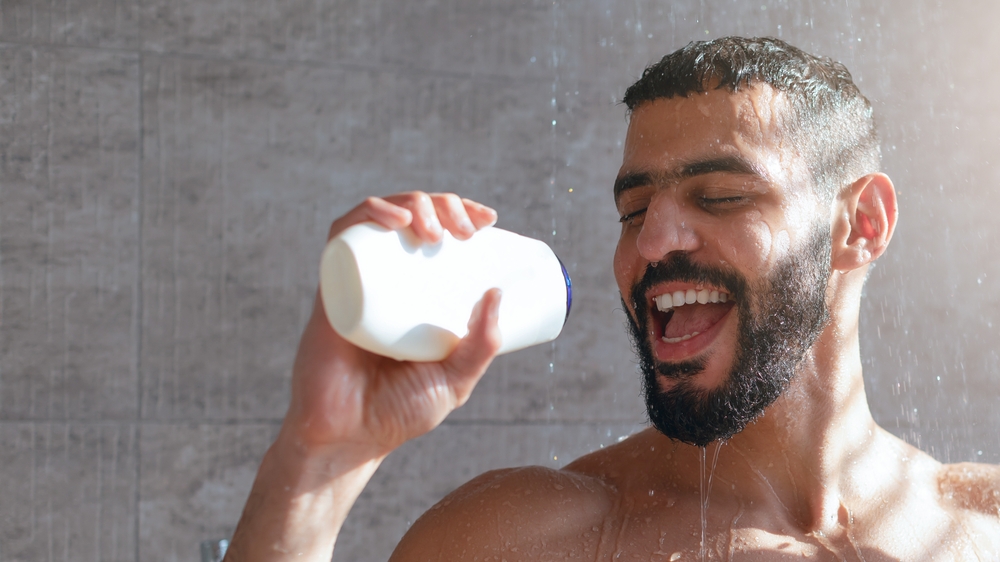

The shower is supposed to be a two-minute rinse on a Tuesday morning. Shampoo, soap, done. But that’s not what actually happens, is it? For a surprising number of people, the shower has quietly become one of the most psychologically productive, emotionally complicated, and – let’s be honest – genuinely odd rooms in the house. It’s the place where you suddenly solve the argument you lost three days ago. It’s where your inner Beyoncé shows up. It’s where you stand completely still, eyes closed, hot water running, for what you’ll later tell yourself was “just a few minutes” but was definitely closer to fifteen.
Nobody talks about this stuff. The bathroom door closes and out comes the weirdest, most unselfconscious version of you – rehearsing speeches, negotiating with shampoo bottles, debating whether to eat a snack with the water still running. And the thing is, there’s actual science behind why the shower turns so many of us into a slightly unhinged version of ourselves. The combination of warm water, sensory isolation, and zero audience creates a mental environment unlike almost anywhere else in modern life.
So if you’ve ever wondered whether you’re the only one doing that one specific thing in the shower that you’d never admit to your housemates – you’re not. Not even close.
1. Having Your Best Ideas
There’s a reason “shower thoughts” has its own corner of the internet. That bolt of clarity that arrives while you’re rinsing your hair – the answer to the thing you’ve been stuck on for a week – isn’t random. The answer lies in the fixed amount of attention your brain has to work with at any given moment. When the rational mind focuses hard on a problem, it eats up much of that available bandwidth, whereas letting the mind wander during a routine task frees up your subconscious to roam beyond the activity at hand.
An additional benefit of the shower is that the white noise of running water blocks outside stimulation. That roar produces a kind of partial sensory deprivation, taking bandwidth that would have been used for other perceptions and redirecting it to the mental space the mind uses to wander. In plain terms: your brain can’t check Instagram, can’t respond to a notification, and can’t get interrupted. For ten minutes, it’s just you and your thoughts, and your thoughts finally get a chance to connect.
During the day, doing something easy and familiar, often involving some kind of movement, is likely to facilitate the flow of spontaneous thoughts. When you’re in the shower, “you don’t have a lot to do, you can’t see much, and there’s white noise.” Your brain thinks in a more chaotic fashion, executive processes diminish, and associative processes amp up. Ideas bounce around, and different thoughts collide and connect. So the next time your best idea arrives mid-shampoo, the practical move is to keep a waterproof notepad by the sink. Slightly neurotic, completely worth it.
2. Singing Like Nobody’s Listening
Because nobody is. That Grammy-worthy performance you’re delivering – the one that somehow sounds incredible in there – isn’t entirely your imagination. Because bathroom tiles don’t absorb sound, your voice bounces back and forth around the room before fading away. Since the shower is a small space, it boosts your voice and even adds a little bass, making your singing sound more powerful. The sound bouncing also gives your vocal styling a reverb effect, which makes your voice hang in the air longer and evens out variations in your singing – essentially a primitive Auto-Tune that makes you sound better than you actually are.
That confidence boost turns out to matter more than you’d think. Singing naturally releases endorphins – the brain’s feel-good chemicals – which can help reduce stress and anxiety, and it also stimulates the vagus nerve, which is linked to relaxation and lower stress levels. A study published in Frontiers in Psychology found a significant decrease in cortisol (stress hormone) in low-stress singing conditions, suggesting that singing in itself is a stress-reducing activity. Solo shower singing, where there’s zero performance pressure, is about as low-stress a singing environment as you can get.
The deeper explanation is just physics and psychology working together. Privacy and relaxation combine to eliminate performance anxiety, allowing you to sing with more confidence and power. When you’re not self-conscious, your vocal cords are more relaxed, leading to better pitch and tone. Step outside the bathroom, though, and the spell breaks immediately. The tiles stop helping you. Suddenly you just sound like a regular person. It’s a mercy that no one had to tell you.
3. Solving Arguments That Already Ended
The dinner party was fine. The conversation at work was perfectly civil. But somehow, three days later, you’re in the shower delivering the exact response you should have said – the one that would have been perfectly measured, not too harsh, exactly right. You’re winning, by the way. Comprehensively.
There’s a reason the rehearsal happens in the shower, the car, the walk. These are environments that occupy just enough of the body to let the verbal mind work without interruption. The shower is one of the last rooms in modern life where nothing asks for your attention, which means the backlog of undelivered sentences finally gets a stage. That’s also why the rehearsals can feel compulsive.
Psychologists differentiate between inner speech (the silent voice in your head) and private speech (talking to yourself out loud). For decades, private speech was considered a childish habit that adults were supposed to grow out of. But research building on the foundational work of Lev Vygotsky has shown that talking to yourself out loud is a vital tool for higher cognitive functioning at any age. Vygotsky saw private speech as having a primary role in the self-regulation of cognition and behavior. When you speak your thoughts, you are forced to structure them more clearly than when they are just bouncing around in your mind, transforming abstract thoughts into concrete language and making them easier to examine and manage. So that imaginary debate you’re winning in the shower? Your brain is actually doing something useful with it.
4. Talking to Yourself (Out Loud)
This one goes further than the internal monologue. Some people have full conversations in the shower. Alone. With themselves. Maybe you’re one of them. Maybe you just won’t admit it.
It’s more common for people to talk to themselves than not to. According to one study on inner experience frequency, 96% of adults say they have an internal dialogue. While self-talk out loud is less common, around 25% of adults say they do it. So roughly one in four people is out there narrating their morning like they’re the main character of a documentary. Statistically, someone in your household is doing this right now.
A 2023 review of the self-talk literature covered 559 published studies on the topic between 1978 and 2020, mapping its documented functions across inner dialogue, problem-solving, self-regulation, emotional expression, working memory, and task switching. The research is, shall we say, abundant. A systematic review of 47 studies found consistent beneficial effects of positive, instructional, and motivational self-talk for performance. Talking yourself through a bad day in the shower is not a sign of eccentricity. It’s a sign of a brain that’s working.
5. Eating Snacks
Raisins. Chocolate. And yes, reportedly, a cookie – consumed in full, in one go, the moment you step under the water. Multiple people have admitted to eating actual food in the shower. The chosen snacks ranged from raisins, to chocolate, to a cookie. The water is hot, you’re pressed for time, the snack is sitting there on the counter. It’s not glamorous. It’s also, apparently, not rare.
There’s no peer-reviewed literature on shower snacking, which feels like a missed opportunity for science. What we do know is that the shower represents a rare pocket of uninterrupted time – no phone, no obligation, no one asking you anything. For busy people, it’s practically the only moment in the day that belongs entirely to them. If that moment happens to overlap with a craving, well. The cookie is right there.
The practical note here is purely about temperature and structural integrity. A warm chocolate biscuit in a steamy shower has a limited operational window. Plan accordingly.
6. Running Through Your Entire To-Do List
The shower should be a break from your responsibilities. For many people, it is precisely where those responsibilities gain the clearest possible form. The grocery list. The email you forgot to send. The thing you promised your mother three weeks ago and still haven’t done.
This happens for the same reason great ideas happen in the shower – your default mode network (the brain’s background processing system) fires up during routine tasks and starts connecting dots. The shower is a prime environment for triggering this network. Because the physical act of showering is so automatic, your conscious mind checks out, and your default mode checks in. This is why you suddenly remember an event from childhood or start planning your goals for next year. Your self-talk in the shower is often the audible expression of this network at work – your brain processing your life story, connecting disparate ideas, and figuring out who you are.
The irony is that the shower – designed for physical cleansing – turns out to be one of the best places your brain has for cognitive housekeeping. Everything that didn’t get sorted during the busy noise of the day quietly surfaces. A small notepad on the bathroom shelf is not a weird thing to own. Several very organized people have one.
7. Standing There Doing Absolutely Nothing
This is different from thinking. This is the opposite of thinking. This is just standing, eyes closed or open, water running, brain completely switched off, as the hot water does whatever it wants to your skin and hair and the concept of time ceases to exist.
Hot showers can help open up the pores of the skin and being in hot water effectively helps relieve body tension and soothe muscle fatigue. When you take a hot shower, the warm water opens your blood vessels – a process called vasodilation – which improves blood flow to your skin and muscles. Warm water also helps muscles relax and reduces stiffness. If you sit a lot at work, a warm shower can help ease tight hips, lower back tension, and neck pain.
So the standing-there-doing-nothing phase isn’t laziness, exactly. It’s your body accepting an invitation to decompress that it doesn’t get very often. The shoulder that’s been up around your ear since Monday morning slowly drops. The jaw unclenches. Ten minutes of hot water won’t fix a stressful week, but your nervous system is at least briefly persuaded that today might be survivable. That’s worth something.
8. Turning It Into an Emotional Processing Session
Something about the shower makes the feelings come up. Maybe it’s the warmth. Maybe it’s the privacy. Maybe it’s the particular acoustics of crying in a small tiled room when you’d rather not do it where someone can hear you. The shower has always been that room.
You move part of your emotional processing into the shower. The water becomes the place where you reframe things and decide what is worth carrying forward. There’s something symbolic in watching soap and bubbles swirl down the drain. Problems may not literally wash away, but the body feels like some of that heaviness does. That symbolic act can be surprisingly powerful for your mood.
This is not a quirk. It’s a function. The shower is, for many people, one of the only genuinely private spaces left in a life that’s otherwise full of open-plan offices, shared kitchens, and phones that know exactly where you are. Whatever needs to be processed without an audience gets processed here. If you’ve ever stepped out of the shower feeling slightly lighter than when you stepped in and couldn’t explain why – that’s probably what happened.
9. Switching Between Hot and Cold Water on Purpose
This one sounds like something only extremely disciplined wellness types do. But it turns out the contrast shower – hot, then cold, then back – has a decent amount of science behind it and a growing number of ordinary people experimenting with it before 8am.
A study in the journal PLOS ONE followed people who finished their normal showers with 30 to 90 seconds of cold water every day. Over several months, this group had about 29% fewer sickness absence days from work than people who did not add cold water. That doesn’t prove cold showers prevent all infections, but it suggests they may help resilience or help you bounce back faster.
Cold water activates the sympathetic nervous system, giving a natural rush of noradrenaline – the brain chemical responsible for alertness and focus. Many people are replacing their morning coffee with a 60-second cold blast and reporting sharper mental clarity throughout the day. The cold part is unpleasant in the way that anything bracing is unpleasant: you brace, and then you’re through it. For those who want the benefits of both temperatures, contrast showers – alternating hot and cold – can be a powerful technique. Starting with hot water to relax muscles and open pores, then switching to cold to close the pores and boost circulation, can also help improve cardiovascular health by training blood vessels to expand and contract efficiently.
10. Doing Things That Have Nothing to Do With Showering
Laundry, to be specific. The bucket method: clothes in a five-gallon container with detergent, stomped underfoot while you shower. This actually isn’t weird so much as brilliant – you put your clothes in a bucket with some laundry detergent and stomp on them while you shower, though apparently wringing everything out once you’re done is a bit of a pain.
Then there’s shower reading, shower podcasts (phone in a Ziploc bag on the shelf, which every podcast devotee has done at least once), and shower planning sessions involving actual written notes on water-resistant paper. The shower has, for many people, become a multitasking zone – which runs somewhat against the point of it being a recovery space, but that’s a tension worth sitting with rather than solving.
What all of these activities have in common is that the shower is a room without an obvious productivity ceiling. Research suggests that tasks like showering aren’t so mindless after all – the mind actually works better when there’s a moderate level of engagement, rather than something truly boring that requires no thought at all. Your brain, it turns out, isn’t done with you just because you’re technically washing your hair.
11. Timing Yourself Like It’s a Competition
Two minutes, thirty seconds. New record. The satisfaction of this is out of all proportion to the achievement, and yet it’s real. For the counter-shower people – the ones who have mentally converted every extra minute under the water into a dollar figure on the utility bill – the quick shower is a small act of self-discipline that feels genuinely good.
This is the behavioral flip side of the ten-minute emotional-processing stand. Both types of showerer exist in the same population and sometimes in the same body, depending on the day. For many people, a warm bath or shower before bed can help the body cool down afterward, which supports easier sleep. Sleep research has found that this kind of routine can shorten the time it takes to fall asleep and improve sleep quality for many adults. The morning sprinters often offset their efficiency with a longer evening shower that serves an entirely different purpose – winding down rather than starting up.
If you’re using your shower as a stress-reduction tool, the length isn’t really the point. Research suggests that a warm shower before bed can help you fall asleep faster, because the warm water raises your body temperature, and the subsequent rapid cool-down period once you step out can induce feelings of drowsiness. Whether you’re a two-minute minimalist in the morning or someone who lingers under hot water until the pipes give out – the shower is doing more for your mental and physical state than pure hygiene would require. And that’s fine.
You’re Not Weird. You’re Just Human.
The shower might be the last genuinely private space that most people have. No notifications, no one waiting for a reply, no ambient hum of other people’s expectations. What fills that space tends to be honest – which is exactly why it’s so strange and specific and occasionally absurd.
The singing, the imaginary debates, the accidental emotional unraveling, the snack consumed before the shampoo: none of it is weird in the sense of being unusual. Most of it is, as it turns out, backed by a reasonable amount of psychology and brain science. The shower creates conditions that almost nowhere else in daily life creates, and the brain responds accordingly. It wanders, it processes, it performs, it resolves. If some of those habits age you faster than others, the shower is at least doing its part to slow things down.
So the next time you step out twenty minutes later than planned, having solved nothing practical but feeling oddly clearer about something you couldn’t name before you stepped in – that’s not wasted time. That’s your brain doing its best work in one of the only rooms that still lets it.
AI Disclaimer: This article was created with the assistance of AI tools and reviewed by a human editor.