
Vintage airport vending machines had their moment in American airports, and it was stranger than you might expect. You could pick up a candy bar from one machine, take a few steps, and buy yourself a life insurance policy from the next one, all before your flight boarded. Coins in, form filled out, policy dispensed. If the plane went down, your family got paid. If it landed safely, you had a piece of paper to throw away. The whole transaction took less than two minutes.
These vintage airport vending machines that sold flight insurance were, for a good stretch of the 1950s and into the 1960s, as ordinary a sight in American and Canadian airport terminals as a payphone or a newsstand. They were a product of their moment: air travel was new enough to feel dangerous, insurance companies were entrepreneurial enough to spot an opportunity, and the regulatory environment was loose enough that almost nobody asked whether this was a good idea. The answer, it turned out, was complicated.
The world that produced them was also the world that eventually turned against them, and the story of why covers everything from chrome-plated kiosks at departure gates to a Denver man who packed his mother’s bag before her last flight.
Why Vintage Airport Vending Machines Existed at All
Commercial aviation was barely a generation old as a mass-market experience in the early 1950s. The postwar boom had put planes within reach of the middle class for the first time, but the emotional associations with flying were still being formed. Glamorous and terrifying in roughly equal measure, and the press gave prominent coverage to every crash, which made the risk feel larger than the statistics actually supported.
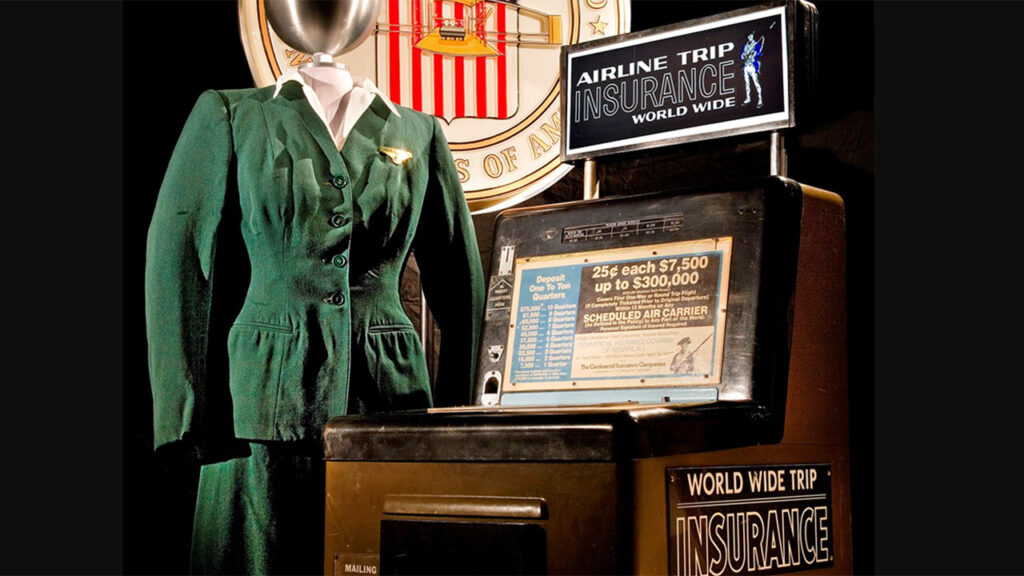
According to Vancouver Is Awesome, the machines were first installed by an insurance underwriting company in 1951, and at that time a single quarter bought $5,000 worth of life insurance. The maximum coverage you could initially purchase was $25,000 worth for $1.25, and that ceiling eventually rose to $75,000. Coverage extended to “accidental loss of life, limb or sight and other injuries” sustained during the flight.
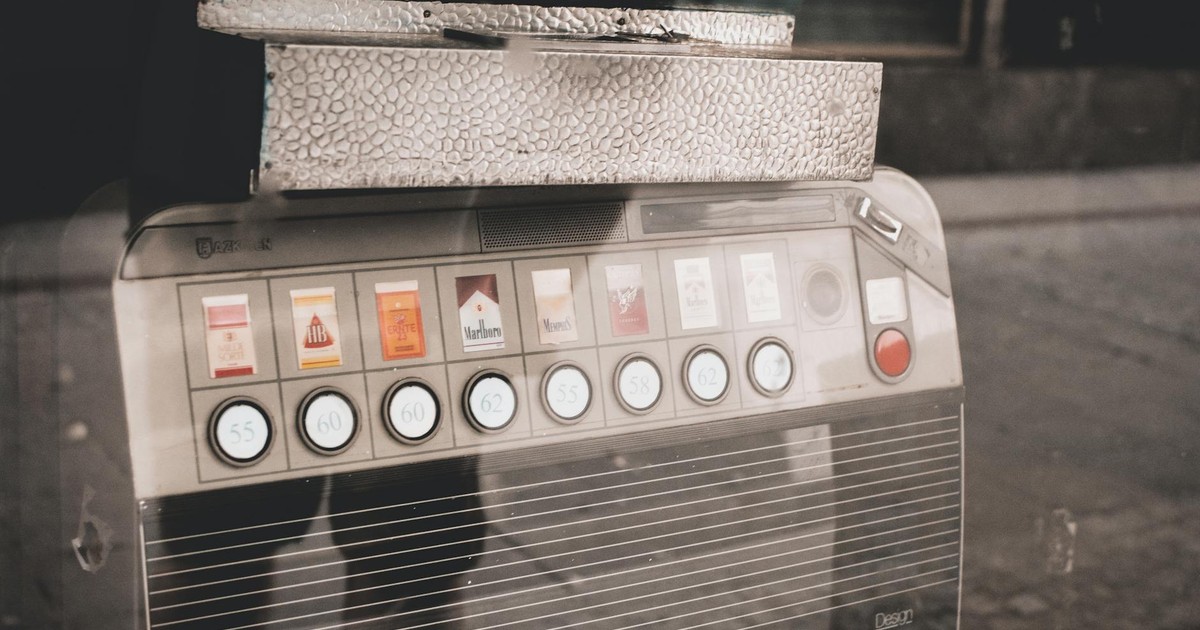
The machines themselves were very much objects of their era. They were chrome-and-enamel kiosks with bold signage, where passengers inserted coins, filled out a small form with their name and beneficiary using a pen chained to the machine, and received a printed paper policy stamped with their name, flight number, and coverage details. The whole transaction could be completed in under two minutes, standing at the gate with a boarding pass in one hand and a quarter in the other. The policy was valid only for that specific flight segment.
Flight insurance vending machines and booths were a common sight at airports throughout the 1950s and 1960s, with the larger US insurance companies generating significant revenue. These machines were frequently operated by companies like Travelers Insurance, Mutual of Omaha, or Aetna, often under contract with the airport or the airline.
The Pushback From Pilots
Not everyone thought these machines were a charming expression of postwar optimism. Airline pilots, in particular, found them insulting. Their objection wasn’t abstract.
Airline pilots in the late 1950s and early 1960s were vocally opposed to flight insurance machines and kiosks at airports. Their argument was essentially that the visible presence of a machine offering death benefits at the departure gate implied that passengers had good reason to fear they wouldn’t arrive. Arthur Hailey, in his 1968 novel Airport, captured the sentiment through a pilot character who considered airport insurance vending to be “a ridiculous, archaic hangover from flying’s early days,” arguing that the very prominence of insurance booths in airport concourses was an insult to commercial aviation and its safety record.
The pilots’ concern wasn’t purely about optics either. Pilots’ associations lobbied against the machines for years, after a number of insurance frauds were perpetrated, and they feared that selling insurance this way encouraged the sabotage of flights. That fear, as would be demonstrated in November 1955, was not theoretical.
The Crime That Changed Everything
On the evening of November 1, 1955, according to the FBI, United Air Lines Flight 629, a DC-6B with 44 persons aboard, took off from Stapleton Airport in Denver, Colorado, bound for Portland, Oregon. Eleven minutes later, the 39 passengers, including an infant, as well as five crew members, were dead, killed instantly when the airliner crashed on a sugar beet farm near Longmont, Colorado.
The FBI investigation that followed would become a landmark in American forensic history. Agents recovered essentially all known luggage from the wreckage in good condition. All except one suitcase, which belonged to a Denver woman named Daisie King. Her son, John “Jack” Gilbert Graham, born January 23, 1932, killed all 44 people aboard United Airlines Flight 629 using a dynamite time bomb. Graham planted the bomb in his mother’s suitcase, apparently to murder her and claim $37,500 worth of life insurance money from policies he had purchased in the airport terminal just before the flight departed. In today’s dollars, that payout was equivalent to roughly $450,000.
Graham had packed the bomb using 25 sticks of dynamite, two electric primer caps, a timer, and a six-volt battery. When investigators found a hidden insurance policy in a cedar chest at Graham’s home, with Graham named as the sole beneficiary, the case broke open. He was convicted of murdering his mother and was executed by the state of Colorado in January 1957.
The legal fallout was immediate. Colorado banned airport insurance vending machines. A bill introduced after the explosion was signed by President Dwight D. Eisenhower, making the intentional bombing of a commercial airline illegal – a law that, astonishingly, had not existed before. Graham’s trial also set another precedent: it became the first in U.S. history to be broadcast on television.
Colorado’s ban on the machines was the exception rather than the rule. Beyond that one legislative action, there was no further outlawing of flight insurance kiosks or machines at airports in the United States. The machines continued operating in most states and in Canadian airports for years afterward.
What Flying Actually Cost You in 1955
It’s worth pausing on the risk picture that actually existed when these machines were running. Flying in the early-to-mid 1950s was genuinely more dangerous than flying today, not by a small margin, but by an order of magnitude.
According to Allianz, the piston-driven aircraft that dominated the world’s airline fleet in 1960 had an accident rate of 27.2 accidents per million departures. That figure dropped dramatically with the introduction of jet airliners like the Boeing 727 and DC-9 in the latter half of the 1960s and early 1970s. When passengers in 1955 dropped a quarter into an insurance machine before boarding, they weren’t being irrational. The math, at that moment, had some real teeth.
The Flight Safety Foundation reports that in 1959, the year generally considered to mark the start of the Jet Age, the fatal accident rate for commercial jet airplanes was more than 35 per million departures. One decade later, Boeing’s data for 1969 measured a decline to fewer than five fatal accidents per million departures. The machines were disappearing precisely as the technology was getting dramatically safer.
The Long Fade Out
The vending machines didn’t get banned out of existence. They mostly just became irrelevant, like telegram offices and rotary dial phones: things that served a purpose until the purpose dissolved.
Over the years, the airport flight insurance kiosks and machines mostly faded away as travelers grew accustomed to air safety, and insurance from other sources reduced both the need and the sales of flight insurance at airports. By the time credit cards became widespread in the 1970s and 1980s, travelers could access comprehensive travel insurance through other channels, at better rates, covering far more than just fatal crashes. The quarter-in-the-slot policy that paid out only if the plane went down started to look thin compared to what was available elsewhere.
As the National Air and Space Museum records, flight insurance had become so popular that vending machines were installed in airports around the country to dispense insurance policies – but that popularity was always tethered to public anxiety about flying, and public anxiety about flying had a limited lifespan. One intact original machine survives in the Smithsonian’s collection, a relic from the era when the Jet Age was still new enough that buying death benefits before takeoff felt like basic prudence.
What was once a common sight throughout most American airport terminals would today seem odd and out of place.
Read More: Ancient Engineers Used a Brilliant Machine to Build the Egyptian Pyramids, Study Finds
Where These Machines Actually Ended Up
Spend any time with this story and a few things become clear. The 1950s traveler standing at the gate with a quarter wasn’t being morbid. They were doing what people do when they face genuine uncertainty: trying to put a number on it and hedge accordingly.
The insurance companies understood this perfectly. So did the pilots who hated the machines. The insurers correctly identified that anxious passengers would pay for peace of mind. The pilots correctly identified that broadcasting that anxiety in airport concourses damaged how flying was perceived – and that the format created a financial incentive some people would act on in the worst possible ways. Both observations were accurate. They just pointed in opposite directions.
What ended the machines wasn’t legislation. It was the accumulation of evidence that flying had become genuinely, measurably safe. The anxiety didn’t disappear overnight, but it stopped being proportionate to the actual risk. Eventually, the market for last-minute death benefits at 25 cents per $5,000 of coverage ran dry. The machines didn’t get retired with any ceremony. They were simply no longer useful, and one by one they came down.
AI Disclaimer: This article was created with the assistance of AI tools and reviewed by a human editor.