
Pull out a recipe card from any 1970s kitchen drawer and you’ll find it: grease-splattered, handwritten in ballpoint, with ingredient quantities that seem almost unhinged by today’s standards. A cup of Cool Whip here. A packet of instant pudding there. A generous splash of Galliano liqueur poured straight into cake batter before anyone thought to ask whether that was a good idea. It was. It absolutely was.
The desserts that defined that decade were theatrical, unashamed, and built for the table rather than the Instagram grid. They arrived at potlucks carried in both hands because they were too precarious to put in the backseat. They were unmolded in front of guests, set on fire at the dinner table.
Most of them have exited the cultural conversation. A few linger in recipe boxes, rarely opened. Others exist only as a half-remembered flavor from someone else’s grandmother’s kitchen. These are the nine vintage 1970s desserts that earned their moment and then, somehow, disappeared.
1. Baked Alaska
Baked Alaska consists of ice cream layered between a slice of sponge cake and a covering of meringue, which is baked quickly at high heat until lightly browned. The meringue acts as an insulating blanket that keeps the ice cream intact while the outside turns golden.
Almost all sources agree that the dessert was named to celebrate the United States acquisition of the former Russian territory of Alaska, with the treaty signed in March 1867 and the formal transfer of the territory taking place on October 18 of that year. It showed up in restaurants and at dinner parties for decades, but the 1970s made it the go-to finale for anyone who wanted their guests to gasp. It was a mainstay on dessert menus across the country and the world during that decade, but nowadays you’re more likely to find it on cruise ships or at vintage-themed restaurants.
Tastes changed, with sugary meringue falling out of fashion, and some chefs came to view the dessert as old-school or a tourist gimmick. There’s also the sheer effort involved: multiple components, advance preparation, an oven at 500°F for only two or three minutes, and a brief but unforgiving window to serve it before the physics stops working in your favor.
2. Watergate Cake
In the wake of one of the most infamous political scandals in American history, an unlikely dessert rose to fame: Watergate cake. With its pastel green hue, nutty flavor, and fluffy pistachio frosting, this sheet cake became a popular fixture at potlucks and dinner parties throughout the 1970s.
The cake is typically made with white cake mix, instant pistachio pudding, chopped walnuts or pecans, and lemon-lime soda, which gives it a light, spongy texture. The frosting is a mixture of whipped topping, more pistachio pudding, and crushed pineapple. Nobody would call the ingredient list refined, but the result had a crowd-pleasing lightness that kept showing up on folding tables from Ohio to Oregon throughout the decade.
Nobody knows exactly how Watergate cake got its politically charged name, but many believe it was a cheeky reference to the scandal. The frosting was sometimes called the “cover-up,” and people joked that it was named after the White House “because of all the nuts that are in it.” That kind of knowing humor is part of what made 1970s food culture so specific to its moment. The cake carried a joke inside it. Today it survives mostly as a novelty rather than a go-to recipe.
3. Harvey Wallbanger Cake
The Harvey Wallbanger cocktail rose to fame through a 1969 Galliano marketing campaign run by McKesson Imports, which turned it into a disco-era staple. One popular legend credits bartender Donato “Duke” Antone with mixing the drink earlier at a Los Angeles bar, though no firm documentation supports that story, and the cocktail did not enter mainstream culture until the early 1970s. The cocktail became synonymous with the disco scene, and as with so many things in that decade, someone decided it needed to become a cake.
The cake itself is booze-filled and citrusy, made with orange juice, vodka, and Galliano liqueur mixed into yellow cake batter. It’s typically baked in a Bundt pan, then drizzled with a sweet glaze that soaks into every slice. The Bundt pan was having its own cultural moment at the time, and the Harvey Wallbanger cake leaned fully into the era’s love of dramatic, ring-shaped presentations.
Early mentions in advertisements indicate that in its first form it was a flat loaf cake combining yellow cake mix with the cocktail’s ingredients, with vanilla pudding powder thrown in for good measure. Once the disco era ended and the Harvey Wallbanger cocktail stopped being something people ordered ironically and started being something nobody ordered at all, the cake went with it. You can still find the recipe in older Bundt pan cookbooks, but it takes a committed retro enthusiast to make one today.
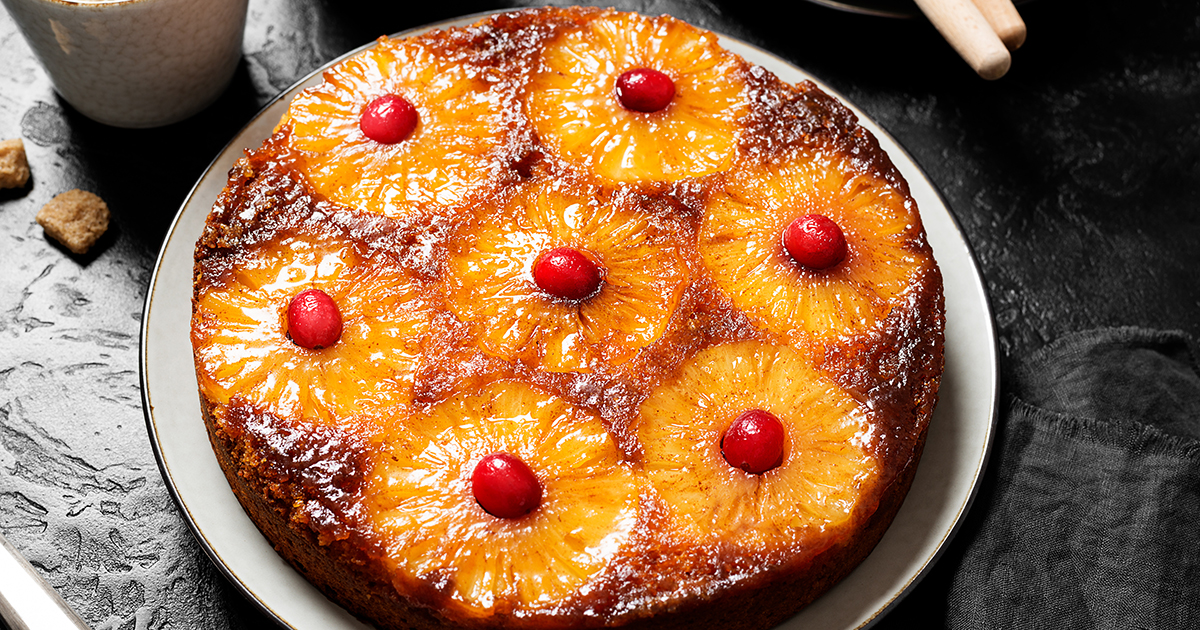
4. Pineapple Upside-Down Cake
Upside-down cake has been made in various forms for well over a century, though food historians debate when the term itself first appeared in print. It wasn’t until the early 20th century that the pineapple upside-down cake began showing up in magazines and cookbooks, following the introduction of canned pineapple. By the 1970s it had been a party staple for decades, the rings of caramelized pineapple and jewel-red maraschino cherries embedded in brown sugar glaze as recognizable as any food image of the era.
Flipping a cast iron skillet upside down to reveal a glistening, perfectly arranged topping felt like a reveal. Guests watched. The moment the pan lifted was the moment the dish announced itself. The dessert gained immense popularity in the 1970s, becoming a staple at dinner parties and potlucks, with its history traceable to the early 20th century when canned pineapples became widely available.
The dessert hit its peak in the 1960s, and while upside-down cakes are still around today, they’re usually made using different fruit. The classic version, with the full pineapple rings and the maraschino cherries in their centers, feels frozen in time, associated with a specific kitchen aesthetic, a specific set of serving dishes, a specific generation. The bones of the recipe are perfectly good, which is why bakers still make variations. But the original, with its canned fruit and its retro color palette, rarely appears as anyone’s first choice anymore.
5. Tequila Sunrise Cake
The 1970s had a habit of turning cocktails into cakes, and the Tequila Sunrise cake was perhaps the most ambitious attempt at the formula. Inspired by the tequila sunrise cocktail, this dessert is vibrant, flavorful, and has a kick. Layered into a Bundt pan, it creates a colorful sunrise effect much like the cocktail. The cake is often garnished with orange slices, maraschino cherries, or pomegranate seeds to mirror the drink’s classic presentation, and it was a popular dessert in the ’70s that embodied the fun, carefree spirit of the era.
This cake was a fairly processed affair, made by combining boxed cake mix with orange-flavored gelatin, then adding tequila, water, eggs, and oil. It was finished with tubbed whipped topping. Before the topping was spread onto the cake, the baker would poke it with a toothpick and pour over grenadine. That grenadine seeping through gave the interior a two-tone orange-and-red gradient, the whole point of the tequila sunrise in liquid form, now replicated in a Bundt.
The reliance on boxed mix and gelatin puts it squarely in an era of convenience-cooking that feels dated. And the actual tequila content, diluted through baking, was more symbolic than intoxicating, which left the cake occupying an awkward middle ground between grown-up and novelty. It was a dessert that required the right moment, the right crowd, and the right decade.
6. Jell-O Poke Cake
The poke cake, promoted by Jell-O, was a ’70s sensation for its moist texture and customizable flavors. A hit for its ease of preparation and endless flavor combinations, it spread from the pages of Jell-O promotional leaflets into recipe boxes across the country.
The method was the gimmick: bake a plain white cake, then immediately poke it all over with a wooden spoon handle or a thick straw, and pour liquid Jell-O over the top. The gelatin drips down into every hole, creating vivid streaks of color through the interior. When sliced, the cake revealed a cross-section that looked intentionally designed, bright stripes of strawberry red or lime green running through the white crumb. It was clever, and it required almost no skill beyond the basic cake bake itself.
The poke cake’s complete dependence on Jell-O as both flavor and visual device kept it alive in some kitchens and made it feel dated in others. The dessert only works if you’re enthusiastic about gelatin as an ingredient, and food culture’s relationship with Jell-O has cooled considerably since its peak. A few recipe sites have tried updating it with fresh fruit compotes poured into the holes instead, but the original, with its artificial colors and concentrated sweetness, belongs to a specific era.
7. Ambrosia
Ambrosia occupies a strange corner of the table: not quite a fruit salad, not quite a dessert, rarely invited to either category anymore. The name came from Greek mythology, where ambrosia was said to be the food of the gods. Mandarin oranges, pineapple chunks, coconut flakes, and marshmallows were all mixed with sour cream or whipped topping. At a 1970s Thanksgiving or church potluck, a bowl of ambrosia was as expected as the tablecloth.
The texture divided people: soft fruit suspended in a cloud of whipped topping, with mini marshmallows that had absorbed enough moisture to become slightly gelatinous, and coconut throughout that added something almost savory to all that sweetness. It was a dessert that asked nothing of the cook and everything of the guest’s willingness to encounter marshmallows in a fruit bowl without flinching.
Like the poke cake, ambrosia’s decline tracks with the broader retreat from Cool Whip and canned fruit as the default ingredients of celebration. The dessert still turns up at family reunions in certain parts of the South and Midwest, carried by whoever in the family has kept the recipe card. But as a mainstream dish, it faded when the era that produced it did, replaced by fruit tarts, pavlovas, and anything that could plausibly be described as “fresh.”
8. Jell-O Cookies
If the poke cake represented Jell-O’s ambitions at their most architectural, Jell-O cookies were its most direct expression. Jell-O cookies are about as ’70s as desserts come. These cookies are an undeniably retro affair that harnessed the power of Jell-O, which was a staple of recipes during the decade, with people practically obsessed with molding it into any shape they could think of. In these cookies, Jell-O was just one ingredient, sitting alongside more standard additions like flour, butter, and sugar in the cookie batter.
The addition of Jell-O to the cookies did several things. The first was to provide them with a sweet, tart flavor, which made each bite a far fruitier affair than a standard wafer. The second was to dye each cookie a fairly lurid color, producing a dessert that came out in the classic pastel colors that were such a staple of sweet food during the decade.
They were a hit at school bake sales and birthday parties. A tray of strawberry-pink and lime-green cookies looked festive and cost almost nothing to produce. The problem was always that the cookies tasted more like a chemistry experiment than a cookie. The artificial fruit flavor never fully integrated, leaving a faint chemical sweetness underneath the butter and sugar. They worked better as an idea than as an eating experience, which is perhaps why they never developed the kind of loyal following that kept other retro treats alive.
9. Black Forest Cake
The Black Forest cake deserves its own conversation, because unlike most of the desserts on this list, it never completely disappeared. It just stopped being special. Also known as the Schwarzwälder Kirschtorte, Black Forest cake has been around for quite a while, but it really caught on in popularity in the U.S. in the 1970s, when it seemed to show up on every restaurant’s dessert menu.
At its peak, it arrived layered: chocolate sponge soaked in Kirsch (cherry brandy), alternating with whipped cream and morello cherries, finished with more cream, grated dark chocolate, and whole cherries on top. It was tall. It was dark. It smelled like something a serious cook had spent hours on. In the 1970s, serving a Black Forest cake signaled that you knew what you were doing.
Supermarket versions appeared: chocolate sponge, a thin layer of cherries in corn syrup, canned whipped topping, chocolate shavings from a packet. The cake kept the name and the silhouette but lost everything that made it worth eating. By the time home cooks lost interest in making the real version, the imitation had already taken its place, and neither the imitation nor the original shows up at dinner tables much anymore.
What We Actually Lost
Every one of these desserts was built for an audience. Baked Alaska needed to be flambéed in front of someone. The poke cake revealed its stripes only when you cut into it. The pineapple upside-down cake had its moment when the pan came off. These were desserts with a built-in reveal, a small piece of theater that asked the room to pay attention.
By the 1970s, older homespun desserts like junket custard had already largely faded in popularity, replaced by refrigerated staples such as Jell-O and boxed puddings. The desserts on this list were the next wave, and they followed the same arc: rise, ubiquity, obsolescence. Each generation of convenience ingredients elbows out the one before it. What replaced the 1970s dessert table wasn’t better food, necessarily. It was different food shaped by different anxieties, different aesthetics, different kitchens.
Making a dessert that did something has largely been replaced by desserts that look like something. The plating era, the Instagram era, has produced beautiful food. But beauty captured in a photograph and beauty experienced at a table are different things. A Baked Alaska looks ridiculous in a photo. A tray of pastel Jell-O cookies looks dated. Put either of them in front of people who’ve never seen one and the reaction is almost always the same: genuine surprise that this was once an ordinary Tuesday night dessert.
Some of these recipes are better off where they are. Others deserve a closer look. The Harvey Wallbanger cake, made with good-quality Galliano and real orange juice in a proper Bundt pan, is significantly better than its reputation. The original Black Forest cake, built from scratch with Kirsch-soaked sponge and real whipped cream, is in a different class entirely from the supermarket version that replaced it. Whether they come back in any meaningful way is probably beside the point. They’re worth knowing about, which is most of what history asks of a dessert.
Disclaimer: This information is not intended to be a substitute for professional medical advice, diagnosis, or treatment and is for information only. Always seek the advice of your physician or another qualified health provider with any questions about your medical condition and/or current medication. Do not disregard professional medical advice or delay seeking advice or treatment because of something you have read here.
AI Disclaimer: This article was created with the assistance of AI tools and reviewed by a human editor.