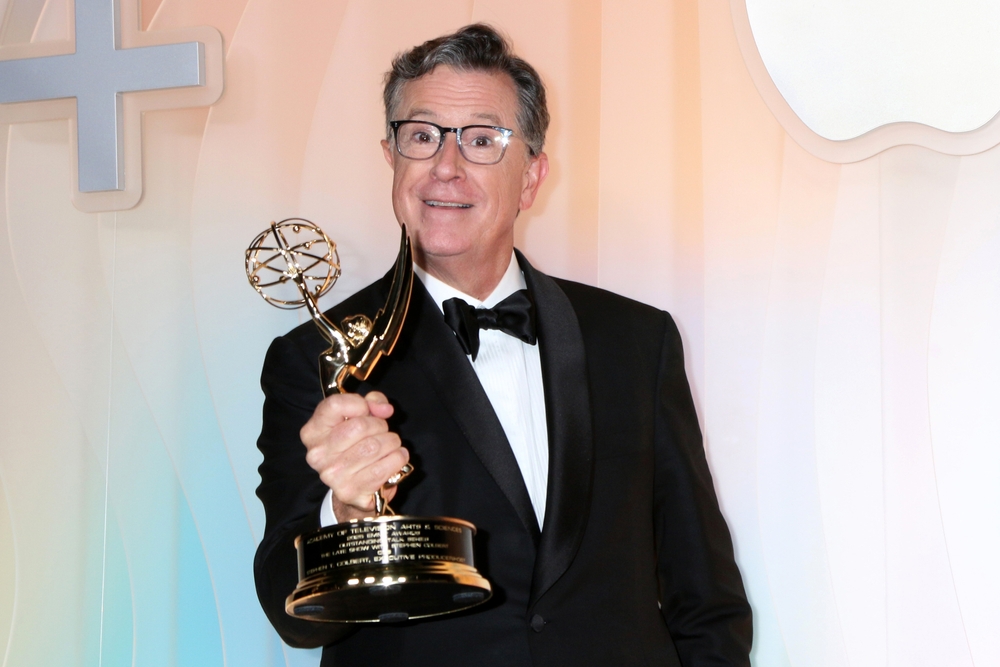

Stephen Colbert’s final broadcast of The Late Show aired on the night of May 21, 2026, eleven years after he first walked onto the Ed Sullivan Theater stage. Paul McCartney was the last guest. The house band played. The crew gathered on stage. Colbert thanked the audience, thanked his staff, and said goodnight. It was warm, celebratory, and conspicuously free of any direct mention of Donald Trump. By 2 a.m., Trump was on Truth Social.
That gap between a gracious farewell and a presidential midnight rant tells you something about the dynamic these two men have had for years. Colbert spent more than a decade using his CBS platform to lampoon, fact-check, and frankly antagonize Trump at every opportunity. Trump spent much of that same decade loudly demanding his firing, questioning his ratings, and calling for his network’s broadcast licenses to be revoked. Now that the show is over, you might expect some version of mutual disengagement. Instead, the social media posts are still coming.
The 2 A.M. Post and What Came After
Shortly before 2 a.m., Trump posted on Truth Social: “Colbert is finally finished at CBS. Amazing that he lasted so long! No talent, no ratings, no life. He was like a dead person. You could take any person off of the street and they would be better than this total jerk.” That was only the beginning.
On Friday morning, Trump followed up on Truth Social, writing that Colbert’s “firing from CBS was the ‘Beginning of the End’ for untalented, nasty, highly overpaid, not funny, and very poorly rated Late Night Television Hosts. Others, of even less talent, to soon follow. May they all Rest in Peace!” Colbert, for his part, never mentioned Trump by name during his final episode.
Instead, he made just one subtle reference to the president, buried inside his interview with Paul McCartney. While McCartney was recalling the Beatles’ 1964 American television debut at that same Ed Sullivan Theater, he mentioned that in England they’d gotten used to wearing stage makeup, but the makeup applied there came out “bright orange.” “That’s very popular in certain circles these days,” Colbert said. The crowd laughed. Trump, apparently, did not.
Then came the video. Posted to Trump’s Truth Social account, the clip appears to use edited footage of The Late Show set combined with AI-generated elements. In it, Colbert is shown delivering what looks like a farewell-style monologue, before Trump appears in the scene, grabs Colbert, and throws him into a large green dumpster on the stage. The video then cuts to Trump dancing in front of the dumpster to the Village People’s “YMCA,” while a studio audience looks on.
The AI-generated video arrived roughly 17 hours after the president’s middle-of-the-night Truth Social post.
The Ratings Claim That Didn’t Hold Up
One consistent thread through Trump’s social media posts was the insistence that Colbert had “no ratings.” The actual numbers made that argument awkward almost immediately.
According to preliminary Nielsen data reported by The Hollywood Reporter, Colbert’s farewell broadcast drew 6.74 million viewers, the largest audience of his entire tenure and more than double his typical viewership. The finale was the most-watched weeknight episode in the show’s eleven-year run. For context, the show had averaged 2.69 million viewers across its final season.
Colbert actually exited ranked No. 1 in late night, with a 2.7 million average during the first quarter of 2026, comfortably ahead of ABC’s Jimmy Kimmel Live at 2.53 million and NBC’s Tonight Show at 1.33 million. The posts didn’t change course when those numbers came in. They kept going. For someone who had, by his own account, already won, the fixation was hard to square with the victory lap.
A Feud That’s Been Running for Years
None of this came out of nowhere. A 2017 analysis by Newsweek found that in Trump’s first 100 days in office alone, Colbert delivered 337 Trump-themed jokes on The Late Show, more than any other late-night host during that period. The relationship between the two only sharpened from there.
Trump had been gunning for Colbert for years. Back in 2024, he posted on Truth Social that “CBS should terminate his contract and pick almost anyone, right off the street, who would do better, and for FAR LESS MONEY.”
As recently as December 2025, with the show still on air but its cancellation already announced, Trump posted on Truth Social that Colbert was “a pathetic trainwreck, with no talent or anything else necessary for show business success” and was “running on hatred and fumes.” That post, reported by Deadline, raised eyebrows for its “put him to sleep” phrasing, a phrase commonly associated with animal euthanasia.
After CBS announced the cancellation last summer, Trump wrote on Truth Social that “I absolutely love that Colbert got fired.” Colbert fired back on-air, telling the president, “Go f— yourself” (with the f-bomb bleeped out on the CBS telecast).
Ahead of his finale, Colbert told People magazine that he had “no fear” of the Trump administration. “How silly would it be?” he said. “The ending of the show aside, which people can speculate about all they want, and I can’t argue with their speculations, but we’re clowns. How much does it diminish the office of the presidency to even notice what we say?” Trump, who noticed plenty and said so repeatedly, did not appear to catch the irony.
The Cancellation Nobody Fully Believes Was Just About Money
The official explanation for why The Late Show ended is straightforward: money. CBS called the cancellation “purely a financial decision against a challenging backdrop in late night.” The economics of late-night TV have been deteriorating for years as audiences migrate to streaming and on-demand clips, taking advertising revenue with them.
The timing, though, made that explanation hard to swallow for a lot of people. The cancellation came in July 2025, just days after Colbert had called CBS parent company Paramount’s $16 million settlement with President Trump a “big fat bribe” on-air. Many saw that settlement as designed to ensure the Trump administration’s FCC would approve the company’s merger with Skydance Media. The timing of the cancellation caused widespread speculation that the two things were connected.
On July 18, 2025, Senator Edward J. Markey wrote to Paramount Global Chair Shari Redstone demanding answers about the circumstances surrounding the cancellation, specifically requesting whether anyone in the Trump administration had asked for the show to be canceled. “Paramount should not be making editorial decisions or compromising its editorial independence at the behest of or under pressure from the government, including in the context of securing FCC merger approval,” Markey wrote.
CBS and Paramount denied that politics had anything to do with the decision. FCC Chair Brendan Carr also denied that the cancellation resulted from political pressure. Colbert himself told the New York Times that he believed both explanations could be true: that the show was costing CBS too much to continue, and that the politics were tangled up in it. “I do not dispute their rationale,” he said of the rumors, while adding that he “completely understood” why people would find it “fishy.”
The Broader Target List
Colbert was never the only one in Trump’s crosshairs. He was just the most prominent, and now the most convenient symbol.
Colbert, ABC’s Jimmy Kimmel, and NBC’s Seth Meyers have all been frequent targets of the president, who has repeatedly called for their firing and suggested that their criticism of him should cost their networks’ broadcast licenses. Trump also went after Kimmel after Kimmel made a joke about Melania at a fake White House Correspondents’ Dinner, quipping that she had the glow of an “expectant widow.” Less than a week later, the FCC’s Media Bureau ordered ABC to reapply for broadcast licenses for its eight owned stations on an accelerated schedule.
The question of whether any of this constitutes government pressure on private media companies, rather than just a president venting on social media, is one that legal scholars and press freedom advocates have been wrestling with since 2025. The AI-generated content adds a newer wrinkle. When a sitting president uses synthetic video to depict a real person being thrown in a dumpster, the technology stops being an abstract concern and becomes something more concrete.
AI-generated images of political figures have proliferated across Truth Social and other platforms over the past year.
Read More: Meet Milla Sofia, The AI-Generated Influencer With Thousands of Fans
A Finale That Spoke Without Saying Much
Colbert’s final show on May 21 featured a roster of celebrity and musical guests, including Paul McCartney, who helped bring the curtain down on the show after 11 seasons. Others who appeared included Bryan Cranston, Paul Rudd, Ryan Reynolds, Tim Meadows, and Tig Notaro.
Colbert used his final episode to reflect on his 11-season tenure, choosing a celebratory tone over political commentary. Prominent figures including Barack Obama, Hillary Clinton, and Kamala Harris later praised his work and influence. Obama wrote that Colbert had been “one of the top voices of late night, making us laugh and, even more importantly, reminding us who we are and what America stands for.”
As for what’s next, Colbert is scripting a Lord of the Rings film for Warner Bros., a dream project for the longtime Tolkien devotee. He has said he has no plans to get into politics, despite what was described as a mild endorsement from former President Obama.
The only official response from Colbert’s camp to Trump’s post-finale social media barrage was a simple photo and a simple caption: “thank you!”
What the Dancing in Front of the Dumpster Actually Tells You
Here’s what makes the past few days genuinely strange: by Trump’s own measure, he won. The show is gone. The host he spent years demanding be fired has been fired. The network that employed him settled a lawsuit, backed down, and approved a merger under a new ownership structure that Trump is reportedly comfortable with. There is no more Monday night monologue about his cabinet, no more Colbert walking out to a roaring audience to take another crack at the administration.
And yet the posts kept coming. The AI dumpster video arrived nearly 17 hours after the 2 a.m. rant, which itself came hours after the show ended. Taken together, the posts follow a pattern that has become familiar in Trump’s online communication style: his Truth Social feed saturated with AI-generated imagery, altered photos, and symbolic victory narratives depicting him towering over opponents, being celebrated by crowds, or restoring order in dramatic visual form. The Colbert video doesn’t attempt to rebut ratings data or engage with anything Colbert actually said. It just puts an opponent in a dumpster and plays “YMCA.”
Colbert spent eleven years pointing a camera at all of this and asking the audience to laugh at it. Whether that did any measurable political good is a question without a clean answer. What is clear is that the attention didn’t end when the cameras did. The show wrapped. The response didn’t. And the dancing-in-front-of-a-dumpster video is now part of the public record of how a sitting American president chose to mark the occasion.
AI Disclaimer: This article was created with the assistance of AI tools and reviewed by a human editor.