
Trump has always been good at controlling what people see. He controls the lighting, the staging, the cadence of his rallies, and, for years now, the particular shade of orange that greets the cameras wherever he goes. So when photographs from the G7 summit in France on June 16, 2026 showed a president who appeared pale, drawn, and minus the bronzer that has become as associated with him as the red tie, a lot of people noticed. It wasn’t just a grooming story. It arrived in the same seven-day window as a slur shouted from the White House lawn, an unexplained mark on his hand, and reports that he’d dozed off at a Cabinet meeting after a three-hour medical visit. All of it fed a conversation that the White House was not particularly equipped to shut down.
The Trump appearance change had come up before, in photographs, in late-night jokes, in a thousand social media threads debating whether the orange was bronzer or self-tanner or something else entirely. But the G7 images were different. They showed something people rarely see: the man underneath the product. And in his 80th year, in one of the most consequential weeks of his second term, that image carried more weight than any press release about a clean bill of health.
The week of June 14 compressed several different storylines into one continuous news event, and none of them were easy for the White House to spin.
The Night at the White House
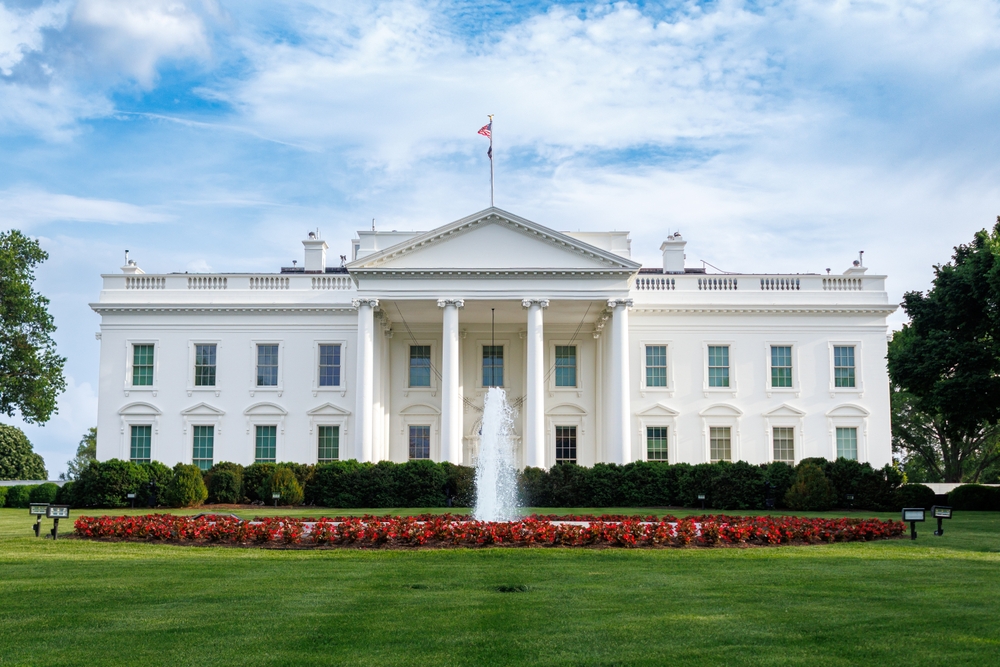
Trump hosted the UFC fight night on the White House South Lawn as part of the programming for America’s 250th anniversary, watching from a cage-side seat between First Lady Melania Trump and UFC CEO Dana White, with his entire immediate family in attendance. UFC covered the estimated $60 million cost for the outdoor event, which featured a massive lighting structure known as “The Claw.”
A watchdog group, the Public Integrity Project, had filed a lawsuit attempting to halt the event, calling the planned fights “deeply corrupt” and arguing that the construction of the venue on federal parkland required congressional approval that was never obtained. The lawsuit also noted that a recent financial disclosure showed Trump himself owns up to $50,000 of stock in the company that owns UFC.
The legal challenge didn’t stop the show. Fight fans were treated to a night of wild knockouts, culminating in two stunning upsets in the co-main bouts, with American Justin Gaethje crowned the new lightweight champion after dethroning Ilia Topuria. But it was what happened after one particular fight that generated the most lasting attention.
The Comment That Changed Everything
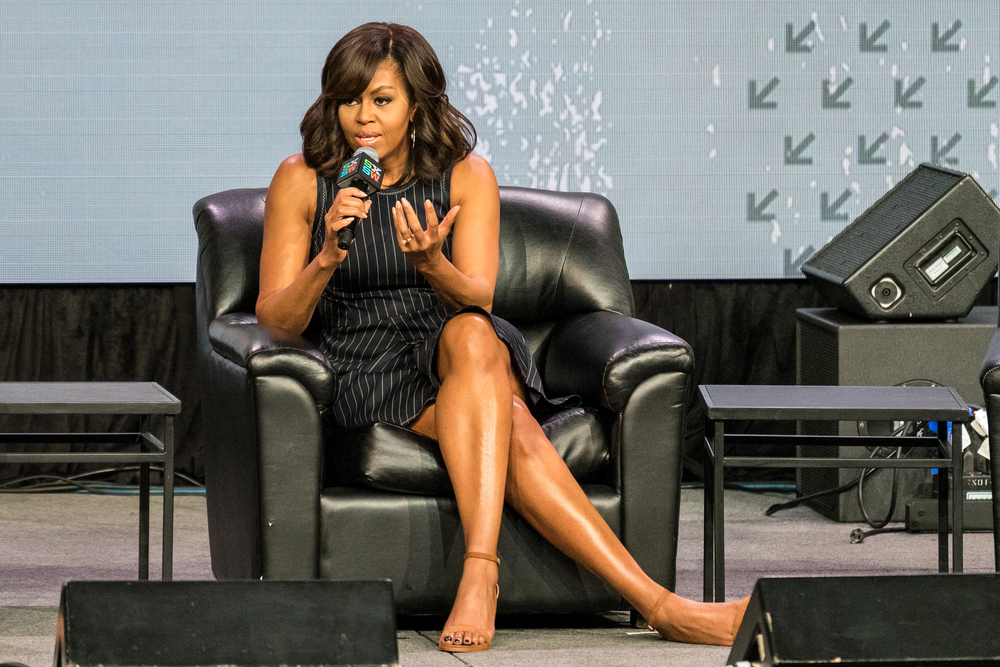
Heavyweight competitor Josh Hokit shocked viewers with his post-fight comments after defeating Derrick Lewis on the South Lawn. Speaking to podcaster Joe Rogan, he said: “Michelle Obama is a man. Am I right, America?” Rogan chose not to engage with the statement, simply responding: “Ladies and gentlemen, Josh Hokit.”
As Hokit made his statement, the crowd burst into cheers, with many also seen applauding the declaration. Trump, who was seated in the front row during the match, “appeared to show a half-smile” following Hokit’s remarks, CNN reported.
The president has since failed to condemn the offensive statement. Taking to Truth Social after the event ended, Trump made no reference to Hokit’s remarks, instead launching into a rant about the Democrats.
What Trump did say, moments earlier at ringside, became its own story. After his win over Derrick Lewis, Hokit was spotted chatting with Trump ringside. Lip reader Jeremy Freeman shared his interpretation of Trump’s words to the fighter. According to Freeman, after Hokit placed a chain around Trump’s neck, the president responded: “Too kind, thank you. You are the champion.”
Sunday wasn’t the first time that Hokit had discussed the former first lady; in 2025, the fighter had also incorrectly claimed that she was a man. He has also declared that he was “100 percent transphobic.” In an interview with MMA Fighting, Hokit explained that his provocative behavior is designed to help him stand apart from others and give himself a competitive advantage as an entertainer.
Michelle Obama, for her part, was absent from the entire controversy in real time. She had chosen to skip Trump’s 2025 inauguration. When she did eventually speak publicly that same week, it was at the dedication ceremony for the Obama Presidential Center. While the former first lady did not mention Trump by name, several lines in her speech drew a clear contrast with the current president. She referenced Obama winning a Nobel Peace Prize, and later commented that “a lasting legacy isn’t an award, a name on a building, or the number of zeros in a bank account, but the difference we make in one another’s lives.”
From the South Lawn to the G7
The birthday celebrations ended. The president boarded a plane. And something changed.
After staying late celebrating his birthday at the UFC event before flying to the G7 Summit in Évian-les-Bains, France, Trump arrived at the Group of Seven summit looking, by multiple accounts, markedly different. A Salon columnist noted that the 80-year-old president seemed unusually low on energy in a setting where his meetings with European leaders have typically turned combative and hostile.
The specific detail that caught the most attention was one most people wouldn’t normally notice: his makeup. At the G7, Trump appeared to have forgotten his usual bronze makeup, which was described as “a startling sight,” and his energy was notably low.
For a president whose appearance has been a talking point for years, the sight of him without his signature bronzed look registered as something more significant than a grooming oversight. According to Wikipedia’s detailed entry on Trump’s use of cosmetics, the use of makeup by Trump, the 45th and 47th president of the United States, has been a subject of media coverage since before his entry into electoral politics. He has been reported to apply his own makeup, and suggestions that his hue results from bronzers, self-tanning agents, or tanning devices have been disputed by White House aides and associates.
The internet has long been full of speculation about Trump’s makeup routine, particularly his use of bronzer, with many criticizing his apparent lack of blending. His makeup choices have sparked pop culture fascination, with headlines focusing on the noticeable shade differences between his face, ears, and neck in various public appearances.
At the G7, all of that was gone. And in its absence, observers were looking at something they rarely see.
What the Makeup Was Doing
Trump’s relationship with bronzer has never been purely cosmetic. For years, people have wondered why he applies layers of bronzer in such a notoriously thick way onto his aging skin. Lately, though, there have been glimpses of his actual makeup-free complexion with increasing frequency.
On February 16, a close-up photograph of Trump was taken showing a man who looks very different from the overly bronzed figure most people are accustomed to seeing. Without the bronzer, Trump appeared haggard, with eyes that seemed puffy, red, and tired, his hair looking white and weakened, his furrowed brow seemingly permanently etched into his wrinkled face.
Makeup artist Kriss Blevens, who has worked with every United States president since Jimmy Carter, including Trump as recently as 2023, observed that Trump’s face was “bronzer” than other portions of his flesh and surmised he deployed self-tanning agents to reflect his Floridian lifestyle. The bronzer, stripped away at the G7, had long been doing more than evening out a complexion. For a man who built a brand on projecting dominance, health, and physical vigor, it was cover, in the most literal sense. The G7 photographs, in which that cover was absent, prompted a level of public commentary about his physical condition that the White House could not simply wave away.
The Health Questions That Won’t Go Away

Observers highlighted multiple moments around the same period where the 80-year-old president appeared unusually tired, subdued, and stiff in his movements. The UFC event itself had generated scrutiny before Hokit ever opened his mouth.
Following Trump’s physician Dr. Sean Barbabell giving him a clean bill of health, the commander-in-chief appeared to doze off during a televised Cabinet meeting after a three-hour medical visit to Walter Reed National Military Medical Center. At the time, it was Trump’s first visit to the medical center in 13 months, following exams in April and October 2025.
At the G7 itself, a separate image drew its own wave of commentary. President Trump stepped out for the summit with a new mark on his hand, a crescent-shaped mark on his left hand visible as he gave a thumbs-up during a working session with other world leaders. The new mark appeared on the opposite side of his chronically bruised right hand. The White House did not offer an explanation when reached for comment, instead focusing on Trump’s busy schedule.
The combination of the unusual mark, the missing makeup, the reported exhaustion, and the imagery from the UFC event fed a news cycle that ran almost entirely on visual evidence. Nobody had access to his medical records. What they had were photographs, and the photographs were doing a lot of work.
The Michelle Obama Thread
The slur that Josh Hokit directed at Michelle Obama on the White House lawn didn’t land in a vacuum. It landed in a political moment already saturated with commentary about the former first lady. Obama had admitted she “sobbed” after Trump’s first inauguration and caused a stir after she skipped out on Jimmy Carter’s funeral. Speculation rose that she didn’t want to be seated next to Trump and Melania, though her team explained her absence was due to scheduling conflicts.
She addressed the divorce rumors that had originated from her husband attending events alone: “People couldn’t believe that I was saying no for any other reason, they had to assume that my marriage was falling apart.” She revealed: “It took everything in my power to not do the thing that was perceived as right, but do the things that was right for me.”
And then the Obama Presidential Center dedication speech, coming within days of the UFC incident, brought the contrast into sharp focus. Here was one former president’s wife speaking about legacy and service, and here was the sitting president’s birthday party producing a moment so inflammatory that it dominated the news for days, with no condemnation from the White House.
Obama recalled that her husband remained “unflappable at every turn” despite the pressures that came with being the nation’s first Black president, including the false attacks on his birthplace and faith. The contrast between that account of steady dignity and the images from the South Lawn the previous Sunday didn’t require any editorial commentary.
What This Actually Means
The week of June 14, 2026 compressed several different stories into one continuous news event: the spectacle of a UFC fight on the White House lawn, a fighter’s offensive slur that the president smiled at and never denounced, a flight to Europe, and then photographs of a man who looked, to put it plainly, tired. The bronzer was gone. The energy was low. The bruise on the hand was unexplained.
Each of those things, individually, could be dismissed. Together, they formed a picture that a lot of people found hard to look away from.
For a president who built so much of his political identity on personal strength and physical vigor, the photographs from France landed differently than any policy story. The White House can issue clean bills of health. It can redirect questions to busy schedules. What it cannot do is control what photographs show, and in the days after the G7, the photographs kept circulating. Some of these questions will keep being asked regardless of what the answers are. The presidency has always been a performance of power, and what happens when the costume comes off in public, even briefly, tends to linger longer than any speech.
AI Disclaimer: This article was created with the assistance of AI tools and reviewed by a human editor.