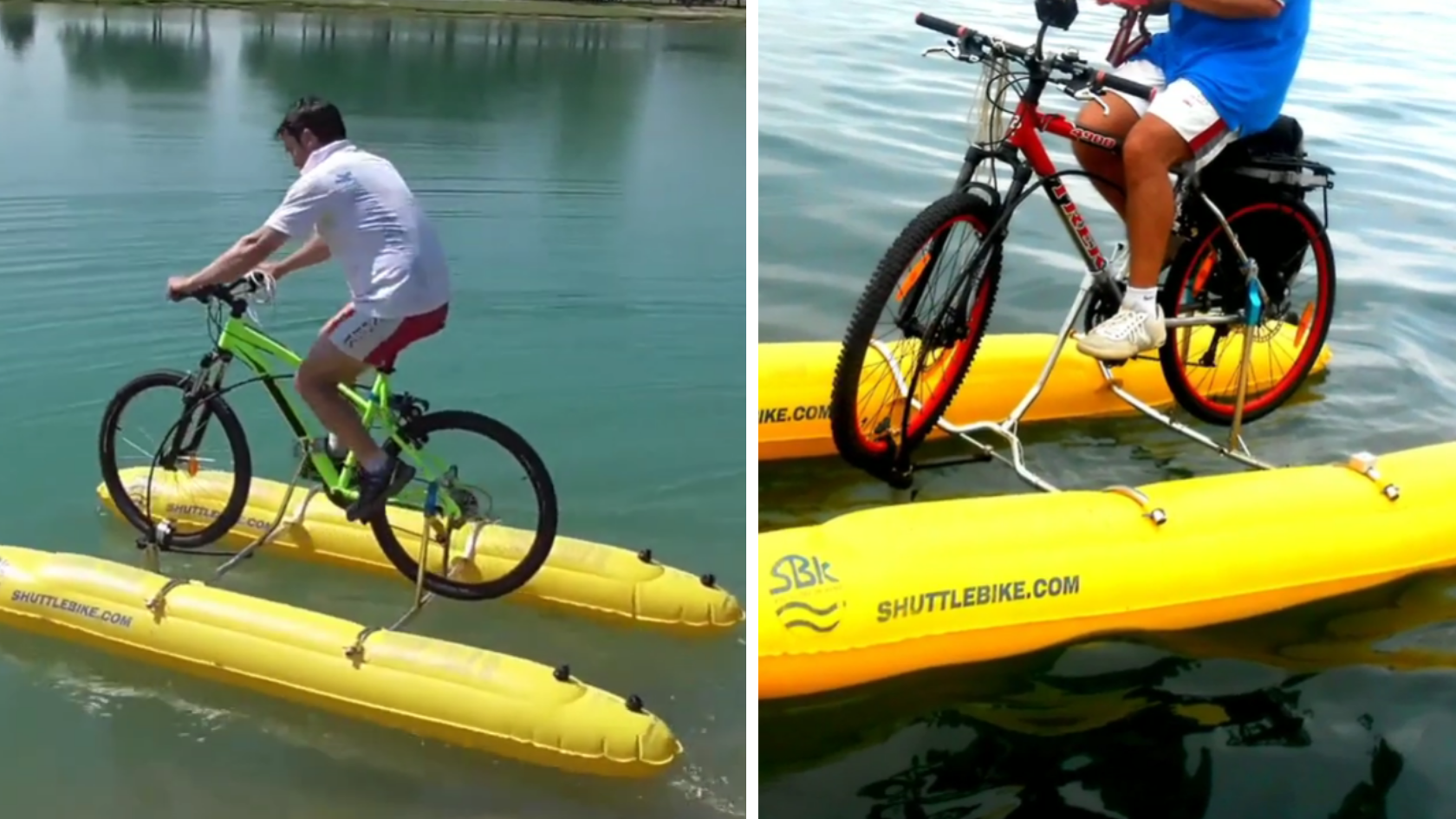

The Shuttle Bike does something that sounds almost made up the first time you hear it. It lets you take a regular bicycle and use it on the water. Not by riding straight into a lake and hoping for the best, but by attaching your bike to a floating pedal-powered system designed to carry it across the surface. Once everything is connected, the bike becomes part of a setup that lets you pedal, steer, and move over the water in a way that still feels connected to cycling.
That is what makes the Shuttle Bike so interesting. It does not ask people to buy a full, separate watercraft and learn an entirely new activity from scratch. It starts with something familiar, your bike, then builds outward from there. The result feels part cycling, part boating, and part outdoor gear experiment in the best sense. It is unusual enough to catch attention right away, but practical enough that you can understand how it fits into a real day outdoors.
The Shuttle Bike Starts With a Regular Bicycle
One of the smartest things about the Shuttle Bike is that it does not throw away the logic of riding a bike. Your bicycle is still central to the whole setup. You are not sitting in a generic floating machine with bike parts attached for decoration. The actual bicycle becomes part of how the whole thing works. You pedal as you normally would, and that movement helps drive you across the water.
That familiarity makes a big difference. A lot of outdoor equipment can feel intimidating because it comes with a completely new posture, new controls, and a new learning curve. The Shuttle Bike avoids some of that by keeping the rider connected to a motion they already understand. Pedal, steer, adjust, keep your balance. The environment changes, but the basic rhythm is still there. That makes the whole thing feel more approachable than a lot of people might expect when they first hear about a bike being used on water.
It Floats Using Inflatable Pontoons
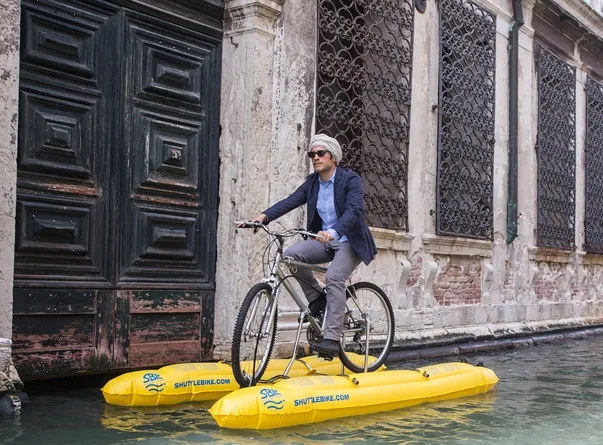
The reason the Shuttle Bike can work at all comes down to flotation. The official Shuttle Bike setup uses pontoons that sit on either side and keep the system stable on the water. According to the official product page, those pontoons are made from a special plastic fabric with a nylon layer for added strength and impact resistance, and they are electro-welded rather than glued.
That part matters because without reliable floats, the whole concept would feel like a novelty rather than something people could actually use. The pontoons are what turn the bicycle from a land vehicle into part of a floating system. They give the Shuttle Bike its base and make it possible for the rider to move above the surface instead of sinking straight down into the obvious problem with putting a bike on water. The design is playful, but the flotation side clearly had to be taken seriously for any of it to work.
The Frame Is Built To Handle Real Water Use
There is a big difference between something that looks clever online and something that can hold up outside. The Shuttle Bike seems to take that seriously in the way its frame is built. The official product page says the structure uses interlocking AISI 316 steel pipes designed for stability and shock absorption when dealing with impacts or unusual wave movement.
That gives a better sense of what this is meant for. The Shuttle Bike is not only supposed to sit prettily on perfectly still water for a photo. It is meant to move. Water is unpredictable, even when it looks calm from a distance. Small waves, awkward landings, and uneven movement all place pressure on a structure. The steel frame helps the whole setup feel more like equipment and less like a temporary gadget. It also shows that the design is not built only around the idea of fun. It is built around the reality of actually being used.
Steering Still Feels Like Riding a Bike
One of the most satisfying parts of the Shuttle Bike design is that steering remains connected to the bike. According to the official product page, the rudder hooks to the base of the front wheel, which allows the rider to maneuver and guide the setup with more precision.
That detail helps preserve the feeling of cycling even when the environment changes completely. You are not suddenly dealing with an unrelated control system bolted onto a weird floating platform. The bike still helps determine direction. That makes the whole experience feel more unified. It also makes the Shuttle Bike easier to understand in practical terms. If people can already picture how they steer a bike, then they already understand part of how this works. The company also says the rudder has a tilting joint that lets it lift when approaching shore or passing over obstacles, which is the kind of small but useful feature that makes the setup feel more thought through.
Pedaling On Water Is Still The Main Experience
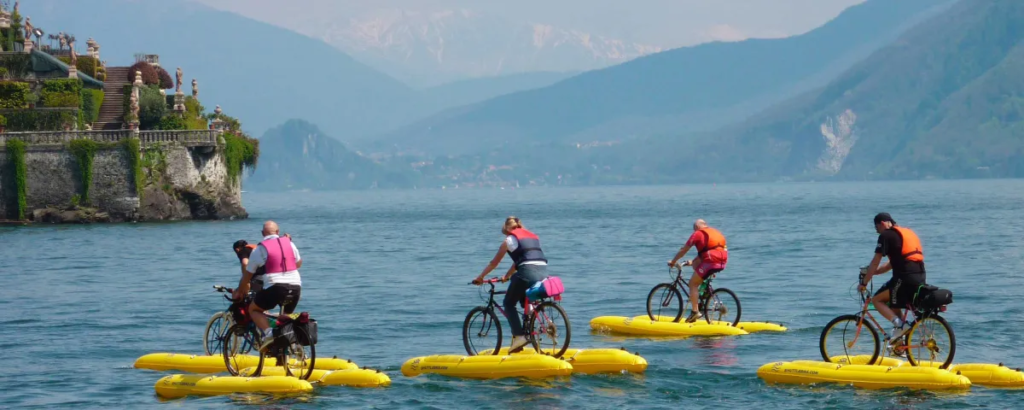
The Shuttle Bike would not be nearly as interesting if your bike just sat there while some separate motor or hidden mechanism did the work. The whole point is that pedaling still matters. On the official site, the company explains that the rear wheel movement is transferred through a traction system using bevel gears and a roller, and that the bike’s own gears can still be used to increase pedaling speed.
That means the water ride still feels physical. You are not drifting lazily unless you choose to stop. You are moving because your body is making the setup move. That is probably one reason the Shuttle Bike feels more engaging than a regular pedal boat. It keeps the athletic side of cycling alive while changing everything around it. The rider is still active, still involved, still doing the work. That makes the setup feel less like a gimmick and more like a genuine crossover between cycling and water recreation.
The Shuttle Bike Is Designed To Be Portable
A lot of outdoor gear sounds fun until you imagine the hassle of hauling it around. That is where the Shuttle Bike has an obvious advantage. The official site says the kit is portable enough to be carried in a simple backpack and brought to the place where you want to use it.
That changes the whole feel of the product. Instead of being something that needs its own storage area, trailer, or permanent launch setup, it becomes something you can bring with you. That kind of portability makes the Shuttle Bike more realistic for people who do not live beside the water and do not want another large piece of equipment taking over their garage. It fits the same general spirit that makes bicycles appealing in the first place. The setup is lighter, simpler, and less demanding than many people would expect from something that lets you pedal on a lake or river.
It Has a Handmade Identity
The Shuttle Bike is manufactured in Italy by SBK Engineering, and the company describes it as a handmade, Made in Italy product. That detail gives it a slightly different feel from mass-market outdoor gear. It sounds less like something pushed out in giant anonymous batches and more like a specialized product with a clear design identity behind it.
That matters because the Shuttle Bike is already unusual by nature. It sits in a category that most people do not think about until they see it. Knowing it comes from a specific maker with a focused concept behind it helps explain why the design feels so cohesive. It is not just random parts assembled around a strange idea. It is a product that has clearly been developed with a particular experience in mind, getting people onto the water using the motion and structure of a regular bicycle.
Not Every Bike Setup Will Be The Same
One practical point that makes the Shuttle Bike sound more realistic is that compatibility still matters. The company includes guidance on choosing the best bicycle for the kit and also says people with special bikes can contact them for customized quotes. That is a sensible approach. It acknowledges that not every bike frame is identical and that a conversion setup like this needs to fit properly to work well.
That kind of honesty makes the Shuttle Bike seem more grounded. It is not pretending every bike on earth can instantly become a perfect watercraft with zero thought. It is built around adaptability, but also around the fact that some bicycles will match the system better than others. The rear clamps even come with different shims to fit different tube diameters, according to the official product page. That is the kind of detail that helps separate a serious product from a clever sketch.

The Shuttle Bike Sits Between Sport And Leisure
The Shuttle Bike is easy to picture as a recreational item, and it definitely is that. The company describes it as being for fun, practice, and adventure, and also notes that it has been used by resorts and seaside hotels near lakes, rivers, and coastal areas. But it also has a sportier side than people might assume at first glance.
Because you are still pedaling and steering, the experience keeps a physical element that many other water activities do not. It is not passive. You are not just floating around while the equipment does everything for you. That blend is part of what makes the Shuttle Bike memorable. It gives people an outdoor activity that feels unusual right away, but it still relies on real movement and coordination. It is playful without being lazy, and active without feeling too serious. That middle ground is probably a big reason it has kept people interested for so long.
It Changes What People Expect From a Bicycle
What makes the Shuttle Bike so satisfying as a concept is that it expands the idea of what a bike can do. People are used to thinking of bicycles in very fixed terms, roads, paths, hills, traffic, trails. The Shuttle Bike breaks that pattern by taking the same basic machine and shifting it into a completely different environment. Suddenly, the bicycle is no longer just a land object. It becomes part of something amphibious.
That kind of shift is what makes good design so interesting. It takes something familiar and repositions it in a way that feels surprising but also logical once you see it. The Shuttle Bike does not ask people to abandon the bicycle. It asks them to imagine it differently. For outdoor enthusiasts, that is a very appealing idea. Instead of buying into a separate world of boating culture, storage, and equipment, you start with the bike and let it become something else for a while.
Final Thoughts
The Shuttle Bike is a water-conversion kit that lets a standard bicycle become part of a floating pedal-powered ride. It uses inflatable pontoons, a corrosion-resistant frame, a rudder connected to the front wheel, and a traction system that turns pedaling into water movement. According to the official site, it is portable enough to carry in a backpack and designed to preserve the familiar feel of riding while adapting it for lakes, rivers, and coastal use.
What makes the Shuttle Bike stand out is how naturally the concept fits together once you understand the parts. Your bike still matters. Your pedaling still matters. Your steering still matters. The water changes the setting, but not the basic relationship between rider and machine. That is why the Shuttle Bike feels more interesting than a simple novelty. It takes something people already know and gives it a second life on the water. If you want, I can also rewrite this into a more magazine-style version with a stronger intro and smoother flow.
This article was created with the assistance of AI tools and reviewed by a human editor.