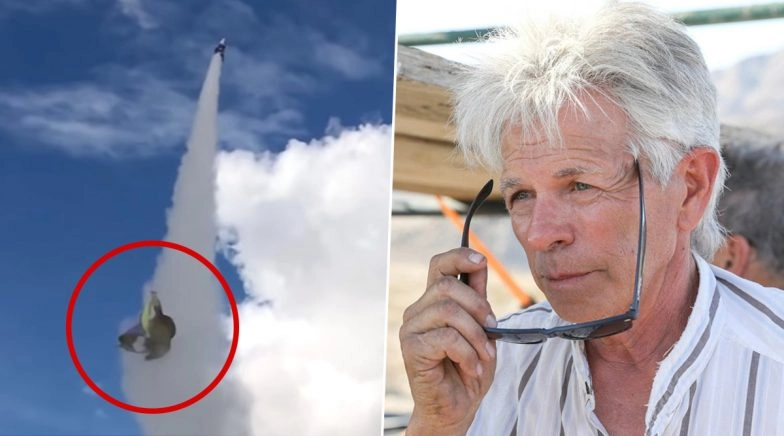

For a long time, “Mad” Mike Hughes sounded like the kind of person people talk about online without ever expecting the story to become real. He was a limousine driver, a daredevil, and a man who claimed he wanted to prove the Earth was flat by launching himself in a homemade steam-powered rocket. That idea was so extreme that many people treated it like a joke, a hoax, or a publicity stunt that would never leave the ground. Then, in March 2018, he actually did it. Hughes launched in the Mojave Desert, climbed to about 1,875 feet, and came down hard, but alive. He did not prove the Earth was flat, and he did not come close to space, but he did manage the one thing most critics thought he would never do. He really built the rocket, got inside it, and took off. That alone was enough to turn him from a fringe curiosity into a much bigger news story.
What made the whole thing so memorable was the clash between the claim and the reality. The claim was huge, absurd, and impossible to take seriously. The reality was much smaller, much rougher, and much more human. Hughes was not some polished figure from a lab or a well-funded team. He looked like a self-made stuntman pushing obsession, attention, and homemade engineering into one unstable project. That made the story easy to laugh at, but also strangely hard to ignore.
Who Mad Mike Hughes really was
Hughes did not come out of nowhere. Long before the rocket story blew up, he had already built a reputation as a daredevil willing to take unusual risks. Public profiles described him as someone drawn to homemade rocket projects, public spectacle, and a style of self-promotion that depended on doing things most people would never attempt. He was not operating inside the world of professional aerospace work. He was closer to an old-school stunt figure, the kind of person who builds his own myth by doing dangerous things in front of an audience.
That background matters because it explains why the launch was never just about the Earth. Hughes already knew how to turn danger into a story. He talked about future missions, bigger goals, and plans that kept the spotlight on him. He did not present himself like a careful investigator. He presented himself like a man willing to put his body where his mouth was, whether the idea made sense or not. That kind of commitment made him easier to remember than the average loud personality online. He was not only talking. He was acting.
Why the flat-Earth angle changed everything
If Hughes had simply been a homemade rocket daredevil, he still might have received some press. But the flat-Earth angle pushed the story into a completely different lane. It gave the stunt a built-in argument and turned it into something much easier to headline, mock, and share. Instead of being just another dangerous personal project, it became a public test attached to one of the internet’s most famous fringe beliefs. Hughes said he wanted to gather evidence for himself, and that claim gave the launch its strange mix of comedy and menace.
Later, the story got even stranger when people around Hughes disagreed about how sincere that belief really was. After his death, his public relations representative suggested the flat-Earth message had partly been a tool for publicity and fundraising. Others who knew him seemed to believe at least some of it was genuine. That uncertainty still hangs over the story. It is one reason Hughes remains more interesting than a simple punchline. He seemed to live in that blurry zone where performance, belief, and self-invention were all mixed together.
The launch took so long because almost everything went wrong first
Part of what made the eventual flight so dramatic was that it had already been delayed, doubted, and publicly picked apart. Hughes had aimed for earlier launches before finally getting off the ground, but those efforts ran into repeated problems. There were disputes around launch locations, trouble with permits, technical malfunctions, and all the obvious difficulties that come with trying to launch a homemade crewed rocket in the desert. One earlier attempt had to be called off after a steam release issue.
Each delay made the project look less believable. It also kept the story alive. Every failed attempt produced more jokes, more headlines, and more people insisting it would never happen. That built pressure around the eventual launch. By the time Hughes finally took off, the flight was not only about his own goal. It had also become a test of whether he could outlast the ridicule and prove that the project was real in the most basic sense.
What actually happened when he took off
When Hughes finally launched, the result was dramatic but limited. His steam-powered rocket lifted off over the Mojave Desert and reached roughly 1,875 feet, with reports putting the speed around 350 miles per hour. That was a real feat for a homemade crewed machine, but it was nowhere near the kind of altitude that would settle any question about the shape of the planet. He came back down hard enough to feel it, but he survived and later said he was relieved.
That reaction says a lot about what the launch really was. It was not a clean scientific mission. It was a dangerous stunt that happened to involve a homemade rocket and a fringe theory. The relief came not from discovering anything world-changing, but from getting through the event alive. In that sense, the flight revealed more about Hughes than about the Earth. It showed how far he was willing to go to make a point, draw attention, or maybe both at once.
What the launch proved, and what it did not
This is where the story becomes strangely useful. Hughes absolutely proved that he was willing to act. He proved he could build a working machine capable of launching him into the air. He proved that many people who dismissed him as all talk had underestimated how far he would go. But he did not prove the Earth was flat. He did not gather meaningful evidence for the claim he attached to the stunt. And he did not reach anything like the kind of altitude that would turn his project into a serious test of planetary shape.
That split between action and evidence is the core of why the story lasted. Hughes succeeded as a spectacle and failed as a truth-seeker. The image of the launch was powerful enough to dominate public memory, even though the actual outcome changed nothing about the question he said he cared about. That imbalance feels very modern. The dramatic act got attention. The lack of proof mattered much less in the public imagination.
Why do people find the story so hard to ignore?
A big part of the fascination came from the fact that Hughes made the story physical. Plenty of people say outrageous things online. Very few build a rocket and climb inside it. That difference gave him a strange kind of gravity. He was easy to laugh at, but he was not passive. He was putting his own body into the center of the claim, and that made him more gripping than the average loud voice on the internet. There was something old-fashioned about him, too, almost like a carnival-era daredevil had wandered into conspiracy culture and found a new stage.
The story also worked because it said something wider about attention itself. Hughes understood, at least instinctively, that a bizarre claim tied to a dangerous stunt would travel far. He may not have had institutional power or technical credibility, but he knew how to make people look. In that sense, he was not only a rocket builder. He was also a very modern media figure, even if he did not look like one.
The ending made everything darker
What makes the whole story much harder to treat as only a joke is what happened later. Hughes kept flying homemade rockets after the Mojave launch. Then, in 2020, he died during another attempt near Barstow, California, while being filmed for a television project. Reports said the parachute deployed early and detached, and the rocket crashed.
That ending changes the tone of everything that came before it. The Mojave launch can still look bizarre and almost surreal, but in hindsight, it also reads like part of a longer pattern of escalating danger. Hughes did not step away after proving he could do it once. He kept going, and the risks that had always been obvious finally became fatal. That makes the story feel less like a strange internet anecdote and more like a tragedy built from obsession, attention, and risk tolerance pushed too far.
Why the story still matters
The real reason people still remember Hughes is not that he got close to proving anything. It is that he embodied a strange mix of modern forces all at once. He turned fringe belief into spectacle, spectacle into headlines, and headlines into a form of personal myth. He made visible the gap between commitment and truth. A person can risk everything and still be completely wrong. A project can be real, difficult, and visually dramatic while proving almost nothing at all.
That may be the real lesson in the end. Hughes did not reveal a hidden truth about the world. He revealed something about the age he was living in. Boldness attracts attention. Visual drama outruns careful evidence. And sometimes the loudest proof a person can offer still proves the wrong thing. His homemade rocket became unforgettable not because it changed reality, but because it turned belief, performance, and danger into one story people still cannot quite file away as just ridiculous or just tragic. It was both.
This article was created with the assistance of AI tools and reviewed by a human editor.