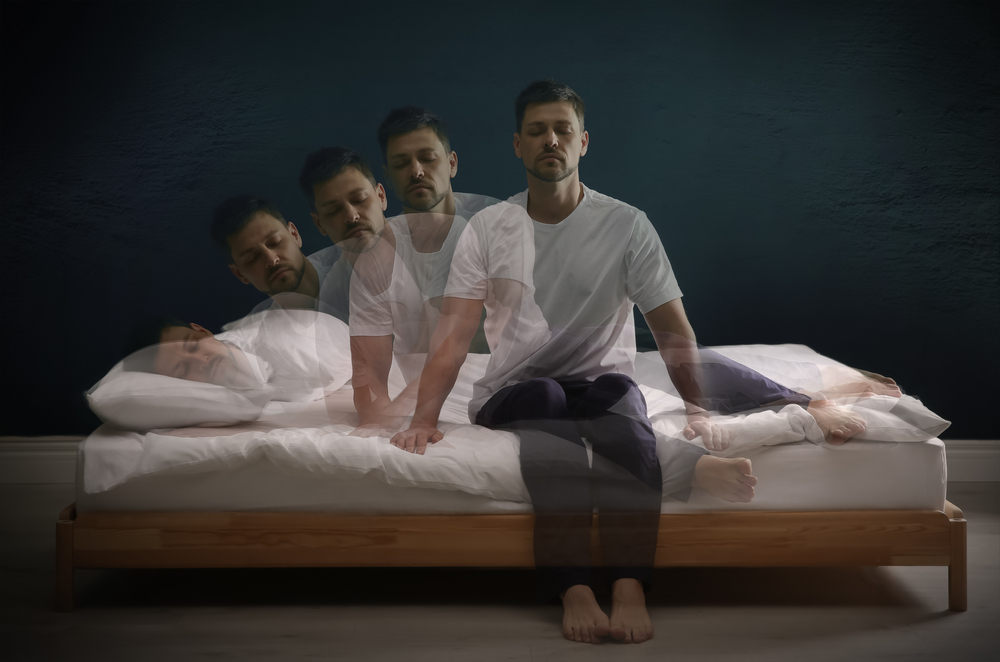

Most of us assume sleep is the quiet part of the day. You lie down, you lose consciousness, you wake up eight hours later. But the brain doesn’t simply switch off. For a significant portion of the population, the hours between lights out and morning alarm are filled with behaviors so strange they sound invented – except they’re fully documented, medically recognized, and far more common than most people realize. The umbrella term for all of them is parasomnias: a broad category of sleep disorders defined by disruptive behaviors or events that hijack your rest. Some are harmless. Some are alarming. A couple of them are early warning signs of something neurologists take very seriously.
What makes these behaviors so easy to dismiss is that the people experiencing them almost never remember what happened. They wake up confused, or they don’t wake up at all, while their brain and body do something completely independent of any conscious instruction. That disconnect between the sleeping brain’s activity and what the waking mind recalls is at the heart of why so many of these sleep behaviors go undiagnosed for years, sometimes decades.
Here’s what sleep science actually knows about some of the most unusual things humans do while they’re supposedly at rest.
Sleep Behaviors That Begin in Deep Sleep
Sleepwalking happens during non-REM (NREM) sleep, usually in stage 3 of the sleep cycle, which is also known as deep sleep. The difference between that and REM dreaming sleep isn’t just academic – it changes everything about what the brain is doing and why you can’t simply snap someone out of it. Sleepwalking is characterized by sudden but partial awakenings out of NREM sleep, during which individuals may interact with their environment in an altered state of consciousness. Behaviors during episodes can be short and simple, such as sitting up and talking, or more complex, like sustaining a conversation, leaving the bed, or manipulating objects.
Sleepwalking formally results in walking or performing other complex behaviors while still mostly asleep. It’s more common in children than adults and is more likely to occur if a person has a family history of the condition, is sleep deprived, or is prone to repeated nighttime awakenings. When it persists into or begins in adulthood, fatigue, lack of sleep, and anxiety are all associated triggers, along with alcohol, sedatives, and some sleeping pills in adults.
A 2024 study published in Nature Communications added an unexpected layer to our understanding of what’s actually happening during these episodes. When sleepwalkers have dream-like experiences during their episodes, they display brain activity patterns that resemble those previously described for dreams, suggesting the brain isn’t simply running on autopilot but may be generating something close to conscious experience. It complicates the long-held view that sleepwalking is purely mechanical, and it raises real questions about what the person is actually perceiving while they move through your house at 2am.
Night Terrors Are Not the Same as Nightmares
One of the most commonly confused distinctions in sleep medicine. Night terrors and nightmares feel related because they both involve fear during sleep, but they’re entirely different phenomena happening in different stages of sleep with different mechanisms behind them.
Night terrors cause a person to suddenly wake up in a terrified state, often accompanied by crying, screaming, and an elevated heart rate. Unlike nightmares, night terrors happen during non-REM sleep and usually don’t involve dream activity. The person isn’t upset about something they just experienced in a dream. The terror is physiological, not narrative – their body has fired the alarm without any story attached. Sleep terrors are usually brief, around 30 seconds, but can last up to a few minutes. They may also be accompanied by a racing heart rate, dilated pupils, fast breathing, and sweating.
Adults can also have night terrors, and they may run in families. Strong emotional stress and alcohol use can make adults more likely to have them. Most adults who experience them have no memory of the episode by morning. Their partner, however, usually does.
The Falling Sensation That Jolts You Awake
If you’ve ever been right on the edge of sleep and suddenly felt yourself plunge downward, heart hammering, eyes wide open, you’ve experienced a hypnic jerk. It’s one of the most universally reported sleep behaviors, and one of the least understood.
Hypnic jerks, also known as sleep starts, are sudden, involuntary muscle twitches that occur as you’re falling asleep. They often feel like a jolt or a falling sensation. Doctors suspect that as you’re falling asleep, a misfire sometimes occurs between nerves in the reticular brainstem, creating a reaction that leads to a hypnic jerk. One theory holds that the body mistakes the sense of relaxation as a sign that you’re physically falling, triggering a reflexive catch response. Another holds that it’s simply the transition between wakefulness and sleep going slightly sideways.
Hypnic jerks are experienced by up to 70% of the adult population at some point in their lives. So if this has happened to you, you’re in the overwhelming majority. Caffeine, nicotine, emotional stress, and strenuous evening exercise are all known to push the frequency higher. According to the American Academy of Sleep Medicine, potential causes include anxiety, stimulants like caffeine and nicotine, stress, and strenuous activities in the evening. Cutting off caffeine earlier in the day and winding down properly before bed genuinely reduces how often these happen for most people.
Sleep Paralysis: Conscious and Immovable
Sleep paralysis is one of those sleep behaviors that has been given supernatural explanations across cultures for centuries. The old hag sitting on your chest. The shadowy intruder in the corner. The incubus. Every culture has a name for it, and for good reason.
Sleep paralysis is common during REM sleep, a period in which the body enters a state of relaxation and temporary paralysis (atonia) to prevent muscle movement while dreaming. It occurs when the body transitions between stages of sleep and wakefulness, so a sudden awakening from REM sleep will leave the body immobilized. The mechanism, in other words, is the body’s normal sleep protection system doing its job at the wrong moment. The paralysis is supposed to be there. You’re just awake for it.
Researchers believe that about 20% of people experience sleep paralysis at some point in their life. It typically lasts between a few seconds and a couple of minutes, though it can feel much longer. The hallucinations that so often accompany it are what tip the experience from strange into genuinely disturbing. People describe seeing figures in the room, feeling a pressure on their chest, or hearing sounds that aren’t there. Episodes are often accompanied by hypnagogic hallucinations (sensory experiences that occur at the edge of sleep) which can become a source of panic and fear. Once you know the mechanism, the experience is less terrifying, even if it remains unpleasant.
You can read more about how stress and sleep interact across different life stages in this piece on bedtime habits.
Exploding Head Syndrome Is Exactly What It Sounds Like
The name alone tends to make people either laugh or Google it immediately. But according to the NIH’s StatPearls database, exploding head syndrome (EHS) is a benign sensory parasomnia characterized by the sensation of hearing a loud sound, such as an explosion or gunshot, during transitions between sleep and wakefulness. This sensation often leads to abrupt awakening, accompanied by distress but without significant pain.
In plain terms: you’re drifting off to sleep, and suddenly your head erupts with a deafening bang that nobody else can hear. No headache, no injury, just a jolt back to full wakefulness and a rapidly beating heart. Other symptoms of EHS include seeing a flash of light, feeling a tingling sensation run through the body, or suddenly feeling hot.
The diagnostic criteria for the condition have only recently been established, and research is still in its early stages, primarily consisting of case studies and series. The underlying cause remains unclear but may involve brainstem dysfunction, aberrant attentional processing, or neurotransmitter imbalances. As of 2025, no clinical trials have been conducted to determine what treatments are safe and effective. For most people, the main intervention is simply knowing it’s real and harmless, which tends to reduce the anxiety that makes episodes more frequent.
Sleep-Related Eating Disorder: Cooking While Unconscious
This one sits at the intersection of parasomnias and something that can have real consequences for health. Sleep-related eating disorder (SRED) involves eating during sleep, and it’s more involved than grabbing a glass of water in the night.
SRED is defined by the onset of recurrent episodes of abnormal eating behaviors during an incomplete awakening and may involve simple or complex motor behaviors, starting from grabbing snacks, to cooking meals, or even driving to a shop to purchase food. Crucially, all eating behaviors reported during these episodes are associated with amnesia, either partial or complete, and individuals may present with weight gain that they can’t account for.
A 2024 systematic review in Frontiers in Psychiatry found that certain medications, including Z-drugs, benzodiazepines, antidepressants, and antipsychotics, may trigger the onset of SRED. Psychiatric and neurologic disorders have also been associated with the condition as risk factors or comorbidities, with genetic factors, neurotransmitter dysfunction, and cerebral glucose metabolism irregularities all implicated as contributing causes.
REM Sleep Behavior Disorder: The One That Doctors Watch Most Closely
If any of these sleep behaviors warrants a real conversation with a doctor, it’s REM sleep behavior disorder (RBD). All the others in this list are largely benign. This one may not be.
During REM sleep, the brain typically sends signals to paralyze the muscles, stopping you from physically acting out your dreams. But in REM Sleep Behavior Disorder, that protective mechanism fails. Instead of lying still, individuals with RBD may move, speak, shout, or even leap out of bed while dreaming, often reacting to vivid or action-filled dreams. Partners have been punched, kicked, and knocked out of bed. People with RBD have woken up on the floor with no memory of how they got there.
RBD’s most significant feature isn’t the behavior itself – it’s what the behavior predicts. Scientists are now able to determine, years in advance, which individuals with this particular sleep disorder will develop Parkinson’s disease or dementia with Lewy bodies. The research focuses on isolated REM sleep behavior disorder, a condition in which people yell, thrash, or act out their dreams, sometimes violently enough to injure a bed partner. The numbers are stark: roughly 90% of people with this sleep disorder will go on to eventually develop Parkinson’s disease or dementia with Lewy bodies.
This is not a reason to panic if you’ve ever moved in your sleep. RBD is distinct, has specific diagnostic criteria, and is most common in men over 50. But it makes RBD one of the most powerful early predictors of Parkinson’s, well before tremors or stiffness begin. Neurologists increasingly ask about sleep for exactly this reason. A person thrashing through vivid nightmares every week in their late 50s deserves a sleep study, not reassurance that it’s nothing.
What to Do With All of This
Here’s the uncomfortable truth about parasomnias: most people who have them don’t know they do. Either they don’t remember the episodes, or their partner has quietly adapted to the chaos, or they’ve assumed that everyone’s sleep is this weird and dramatic and just gotten on with it.
The reasonable takeaway isn’t to lie awake cataloguing your symptoms. Most of these behaviors are benign, treatable with improved sleep hygiene, and significantly worsened by the two things most adults are chronically low on anyway: sleep quantity and stress management. Cutting caffeine after noon, bringing alcohol consumption down, and actually going to bed at a consistent time will reduce the frequency of hypnic jerks, night terrors, sleepwalking episodes, and exploding head events for many people. Not all of them. But many.
The case for taking sleep behaviors more seriously comes when they’re new in adult life, when they’re causing injury, when a bed partner is the primary witness, or when they fit the description of RBD specifically. Those are the circumstances where a sleep study, not a supplement, is the right next step. The rest of the time, knowing that your brain does genuinely strange things in the dark, and that you’re far from alone in that, is probably enough.
AI Disclaimer: This article was created with the assistance of AI tools and reviewed by a human editor.