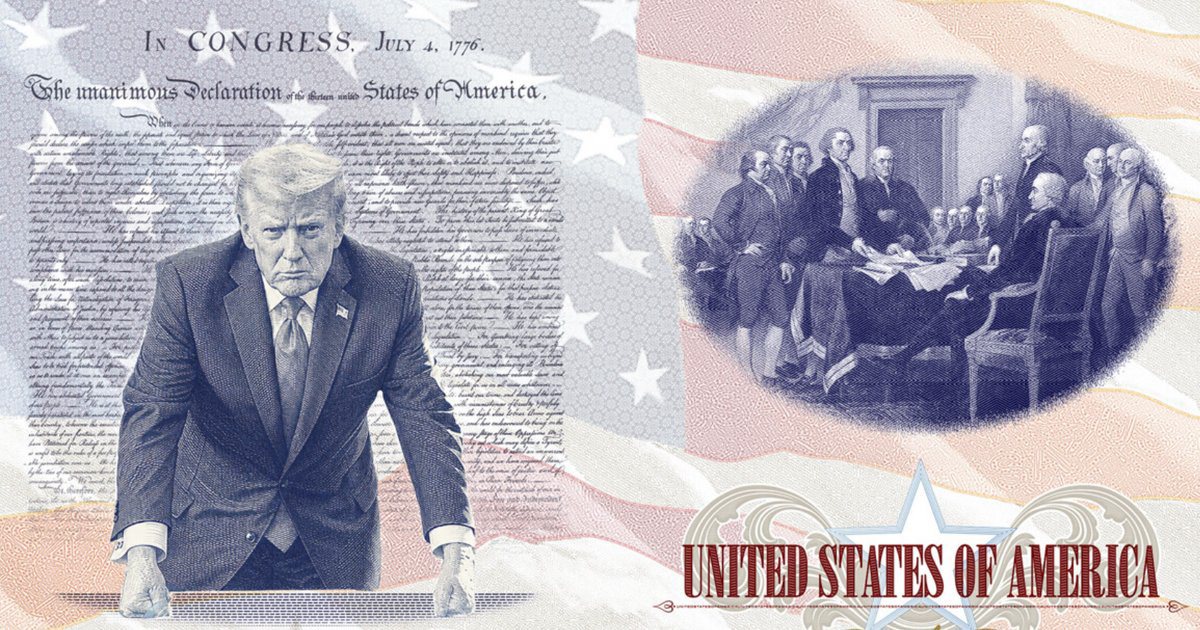

On June 26, 2026, President Trump posted an image on Truth Social of what he called “The U.S.A.’s New Passport.” It showed his own face staring out from the inside cover, superimposed over the text of the Declaration of Independence, with his signature stamped in gold beneath it. The caption read, “The U.S.A.’s New Passport, which says, ‘Welcome, but be good!’ President DJT.” Within hours, that single post had generated more confusion, mockery, and genuine outrage than most pieces of government stationery ever manage to produce.
The reason it landed so hard isn’t hard to understand. The commemorative passport is the first U.S. passport to feature a living president. Every American who has held a passport has seen historical paintings, national parks, the Liberty Bell, the Great Plains. What they have never seen is the sitting president staring back at them from the page. That’s not a small detail.
The new limited-edition travel document was first announced in April as part of the nation’s 250th anniversary celebrations, but the Truth Social post on June 26 brought it to mass attention in a way the initial State Department announcement hadn’t quite managed. By the time the weekend arrived, the “Patriot Passport,” as the White House called it on X, was one of the most talked-about items in the country.
What the New US Passport Design Actually Looks Like
The sample passport page Trump shared features an image of him looming over the Resolute Desk, with the text of the original Declaration of Independence in the background and his signature on the bottom. The opposite page carries an image of “The Declaration of Independence” painting by John Trumbull.
The photo was originally taken by White House photographer Daniel Torok. The new passport appears to feature a rendering based on Trump’s portrait from the Smithsonian National Portrait Gallery in Washington, though it remains unclear whether the image Trump shared is the official version of the commemorative passport or an early mock-up, since the image of the president is not the same as earlier State Department renderings, which showed a different Trump portrait.
The exterior of the passport also breaks from the familiar navy blue booklet most Americans carry. The front cover now reads “Passport” in gold text above a rendering of the bald eagle from the center of the seal of the United States, with “United States of America” in smaller text beneath it – a reversal of the standard cover layout. The back of the passport will display an image of the 1777 version of the American flag, with “250” inscribed at the center of 13 stars representing the original colonies.
The State Department began issuing a next-generation U.S. passport book in 2021, which includes a polycarbonate data page, laser engraving, updated artwork, and security fibers in the passport paper that look like tiny hairs, as well as a perforated alphanumeric passport number on every page. The 2026 commemorative version is a limited-edition variation of that same next-generation passport, with custom artwork and enhanced images on the front, back, and inside covers, and all the same advanced security features.
For comparison, the only presidents featured in current U.S. passports are in a double-page depiction of Mount Rushmore – George Washington, Thomas Jefferson, Theodore Roosevelt and Abraham Lincoln. Other depictions include the Statue of Liberty, the Liberty Bell, Independence Hall, and scenes of the Great Plains, mountains and islands. Current passports also contain quotations from Martin Luther King Jr. as well as Presidents Washington, Jefferson, Roosevelt, John F. Kennedy and Dwight Eisenhower. Trump’s design is a significant departure from all of that.
How to Get One – and Whether You Have a Choice
The State Department has created a limited-edition U.S. passport to commemorate the historic occasion of America’s 250th anniversary. It features custom artwork and enhanced images on the front, back, and inside covers, retains all the same advanced security features as the standard passport, and will be issued at the Washington Passport Agency in Washington, D.C. starting on July 6, 2026, while supplies last.
Between 25,000 and 30,000 of the new passports will be available to applicants at the Washington, D.C. passport office beginning shortly before July 4, though the State Department has also announced special passport acceptance events at the Washington Passport Agency on August 22 and September 26, 2026, for those who can’t make the initial July window.
There will be no extra fee for the limited-edition passports. “The new designs will be available for any American citizen who applies for a passport when the rollout happens and will continue for as long as there is availability,” a department official said, while refuting earlier reporting that only 25,000 passports would be produced, without specifying the actual number.
The redesigned versions will be the default passport option at the Washington Passport Agency once available, but online options or other passport-issuing locations will maintain the existing U.S. passport design. So if you want the standard booklet, you simply apply through any channel other than the Washington office in person.
“Welcome, But Be Good” – and the Confusion That Followed
The line Trump attached to the passport in his Truth Social post generated as much discussion as the design itself, and not for the reasons he might have hoped. A U.S. passport is issued to American citizens for international travel and is not a visa, green card, or citizenship document. It is not used to admit foreign visitors to the country.
It is not clear what Trump means with the warning in his welcome message, as American passports are only given to American citizens. In other words, the people carrying these passports are Americans heading abroad, not foreign nationals arriving here. A “Welcome, but be good!” message addressed to the passport holder is, at minimum, a strange fit.
The confusion was widespread and immediate. Political scientist Jonathan Ladd asked on social media, “Do they understand that passports are for American citizens who are leaving the country?” Journalist and columnist Katelyn Burns posted, “I don’t think Trump knows what a passport does.” The quip spread quickly, though the White House declined to clarify what exactly the message was meant to communicate or to whom.
The White House also shared a photo of the passport on its X account, saying the design was to commemorate America’s Declaration of Independence on July 4. No further explanation of the “Welcome, but be good!” text was offered.
The Broader Pattern of Putting Trump’s Name on Things
The passport design didn’t arrive in isolation. Trump’s second term has seen him give his name or likeness to a wide range of things, including national park passes, the “Gold Card” given in a program that allows wealthy foreign nationals to apply for U.S. residency more quickly if they make a large financial contribution to the federal government, and a 24-karat gold commemorative coin.
Trump’s name has been added to major cultural institutions, most notably the John F. Kennedy Center for the Performing Arts, where signage was updated to include his name following a board vote by Trump appointees. The administration also moved to rebrand the U.S. Institute of Peace as the Donald J. Trump U.S. Institute of Peace. There are also efforts to put Trump’s signature on all new U.S. paper currency, a first for a sitting president, as well as to include his image on a gold commemorative coin to celebrate the country’s founding.
Patrick Bixby, a passport historian at Arizona State University and author of License to Travel: A Cultural History of the Passport, described the passport redesign as unprecedented. “This is entirely novel,” he said. Bixby noted that Trump’s face is “layered over the Declaration of Independence, obscuring the text of that document as if his image is more important.”
Read More: Senator warns Trump administration plans to deport 500+ migrant kids within days
The Political Reaction
The response from Democratic lawmakers was immediate and sharp. Sen. Chris Van Hollen of Maryland said, “It’s a scary day in America when an actual King behaves more democratically than the President of the United States,” referencing King Charles III’s state visit.
Rep. Mike Levin of California put it more bluntly. He said: “The State Department is putting Donald Trump’s scowling face on the U.S. passport. His signature in gold. Superimposed over the Declaration of Independence, a document literally written to get away from this exact behavior.”
In response to the criticism, White House spokesperson Olivia Wales told TIME: “President Trump wants all Americans to enjoy the celebration of America’s 250th anniversary this year – and it’s a shame that Democrats are choosing partisan politics over unity. The President and his Administration are proudly leading a renewal of national pride and patriotism for all Americans during this historical semiquincentennial celebration, ensuring America gets the spectacular birthday it deserves.”
Not all the reaction was partisan. The White House directed questions to the State Department when asked if the latest image was the official rendering of the commemorative passports. And there is a real ambiguity in the design rollout: the image Trump shared on Truth Social appears to differ from the mock-ups the State Department released back in April, leaving open the question of whether June 26’s post represented a finalized design or another work in progress.
What This Means, and What Comes Next
There’s a particular irony in the choice of document. A passport, of all civic objects, exists not to celebrate the nation to itself but to represent the nation to others. It is the thing an American hands to a foreign border agent, the document that establishes who you are in someone else’s country. Putting a sitting president’s portrait inside it, over the text of the founding document, does something different from hanging his name on a building or printing it on a park pass. It goes with you.
The commemorative passport is one of several initiatives launched by the Trump administration to commemorate the nation’s 250th birthday, alongside a series of events and special programs planned around Independence Day. The context matters: the America250 celebration is real, and a commemorative passport design isn’t inherently controversial. What’s new here, and what has people paying attention, is the specific decision to center the sitting president rather than the nation. Every other U.S. passport redesign in history chose symbols, landscapes, and historical figures. This one chose the person currently in office.
Whether that registers as patriotism or something else depends almost entirely on where you’re standing. What isn’t in dispute is the basic fact: if you apply in person at the Washington Passport Agency between now and when supplies run out, the booklet you walk out with will carry Donald Trump’s face on the inside cover. If you’d rather have the traditional version, you can apply online or at any other agency and get it. That choice existing at all is, in its own way, part of the story.
AI Disclaimer: This article was created with the assistance of AI tools and reviewed by a human editor.