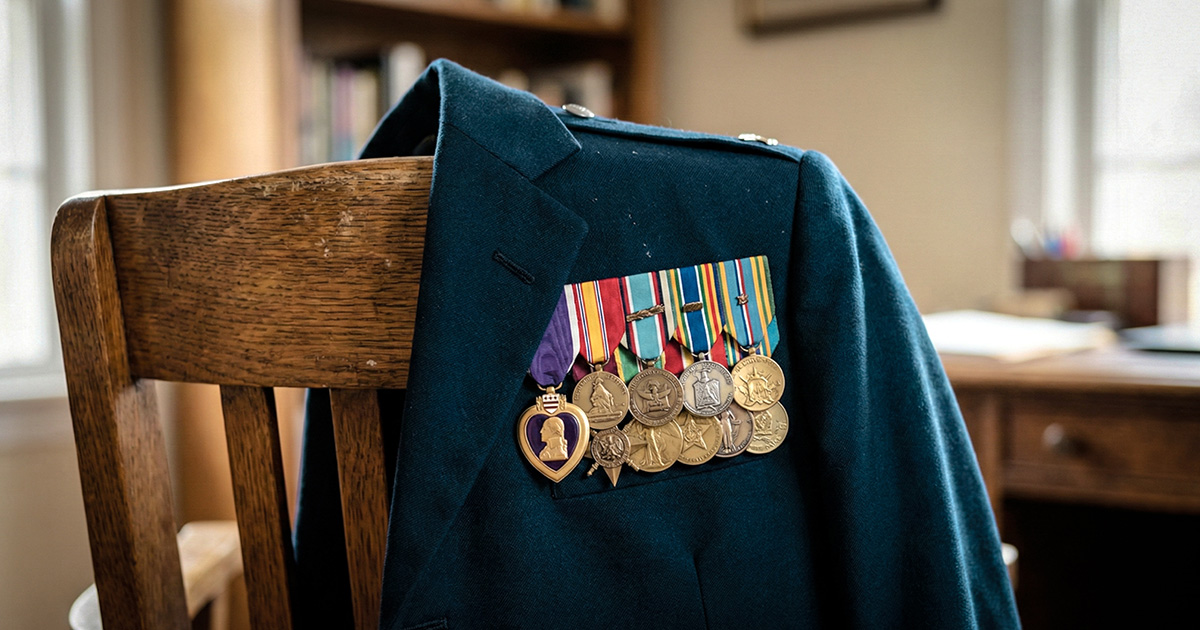
The last time the U.S. Army formally surveyed which soldier carried the most decorations in the nation’s history, the answer surprised people. According to the Army Historical Foundation, researchers Joseph Bowman and Eric Caubarreaux concluded in their detailed 2012 study that General of the Army Douglas MacArthur was, by the numbers, the most decorated serviceman in United States military history. It wasn’t Audie Murphy, though Murphy is the name most Americans reach for. It wasn’t George Patton, whose name still fills stadium-sized screens in cinema and whose speechifying style gets borrowed by football coaches.
American military history stretches across nearly 250 years of continuous conflict, from Valley Forge to the mountains of Afghanistan. The soldiers who have defined it are not a uniform type. They are teenagers from Texas sharecropper families, Civil War professors, Japanese Americans who had to fight a legal battle just to be allowed to enlist, and Green Berets who walked out of hospitals they were never supposed to leave. What they share is the refusal, under the most extreme circumstances, to stop.
These are the 14 legendary U.S. soldiers whose names have stayed in the national memory.
1. Audie Murphy
Murphy’s Medal of Honor action came at age 19, when he single-handedly held off a company of German soldiers for an hour at the Colmar Pocket in France in January 1945, before leading a successful counterattack while wounded. He was standing on a burning M10 tank destroyer at the time, directing artillery by radio with one hand and firing its .50-caliber machine gun with the other.
With 33 military medals including the Medal of Honor, a Distinguished Service Cross, multiple Silver Stars, and three Purple Hearts, Murphy’s combat record is irrefutable. He fought in nine major campaigns across Europe, from North Africa and Sicily through Italy and into France and Germany. He is credited with killing over 240 enemy soldiers, wounding and capturing many others, and became a legend within the 3rd Infantry Division.
Murphy was born into a large family of sharecroppers in Hunt County, Texas. His father abandoned the family and his mother died when Murphy was a teenager, and he left school in fifth grade to pick cotton and find other work to support his siblings. When he tried to enlist after Pearl Harbor, both the Army and Marine Corps initially turned him away for being too small. He falsified his age, got in, and became the most decorated American combat soldier of the Second World War before he was old enough to buy a drink. His grave at Arlington National Cemetery is one of the most visited there, drawing visitors consistently alongside those of presidents and Unknown Soldiers.
2. Alvin C. York
During the Meuse-Argonne Offensive in 1918, York led a small patrol that had been pinned down by German machine-gun fire, single-handedly silenced multiple enemy positions, and compelled the surrender of 132 German soldiers, an act for which he was awarded the Medal of Honor. He did it with a rifle and a pistol, working his way through the German positions with the methodical accuracy of a man who had spent his whole childhood hunting in rural Tennessee.
York initially tried to claim conscientious objector status on his draft card. His church preached nonviolence. Only after his commanding officers helped him reconcile his faith with the call to serve did he enlist. He earned decorations from several Allied countries, including France, Italy, and Montenegro.
After the war, York returned to Tennessee, declined commercial offers to trade on his fame, and spent decades building schools and a Bible institute for the children of rural mountain communities. General John Pershing called him “the outstanding civilian soldier of the war.” The 1941 Gary Cooper film made York a household name, but York himself reportedly found the film’s heroic framing difficult. He preferred that people remember the schools.
3. Roy Benavidez
On May 2, 1968, a 12-man Special Forces reconnaissance team was inserted by helicopter into a dense jungle area west of Loc Ninh, Vietnam, to gather intelligence on confirmed large-scale enemy activity. The area was routinely patrolled by the North Vietnamese Army. After a short time on the ground, the team met heavy resistance and requested emergency extraction. Three helicopters attempted to land and were driven back by intense fire.
Benavidez heard the radio appeal for help and boarded a helicopter to respond. Armed only with a knife, he jumped from the aircraft carrying his medical bag and ran toward the trapped patrol. Over the next six hours, he was shot, stabbed, and hit by grenade fragments repeatedly. According to the Congressional Medal of Honor Society, he sustained a broken jaw and 37 bullet and bayonet puncture wounds during the engagement. When the battle ended and he was evacuated, he was placed in a body bag. A doctor examined him and believed he was dead. The doctor was about to zip up the bag when Benavidez managed to spit in his face, alerting the doctor that he was alive.
President Ronald Reagan presented Benavidez with the Medal of Honor on February 24, 1981. Reagan reportedly told the press afterward: “If the story of his heroism were a movie script, you would not believe it.” In addition to the Medal of Honor, Benavidez received five Purple Hearts, the Defense Meritorious Service Medal, the Meritorious Service Medal, the Army Commendation Medal, and the Texas Legislative Medal of Honor.
4. Daniel Inouye
Born in Honolulu on September 7, 1924, to a second-generation Japanese American family, 17-year-old Daniel Inouye witnessed the Japanese attack on Pearl Harbor. As soon as he graduated from high school in 1942, he attempted to enlist in the Army, but the War Department classified Japanese Americans as “enemy aliens.” Not until those restrictions were lifted the following year could Inouye enlist.
Inouye joined the 442nd Regimental Combat Team, a unit comprised almost entirely of second-generation American soldiers of Japanese ancestry but commanded by Caucasian officers. He progressed rapidly through the ranks, and in 1944, the 442nd deployed to Italy where Inouye earned his combat experience in the fighting around Rome and central Italy. On April 21, 1945, Inouye led his platoon against a heavily defended ridge outside of San Terenzo. Crawling to within five yards of the nearest machine gun, he hurled two grenades and destroyed the emplacement, then neutralized a second position. Although seriously wounded by a sniper’s bullet, Inouye engaged more enemy positions until a grenade shattered his right arm.
On June 21, 2000, President Bill Clinton bestowed the Medal of Honor on Inouye and 19 other members of the 442nd Regimental Combat Team. The original awards had been downgraded after the war, a downgrading that military historians have attributed directly to the racial climate of the era. Inouye later became a U.S. Senator from Hawaii and served in Congress for nearly five decades. President Barack Obama granted Inouye a posthumous award of the Presidential Medal of Freedom in 2013.
5. Lewis “Chesty” Puller
The most decorated Marine in U.S. history, “Chesty” Puller earned five Navy Crosses and fought in four wars. Marines still chant his name in cadences today, recalling the general who once remarked during the Battle of Chosin Reservoir, “We’re surrounded. That simplifies our problem.”
Puller joined the Marine Corps in 1918 and served in Haiti, Nicaragua, China, World War II, and Korea. He commanded Marines in every major 20th-century war except Vietnam, and at Chosin Reservoir in Korea, his outnumbered unit faced a Chinese force that suffered more than 40,000 total casualties across the battle. The battle at Chosin in the winter of 1950 was one of the most brutal engagements in American military history. The Marines were surrounded by Chinese forces in temperatures that reached 35 below zero, and Puller’s First Marine Division fought its way out on foot.
He retired in 1955 as a Lieutenant General, having become the only Marine in history to earn the Navy Cross five times. His son, Lewis Puller Jr., later served in Vietnam and lost both legs to a mine explosion, going on to write a Pulitzer Prize-winning memoir about the experience.
6. George S. Patton
An Olympian and West Point graduate, General George S. Patton is most known for his role in creating the Armored Corps, leading tanks in World War II, and his collection of fiery speeches, but he also served in World War I and the American expedition to capture Pancho Villa in Mexico. He competed in the modern pentathlon at the 1912 Stockholm Olympics, finishing fifth. He carried ivory-handled revolvers. He believed he was the reincarnation of ancient warriors.
Patton commanded the U.S. Seventh and Third Armies in World War II. His bold strategies and relentless pursuit of the enemy were key to several Allied victories, including the liberation of France and the Battle of the Bulge. His Third Army moved with a speed that German commanders found genuinely disorienting. During the Bulge, when American forces at Bastogne were surrounded and General Anthony McAuliffe famously answered “Nuts!” to the German demand for surrender, it was Patton’s Third Army that drove through winter conditions to relieve them in 48 hours.
Patton was often a controversial figure due to his outspoken nature and occasional insubordination. He was nearly removed from command twice. He died in Germany in December 1945 after a car accident, weeks after the war’s end, having never been shot in combat despite spending decades looking for the opportunity. His legacy as a battlefield commander remains, across the decades, largely uncontested.
7. Douglas MacArthur
Researchers who studied MacArthur’s full decorations record concluded that he is the most decorated serviceman in United States military history, a claim that rarely comes up in popular memory because people tend to think of Audie Murphy or Alvin York first. The Bowman and Caubarreaux booklet, published through the Army Historical Foundation, noted that MacArthur was “awarded every combat decoration the U.S. Military can bestow, plus over thirty-five foreign decorations.”
MacArthur’s leadership during World War II was pivotal in the Pacific Theater. As Supreme Commander of Allied Forces, he orchestrated the successful island-hopping campaign that led to Japan’s eventual surrender. His promise, “I shall return,” became a rallying cry for American forces in the Philippines. He kept that promise when American forces returned to Leyte in October 1944 in one of the largest amphibious operations of the war.
After the war, MacArthur oversaw the occupation of Japan, implementing significant reforms that helped rebuild the country. His leadership during the Korean War further cemented his legacy, despite his controversial dismissal by President Truman. That dismissal came in April 1951, after MacArthur publicly contradicted Truman’s policy of limited war in Korea. It remains one of the sharpest demonstrations of civilian control over the military in American history. MacArthur received a hero’s welcome home, addressed a joint session of Congress, and then, in his own famous words, simply faded away.
8. Joshua Lawrence Chamberlain
Joshua L. Chamberlain was a college professor, Civil War general for the Union, Medal of Honor recipient, and the 32nd Governor of Maine. He had no military training when the war began. He was teaching rhetoric and modern languages at Bowdoin College.
On July 2, 1863, the 20th Maine Infantry held the far left flank of the Union line on Little Round Top at Gettysburg. When Chamberlain’s men ran out of ammunition after repelling multiple Confederate attacks, he ordered a downhill bayonet charge rather than a retreat. The charge broke the Confederate assault and held the Union flank. Military historians widely regard it as one of the most consequential decisions made by a junior officer during the entire war.
Chamberlain was wounded six times during the war and was given a battlefield promotion to brigadier general by Ulysses S. Grant himself. At the formal Confederate surrender at Appomattox in April 1865, Grant assigned Chamberlain the honor of commanding the Union troops who received the surrender parade. He ordered his men to salute the defeated Confederate soldiers as they passed. The gesture was not universally applauded. Chamberlain did it anyway.
9. Henry Johnson
Henry Johnson, a railroad porter from Albany, New York, was part of the 369th Infantry, known as the Harlem Hellfighters, an African American unit that the U.S. Army assigned to fight under French command because white American units refused to serve alongside Black soldiers. On the night of May 14, 1918, Johnson and fellow soldier Needham Roberts were attacked by a German raiding party of at least 24 men. Roberts was wounded early. Johnson, despite multiple serious wounds, fought with his rifle until it jammed, then used it as a club, then drew a bolo knife and continued fighting alone until the Germans retreated, taking two of their own wounded with them.
France awarded Johnson the Croix de Guerre for his valor. Johnson received no recognition from the U.S. government after the war. He returned to Albany, broke and suffering from his wounds, and died in 1929 at 36. President Barack Obama awarded Henry Johnson the Medal of Honor posthumously in 2015.
10. John Basilone
John Basilone became the only Marine in World War II to earn both the Medal of Honor and the Navy Cross. He stopped a fierce Japanese assault at Guadalcanal, then died leading Marines on Iwo Jima. A national celebrity, his story lives on in HBO’s The Pacific.
At Guadalcanal in October 1942, Basilone commanded a machine gun section against a Japanese assault that came in waves for two nights. With his position nearly overrun and his crew running low on ammunition, Basilone moved through hostile fire to secure more rounds, repaired his guns under fire, and reportedly held a machine gun barrel in his bare hands to keep it firing when the mount failed. An estimated 3,000 Japanese soldiers attacked that night. His section held. He was awarded the Medal of Honor in 1942.
He could have sat out the rest of the war on a war bond tour. That’s what the Marine Corps offered him. He refused and requested reassignment to a combat unit. On February 19, 1945, he landed with the 5th Marine Division at Iwo Jima, led his men through withering fire to destroy a Japanese blockhouse, and was killed by mortar fire later that day. He was 28 years old. The town of Raritan, New Jersey, held a parade in his honor in 1943 that drew 30,000 people. They named a highway after him.
11. Desmond Doss
Desmond Doss refused to carry a weapon in World War II, yet earned the Medal of Honor. During Okinawa, he dragged 75 wounded men to safety. His medic’s pouch held no bullets, only bandages and unwavering conviction.
Doss was a Seventh-day Adventist from Virginia who believed on religious grounds that he could not carry a weapon or kill. When he enlisted in 1942, his unit ridiculed him, his superiors tried to have him discharged, and fellow soldiers made his life difficult enough that he could have quit any number of times. He didn’t. He became a combat medic and requested to serve in the most dangerous forward positions, where casualties were highest and the medical need was greatest.
On May 5, 1945, on the Maeda Escarpment at Okinawa, a 400-foot cliff held by Japanese forces, Doss’s unit was ordered to withdraw after suffering devastating casualties. Doss stayed. Over the next hours, he carried wounded men to the edge of the escarpment one by one and lowered them down on a rope. He did this 75 times. He later said he prayed with each man before lowering him. The 2016 Mel Gibson film Hacksaw Ridge is based on his story, though the filmmakers had to tone down several incidents because they tested too extreme for audiences to find believable.
12. George Washington
Before he was a president or a founding father or a face on currency, George Washington spent years doing something that historians sometimes understate: keeping an army alive when it had every reason to dissolve. During the winter of 1777-1778 at Valley Forge, Washington’s Continental Army was undersupplied, unpaid, and losing men to disease and desertion at a rate that would have broken most commanders. He stayed in the field, drilled his remaining men with the help of Prussian military trainer Friedrich von Steuben, and emerged in spring with a force that could fight.
Washington had been under fire since the French and Indian War, where he survived two horses being shot from under him and found four bullet holes in his coat after one engagement. He was not a tactician of the caliber of Napoleon or MacArthur. He lost more battles than he won, but he understood something those commanders sometimes didn’t: that the war would be won by the side that refused to stop. His greatest military attribute was endurance. In the Revolutionary War context, endurance was everything. The British could not sustain an indefinite campaign across an ocean. Washington simply had to outlast them.
He resigned his military commission in 1783, returning power to Congress in a gesture that astonished European observers who fully expected him to take command of the country by force. The gesture was not accidental. It was the point.
13. Ulysses S. Grant
Grant is often discussed as a president first and a soldier second, which gets the order exactly wrong. He graduated from West Point in 1843, served in the Mexican-American War, and returned to a difficult civilian life before the Civil War gave him a second chance. He took it.
As commander of Union forces, Grant understood something that his predecessors hadn’t fully grasped: the Confederacy had to be destroyed as a fighting force, not just outmaneuvered. His Overland Campaign in 1864 against Robert E. Lee was costly in a way that shocked the Northern public. The battles of Cold Harbor and the Wilderness produced casualties that felt to many like slaughter. Grant kept going. He besieged Petersburg and cut off Confederate supply lines, forcing the situation that ended at Appomattox.
What distinguished Grant was his calm under pressure and his refusal to interpret setbacks as defeat. When Lincoln was considering replacing him after particularly bloody engagements, a delegation of critics came to the White House. Lincoln reportedly responded: “I can’t spare this man. He fights.” That specific quality, the willingness to absorb punishment and continue, defined Grant’s generalship and eventually determined the outcome of the Civil War.
14. Theodore Roosevelt Jr.
Theodore Roosevelt Jr., the son of President Theodore Roosevelt, is often overshadowed by his famous father, but his own military record stands apart from the family name entirely. He served in both World Wars, was wounded multiple times, gassed in WWI, and spent World War II in his 50s insisting on front-line assignments that his commanding officers tried to refuse him.
On D-Day, June 6, 1944, Theodore Roosevelt Jr. was 56 years old, walked with a cane from his WWI wounds, and had a heart condition serious enough that his request to land with the first wave at Utah Beach was turned down twice. He got permission on his third request by arguing: “It will steady the boys to know I’m with them.” He was the oldest man and the only general to land in the first wave on D-Day. When his unit landed at the wrong section of beach, instead of pulling back, Roosevelt surveyed the terrain, made a quick assessment, and said the words that have become part of the record: “We’ll start the war from right here.” His unit advanced from that position.
He was awarded the Medal of Honor for that day’s action, the only father-son pair in American history to both receive the Medal of Honor. He died of a heart attack in Normandy five weeks later. He is buried there, in the same Norman soil he helped to take.
Read More: 18 Famous Celebrities Who Have a Twin You’ve Never Heard Of
What These Stories Actually Have in Common
What runs through all fourteen of these legendary U.S. soldiers is not fearlessness. Several of them, on the record, admitted being afraid. What connects them is a decision made at a specific moment, often in less than a second, to do the thing that the situation required rather than the thing that self-preservation demanded.
That decision gets made in a foxhole in France, on a burning tank destroyer, at the bottom of a cliff in Okinawa, or in a body bag. It doesn’t look the same twice. Roy Benavidez spitting in a doctor’s face to prove he was still alive is not the same gesture as Joshua Chamberlain ordering a bayonet charge downhill on an empty rifle, but they are made of the same stuff. The names on this list represent the documented extremes of what human beings are capable of doing for each other, and for something larger than themselves. The records are specific. The courage, when you read what actually happened, is harder to explain.
Some of these men came home and struggled for the rest of their lives. Audie Murphy spent his postwar years fighting nightmares and addiction, publicly warning that PTSD was real a decade before the term existed. Henry Johnson came home to nothing. Desmond Doss was wounded after his famous night of rescues and never had a weapon to defend himself. The legend and the aftermath rarely match up, which is probably why the stories keep being told. They remind us that valor and hardship are not opposites.
Disclaimer: This information is not intended to be a substitute for professional medical advice, diagnosis, or treatment and is for information only. Always seek the advice of your physician or another qualified health provider with any questions about your medical condition and/or current medication. Do not disregard professional medical advice or delay seeking advice or treatment because of something you have read here.
AI Disclaimer: This article was created with the assistance of AI tools and reviewed by a human editor.