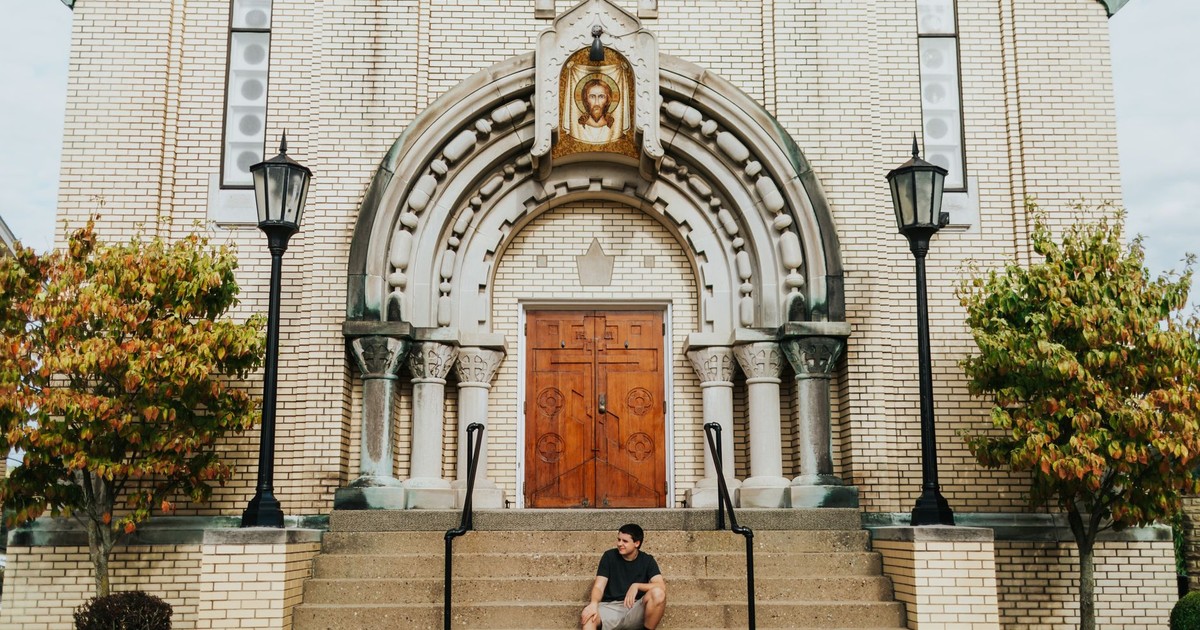

April Ajoy saw a face she recognized on her television screen on January 6, 2021. Someone from her church stood under a Christian nationalist flag, storming the U.S. Capitol.
For Ajoy and a growing number of Americans, that moment crystallized something that had been building for years. The faith they’d grown up in, the community that had shaped them, the language they’d used to understand the world had become something they no longer recognized. Leaving wasn’t a single decision. It was the end of a long, painful process of watching the church they loved fold itself around a political identity.
The term “exvangelical” entered the cultural vocabulary around 2016 to describe people stepping away from evangelical Christianity, whether into other Christian traditions, other faiths, or no organized religion at all. The movement has accelerated sharply since then, and the reason people cite most often isn’t a crisis of theology. It’s a crisis of politics.
When the Flag and the Cross Became One Thing
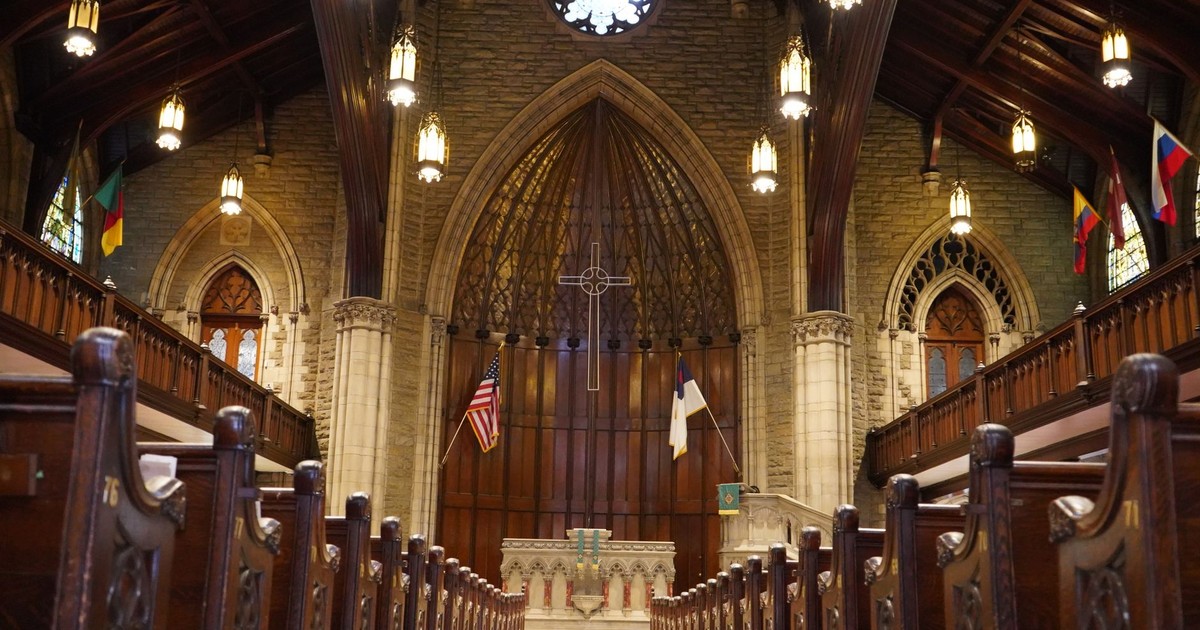
Religious leaders increasingly endorsed candidates from the pulpit and worship music shared space with patriotic anthems. Congregations fractured over public health measures, immigration, race, and the policing of cultural “morality.”
Taylor Yoder grew up in an evangelical family. “What upsets me most is how politics has become so intertwined with the church,” she said. “It turned a lot of evangelicals in my life really ugly.” Her family’s support of Trump, she said, caused her to begin deconstructing her faith. Friendships with LGBTQ colleagues pushed that process further. She found herself asking: “Do I really believe that these people deserve to burn in hell just because they don’t believe like me?”
Yoder is part of a broader trend. Exvangelical women have generated a wave of memoirs, podcasts, social media accounts, and YouTube channels depicting evangelical culture as oppressive and harmful. Their critiques converge on four themes: politics, patriarchy, abuse, and the treatment of LGBTQ people.
According to the Public Religion Research Institute, 40% of women ages 18-29 are now religiously unaffiliated, a figure that for the first time outpaces the rate for young men, which sits at roughly 35%. Research from PRRI also suggests that exvangelicals are disproportionately female: 58% compared with 42% who are men.
What Leaving Actually Costs
People don’t just lose a church. They lose a social infrastructure that has organized every major event of their lives: their weddings, their grief, their friendships, their understanding of who they are.
The exit costs of leaving a high-control faith group include isolation and feeling rejected by the communities that raised you. The fear of losing that sense of belonging often keeps people tethered to spaces that no longer align with their beliefs.
Noelle Giuliano, from Texas, left her church in August 2025. It’s still hard to find an affirming congregation in her area, and the discourse around Christian nationalism continues to shape her experience. “So many ‘Christians’ are showing their true colors, and I don’t want to be around that,” she said. Her faith, she admits, isn’t doing well, though she still prays, listens to worship music, and reads her Bible. “I can’t think of Him without thinking of the pain.”
She misses her church. She misses worshiping with others, the advice that moved back and forth between congregation members, and singing in the choir. The institution failed her, but the community was real.
For Vinny Kopilow, from northern California, the breaking point wasn’t political messaging from the pulpit so much as governance. The issue was not just what was preached, but who got to decide, and who could be held accountable. He describes leaving a church where a husband-and-wife team of co-pastors hand-picked a leadership circle that, by his account, answered mainly to them. The theology and the politics eventually became inseparable from that structure of control.
The People Speaking Out

Amy Hawk, author of The Judas Effect: How Evangelicals Betrayed Jesus for Power, represents one of the more visible faces of the leaving MAGA Christianity conversation. Since publishing the book, Hawk has been producing social media videos in which she argues, Bible in hand, that it is unbiblical to support Trump. This has made her a gathering point for women who have left the church. “Many are coming to me and saying, ‘Thank you, I thought I was going out of my mind,'” she said.
When April Ajoy’s brother came out as gay, her evangelical faith was shaken further. “I spent nights crying because I felt so alone and confused, questioning if everything I ever believed was a lie,” she said, and only later began to reckon with things she herself had once said to others.
Christian author Sheila Wray Gregoire draws a long historical frame around what’s happening. She likens the stories of exvangelical women to the early stages of the Protestant Reformation in the 1500s. “It’s a rejection of Christianity as being about power,” Gregoire said. “I think that’s where we are, where people are dissatisfied with the church as it is.”
Historian and author Jemar Tisby is more pointed. In his view, “White Christian Nationalism is the greatest threat to democracy and the witness of the church in the United States today.” He puts the question directly: “Why are people leaving the church, leaving Christianity? It’s not because we loved too much. It’s not because we practiced too much justice, too much equality, too much love. It’s because they see White Christian Nationalism and they say, ‘Well, if that’s Christianity, I want nothing to do with it.'”
The Cracks in the Base
Evangelicals and Catholics uneasy with President Trump’s rhetoric and immigration policies are subtly distancing themselves from MAGA, taking some congregation members with them. Some churches are seeing a pattern that pastors describe as clergy avoiding political sermons and helping members disengage from Trump’s movement without ostracizing family members who remain devoted to it.
Dave Gibbons, lead pastor of the multiethnic Newsong Church in Santa Ana, California, has talked with people walking away from MAGA because of the mass deportations. Precisely how many evangelicals are taking that step isn’t clear, since most don’t announce it publicly for fear of being criticized or harassed online.
Survey data on Christian nationalist ideology shows which groups remain most committed to the fusion of faith and politics. White evangelical Protestants (67%) and Hispanic Protestants (54%) are the only major religious groups in which a majority hold Christian nationalist beliefs, and white Christians overall are more likely than Christians of color, non-Christians, and the religiously unaffiliated to qualify as Christian nationalism adherents or sympathizers.
White evangelicals still strongly approve of Trump: Pew Research Center measured approval among that group at 72% in April 2025, down from 78% in February 2025, with the figure continuing to trend downward since.
What People Keep, and What They Don’t

Not everyone who walks away from a politicized church walks away from faith. The loudest voices tend to be the ones who left entirely, but a significant portion of exvangelicals are doing something more complicated: holding onto the core of what they believed while stripping away everything that feels, to them, like it was retrofitted by politics.
Some people like Yoder have abandoned their faith entirely. Others still follow Jesus but seek to reclaim what they believe is a purer, more inclusive version of the faith.
People who’ve stepped away often describe the same specific grievance: conservative political goals began to be framed from the pulpit as a divinely ordained religious fight. Taking a political position is one thing. Being told that position is the will of God is another, and that’s the line most of them say they couldn’t cross.
One woman who left described her faith now, outside those spaces, as much freer. She said she no longer cares what anyone thinks of her. She has deconstructed what she calls “the prosperity gospel, the perfectionism, the white supremacy and nationalism, and the hyper-individualism that permeates so much of the Western church” while holding onto the faith she had as a child.
Some who leave end up in more progressive churches. Many who can’t find one meet in private homes. New forms of community are being built outside the institutions, in living rooms, in group chats, in comment sections where people recognize each other across geography.
The Broader Shift
American Christianity has been losing ground for two decades, though the pace has recently slowed. In 1963, 90% of U.S. adults called themselves Christian. A 2025 Pew Research Center study found that figure now stands at 62%, with the Christian share of the population holding relatively stable since 2019. The rapid growth of the religiously unaffiliated has also reached at least a temporary plateau.
Gallup reported in late 2025 a 17-percentage-point drop in the share of U.S. adults who say religion is an important part of their daily life between 2015 and 2025, from 66% to 49%. That is the largest decline Gallup has recorded in any country over any ten-year period since it began measuring in 2007.
Many conservative Christian leaders now view Trump less as a symbol of religious virtue and more as a political instrument, someone who can preserve their influence in a country where Christian identity is no longer a demographic default. Conservative churches and religious organizations increasingly frame Trump as a defender of their place in American public life, even as the next generation moves away from organized religion.
What’s Left When You Go

The hardest part of leaving MAGA Christianity isn’t the theology. It’s the Tuesday morning when you’d normally text someone from your small group and realize you have no idea whether that friendship survives outside of a Sunday context. It’s the holidays. The weddings. The funerals. The infrastructure of belonging, all of which was wrapped up in a place you no longer feel you can be.
Jemar Tisby’s observation: people aren’t leaving because the faith asked too much of them. They’re leaving because the version of it they were handed had fused with something that looked, to them, like the opposite of what they’d been taught to call holy. For many of the people in these accounts, the working through isn’t finished. Some have found their way to other communities. Some are still in the space between what they left and whatever comes next.
One person who went through this process expressed a hope that the broader church would “deconstruct nationalism, and would preach not just about personal morality, but about Jesus’ teachings regarding caring for the poor, the orphans and the foreigners.” That’s not a radical statement by any historical theological standard. That it now reads as countercultural within large portions of American Christianity is precisely the thing that drove so many people out the door.
The willingness of American evangelical culture to absorb and baptize the dominant cultural anxieties of any given era, whether that’s the Cold War, the culture wars of the 1990s, or the nationalist politics of the 2020s, isn’t new. What’s new is the speed and the visibility of the fracture it’s causing now, and the number of people willing to say out loud what it cost them to finally leave.
Disclaimer: This information is not intended to be a substitute for professional medical advice, diagnosis, or treatment and is for information only. Always seek the advice of your physician or another qualified health provider with any questions about your medical condition and/or current medication. Do not disregard professional medical advice or delay seeking advice or treatment because of something you have read here.
AI Disclaimer: This article was created with the assistance of AI tools and reviewed by a human editor.