
The person who told you “I’m not like most people” within fifteen minutes of meeting them, then did something almost identical to every warning sign you’d ever read about – you already know exactly who that is. The problem wasn’t that you couldn’t see it coming. The problem is that the language they used was designed to feel like the opposite of a red flag.
Inauthentic phrases people use don’t typically announce themselves. What they do instead is reach for a set of phrases that perform sincerity without delivering it. These phrases work because they sound like things a genuine, self-aware person would say. They reference honesty, loyalty, caring. But stripped of context and examined phrase by phrase, a pattern emerges: each one shifts power, deflects accountability, or manufactures a closeness that hasn’t been earned.
The list below covers twelve of the most reliably inauthentic phrases in everyday circulation. Not fringe manipulation tactics from a psychology textbook, but the ones that get used in workplaces, friendships, family dinners, and relationships so often that most people have stopped questioning them.
1. “I’m Just Being Honest”

Honesty is a virtue. “I’m just being honest” is a tool. The phrase works as a preemptive defense, announcing sincerity right before delivering something the speaker knows will land hard. When someone declares themselves “brutally honest,” they get an easy out. By adding the word “honest,” they’re informing you that they are about to hurt you, but that you should not experience any hurt because they’re just being honest.
A person with actual integrity doesn’t narrate their honesty before delivering it. They just say the thing, and they say it with care. “I’m just being honest” does the opposite: it places the burden of sensitivity on you, the listener, before the sharp comment has even landed. If you flinch, you’ve been told in advance that’s your problem.
When phony people say “I’m just being honest,” they claim honesty as a defensive tactic, shielding themselves from any pushback they’ll receive for being unnecessarily harsh and hurtful. The phrase allows them to deliver what they see as truth, when it’s just another harsh judgment. Genuine honesty doesn’t need advance billing.
2. “No Offense, But…”

This one functions almost identically to the first, except it’s even more transparent about what it’s doing. The speaker explicitly acknowledges, right before speaking, that what they’re about to say will cause offense. And then they say it anyway.
The phrase is a social courtesy hollowed out of its actual purpose. Courtesy exists to protect other people’s feelings. “No offense, but..” uses the language of courtesy to do precisely the opposite: it pre-authorizes cruelty by labeling it neutral. It works because recipients are trained to accept the caveat at face value, treating what follows as a harmless observation rather than a pointed attack.
Gentle feedback points out where you could improve, but criticism is designed to make you feel bad about yourself. When someone criticizes you, they focus on your worth as a person. Feedback focuses on the problem to be solved. People who care about your feelings don’t need the disclaimer. They just choose their words differently from the start.
3. “I Was Just Joking”

When you hear phrases like “It was only a joke; you’re too sensitive” frequently enough, you can start to doubt yourself. A joke, by definition, is meant to produce amusement. When something lands badly and the speaker retreats to “I was just joking,” they’re not actually clarifying their intent. They’re refusing to own the impact.
The phrase doesn’t say “I’m sorry, that came out wrong” or “I can see that wasn’t funny.” It says “I was just joking,” which reframes the problem as your inability to correctly receive a joke. The discomfort you felt becomes evidence of your failure to have a sense of humor, not evidence of something they said that was genuinely unkind.
Gaslighting is one of the main manipulative strategies used by Machiavellian personalities, those oriented toward power and control rather than toward the well-being of others. Instead of taking responsibility for something hurtful, the gaslighter blames your reaction. The most reliable sign that “I was just joking” is being used inauthentically is that it arrives where an apology should. A genuine person offers the apology instead.
4. “I’m Not Like Other People”

Phony people often use this phrase to manipulate you into thinking they’re special when, in reality, it’s a tactic to gain trust for self-serving reasons. This phrase has been said countless times, emerging from the mouths of phony people worldwide. They say this phrase to make you feel special, as though they saw you across a crowded room and instantly felt a connection.
The phrase is effective because it creates a flattering story for both parties. The speaker gets to feel exceptional. The listener gets to feel like they’re receiving something rare. But “I’m not like other people” is, without a trace of irony, one of the most commonly deployed inauthentic phrases in existence. The fact that so many people reach for it undermines its entire premise.
People who genuinely possess an unusual perspective on life don’t often need to announce it. They demonstrate it. The announcement itself, particularly early in a relationship, is a trust-building maneuver dressed up as vulnerability. They want you to think that they’re special, so special that any harm they cause you is worth the pain.
5. “I Didn’t Say That”

Reality distortion doesn’t always come in the form of elaborate stories. Sometimes it arrives in three words. “I didn’t say that” is a classic gaslighting tactic that distorts reality and makes you question your perception of events. Too often, people use this phrase to deny things they’ve said in the past.
Willis Klein, a PhD candidate in the Department of Psychology at McGill University, was lead author on a 2025 paper developed with colleagues at McGill and the University of Toronto that reframed gaslighting as a process rooted in how our brains handle prediction and surprise. This model highlights how trust and close relationships can be exploited by manipulators who repeatedly undermine a person’s confidence in their own reality. As Klein explained: “When you trust or you love somebody, you expect them to behave in a particular way. Gaslighters are behaving in an atypical way, one that is somewhat surprising, and they’re making use of that surprise to direct the learning of the people they target.” When someone we trust consistently contradicts our memory, the brain doesn’t simply reject the contradiction. It begins to factor it in.
According to this 2025 research, some people who deny what they said genuinely want to refute an accusation during disagreement, and they aren’t intending to be phony or manipulative. A better phrase might be “If I said that, I did not mean it at all” or simply “I remember this differently.” If someone isn’t willing to use a less absolute term, they’re probably not authentically interested in connection and a trusting relationship.
6. “I Don’t Want to Hurt You, But…”

The structure of this phrase promises care before withdrawing it entirely. It announces emotional consideration as a preamble and then sets it aside to deliver the thing the speaker actually wanted to say.
Everything before the “but” in this kind of statement functions as packaging. What follows is the actual message, and the setup is there to lower your defenses before it lands. “I don’t want to hurt you” is the wrapping paper. The statement that comes after is what was always going to be said. People who genuinely don’t want to hurt you tend to ask first, whether the moment is right, whether you want feedback, whether you’re ready to receive what they have to say.
This double move pairs a show of concern with a pointed attack: it isolates the listener and can make them question whether their reaction is even reasonable, since the speaker already claimed to have their best interests at heart. The lasting sting isn’t just the thing that came after the “but.” It’s the confusion that follows: they said they cared about your feelings, so why do you feel so bad?
7. “I Hate Drama”

Ironically, the people who declare their hatred of drama tend to be the ones constantly surrounded by it. Sure, they say they can’t stand chaos, but they often gossip, stir up conflict, and somehow always end up at the center of it. People who truly dislike drama don’t talk about it. They just avoid it.
“I hate drama” is a reliable signal because it usually appears before any drama has occurred, almost like a pre-emptive positioning statement. The effect is that when conflict does arise later (and it will), the speaker has already established themselves as someone who avoids it, which means any conflict that materializes must have been caused by someone else. By you, specifically.
The phrase transfers responsibility in advance. If you have a concern, raising it now becomes “starting drama.” If you’re hurt, addressing it becomes “creating a problem.” A simple self-description turns into a pre-built deterrent against anyone holding the speaker accountable for anything.
8. “I Was Just Looking Out for You”

This is the retroactive justification, the phrase that appears after someone has done something controlling, intrusive, or boundary-crossing, and needs a framework that makes the behavior look like generosity. High-level manipulators often throw themselves a pity party of one to gain sympathy and compliance. “When we feel sorry for someone, we have a natural desire to help them or make them feel better,” explains Dr. Radice-Vella, cited in a Parade report on manipulation tactics.
The phrase takes something that felt unwelcome and retroactively frames it as care. It makes the person on the receiving end feel churlish for objecting, because how do you argue with someone who was only trying to help? People who genuinely care ask before acting. They check whether help is wanted and adjust when it isn’t.
“I was just looking out for you” tends to arrive after a decision has already been made on your behalf, a boundary has been crossed, or a piece of information has been shared that you didn’t authorize. The care it claims happened privately, before this conversation. The phrase happens now, to manage your reaction to it.
9. “I’m Sorry You Feel That Way”
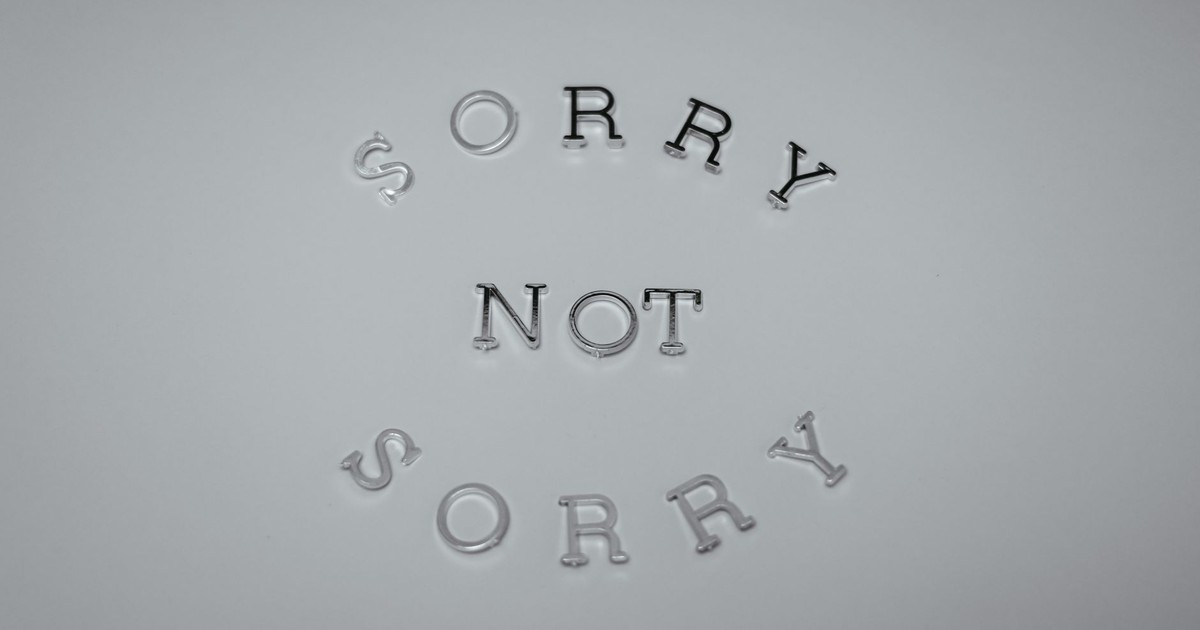
This is perhaps the best-known non-apology in circulation, and for good reason. It mimics the structure and tone of an apology without containing any of the key elements. Merriam-Webster defines gaslighting as the psychological manipulation of a person, usually over an extended period of time, that “causes the victim to question the validity of their own thoughts, perception of reality, or memories and typically leads to confusion, loss of confidence and self-esteem.” “I’m sorry you feel that way” is a tidy entry point into that process. It makes your emotional state sound like a private problem you arrived at on your own.
An apology acknowledges what the speaker did and its effect. “I’m sorry you feel that way” acknowledges only that you have feelings. The speaker takes no responsibility for causing those feelings. They position your emotional state as a self-contained problem, something that happened to you, not something they contributed to.
The phrase becomes even more telling when it appears in a pattern. One instance might be an awkward attempt at reconciliation. A repeated pattern of this kind of non-apology, every time accountability is on the table, is something different: it’s a system for making conflict disappear without ever addressing what caused it.
10. “I’ve Already Apologized”

Closely related to the non-apology, this phrase takes the deflection one step further. Rather than issuing a false apology in the moment, the speaker references an apology already given as a reason the conversation should now be closed. Phony people who say “I didn’t mean to hurt you” often avoid accountability, turning their actions into emotional problems. While this phrase implies someone is about to say sorry, in reality, those crucial words aren’t coming anytime soon.
“I’ve already apologized” treats the apology as a payment that cancels the debt. Once it’s been made, the matter is resolved, at least from the speaker’s perspective. If you’re still hurt, you’re failing to honor the terms of the transaction. This is a fundamentally transactional view of accountability: it’s not about repairing the relationship, it’s about completing a social requirement so the subject can be dropped.
What a genuine apology does is open a conversation, not close one. It invites the other person to say whether the harm has been addressed, whether they feel heard, and what might need to happen next. “I’ve already apologized” is the phrase that arrives when someone wants to skip that part.
11. “You’re Too Sensitive”

Phrases like “You’re too sensitive” invalidate your emotions by relocating the problem from what was said to how you received it. It’s one of the more efficient inauthentic maneuvers available, because it addresses two things simultaneously: it dismisses your response and it implies a character flaw in you for having it. The implication is that a more emotionally regulated, reasonable person would not have reacted as you did.
Over time, hearing “you’re too sensitive” trains you to doubt your own emotional responses. Eventually you start second-guessing whether anything really happened at all. That second-guessing is the goal. Once you start questioning whether your reactions are proportionate, you become a less reliable narrator of your own experience.
The phrase also escalates over time. The first time it lands, you might shake it off. By the thirtieth time, you’ve started to genuinely wonder whether they’re right. That gradual erosion of trust in your own feelings is one of the defining effects of this kind of repeated emotional invalidation over long periods.
12. “Everyone Agrees With Me”

This phrase invokes a social consensus that the speaker has no way of verifying and often hasn’t bothered to check. Its function is to make the listener feel isolated, as if their perspective is not just wrong but uniquely wrong, an outlier position held by no one else. It isolates the target and makes them question their own read on a situation, since apparently the entire room sees things differently.
Gaslighting is one of the main manipulative strategies used by Machiavellian personalities, those oriented toward power and control rather than toward the well-being of others. Cold, calculating Machiavellians, no matter how charming or attractive they seem, will prioritize deception and control when they get close to someone.
“Everyone agrees with me” accomplishes something specific: it frames any disagreement as a personal failing rather than a genuine difference of perspective. If everyone else sees things this way, and you don’t, the problem is self-evidently with you. It also makes the unnamed others into a tribunal you can’t question or appeal to. They’re invoked but never produced. The consensus is real enough to pressure you and vague enough to be unverifiable.
What to Do With All of This

Recognizing these phrases is genuinely useful, but it’s worth being careful about what recognition actually means. Not every person who says “I’m just being honest” is running a conscious manipulation campaign. Some people picked up these phrases from families where this was simply how people talked. Some use them out of social habit, not malice.
What pays attention to is frequency and function. A phrase becomes a tactic when it reliably appears at the moments that require accountability. If “I was just joking” arrives every time a comment lands badly, if “I’ve already apologized” appears every time you try to revisit something unresolved, if “you’re too sensitive” shows up every time you raise a concern, the pattern is telling you something the individual phrases never would.
Some of these patterns run deeper than the relationship they’re appearing in. The person who says “I don’t want to hurt you, but..” learned that phrasing somewhere. The person who reflexively says “I was just looking out for you” may genuinely believe it, which is its own complicated thing entirely. Naming what a phrase is doing in a conversation doesn’t resolve where it came from or why the person across from you reaches for it. But it does mean you stop spending the next three days wondering if maybe you really are too sensitive.
Disclaimer: This information is not intended to be a substitute for professional medical advice, diagnosis, or treatment and is for information only. Always seek the advice of your physician or another qualified health provider with any questions about your medical condition and/or current medication. Do not disregard professional medical advice or delay seeking advice or treatment because of something you have read here.
AI Disclaimer: This article was created with the assistance of AI tools and reviewed by a human editor.