
Somewhere in the Egyptian desert, about 160 kilometers south of Cairo, a team of archaeologists cracked open a Roman-era tomb and found something that stopped everyone cold. Not gold. Not a royal inscription. Not a perfectly preserved mummy face staring back at them through 1,600 years of silence. What they found was a piece of paper – or the ancient equivalent of one – and what was written on it had no business being there at all.
The text was Homer. Specifically, it was a passage from one of the most celebrated works in all of Western literature, tucked deliberately inside the body of a mummy, sealed beneath layers of linen wrapping. The people who placed it there had been dead for more than a millennium and a half. The poem they chose had already been old when they buried it. And the question of why they did it remains, even now, genuinely unanswered.
This is the kind of find that makes career archaeologists pause mid-sentence. Not because Homer’s writing is rare – it isn’t – but because of where this fragment was found, and what that placement tells us about the strange, layered world of Roman-era Egypt.
A City That Kept Its Secrets in the Sand
The discovery was made at the Al Bahnasa necropolis, the Egyptian site identified with ancient Oxyrhynchus, one of the most important cities of Greco-Roman Egypt, located approximately 190 kilometers south of Cairo, next to the branch of the Nile known as Bahr Yussef.
The Oxyrhynchus Archaeological Mission, run by the Institute of Ancient Near East Studies (IPOA) at the University of Barcelona and led by Maite Mascort and Esther Pons, identified a papyrus containing a fragment of Homer’s Iliad inside a Roman-era tomb dating to approximately 1,600 years ago. The excavation was part of the University of Barcelona’s Oxyrhynchus Archaeological Mission, which launched in 1992.
The site has a long and rich archaeological biography. Since the late 19th century, the area around Oxyrhynchus has been excavated almost continually, yielding an enormous collection of papyrus texts dating from the Ptolemaic Kingdom and Roman Egypt. Approximately 70 percent of all the ancient Egyptian literary papyri so far discovered come from Oxyrhynchus, including copies of well-known standard works and previously unknown works by the greatest authors of antiquity. The papyri found there – dating from about 250 BCE to 700 CE – include religious texts and masterpieces of Greek classical literature, among them texts once considered lost, including selections of early Greek lyric poetry, works of Pindar, and dramatists such as Menander.
The original Oxyrhynchus papyri were discovered during excavations by two British archaeologists, Bernard Grenfell and Arthur Hunt, between 1896 and 1907. These tens of thousands of documents, dating over a period of about a thousand years, were found in the town’s garbage dump located on the desert plateau above the city. Oxyrhynchus had, in short, given scholars extraordinary gifts before. But what the University of Barcelona team pulled from the earth in late 2025 was different in a way no one had seen before.
The Mummy in Tomb 65
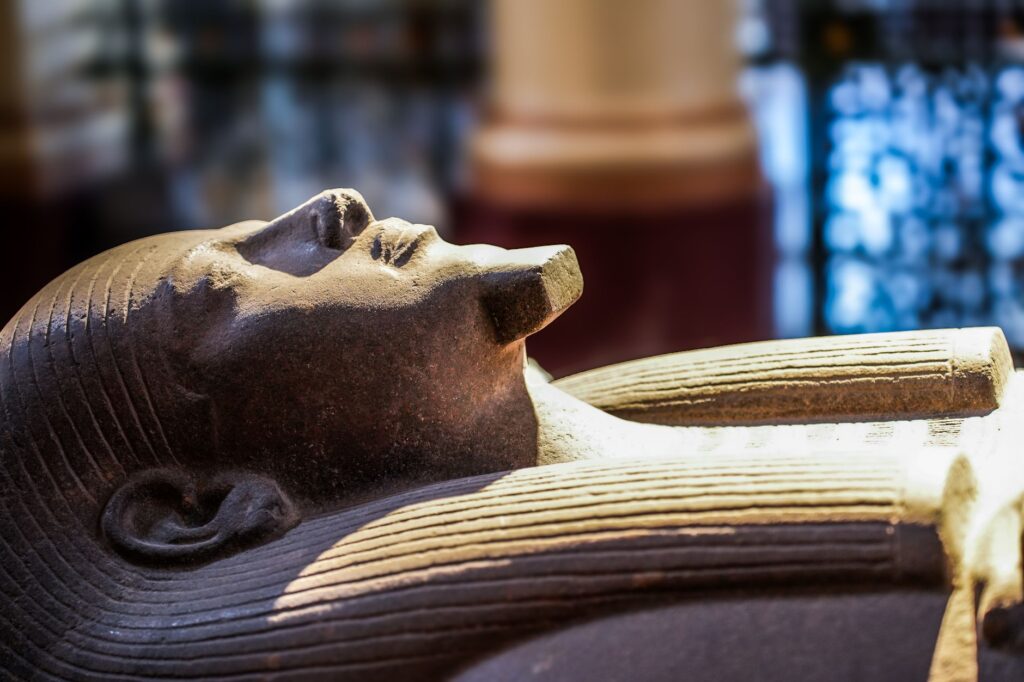
During the campaign carried out between November and December 2025, Núria Castellano‘s team discovered a Roman-era mummy in Tomb 65 of Sector 22 that featured an unusual element: a papyrus placed on the abdomen as part of the embalming ritual.
The tomb itself was part of a larger funerary complex. The excavation revealed a funerary complex comprising three limestone chambers in which Roman-era mummies and decorated wooden sarcophagi were found, many of them in a state of disrepair due to past looting. Several mummies were found inside wooden coffins, some still wrapped in textiles decorated with geometric patterns. Among the most striking finds were small tongues made of gold, along with one made of copper, placed inside the mouths of the deceased. Archaeologists link these objects to ideas about speech after death – a practice described in written sources but rarely preserved in such clear physical form.
These golden tongue amulets were believed to ensure the dead could speak in the afterlife, particularly when facing judgment before Osiris, the Egyptian god of the underworld. Such details suggest that the individuals buried here likely belonged to a wealthy or elite class.
But it was one specific mummy that stopped the team entirely. One of the mummies was unearthed alongside a particularly unusual artifact: a papyrus fragment from Homer’s Iliad, the epic poem set during the Trojan War. The ancient Greek text had been tucked beneath the wrappings on the mummy’s abdomen during the embalming process.
What the Fragment Actually Says
The passage is from Book II of the epic poem, in which Homer cataloged the Greek ships that came to do battle with Troy after Helen, the queen of Sparta and a daughter of Zeus, was taken there by Paris, the son of the king of Troy.
Known as the Catalogue of Ships, it is an epic catalogue in Book 2 of Homer’s Iliad which lists the contingents of the Achaean army that sailed to Troy. The catalogue gives the names of the leaders of each contingent, lists the settlements in the kingdom represented by each contingent, and gives the number of ships required to transport the men to Troy. It is, in modern terms, something like the most elaborate military roster ever committed to verse.
The catalogue serves as a list of all the characters involved in the rest of the poem as well as a reminder of the long years of fighting that preceded the story’s opening. It is also of interest to historians and scholars who use its descriptions of over 150 places and characters as a source for piecing together information about Bronze Age Greece.
The background of the story – the reason all those ships set sail in the first place – is the abduction of Helen. According to Britannica, Helen was the wife of Menelaus, the king of Sparta, and was considered the most beautiful woman in the world. Book Two of the Iliad notoriously contains a list of nearly 190 place names and includes the 29 contingents that make up the Greek expedition to Troy.
Why This Has Never Been Seen Before
The discovery is exceptional: it is the first time in the history of archaeology that a Greek literary text has been found deliberately incorporated into the mummification process.
That distinction matters. According to Ignasi-Xavier Adiego, a professor of Indo-European linguistics at the University of Barcelona and director of the Oxyrhynchus project, this was not the first time the team had found Greek papyri bundled, sealed, and incorporated into the mummification process – but until now, their content had been mainly magical. The excavation leaders believe those earlier papyri “were elements related to the protection of the individual,” and note that “generally, these papyri are folded, tied and sealed.” Finding text from Homer in that same position is what made the discovery genuinely unprecedented, because “the real novelty is finding a literary papyrus in a funerary context.”
As Mascort and Pons put it in a statement to Smithsonian magazine: “The fact that in this case the text, in Greek, refers to a literary text is truly novel.”
The discovery of a papyrus fragment containing a passage from Homer’s Iliad underscores the fusion of Greek literary culture and Greco-Roman religious iconography with local Egyptian burial customs.
The Analysis: Months of Careful Work
Researchers discovered the mummy at a funerary complex located south of Cairo, in Al Bahnasa, the modern-day location of the ancient Greco-Roman city of Oxyrhynchus, during an excavation in late 2025. But identifying what they had found required months of specialized work afterward.
Upon examination, the team revealed a sheet of papyrus inside the mummy’s abdomen that contained text from the Iliad, the ancient Greek poet Homer’s epic account of the siege of Troy. In a campaign in January and February 2026, the papyrus was analyzed by conservator Margalida Munar, papyrologist Leah Mascia, and Ignasi-Xavier Adiego, a professor at the Department of Classical, Romance and Semitic Languages and director of the Oxyrhynchus project. “The material consists of fragments, some of them extremely small,” Adiego noted. “The text is highly incomplete and only parts of words could be identified.” To verify the text, Adiego consulted a corpus of historical data, and he and his colleagues found that one packet contained verses from Homer’s Iliad.
According to papyrologist Leah Mascia, who analyzed the fragment, “The discovery of a copy of the Iliad in an Egyptian city like Oxyrhynchus is certainly not unusual.” What was unusual, she and her colleagues agreed, was finding it in a mummy. The excavation revealed a range of mortuary practices, including mummification with linen wraps and gold leaf, as well as the deposition of cremated remains within limestone chambers alongside animal offerings.
The World This Mummy Lived In
To understand why a Homer text might end up inside a mummy’s wrappings in Roman Egypt, some historical context helps. When Egypt came under the rule of Alexander the Great in 332 BCE, Greek became the primary language used in government documents. Egypt became a Roman province in 30 BCE, after the Roman emperor Octavian defeated Mark Antony and Cleopatra.
Greek was the language of the educated class following the conquest. Over time, traditional Egyptian burial customs had mashed together with Greek and Roman traditions. Instead of carefully storing organs in traditional canopic jars, Roman-era embalmers preferred to pack the body cavity with preserved materials. People read Greek literature in school, and the Iliad was universally beloved.
Because papyrus was expensive, paper was often reused: a document might have farm accounts on one side, and a student’s text of Homer on the other. The Iliad was, in other words, everywhere in that world – copied by schoolchildren, quoted by officials, and apparently, at least on one occasion, folded into the linens of the dead.
Papyrus was also very expensive to the point that scribes often preferred to recycle old texts and write new ones over spent papyrus. The research is ongoing, and archaeologists hope further study will reveal whether this ancient Egyptian truly loved Homer, or if the embalmers simply had something else entirely in mind.
What Nobody Can Fully Explain Yet
The honest answer from the researchers is that they don’t know exactly why the Iliad passage was placed there. Was the deceased a devoted reader of Homer, someone for whom this particular text held personal meaning? Was the passage chosen for symbolic reasons, perhaps because a catalog of warriors setting sail for battle carried protective significance? Or did the embalmer simply reach for a scrap of papyrus that happened to be nearby?
Maite Mascort, co-director of the mission, explained that during the time the Romans controlled Egypt, it was common for papyri to be put inside mummies, in the chest or abdomen. However, it’s unclear why ancient Egyptians thought papyri would help protect the deceased.
Small terracotta and bronze figures found nearby include images of Harpocrates and a figure resembling Cupid, reflecting a blend of Egyptian and Greco-Roman religious traditions that shaped funerary practices in the region. The whole burial site, in other words, is a layered record of a culture in transition – one where Greek gods and Egyptian ones coexisted, where Homer was taught in schools and perhaps also, somehow, honored in tombs.
Read More: 9,000-Year-Old Ancient City Found Near Jerusalem
What This Means for You
Most of us will never hold a 1,600-year-old papyrus in our hands. But what discoveries like this one offer is something more accessible: a reminder that our relationship with stories, with literature, with the written word, is not a modern invention. People have been reaching for meaningful text in their darkest and most profound moments for as long as writing has existed.
This is the first time in the history of archaeology that a Greek literary text has been found deliberately incorporated into the mummification process, and that alone should give us pause. Someone, 16 centuries ago, chose Homer’s Iliad as something worth carrying into death. Whether they understood it as protective magic, a beloved piece of culture, or something we have no category for today, the gesture tells us that ancient people were not so different from us. They, too, found meaning in stories. They, too, wanted to keep the ones they loved close, even at the end.
As Mascort noted, “We cannot rule out that some other literary text may also appear.” More digging is planned. More sealed packets wait to be opened. Work on the Oxyrhynchus papyri has continued since the 1930s, and decades of scholarship have already transformed what we know about the ancient world. If the University of Barcelona team’s own instincts are right, this mummy’s papyrus may not be the last literary text they find buried in these sands.
Disclaimer: This article was created with AI assistance and edited by a human for accuracy and clarity.