
There’s something quietly disorienting about standing in the Great Hall of an enormous American mansion and realizing that the family who lived there used it as a summer house. Not their main residence. Their summer house. The place they went to escape. That moment – somewhere between awe and genuine confusion – is one of the great experiences that historic house museums offer, and it’s not something you can replicate from a photograph or a documentary. You have to stand in the room.
America’s Gilded Age, roughly the last three decades of the 19th century and the early years of the 20th, produced a class of wealth so concentrated and so theatrical that the physical evidence of it still stops people cold. Railroad barons, coal magnates, silver heiresses, and financiers poured their fortunes into homes that were less about comfort and more about statement – built to impress guests, signal status, and outshine rivals. Most of those homes are gone now, demolished when the taxes became impossible and the families dispersed. But a surprising number survived, saved by nonprofits, government agencies, and the sheer force of collective will.
Here are some of the most extraordinary historic US mansions open to visitors today – publicly accessible historic estates in America that let you walk through the very rooms where American industrial power was on full, extravagant display. Whether you’re planning a trip or just want to know what’s actually out there, this is what you need to know about each one.
The Breakers, Newport, Rhode Island
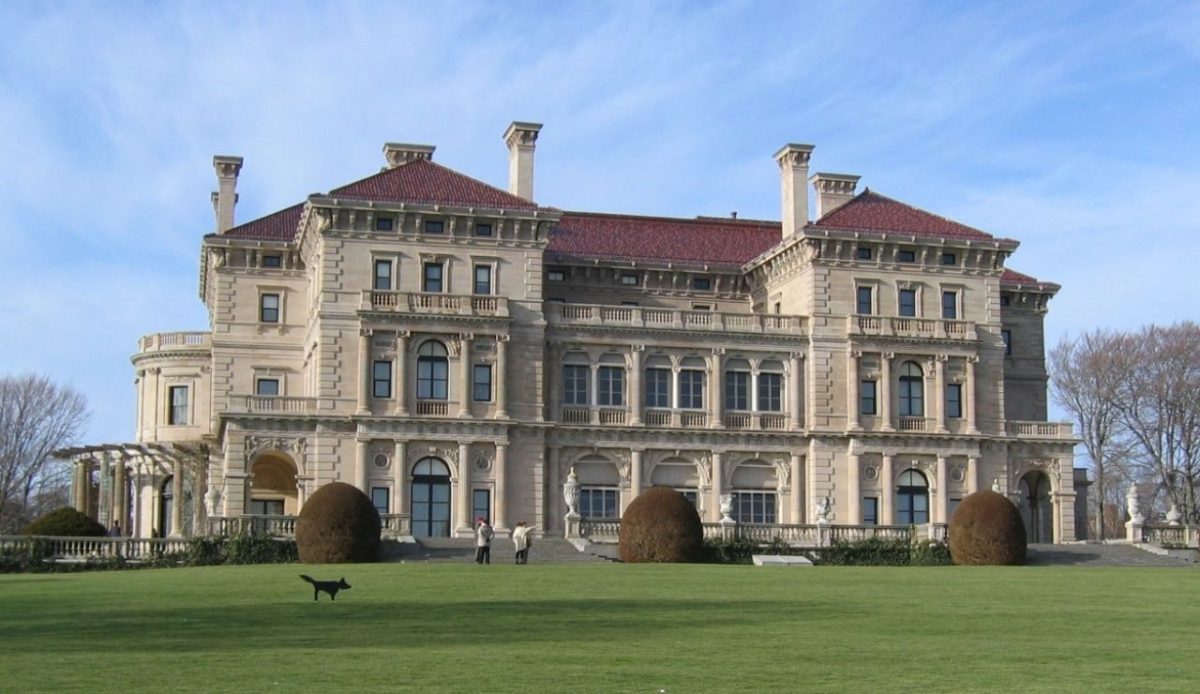
The Breakers sits at 44 Ochre Point Avenue in Newport, Rhode Island, and was built between 1893 and 1895 as a summer residence for Cornelius Vanderbilt II. The man was the president and chairman of the New York Central Railroad. This was his vacation home. The 70-room mansion, with a gross area of 138,300 square feet spread across five floors, was designed by Richard Morris Hunt in the Renaissance Revival style.
Its interiors include rich marbles and gilded rooms, a 50-foot-high Great Hall, mosaic tile floors and ceilings, and open-air terraces with magnificent ocean views. Hunt directed an international team of craftsmen and artisans to create an Italian Renaissance-style palazzo, inspired by the 16th-century palaces of Genoa and Turin. In order to complete the house in just two years, many of the interior rooms were actually constructed in Europe, taken apart, shipped over, and reassembled on site in Newport.
The dining room seats 34 people. The red alabaster columns came from Algeria. The ceiling is gilded oak. Crystal chandeliers cast light across the table. Orchestras played in the adjoining Music Room while the family ate. The Morning Room features a platinum leaf ceiling – not gold, because platinum was rarer in 1895 and therefore an even bigger statement.
The service areas tell a separate story. Industrial-scale kitchens, a butler’s pantry, storage rooms, and staff quarters supported the household. It took dozens of servants to run the mansion during the summer season. The separation is stark: family rooms upstairs and front-facing, service areas hidden below and behind. Two worlds under one roof.
For the first time in the 130-year history of The Breakers, the private third-floor family space occupied by generations of Vanderbilts is now open for public tours. That access came after the Szapary family – Vanderbilt descendants – vacated the third floor in 2018, which was opened for public tours for the first time in 2024. It had been their summer apartment for decades.
The Breakers was designated a National Historic Landmark in 1994. As of 2025, timed tickets are now required for entry, with slots available every 30 minutes between 9 a.m. and 4 p.m. – it’s the only Newport Mansions property with this requirement, due to its overwhelming popularity. Adult admission is $32. Note that the back terrace is closed for restoration from January through November 2026, but the gardens and ocean lawn remain open.
Marble House, Newport, Rhode Island
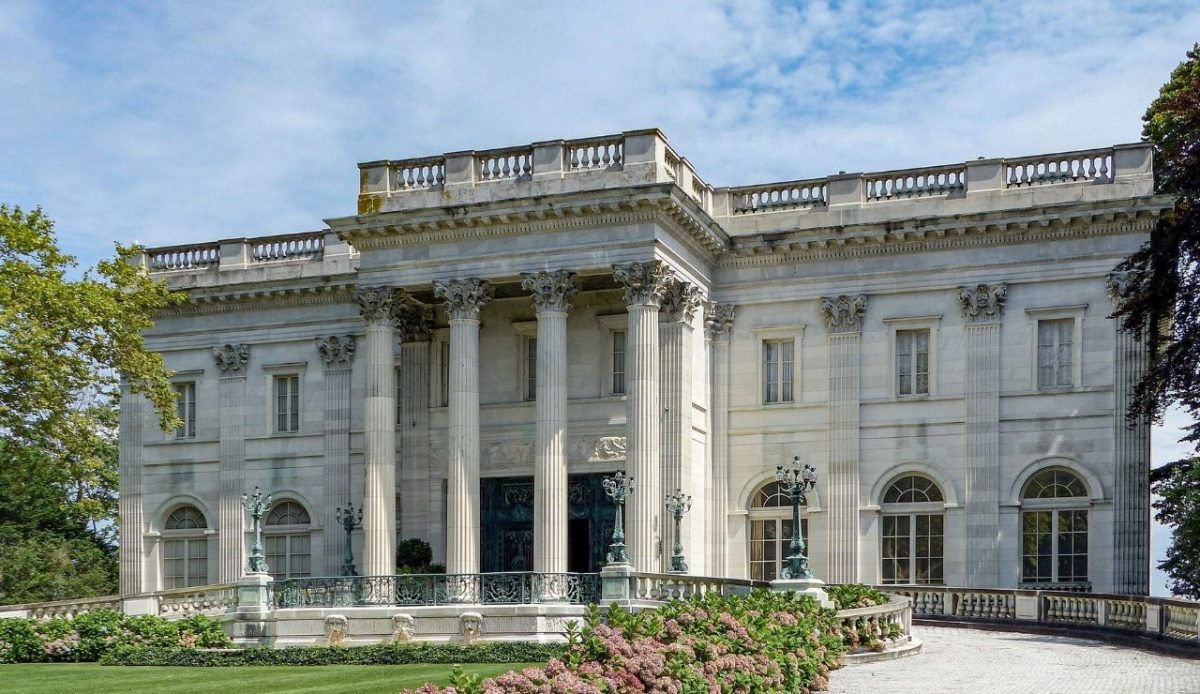
Marble House was completed in 1892 for Alva and William Kissam Vanderbilt, and cost $11 million to build – equivalent to approximately $394 million in 2025 – of which $7 million was spent on 500,000 cubic feet of marble. William gave it to Alva as a birthday gift. She was 39. The marriage did not survive the decade.
Richard Morris Hunt designed it, taking inspiration from the Petit Trianon at Versailles. The result is one of the most opulent interiors in the Western Hemisphere – gold-encrusted rooms, towering ceilings, and the sheer weight of all that marble underfoot. The ballroom is covered in gilded bronze. The dining room has crimson marble columns and amber-tinted walls. Nothing is understated because understatement was not the point.
Alva used Marble House as a social platform with genuine calculation. After her divorce from William and her remarriage to Oliver Hazard Perry Belmont, she eventually returned to Marble House in her widowhood. She added a Chinese Tea House on the seaside cliffs in 1914 and used the estate to host suffragette fundraisers – turning a monument to Gilded Age privilege into a base for political organizing. That’s a detail most visitors don’t expect.
The Preservation Society of Newport County purchased Marble House in 1963 from the Prince Trust, with funding provided by Harold Stirling Vanderbilt, the couple’s youngest son. The Prince family donated virtually all original furniture to the Society at the same time. Marble House was added to the National Register of Historic Places in 1971 and designated a National Historic Landmark in 2006; it is now open to the public as a museum operated by the Newport Preservation Society.
As of 2025, the Preservation Society of Newport County stewards 11 historic properties open as house museums, including Marble House, The Breakers, The Elms, Rosecliff, Chateau-sur-Mer, Kingscote, Isaac Bell House, and Green Animals Topiary Garden. Tickets are available online and at the door for most properties except The Breakers, which requires timed entry.
The Elms, Newport, Rhode Island
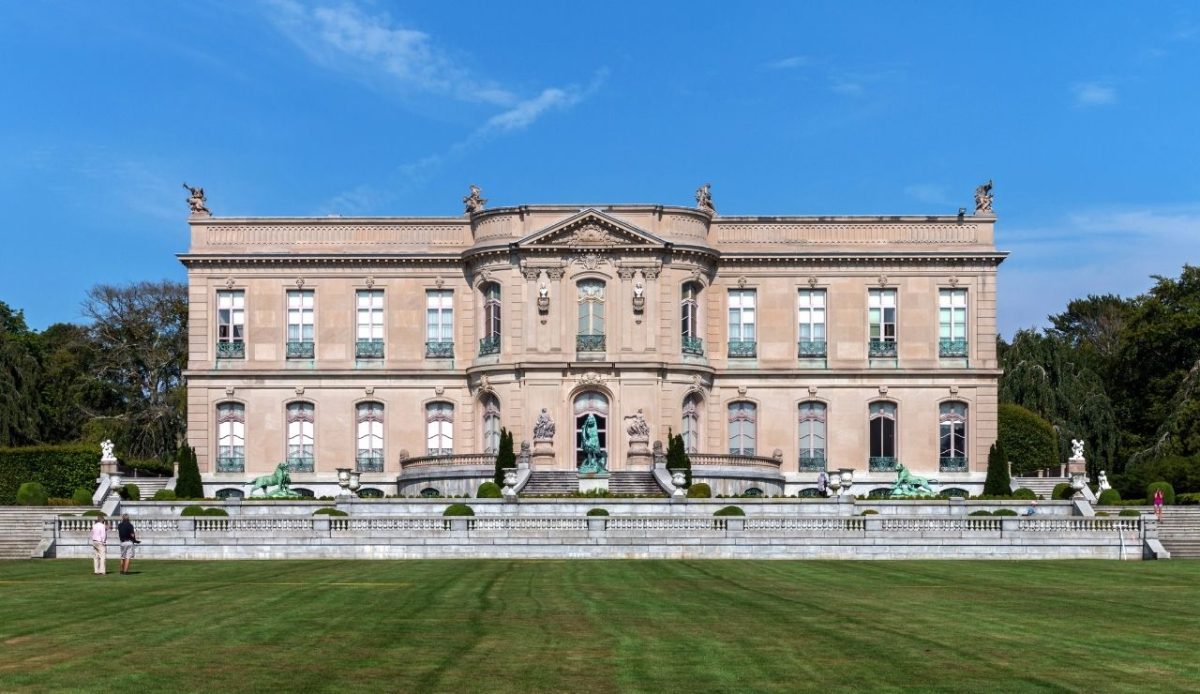
Architect Horace Trumbauer designed The Elms for coal baron Edward Julius Berwind, taking inspiration from the 18th-century Château d’Asnières in Asnières-sur-Seine, France. Completed in 1901, The Elms was the summer home of Mr. and Mrs. Edward Julius Berwind. Berwind built his fortune on the vast coal industry that powered America’s rise to global prominence.
The mansion’s interiors were executed by the renowned Parisian firms Allard and Sons and Lucien Alavoine, who brought the highest standards of French decorative art to every room. Visitors today can admire an outstanding collection of Renaissance ceramics, 18th-century French and Venetian paintings, and Oriental jades displayed throughout the elegantly appointed rooms.
The grounds of The Elms are among the most impressive of any Newport mansion. Elaborate Classical Revival gardens developed between 1907 and 1914 feature marble pavilions, ornamental fountains, a sunken garden, and an impressive collection of bronze sculptures set among a park of exceptional specimen trees. The landscaped grounds were designed as an integral extension of the house itself.
What sets The Elms apart from its neighbors is the behind-the-scenes access. In addition to a self-guided audio tour, The Elms offers a Servant Life Tour, which brings guests to the basement to view the coal-fired furnaces and the tunnel from which the coal is brought in from a nearby street. The tour shows the lengths to which Berwind went to keep the servants out of view from guests on all floors. Visitors on the tour view the laundry room, steamer trunk storage area, the giant circuit breaker box, ice-makers, galley, and wine cellar below the main floor, and climb the service staircase to the servants’ quarters on the third floor.
The Elms is a National Historic Landmark and a French-style chateau that was one of the first Newport houses to be fully electrified. The estate includes a 10-acre park and elaborate sunken garden. It was purchased by the Preservation Society of Newport County in 1962, saving it from potential demolition, and has since been designated both a National Register of Historic Places site and a National Historic Landmark.
Rosecliff, Newport, Rhode Island
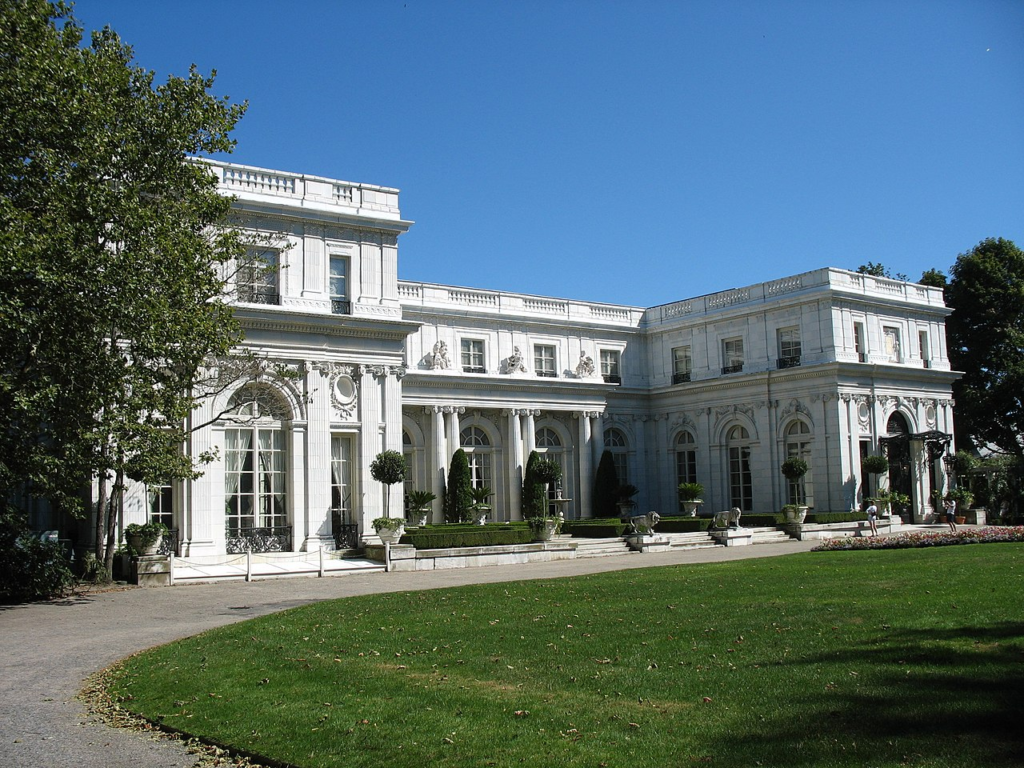
Commissioned in 1899 by Nevada silver heiress Theresa “Tessie” Fair Oelrichs, Rosecliff was completed in 1902 at a cost of $2.5 million. It was designed by architect Stanford White of McKim, Mead & White, who modeled it after the Grand Trianon, a garden retreat of French kings at Versailles. Tessie’s father had made his fortune in the Comstock silver lode, and she spent it freely – Rosecliff became the backdrop for the most talked-about parties in Newport, including one where magician Harry Houdini performed and swans floated in the fountain.
Rosecliff is best known today for its world-class exhibitions, which fill the second floor with vibrant, ever-changing displays of art, design, and culture. While its heart-shaped staircase and grand ballroom recall its Gilded Age past, the house is now lightly furnished to allow for frequent private events – letting the exhibitions and architecture take center stage. Its cinematic beauty has also made it a favorite film location, featured in more than a dozen movies, including “The Great Gatsby” and “True Lies.”
The ballroom is the largest ballroom in Newport, which made it an obvious choice for Hollywood. The 1974 version of The Great Gatsby with Robert Redford was filmed here, as was Arnold Schwarzenegger’s True Lies and the romantic comedy 27 Dresses. Rosecliff has a particular gift for looking like the past while remaining very much alive – it regularly hosts the annual Newport Mansions Wine & Food Festival and other major events.
In 2024, the Preservation Society received the Historic Preservation Project Award for its $7.4 million restoration of Rosecliff mansion. That investment shows. The white-glazed terra-cotta exterior gleams, and the heart-shaped staircase – perhaps the single most photographed architectural detail in Newport – looks exactly as Stanford White intended it.
Chateau-sur-Mer, Newport, Rhode Island
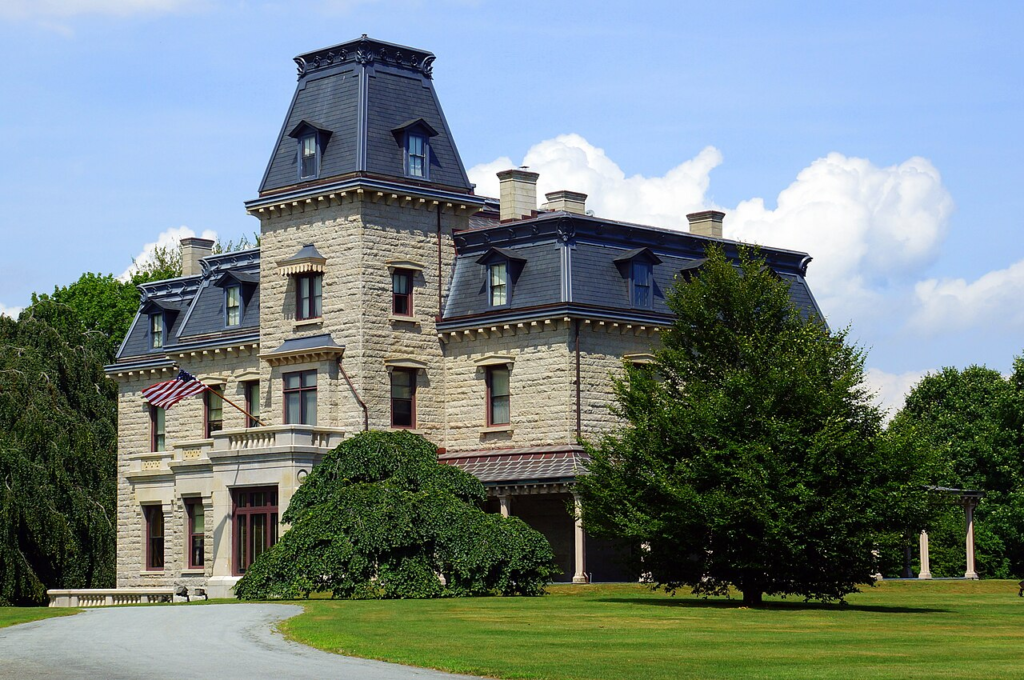
Most people who visit Newport head straight for the Vanderbilt houses, which means Chateau-sur-Mer tends to have shorter lines and a more relaxed pace. That’s a genuine advantage for visitors who want to spend time actually looking at what they’re seeing.
Located at 474 Bellevue Avenue, this granite villa was originally built in an Italianate style in 1852 for William Shepard Wetmore, who made his fortune in the China trade. In the 1870s, his son George Peabody Wetmore hired Richard Morris Hunt to dramatically enlarge and redecorate the house, transforming it into the grand Second Empire-style mansion seen today. It is a treasure trove of Victorian furniture, wallpapers, and stenciling.
Chateau-sur-Mer epitomizes High Victorian architecture, furniture, wallpapers, ceramics, and stenciling. It was the most palatial residence in Newport until the appearance of the Gilded Age Vanderbilt houses in the 1890s. What that means in practical terms is that it represents a slightly earlier, more restrained form of American wealth – still grand, but not yet in the business of competing with Versailles. The interior feels denser and more personal than the later Vanderbilt houses, stuffed with objects collected over generations by a family that was rooted in the China trade and deeply interested in the decorative arts.
This stone mansion is a classic example of High Victorian architecture and furnishings, including wallpaper, ceramics, and stenciling, constructed for China Trade merchant William Wetmore. His son, George Peabody Wetmore, became Governor of Rhode Island and U.S. Senator. The house is noted for its original Victorian park, with century-old weeping and copper beech trees, a Chinese moongate, and a Colonial Revival garden pavilion.
Chateau-sur-Mer is managed by the Preservation Society and open seasonally. It’s one of the older properties in the Newport collection and offers a useful counterpoint to the later, more theatrical mansions nearby – it shows where Gilded Age excess came from and what the aspirations of an earlier generation of American wealth actually looked like in stone.
Kingscote, Newport, Rhode Island
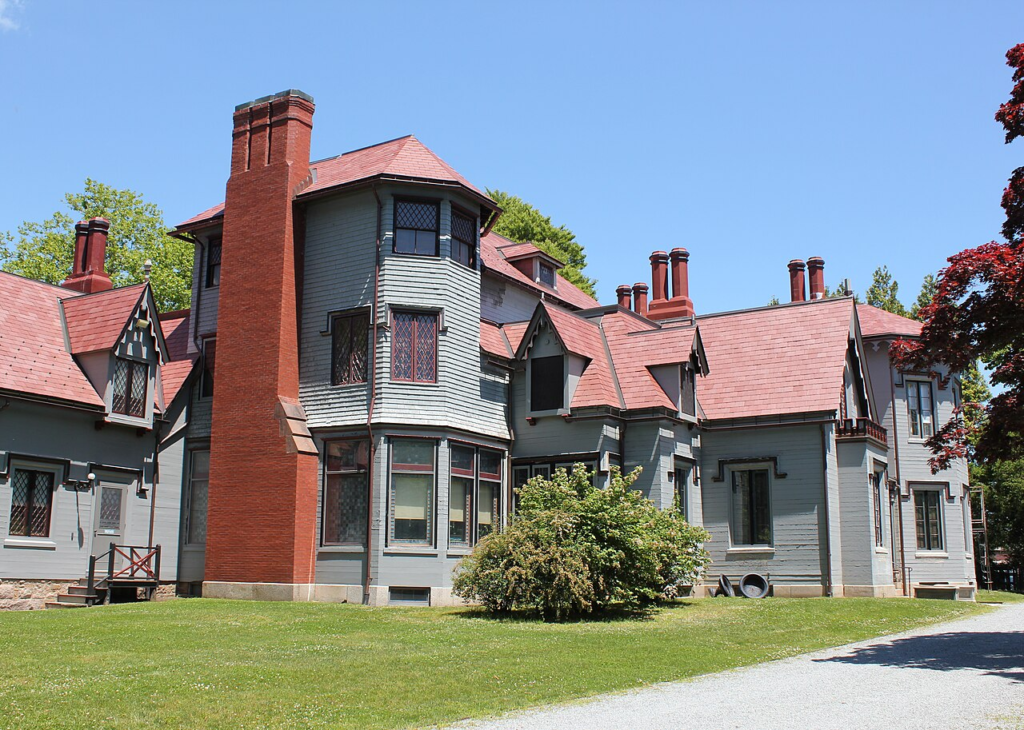
Kingscote is a landmark of the Gothic Revival style in American architecture. Its appearance in Newport marked the beginning of the “cottage boom” that would distinguish the town as a veritable laboratory for the design of picturesque houses throughout the 19th century.
Built in 1839 for a Georgia plantation owner named George Noble Jones who wanted a summer retreat far from the Southern heat, Kingscote predates the Gilded Age mansions by half a century. It changed hands, was updated, and eventually came into the possession of the King family – hence the name – who made a number of significant additions. The most notable of these is the dining room, which features original Tiffany glass brick panels commissioned from Louis Comfort Tiffany himself, installed in the 1880s and still extraordinary to look at.
Kingscote is a Gothic Revival home with original Tiffany glass bricks in the dining room – which sounds like a small detail but is, in fact, one of the most remarkable single rooms in any historic house museum in the country. The glass bricks are backlit by natural light in a way that Tiffany clearly calculated, and the effect is genuinely unusual.
As the earliest surviving example of a Newport “cottage” and a demonstration of the Gothic Revival style that Alexander Jackson Davis championed, Kingscote gives visitors a sense of what Newport looked like before the railroad money arrived and everything got significantly larger. It is operated by the Preservation Society, open seasonally, and tends to be one of the quieter properties on the Bellevue Avenue circuit.
Isaac Bell House, Newport, Rhode Island
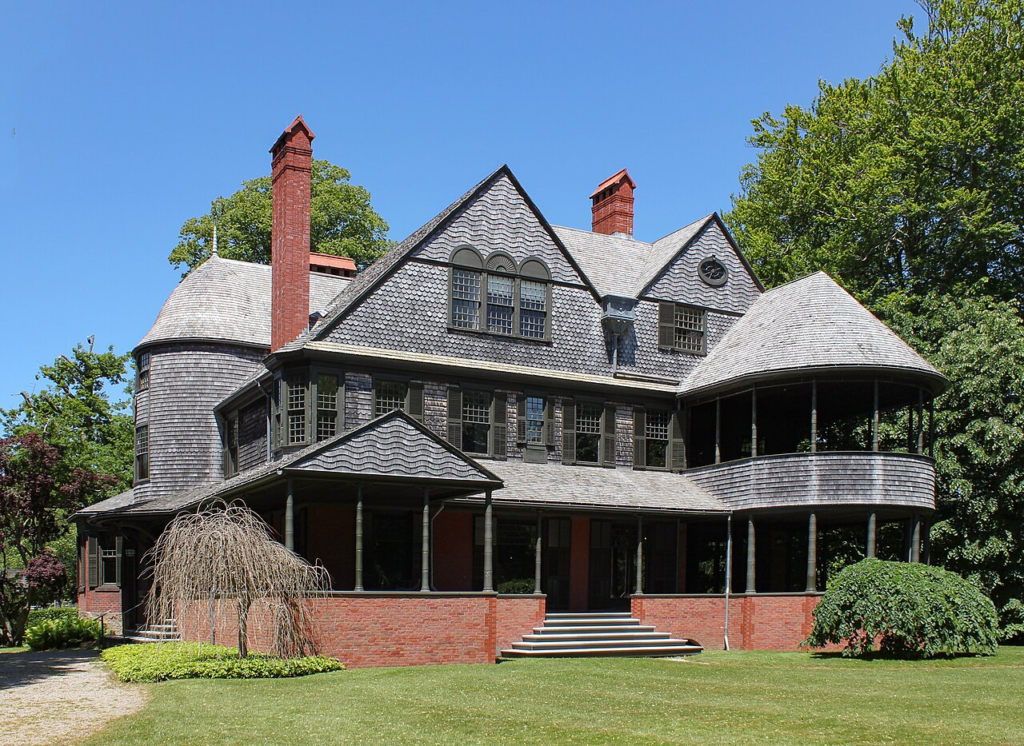
Isaac Bell House is one of the finest surviving examples of shingle-style architecture in the country. Designed by McKim, Mead & White, it blends international and American influences into a distinctive Gilded Age style. With minimal furnishings, the house allows its innovative interior and exterior design to take center stage, highlighting the craftsmanship, natural materials, and open layout that make it architecturally significant.
Built in 1883 for cotton broker Isaac Bell, this is the mansion for visitors with an interest in architecture rather than opulence. The shingle style was a genuinely American architectural invention – a rejection of the heavy European grandeur that would dominate Newport by the 1890s – and this house is considered one of the purest expressions of it anywhere. The open interior plan, the use of natural materials, the integration of Japanese and Moorish decorative elements: it all feels surprisingly modern for something built in the 1880s.
Isaac Bell House is a self-guided tour with no audio component, which actually suits it well – you move through the spaces at your own pace and notice what you notice. It’s open on a limited schedule (Fridays and Saturdays from June through late August), which makes planning ahead worthwhile. Managed by the Preservation Society, it’s architecturally significant in a way that doesn’t require you to know much about architecture to appreciate.
Biltmore Estate, Asheville, North Carolina
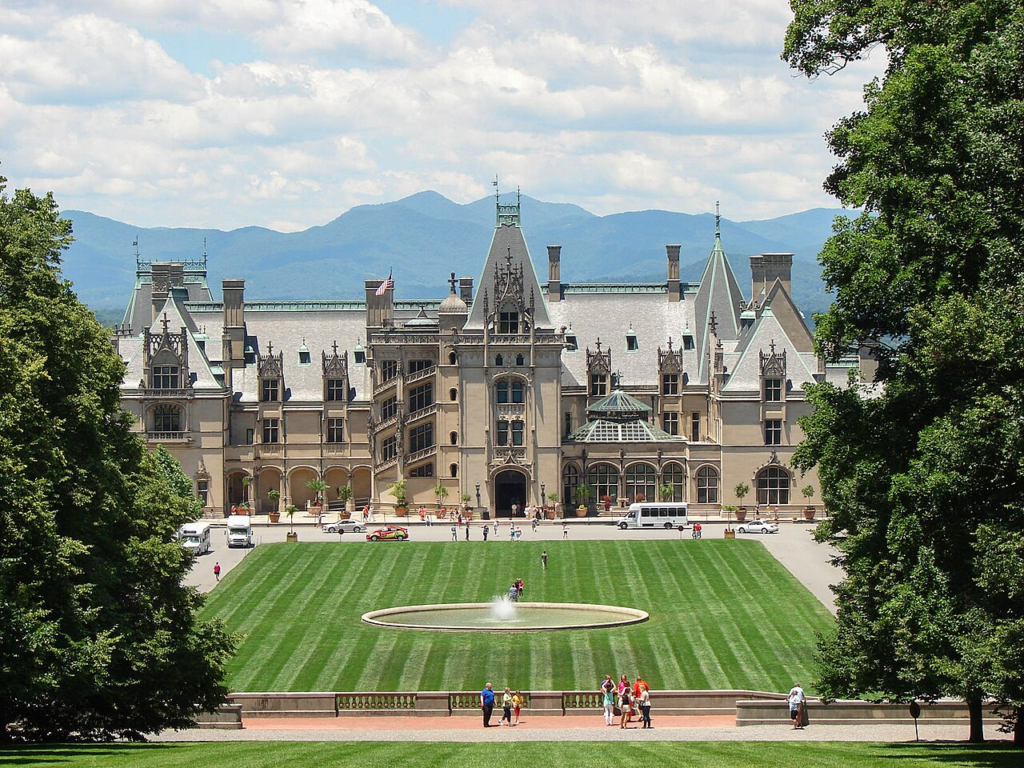
Biltmore Estate is a historic house museum and tourist attraction in Asheville, North Carolina. The main residence, the Biltmore House, is a Châteauesque-style mansion built for George Washington Vanderbilt II between 1889 and 1895. It is the largest privately owned house in the United States at 178,926 square feet of floor space.
Built by George Washington Vanderbilt, the estate consists of 8,000 acres of grounds. The house has 250 rooms, 75 acres of gardens, and one of the nation’s most-visited wineries. The architect was again Richard Morris Hunt, who, with Vanderbilt, traveled extensively in Europe studying French châteaux – including Château de Blois, Chenonceau, and Chambord in France and Waddesdon Manor in England – before settling on the Châteauesque style that defines the exterior.
The landscape design came from Frederick Law Olmsted, who designed Central Park and dozens of other American civic spaces. At a time when many Americans were still using gas lamps and candles, Biltmore’s 70,000-gallon heated indoor swimming pool boasted groundbreaking underwater lighting powered by direct current. Along with Richard Morris Hunt, George Vanderbilt enlisted the services of Frederick Law Olmsted to work on the estate. Decades before, Olmsted and his partner Calvert Vaux had won the competition to design Central Park.
The 178,000-square-foot Biltmore House contains some 250 rooms. Among its many interior partitions are more than a few hidden entrances and secret passageways. For example, a Renoir painting in the Breakfast Room obscures a hidden entrance to the butler’s pantry. And a secret door in the Billiard Room afforded entry into the gentlemen ‘s-only Smoking Room.
George Vanderbilt officially opened the home to friends and family on Christmas Eve in 1895. He had created a country retreat where he could pursue his passion for art, literature, and horticulture. The estate has been owned by Vanderbilt’s descendants ever since and is operated as a private business rather than a nonprofit. The estate was designated a National Historic Landmark in 1963 and receives around 1.4 million visitors each year, making it one of the most visited historic house museums in America. In 2024, Hurricane Helene forced Biltmore to shut down for only the third time in its history during October, but it reopened in time for the holiday season.
Vanderbilt Mansion National Historic Site, Hyde Park, New York
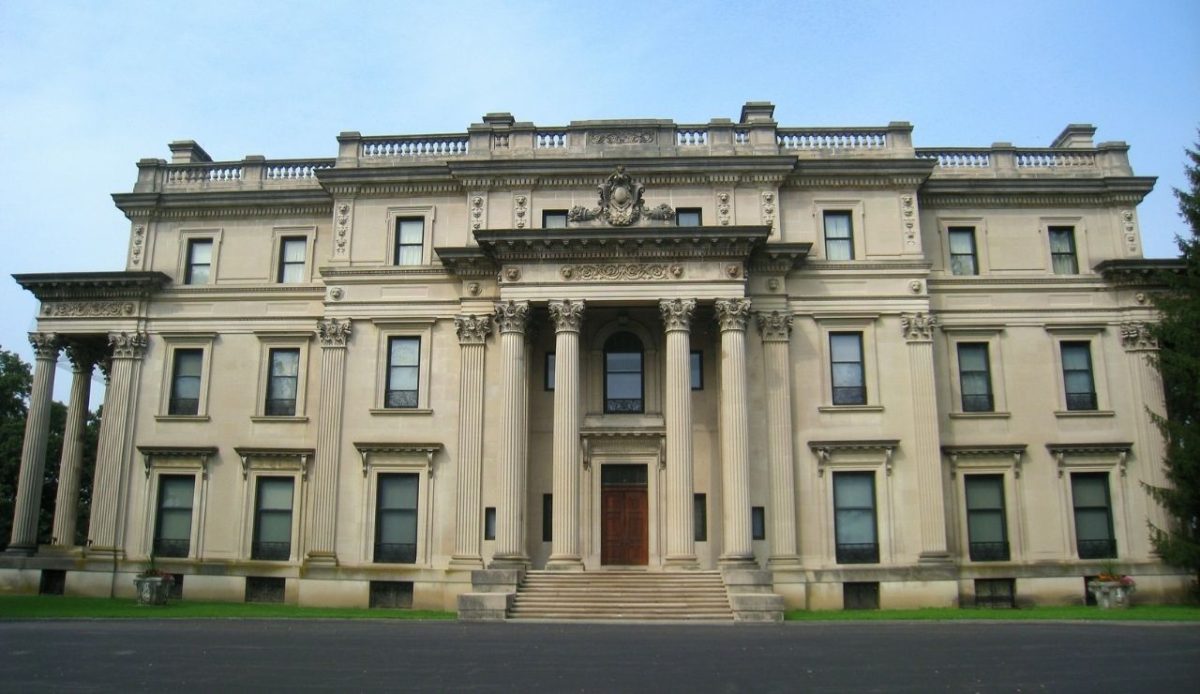
Vanderbilt Mansion National Historic Site is a historic house museum in Hyde Park, New York. Designated a National Historic Landmark in 1940, it is owned and operated by the National Park Service.
The 54-room Vanderbilt mansion was designed by the preeminent architectural firm McKim, Mead & White. It was built between 1896 and 1899. The house is an example of the Beaux-Arts architecture style. The interiors are archetypes of the American Renaissance, blending European architectural salvage, antiques, and fine period reproductions representing an array of historical styles.
The site includes 211 acres of the original larger property, situated on a bluff overlooking the Hudson River, and includes manicured lawns, formal gardens, woodlands, and numerous auxiliary buildings. The views of the Hudson are exceptional – it’s easy to understand why Frederick Vanderbilt chose this particular stretch of riverbank. The location offered quick and easy access to New York City on the Vanderbilts’ own New York Central Railroad.
The estate provides a glimpse of estate life, the social stratification of the period, and the world of the American millionaire during the era historians refer to as the Gilded Age. The National Park Service preserves over 200 acres of the original property, including historic buildings, original furnishings, manicured landscapes, natural woodlands, formal gardens, and associated documents.
What makes this property distinct from the Newport mansions is its operating model. As an NPS site, it benefits from federal preservation resources and ranger-led interpretation. The house, the grounds, and the river views are all part of the same experience, and because it isn’t as well-known as the Vanderbilt properties in Newport or Asheville, crowds are generally manageable. The Vanderbilt Mansion is considered one of the finest examples of Beaux-Arts architecture in the United States.
Lyndhurst, Tarrytown, New York
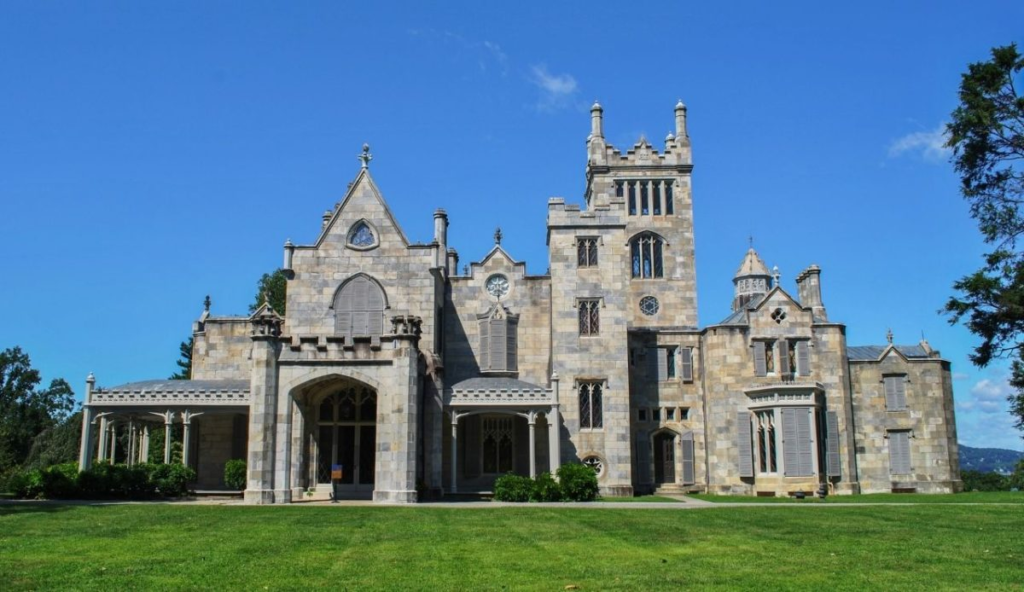
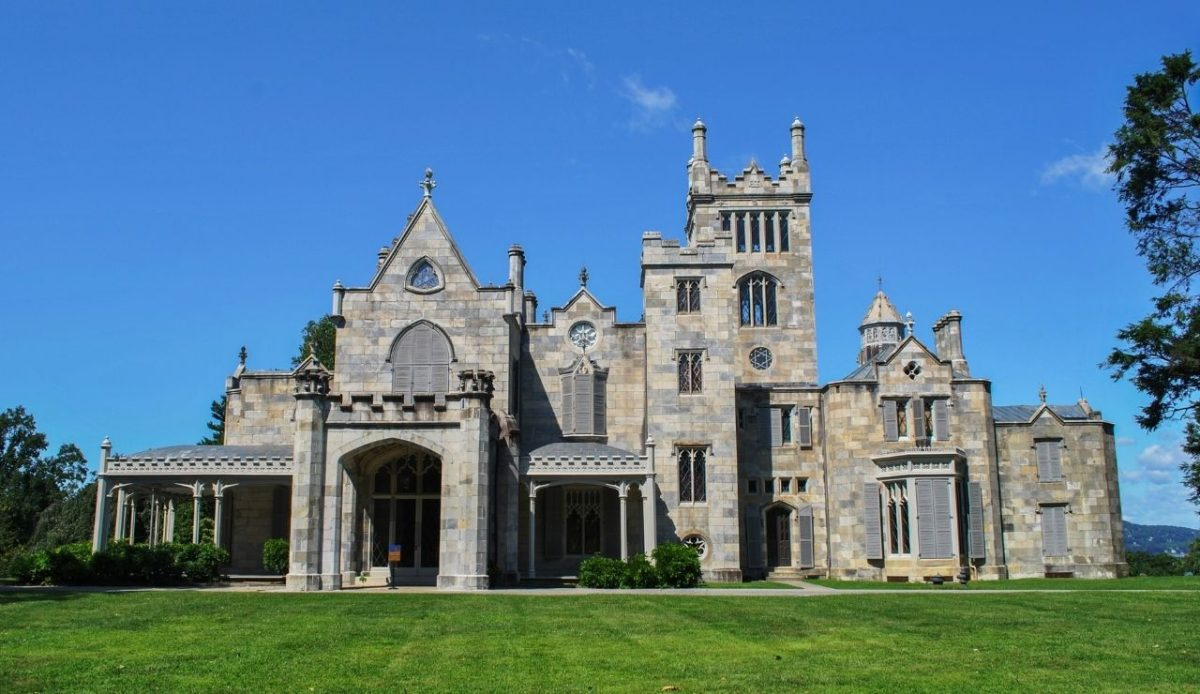
Lyndhurst, one of America’s finest Gothic Revival mansions and a National Trust Historic Site, was designed in 1838 by Alexander Jackson Davis. Its architectural brilliance is complemented by the park-like landscape of the estate and a comprehensive collection of original decorative arts.
Overlooking the Hudson River in Tarrytown, New York, is Lyndhurst, one of America’s finest Gothic Revival mansions. The house passed through three major families before becoming a National Trust property. Noteworthy occupants include former New York City mayor William Paulding, merchant George Merritt, and railroad tycoon Jay Gould. Lyndhurst’s vast collection of art, antiques, and furniture remains largely intact. In most instances, the furnishings are original to the house, and more than 50 pieces were designed by the architect himself, Alexander Jackson Davis.
A member of the prominent Gould family and one of the wealthiest people in the United States, Jay Gould purchased the property in 1880 to use as a country house. He occupied it until he died in 1892. Gould was one of the most controversial figures of the Gilded Age – a railroad speculator whose business tactics earned him the nickname “the Robber Baron of Robber Barons” – and Lyndhurst was his escape from all of it. He retained Master Gardener Ferdinand Mangold to continue developing the grounds and run the greenhouse, which was filled with Gould’s orchid collection. Jay Gould’s wife Helen died in 1889, and in 1892, Jay himself finally succumbed to tuberculosis.
The mansion’s rooms are strongly Gothic in character. Hallways are narrow, windows small and sharply arched, and ceilings are fantastically peaked, vaulted, and ornamented. The effect is at once gloomy, somber, and highly romantic; the large, double-height art gallery provides a contrast of light and space.
In 1961, Gould’s daughter Anna Gould donated the estate to the National Trust for Historic Preservation. The mansion and what is now a 67-acre estate remained in the Gould family until that point, though it once exceeded 500 acres. Other historically significant structures on the grounds include a Shingle-style Recreational Pavilion – one of the oldest regulation-sized bowling alleys in the world, built in 1894 – an elaborate swimming pool building from 1911, and the Rose Cottage, constructed around 1912 as a children’s playhouse.
Lyndhurst offers several special tours, including seasonally-themed mansion tours and Lyndhurst After Dark. The estate hosts special events, exhibits, and performances, including Gothic Market Weekends, book signings, theater performances, and concerts. Lyndhurst is closed to the public from January through March but welcomes guests throughout the rest of the year.
Why These Places Still Matter
What all of these historic mansions open to visitors have in common is that they survived because someone decided they were worth saving. That sounds obvious, but it isn’t. For every Breakers or Biltmore, there are dozens of comparable properties that were demolished when the cost of upkeep outpaced the will to maintain them. Preservation is not passive – it requires money, expertise, and ongoing institutional commitment.
In 2024, the Preservation Society of Newport County hosted more than 863,000 tours across its properties, marking a recovery from pandemic-era declines, according to CEO Trudy Coxe. That’s not just a tourism number – it’s a measure of how many people chose to spend their time engaging with these buildings, their history, and the lives of the people who built, staffed, and inhabited them.
And these buildings cover all of those lives, not just the wealthy ones. The servant life tours at The Elms, the below-stairs access at The Breakers, the hidden passageways at Biltmore – these details matter because they shift the story from myth to reality. The Gilded Age wasn’t just chandeliers and ocean views. It was also the 40 servants required to run The Elms for a few months each summer, and the coal tunnels that kept them invisible while they did it. As of 2025, a free hop-on, hop-off trolley from Rhode Island Public Transit Authority Route 67 runs from May 23 through October 31 to Marble House, The Breakers, and The Elms, making them more accessible than ever.
Whether you visit one or all eleven, these publicly accessible historic estates in America offer something that goes beyond architecture and interior decoration. They make visible what was once private, permanent what was once contingent, and public what was once emphatically not. That’s a remarkable thing for a summer house to accomplish.
A.I. Disclaimer: This article was created with AI assistance and edited by a human for accuracy and clarity.