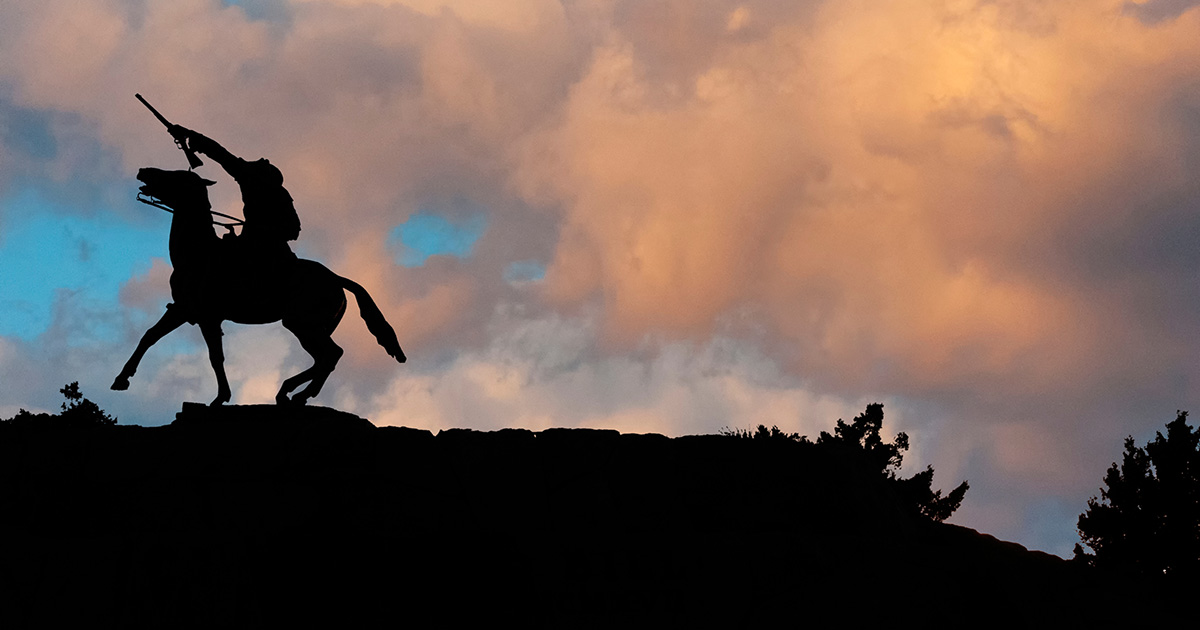

The morning greeting in Cimarron, New Mexico during the 1870s and 1880s wasn’t “good morning.” It was, according to local custom, “Who was killed at Lambert’s last night?” That tells you most of what you need to know about the St. James Hotel before you’ve even walked through the door.
The building still stands in the same spot on the Santa Fe Trail where it has stood since 1872, a low, sun-baked adobe structure that looks, from the outside, like it might have seen better days. Inside, the original tin ceiling of the dining room still holds 22 visible bullet holes. When Henry Lambert’s sons renovated the place in 1901, they discovered over 400 holes in the roof that had accumulated across a few decades of heavily armed clientele. Lambert, showing unusual foresight for the era, had reinforced the ceiling with a double layer of hardwood specifically to stop drunk cowboys from shooting guests sleeping in the rooms above.
The violence, the legend, and the still-living evidence of both are woven into the actual architecture. This is one of the most genuinely extraordinary haunted New Mexico hotel destinations in the country.
A French Chef, a Dead President, and a Wild West Saloon
According to Legends of America, the St. James Hotel was built in 1872 by Henri Lambert, who later anglicized his name to Henry, and was initially called Lambert’s Inn. Its saloon, restaurant, and 43 rooms witnessed at least 26 murders during Cimarron’s wilder days. Lambert’s route to northeastern New Mexico was unusual enough to deserve its own telling.
Before making his way to New Mexico, Lambert worked as a cook for Union forces during the Civil War, serving under generals including Ulysses S. Grant. He eventually moved west in search of gold. Finding little of it, he opened a saloon and restaurant instead. On the advice of President Grant, he eventually built the Lambert Hotel in Cimarron at a cost of $17,000, a genuine investment in what was essentially a lawless outpost at the edge of the frontier.
Cimarron, whose name comes from the Spanish for “feral” or “wild,” was a focal point of the Colfax County War in the late 1800s, pitting settlers against a land grant company. The St. James sat at the center of all of it. It sits nestled at the base of a mountain in the town of Cimarron, just paces off the Santa Fe Trail in northeastern New Mexico, originally established as a restaurant and saloon before being transformed into a rough-and-tumble establishment offering refuge to outlaws, American Indians, and Santa Fe Trail travelers.
The guest list reads like a casting call for every Western film ever made. The hotel hosted Wyatt and Morgan Earp (on their way to Tombstone), Doc Holliday, General Sheridan, Jesse James, Clay Allison, Frederick Remington, Governor Lew Wallace, Black Jack Ketchum, Buffalo Bill Cody, Annie Oakley, Billy the Kid, Bat Masterson, and author Zane Grey. Many of them were regulars, and some of them died here.
Buffalo Bill Cody was among the hotel’s most celebrated visitors. When Lambert’s son Fred was born during a blustery snowstorm, Buffalo Bill nicknamed him “Cyclone Dick” and was asked to be his godfather, and would later be one of the first to teach him how to use guns. Fred Lambert went on to spend his life as a Cimarron sheriff, a tribal police officer, and a territorial marshal, raised, in every sense, in the shadow of this building and its extraordinary cast of characters.
The Ceiling, the Rooms, and the Body Count
Lambert had the foresight to reinforce the ceiling to prevent drunk cowboys from shooting customers in the rooms above. When his sons renovated the property in 1901, they discovered more than 400 holes in the roof. Though they removed or repaired most during the remodel, there are still 22 bullet holes visible in the tin-punched ceiling of the dining room.
Those bullet holes aren’t decoration. They are a physical record of what the saloon’s clientele, outlaws, gamblers, and lawmen alike, left behind across decades of rowdy nights. Built during a time when law and order were nonexistent, the saloon quickly gained a reputation as a place of violence, and the first question usually asked around Cimarron in the morning was: “Who was killed at Lambert’s last night?”
The Santa Fe Trail Historic Sites database, which catalogs certified stops along the original trail corridor, confirms the hotel sits just paces off the Santa Fe Trail in northeastern New Mexico, a position that made it the natural meeting point for everyone passing through the region. The hotel is listed in the National Register of Historic Places and is an integral part of the Cimarron Historic District. Today, guests can stay in either the 12 restored rooms of the original historic building, where the furniture dates to the 19th century, or in a modern annex alongside. Lambert’s Restaurant still operates within the hotel walls, serving food beneath that same perforated ceiling.
Room 18 and the Ghost Who Never Checked Out
The paranormal history of the St. James centers most intensely on a single locked door. Room 18 sits permanently locked and off-limits to guests, occupied according to staff by the restless spirit of Thomas James Wright, who is said to have been shot after winning the hotel itself in a high-stakes poker game. The room has remained sealed for decades, with the legend holding that Wright never made it back to claim his prize.
The room has been closed to guests for decades. Staff members have described hearing sounds from within it. As featured on the television series Unsolved Mysteries, the most haunted room has been sealed for the protection of hotel employees and guests, its ghostly inhabitant still claiming ownership of the hotel he reportedly won in an Old West poker game.
Historical accounts suggest that at least 26 people lost their lives inside these walls during the hotel’s wildest years, making it one of the most storied addresses in the entire Southwest. Some researchers believe the actual count runs even higher.
The second most active room, according to guests and paranormal investigators who have stayed there, is reportedly room 17. Room 307 is, according to local legend, haunted by the ghost of a maid named Irene. Visitors claim to hear creaking floorboards and report that faces are visible in the wallpaper. The hotel takes these accounts seriously enough that it does not dismiss them, and the staff, by most visitor accounts, discuss the paranormal history with the same matter-of-fact tone they use when explaining breakfast hours.
The Other Haunted New Mexico Hotel Worth Knowing
The St. James is the most storied haunted New Mexico hotel, but it’s not the only one worth knowing.
La Posada de Santa Fe, a luxury resort just steps from the historic Plaza in downtown Santa Fe, carries a very different kind of ghost. The original mansion was built by Abraham Staab, a prominent German-Jewish merchant who became one of Santa Fe’s most influential businessmen. The Victorian mansion he constructed for his bride Julia became the foundation for what would eventually become La Posada Resort, and the original Staab House, built in 1882, can still be found in the main lobby building.
Julia suffered through a series of difficult pregnancies that took a toll on both her mental and physical wellbeing. Abraham did all he could to help his wife, including sending her on exclusive trips to Europe’s most prestigious health resorts. Nevertheless, Julia gradually faded and passed away at the age of 52 in 1896.
The first recorded sighting of Julia’s ghost at La Posada came in the 1970s, when a janitor mopping the floor encountered a white-haired woman in a Victorian-era gown standing next to the fireplace. This was followed by several more accounts from resort staff noticing the same woman, disappearing as suddenly as she appeared. In one instance, the La Posada ghost was spotted wandering the hallways by a security guard, who immediately ran.
According to Historic Hotels of America, recorded sightings of ghostly activity at La Posada have included gas fireplaces turning on and off, swaying chandeliers, and items in guestrooms vanishing. A bartender once stated that on a particularly busy evening, all the glasses on one shelf flew off and crashed to the floor. During her life, Julia loved gardening and decorating the house with roses. As such, some visitors have referenced encountering the distinct smell of roses throughout the building. All alleged activity is confined to the former Staab House, so guests staying in the newer accommodations have never reported similar experiences.
Julia Staab is believed to be the primary spirit haunting La Posada de Santa Fe. Her apparition appears most frequently in what was once her bedroom suite, now Room 256.
What Makes These Places Different
Most places described as haunted are trading on atmosphere: a dark hallway, some creaking wood, a story that gets better with each retelling over a few drinks. The St. James is something genuinely distinct. The violence that happened within its walls is documented. The names of the people who passed through are on historical records. The bullet holes are still in the ceiling. The legend of Thomas Wright winning the hotel in a poker game, only to be shot before he could claim it, is a specific story attached to a specific room that the hotel, to this day, keeps locked.
The St. James Hotel is currently closed and looking for buyers, but remains a historic and haunted location in New Mexico. The hotel has changed hands many times since Lambert died in 1913. The St. James fell into disrepair after the railroad came through and effectively killed the Santa Fe Trail. From 1926 to 1985, the hotel passed from owner to owner, but in 1985 it was restored to its former glory.
Whatever its current ownership situation, the structure endures. The rooms named for Billy the Kid, Jesse James, and Clay Allison still have their doors. The dining room still serves food under the bullet holes. And Room 18 stays locked. Some things about the St. James Hotel seem entirely resistant to change, regardless of who signs the deed.
The history of the American West is often told through broad strokes: the frontier, the outlaws, the lawmen, the land grants. What a place like the St. James preserves is something more granular and more honest than that: the record of a specific saloon, in a specific mountain town, where specific people drank and gambled and occasionally killed each other, and where the evidence of all of it is still right there in the ceiling above your dinner table. That’s not a ghost story. That’s just what happened here. The ghost stories come with it.
Disclaimer: This information is not intended to be a substitute for professional medical advice, diagnosis, or treatment and is for information only. Always seek the advice of your physician or another qualified health provider with any questions about your medical condition and/or current medication. Do not disregard professional medical advice or delay seeking advice or treatment because of something you have read here.
AI Disclaimer: This article was created with the assistance of AI tools and reviewed by a human editor.