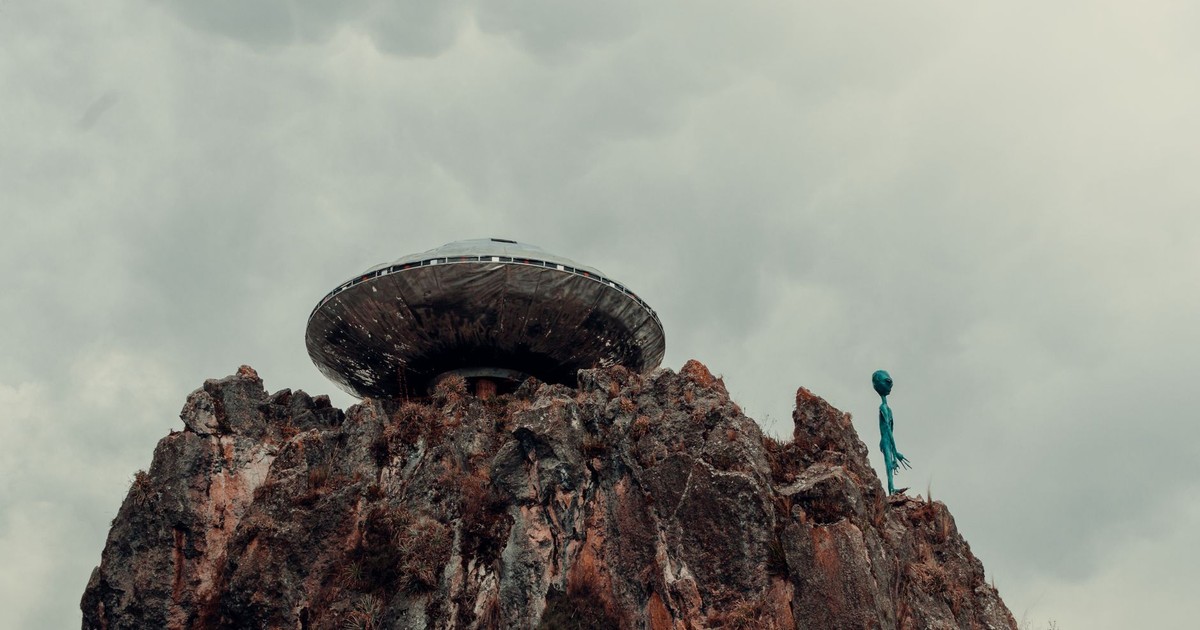

The government website where Americans can read declassified UFO records went live on May 8, 2026. By the time the third batch of files dropped in June, the site had received over 1.7 billion hits worldwide. The question of what’s in the sky no longer belongs to the fringes.
The White House has put a face to the investigation, and it’s a face that has made plenty of scientists deeply uncomfortable. Avi Loeb, a cosmologist who studied black holes and served as head of Harvard’s astronomy department until 2020, has been appointed to helm a new scientific advisory council tasked with investigating the origins of mysterious orbs and other objects reported by military personnel in recent years. The Harvard UFO Council, as it’s quickly come to be called in press coverage, sits at the center of a federal transparency push unlike anything the U.S. government has attempted before.
Loeb’s view on all of this? “It’s like a detective story,” he told the Associated Press. “It’s a lot of fun, as long as you don’t pay too much attention to the critics.” His critics, for their part, are not being equally relaxed about it.
Who Is Avi Loeb, and Why Is This Appointment So Divisive?

Before he became known for his alien theories, Loeb was a respected cosmologist who authored hundreds of papers, specializing in black holes and the birth of galaxies. He served as chair of Harvard’s astronomy department for nearly a decade. His is the résumé of someone who built serious scientific credibility over decades before deciding to spend it.
Loeb’s career took a notable turn with his “light sail” theory in 2017, which he presented in a paper and later a book. The object at the center of that theory was ‘Oumuamua, the first interstellar visitor ever detected passing through our solar system. In October 2017, an observatory in Hawaii detected a strange object speeding through our solar system at a velocity far exceeding that of objects gravitationally bound to the Sun. Its hyperbolic trajectory confirmed it originated beyond our solar system, and it was nicknamed ‘Oumuamua, meaning “scout” or “messenger” in Hawaiian.
Most astronomers looked at ‘Oumuamua and reached for natural explanations. Loeb went a different direction. To him, the most plausible explanation was as obvious as it was sensational: taken together with its possibly pancake-like shape and high reflectivity, ‘Oumuamua’s anomalous acceleration made perfect sense if the object was in fact a light sail, perhaps a derelict from some long-expired galactic culture. In late 2018, Loeb and his co-author Shmuel Bialy, a Harvard postdoctoral fellow, published a paper in the Astrophysical Journal Letters arguing that ‘Oumuamua had been humanity’s first contact with an artifact of extraterrestrial intelligence.
The scientific community’s reaction ranged from skeptical to scornful. Peer review is the bedrock of how science self-corrects, and some researchers chafe at Loeb’s habit of skipping that process and bringing claims directly to the public. Steve Desch, an Arizona State University astrophysicist who has challenged some of Loeb’s theories, said Loeb uses flawed methods to reach wild conclusions about alien life, all while shunning a more established branch of science searching for life beyond Earth.
Loeb followed the ‘Oumuamua paper with a bestselling book and then went further. He founded the Galileo Project at Harvard, with a stated mission to search for artifacts from alien civilizations. His team drew attention in 2023 when they used magnets to retrieve hundreds of small spheres from the floor of the Pacific Ocean, near the possible site of a 2014 meteor crash. The spheres didn’t produce the alien confirmation Loeb had hoped for, but they didn’t stop his momentum either.
Loeb’s formal credentials are extensive: he was Founding Director of Harvard University’s Black Hole Initiative (2016–2021), former director of the Institute for Theory and Computation at the Harvard-Smithsonian Center for Astrophysics, a former member of the President’s Council of Advisors on Science and Technology, and a former chair of the Board on Physics and Astronomy of the National Academies. Whatever you think of his theories, this is not someone who stumbled into government work.
What the Harvard UFO Council Is Actually Being Asked to Do

On a Substack post describing his new role, Loeb said he was “tasked by the White House, the Pentagon’s All Domain Anomaly Resolution Office (AARO), the Office of the Director of National Intelligence (ODNI), the FBI, and the Intelligence Community, to assemble a ‘UAP Science Advisory Council.'” That’s a long chain of institutional sign-off for someone the scientific establishment treats as a controversial figure.
The appointment is part of a broader push by the Trump administration for transparency on unexplained aerial phenomena, positioning Loeb at the center of a government-backed effort to evaluate national security risks. His newly formed UAP Science Advisory Council reports to the UAP Governance Board, an interagency entity bringing together military, law enforcement, the intelligence community, and other civilian agencies.
An ODNI official told DefenseScoop that the agency, alongside the FBI and DOD, established the new board “to provide guidance, recommendations and coordination at the interagency level, bringing together military, law enforcement, the intelligence community, and other civilian agencies,” in support of Trump’s recent directive on UAP transparency.
Loeb says his starting point isn’t alien life. He’s promising a grounded approach, starting with the assumption that UAPs are human-made and treating them as a national security question first. As he explained to CBS Boston, “If they were sure, confident that these objects are human-made, they would file these cases as classified reports within the Pentagon, within the intelligence agencies. The fact that they open up to the scientific community implies that there is a chance that perhaps one or more of these objects might be not human-made.”
The government’s own behavior is the tell. When agencies stop keeping something purely internal and invite outside scientists in, the inside answers aren’t satisfying.
The Team Loeb Has Assembled

His hand-picked team includes more than a dozen scientists and UFO activists. The council’s composition immediately drew scrutiny, because it mixes credentialed researchers with figures who have made claims that go well beyond what the data supports.
Among the team is Timothy Gallaudet, a retired rear admiral who has warned about UAP controlled by “nonhuman intelligence,” claiming the United States has recovered crashed aircraft. Also on the team is Ben Lamm, a billionaire working to revive extinct species. The broader council membership, as Loeb described it in his own posts, covers data analysis, AI tools, anomaly identification, physics, instrumentation, oceanography, statistics, and human psychology, suggesting a genuinely interdisciplinary approach rather than a team assembled to reach a predetermined conclusion.
Loeb noted that including at least one member with a skeptical perspective in every committee is highly important, arguing that a skeptic prevents blind spots, reduces cognitive biases, and actively protects groups from disastrous decision-making as a result of groupthink. Whether the final team achieves that balance is something critics are watching closely.
After the council’s first meeting, the team sent a request to the Pentagon asking for more than 50 videos, images and other documents related to known UAP incidents. Loeb’s group meets behind closed doors, but he has vowed to brief the public and create a website to share findings.
The Declassification Push Behind the Council

The Harvard UFO Council doesn’t exist in isolation. It’s embedded in a much larger government transparency operation that has been building since early 2026. Trump first directed agencies in February to begin identifying and releasing government files tied to UFOs, UAPs and extraterrestrial-related material, saying there was “tremendous interest” in the subject.
The UFO files, officially called the Presidential Unsealing and Reporting System for UAP Encounters (PURSUE), were released by the Trump administration beginning on May 8, 2026. The files were published through a government website created to release reviewed UAP-related material to the public. So far, there have been three batches of UAP files released on May 8, May 22, and June 12, 2026.
The third release, on June 12, included 53 documents, 10 images, 6 videos, and 3 audio recordings from the CIA, the FBI, NASA, and the Pentagon. The Pentagon said the archive includes 209 sightings of “green orbs,” “discs,” and “fireballs” reported close to a military facility. The report also noted that 40% of reported phenomena lack reasonable explanation and remain unresolved.
That 40% figure gives the council its real mandate: these cases haven’t been explained away as weather balloons or sensor malfunctions. The third batch also included a report dated June 5, 2026, by AARO’s director Dr. Jon Kosloski, detailing an orange “mother orb” observed launching smaller red orbs. The description sounds like science fiction. It’s in an official government document.
The Critics Won’t Stay Quiet
Sean Kirkpatrick, a physicist who previously investigated UAP at the Pentagon’s All-domain Anomaly Resolution Office, said Loeb is “not viewed favorably” in the scientific community and lacks national security experience. He said the makeup of Loeb’s team suggests the White House is more interested in fringe theories than hard science.
Desch went further, saying Loeb’s role on the White House panel casts doubt on the entire endeavor. “I don’t know what’s going to come of this, but we’re not going to get any closer to answering these questions with him in charge,” Desch said.
The frustration from mainstream astronomy has a logic to it. The field has its own methods for searching for extraterrestrial life, developed through programs like the SETI Institute (Search for Extraterrestrial Intelligence). Loeb has been openly dismissive of those efforts, arguing they lack imagination. That posture, combined with his direct route to the press and now to the White House, makes him a genuinely unusual figure: a scientist whose influence has grown in inverse proportion to his standing within his own discipline.
Loeb brushes his critics aside, saying they lack the imagination to consider new ideas. His response to Kirkpatrick and Desch was characteristically direct: “Let’s keep our eyes on the orbs,” he said, “not the social media.”
Read More: 32 Real Alien Worlds That Belong in a Sci-Fi Movie
What Happens Now
Loeb has framed the council’s purpose in bluntly practical terms: the best way to resolve the nature of UAPs is by getting higher-quality scientific data. Either the government is dealing with a serious breach of national security, or with the biggest scientific discovery in history. Neither option makes inaction look anything but reckless.
If the government invests in better data collection on UAPs, Loeb has said, it could settle the alien debate once and for all. The more likely short-term outcome is an extended period of inconclusive data analysis, bureaucratic friction, and continued disagreement about what any given piece of footage actually shows.
A Pentagon office that investigates UAP says it has seen no evidence of alien life. Loeb said he doesn’t buy into cover-up theories either. “My impression is the government is baffled by not being able to infer the nature of some of these objects,” he said. That distinction matters. The most serious version of this story isn’t about hidden knowledge – it’s about genuine institutional confusion, and whether a scientist willing to ask uncomfortable questions out loud can force a clearer answer than the cautious, classified processes of the past several decades.
Military pilots have reported these objects. Radar systems have tracked them. AARO has a caseload exceeding 2,000 incidents. The 40% that remain unresolved after government review aren’t going away because the scientific community finds Loeb irritating.
He might be wrong about ‘Oumuamua. He might be wrong about the spheres from the Pacific floor. The mainstream critique of his methods isn’t unfounded. But the data sitting in those declassified files doesn’t belong to him, and it doesn’t disappear if he turns out to be chasing the wrong answer. The real question isn’t whether Avi Loeb is the right person for this job. It’s whether anyone with the right credentials would have taken it.
AI Disclaimer: This article was created with the assistance of AI tools and reviewed by a human editor.