
There are three things about America that pretty much everyone who’s visited from abroad notices immediately: the portions are enormous, the flags are everywhere, and the price of a hospital visit will make you want to lie down on a free park bench and reconsider your life choices. But those are the obvious ones, the observations people share at dinner parties. The deeper stuff, the numbers that sit behind the famous swagger of American exceptionalism, tends to stay quietly buried beneath the noise.
Some of it is funny in a can’t-quite-believe-it way. Some of it is the kind of thing that makes you furrow your brow and stare at the ceiling. And some of it is both at once, which is sort of the defining experience of paying attention to this country. The United States is, by any measure, one of the most remarkable nations in human history. It is also, by many of the same measures, a place doing some genuinely strange and occasionally self-defeating things on a world-historical scale.
None of these facts are here to score political points or throw shade at an entire country. They’re here because they’re real, they’re verifiable, and the majority of Americans, busy with actual life, have never had cause to look them up. Some of them you’ll laugh at. Some of them you’ll want to argue about. All of them are true.
1. There Are More Guns Than People

The United States has the highest rate of civilian gun ownership on earth, with 120.5 firearms for every 100 civilians. Switzerland, second on the list, has just 27.58 per 100. To put that another way, you could give every single person in the country a gun and still have tens of millions left over. American civilians account for an estimated 393 million, or roughly 46 percent, of all civilian-held firearms on the planet. That’s nearly half the world’s civilian guns concentrated in one country that represents about 4 percent of the global population.
In 2023, roughly 16.7 million firearms were sold in the U.S., and in the first four months of 2024 alone, nearly 5.5 million more changed hands. The market has cooled somewhat from its pandemic-era peak, but the inventory is already out there.
2. The Healthcare Bill Is Staggering, and the Results Don’t Match

In 2024, the United States spent an estimated $14,885 per person on healthcare, the highest per-capita healthcare cost of any country in the OECD. And yet, as the Commonwealth Fund’s 2024 Mirror, Mirror report found, despite higher healthcare spending, America’s health outcomes are not better than those in other developed countries – the U.S. actually performs worse on metrics including life expectancy, infant mortality, unmanaged diabetes, and safety during childbirth.
In 2025, 36 percent of U.S. adults reported skipping or delaying needed medical care because of cost, including more than a third of those who had insurance. In the EU, only 3.6 percent of adults reported unmet medical needs due to cost, distance, or waiting lists combined. More spending, fewer people actually getting care.
3. The National Debt Per Person Would Make Your Eyes Water
Total gross national debt currently amounts to approximately $113,792 per person, or around $288,676 per household. The federal debt as of March 2026 stood at $39.1 trillion, which is 4 percent higher than it was a year prior and up 37 percent from 2019, before the COVID-19 pandemic.
In 2024, federal interest payments on the national debt surpassed spending on both Medicare and national defense combined. That’s the United States paying more to service its debt than it spends keeping people healthy or the military running. It’s the fiscal equivalent of only ever making the minimum monthly credit card payment and then bragging about your credit limit.
4. The Prison Population Is One of the Largest on Earth

With nearly two million people behind bars at any given time, the United States has the highest incarceration rate of any country in the world, spending about $445 billion every year to lock up nearly 1 percent of the adult population. The country remains a global leader in per capita incarceration rates, and the toll shows up clearly in the numbers: today, one in six imprisoned people in America is serving a life sentence.
For context, Germany has an incarceration rate of 67 per 100,000 people. Italy’s is 97 per 100,000. The U.S. rate dwarfs both. That gap isn’t easily explained by crime rates alone, which makes it one of the more genuinely uncomfortable facts on this list.
5. Less Than Half of Americans Have a Passport
Less than half of Americans have a valid passport. Between 45 and 50 percent of the country currently holds one. This is, to be fair, improving, and it’s partly because the U.S. is geographically massive with two neighboring countries most people can drive to. Still, in comparative terms, it’s a striking figure.
In 1990, only about 4 percent of the U.S. population held a valid passport. The number has risen sharply since, but it does say something about a country’s relationship with the wider world when the majority of its people have never needed a document to leave it. There are 30-year-olds with strong opinions about international affairs who have never set foot outside North America.
6. The 50-Star Flag Was Originally Graded a B-Minus
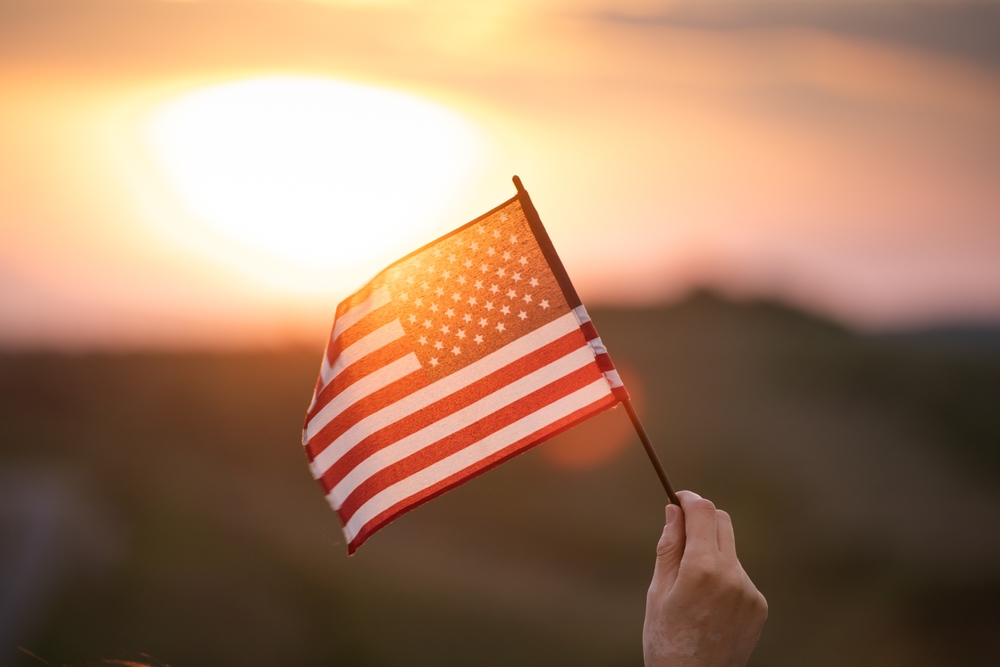
Here’s a fun one that doubles as a mild indictment of a teacher’s confidence in their students. The current 50-star American flag was designed as a high school project by a 17-year-old named Robert G. Heft. He received a B-minus for his efforts, but his teacher agreed to reconsider the grade if Congress actually adopted the design. In 1959, that’s exactly what happened, and his design was selected as the official flag. His teacher promptly changed the grade to an A.
The flag that hangs in schools, government buildings, and on the lapels of approximately every politician who has ever run for anything was designed by a teenager for a class assignment. That’s not embarrassing so much as it is genuinely charming – though presumably Mr. Heft wished his teacher had started with the A.
7. Americans Spend More on Healthcare Than Going to the Doctor

The U.S. spends nearly twice as much on healthcare per person as comparable wealthy nations – $13,432 versus $7,393 per person on average – yet healthcare utilization in America, from doctor visits to surgeries, is generally lower than in other wealthy countries. That means the U.S. isn’t spending more because people are seeing more doctors. It’s spending more because everything costs more.
The Peterson-KFF Health System Tracker confirms that in 2024, the U.S. spent 17.2 percent of GDP on health, substantially higher than peer countries, which average 11.2 percent. That 6-point gap represents trillions of dollars that go somewhere – just not, apparently, to better outcomes.
8. The Official American Flag Had No Official Language to Describe It

Here’s a quirky constitutional gap most civics teachers skip over. The United States has no official national language. English is the de facto language of government, business, and daily life, but it has never been formally designated at the federal level. Dozens of bills have been introduced in Congress to make English official over the decades, and none have passed.
Seventeen states have laws declaring English as their official state language, and about 32 states have some form of English-language legislation. But federally? Nothing. The country that invented “Americanism” as a concept has never gotten around to officially naming the language it invented it in.
9. Americans Throw Away an Extraordinary Amount of Food

The U.S. Department of Agriculture estimates that between 30 and 40 percent of the entire food supply in the United States is wasted. That works out to roughly 133 billion pounds of food per year – food that was grown, transported, refrigerated, and purchased before being tossed. For a country where food insecurity affected around 47 million people in 2023, according to the USDA’s Economic Research Service, that particular gap tends to generate strong feelings when people actually stop to think about it.
The average American household throws away approximately $1,500 worth of food each year. The food waste alone, if it were a country, would be among the largest emitters of greenhouse gases in the world.
10. The U.S. Has More Self-Storage Units Than Any Nation on Earth

Americans own so much stuff they pay money to store the overflow. In the United States, driving is more than a mode of transportation – it represents independence, mobility, and identity. Even when walking might be quicker, many still choose to drive. That same impulse toward accumulation extends to possessions. There are more than 50,000 self-storage facilities in the United States, which works out to roughly one for every 6,600 people. That’s more than the combined total of McDonald’s, Dunkin’, and Starbucks locations nationwide.
The self-storage industry generates over $40 billion in annual revenue. Put differently: Americans collectively spend more on storing things they don’t currently need than the GDP of many small nations.
11. America Pays Its Fast-Food Workers Poverty Wages in Many States

The federal minimum wage has been $7.25 per hour since 2009, and Congress has not raised it since. In inflation-adjusted terms, the federal minimum wage today is worth less than it was in 1968. While several states and cities have moved their own minimums significantly higher, a worker earning the federal minimum full-time, 52 weeks a year, would gross $15,080 before taxes. The federal poverty line for a single person in 2025 is $15,650. By design, the federal minimum wage doesn’t clear the poverty threshold for a single adult working every week of the year.
12. The U.S. Is One of Only Two Countries Without Paid Parental Leave

The United States remains one of the only countries in the world without a national paid parental leave policy. Papua New Guinea is frequently cited as the only other nation in a similar position among countries with functioning labor codes. Every other wealthy democracy, and many much poorer ones, provides some form of paid leave for new parents. The U.S. has the Family and Medical Leave Act, which guarantees up to 12 weeks of unpaid leave – for those who qualify. About 44 percent of American workers don’t meet the eligibility requirements.
13. A Third of Americans Believe in Ghosts

A 2025 Gallup poll found that 39 percent of Americans believe in ghosts, while around 24 percent believe in witches and 24 percent believe in reincarnation. This is not a trivial footnote – it tells you something about what a substantial portion of the population is working with when evaluating information. The same polling tradition has consistently found that meaningful shares of Americans hold beliefs most scientists would classify as firmly unsupported by evidence, on topics ranging from the paranormal to the extraterrestrial.
None of this is uniquely American, of course. But when combined with some of the other items on this list, it raises reasonable questions about the relationship between a culture and its critical thinking infrastructure.
14. Obesity Rates Are Among the Highest in the Developed World

A CDC data brief reports that the adult obesity rate in the United States stands at 40.3 percent, making the U.S. one of the heaviest countries in the developed world by this measure. That figure has roughly doubled since the 1980s. The causes are well-documented: food environments saturated with ultra-processed options, car-dependent communities that make walking difficult, and healthcare systems better equipped to treat the consequences of obesity than prevent them.
Related to the items on healthcare costs elsewhere on this list, obesity-related conditions including type 2 diabetes, heart disease, and certain cancers are estimated to cost the U.S. healthcare system several hundred billion dollars annually – a number that grows quietly larger each year.
15. American Students Score Poorly on Global Rankings

The OECD’s Programme for International Student Assessment (PISA), which measures reading, math, and science skills in 15-year-olds across dozens of countries, has consistently placed the U.S. in the middle of the pack or below, particularly in mathematics. In the 2022 results, the most recent available, U.S. students scored below the OECD average in math and near average in reading and science. Countries including South Korea, Japan, Canada, Australia, and most of Western Europe consistently outperform the U.S.
For a country that spends more per student on K-12 education than almost any other nation, this is a persistent and genuinely puzzling gap. The money is going somewhere; it’s just not reliably showing up in international test scores.
16. The U.S. Has Never Used the Metric System, Despite Officially Adopting It

Americans are among the only people in the world who rely on the imperial system for daily measurements, calculating length in inches, feet, and miles instead of the metric equivalents. This system is embedded in road signs, construction, education, and recipes. Nearly every other country switched to metric for its simplicity and global standardization.
What most Americans don’t know is that the U.S. officially adopted the metric system in 1975 when the Metric Conversion Act was signed into law. The act declared metric the “preferred system” of measurement. Congress then made conversion entirely voluntary, at which point the country shrugged collectively and went back to feet and inches. NASA’s 1999 Mars Climate Orbiter was lost because a contractor used imperial units while the agency used metric. The spacecraft burned up entering the Martian atmosphere. Price tag: $327 million.
17. Tipping Is Effectively a Hidden Wage Subsidy

Tipping is deeply embedded in American culture, particularly in the restaurant and service industries. Americans often tip between 15 and 25 percent, and in some places tipping less than 20 percent is considered rude. This expectation exists because employers often pay below minimum wage with the assumption that tips will make up the difference.
The federal tipped minimum wage is $2.13 per hour, a rate that has not been updated since 1991. Restaurant workers in states that enforce this rate are dependent on customer generosity to reach any livable wage. Most other wealthy countries have decided this is not an acceptable arrangement and simply pay workers. The American system outsources the ethical burden of fair compensation to the customer, and then makes that customer feel guilty when they don’t comply.
18. Americans Drive Everywhere, Even a Quarter Mile

Most American towns and suburbs were designed entirely around cars, often lacking safe sidewalks or bike paths. Public transit is limited or inconvenient outside major cities, making car ownership a near-necessity. Some communities even associate walking with an inability to afford a vehicle, creating a social stigma around it.
The result is that the U.S. has one of the highest rates of car ownership per capita in the world and one of the lowest rates of walking and cycling for transportation. The same infrastructure design that makes cars necessary also makes physical activity something Americans have to schedule rather than something that simply happens as part of daily life. The gym membership and the two-car garage are, in this sense, not unrelated expenses.
19. Workstipation Is Apparently a Real Thing

Two-thirds of Americans, or 66 percent, are so bathroom-shy at work that they hold it in to avoid using their workplace restroom, according to a survey commissioned by MiraLAX. The survey found 71 percent are simply uncomfortable using the office bathroom because they feel self-conscious about bad smells, potential visibility through stall gaps, and embarrassing sounds. As a result, 63 percent use a restroom outside their workplace during the day, and separately, 51 percent of all Americans sit on their toilet at home, whether they need to go or not, just to get some peace and quiet.
This made it into a national survey because, apparently, enough people identified with it that the data became statistically significant. America is many things. It is also a nation of people sneaking to the Starbucks bathroom two blocks away rather than using the one down the hall. That’s not shameful. That’s just human. But it does feel like something.
20. The U.S. Borrows Money Faster Than Most Countries Can Imagine

Over the past year, the U.S. national debt grew at an average rate of $7.39 billion per day, $307.98 million per hour, and $5.13 million per minute. That’s the debt clock ticking in the background of every congressional speech about fiscal responsibility. In October 2025, the U.S. paid $981 billion in net interest over the preceding 12 months, nearly triple what it paid five years earlier, and the Congressional Budget Office forecasts that figure will keep growing.
This is the kind of number that’s so large it becomes almost meaningless, which may be exactly why it rarely interrupts anyone’s day.
21. Americans Go to the Toilet for Privacy

Yes, we covered the bathroom thing above, but there’s a related entry here that deserves its own moment. A OnePoll survey found that 51 percent of all Americans sit on their toilet, whether they need to go or not, just to get some peace and quiet. Half the country has quietly decided the bathroom is a sanctuary. This is, objectively, both the saddest and most relatable fact on this list. Life is full, families are loud, open-plan offices are brutal, and sometimes a locked door with a porcelain throne is the best office available.
22. The U.S. Produces Nearly No Coffee, Despite Drinking Enormous Amounts

America imports 99.99875 percent of its coffee, according to USAFacts. The country runs on the stuff – coffee shops on every corner, a $50 billion domestic coffee market – and virtually none of it grows on American soil. The tiny exception is Hawaii, where some high-end specialty coffee is grown in volcanic soil, but the output barely registers against the volume of beans the country consumes daily.
This is more charming than embarrassing, but it does represent a significant dependence on global supply chains for something that is essentially a national cultural habit. The daily ritual of 150 million Americans getting their morning cup begins, almost entirely, on a hillside in Colombia, Brazil, or Vietnam.
23. Student Loan Debt Has Passed $1.7 Trillion

The total outstanding student loan debt in the United States has passed $1.7 trillion, held by approximately 43 million borrowers. Federal Student Aid data shows the average federal student loan borrower carries around $37,000 in debt. The U.S. is one of the few wealthy nations where the cost of a public university degree routinely leaves a graduate with a five-figure financial liability before they’ve earned their first paycheck.
Most peer nations fund higher education significantly through public spending, keeping tuition low or free. The U.S. chose a different model – one that works quite well for people who graduate into high-paying fields, and creates genuinely lasting hardship for those who don’t, or who never finish their degree but still carry the debt.
24. The American Flag Was Originally Only Red and White

The Betsy Ross version of the American flag most people picture had 13 stars and 13 stripes for the original colonies. What most people don’t know is that the design has officially changed 27 times since the first version was adopted in 1777. Each time a new state was added, a new star was added to the flag. For a brief and chaotic period in the early 19th century, Congress also added new stripes for new states, which would have eventually produced a flag that looked more like a barcode than a national symbol. In 1818, they reverted to 13 stripes and just kept adding stars instead.
25. More Than 1 in 3 Americans Believes Aliens Live Among Us

According to a survey cited by Reader’s Digest, 1 out of every 3 Americans believes that aliens live among us. This is not a fringe position in the United States. It sits comfortably alongside the 7 percent of Americans who believed the moon landing was faked, according to a 2013 Public Policy Polling survey – a number that various subsequent polls have suggested may have grown since then.
None of this is uniquely American, and curiosity about what else might be out there is arguably one of the more appealing human traits. But when “aliens are living among us right now” is the sincere belief of roughly 100 million people, it’s worth adding to the list.
What to Do With All of This

None of these facts are a verdict on America, and they’re certainly not an invitation to feel bad about being American. The U.S. is also the country that put humans on the moon (really, despite the 7 percent), invented the internet, produces more scientific research than any other nation, and has an extraordinary record of cultural creativity that the rest of the world consumes with obvious enthusiasm. Complexity isn’t a bug. It’s the actual shape of the place.
But there’s something useful about looking at the numbers without the filter. When the gap between the story a country tells about itself and the data that describes it is this wide, it usually means there are some interesting conversations that haven’t fully been had yet. Healthcare, debt, incarceration, food waste, bathroom anxiety, and a toilet-based national privacy strategy – these are not random quirks. They’re signals. The most interesting question isn’t “isn’t this embarrassing?” It’s: what would have to change for these numbers to look different?
That question is harder than it sounds, because most of these things aren’t accidents. The tipped wage system wasn’t a mistake. The car-dependent suburbs were designed that way. The student loan structure was a policy choice. Which means change is possible in principle, even if it moves slowly and noisily in practice. In the meantime, knowing the numbers is at least a place to start. You can’t push back on a story you’ve never actually examined.
AI Disclaimer: This article was created with the assistance of AI tools and reviewed by a human editor.