
Most cities don’t end up on a “climate haven” shortlist by accident. The ones that do tend to share a few quiet advantages: they sit inland, they have access to fresh water, and they haven’t spent the last century building their economies on a coastline that’s now being slowly reclaimed by the ocean. The gap between those cities and the most vulnerable parts of the country is becoming harder to ignore.
That gap is showing up in the data. Research published in the journal Nature Communications, found that 3.2 million Americans moved away from high-flood-risk areas between 2000 and 2020 – and that current “climate abandonment areas” are projected to lose another 2.5 million residents over the next three decades as flood exposure continues to rise. Those aren’t abstract projections. They’re the neighbors who sold the Florida beach house at a loss, the cousins who packed up Phoenix after the fifth summer of 115-degree days, the people who just got tired of being scared every fire season.
But while some cities are quietly becoming harder to live in, others are quietly becoming more attractive than they’ve been in decades. A set of mostly inland urban centers – many of them in the Great Lakes region, the upper Midwest, and the Northeast – keeps appearing on the lists that climate scientists and urban planners compile when they’re asked where people should be thinking about moving. They’re often called “climate havens” or “climate refuges.” The label is imperfect. No city is fully insulated from what’s coming. But the gap between these places and the most exposed parts of the country is real, and it’s growing. Here are eleven cities that consistently end up on the right side of it.
1. Buffalo, New York
Buffalo used to be the butt of the joke. All that snow, all that rust, all those decades of being a city people left rather than moved to. Now, climate scientists and urban planners are describing it as one of the more enviable positions in the country.
According to Inside Climate News, Buffalo is the last major city in the continental United States to not reach 100 degrees Fahrenheit, and while it will reach that threshold eventually, experts believe it will be one of the last places to do so. Rep. Tim Kennedy (D-N.Y.) has pointed to the city’s position on Lake Erie as the core of its appeal: “Because of our position on Lake Erie, we have become a climate refuge,” he said, noting that as temperatures rise elsewhere, more people are looking to Buffalo to find their homes – “recognizing that Lake Erie is a natural air conditioner.”
That freshwater advantage is already drawing new residents. Buffalo’s western lake-side districts have become hubs of Puerto Rican and Hispanic life, with an estimated 70,000 Puerto Ricans now living in Buffalo’s Erie County, many having arrived after hurricanes Irma and Maria devastated the island in 2017.
That said, experts caution against treating the city as a guaranteed safe house. Stephen Vermette, a professor of geography at SUNY Buffalo State University who has researched climate trends in Western New York since 2015, put it plainly: “A climate refuge is not an oasis. It’s not a place that’s not going to have extreme weather or be immune to climate change.” The relative resilience Buffalo has shown historically doesn’t guarantee the same patterns will continue. Still, for long-term planning, few inland northeastern cities offer the same combination of freshwater access, moderate temperatures, and affordable housing.
2. Minneapolis, Minnesota
Minneapolis sits in a region that climate resilience researchers keep returning to. It has lakes, it has water infrastructure, and it has a city government that has been building toward long-term climate preparedness for over a decade.
Minneapolis has updated its zoning policies and adopted land-use strategies to permit more multifamily housing that increases density but prevents sprawl. The city also enjoys a robust public transportation system, and programs like the Green Cities Accord underscore its commitment to sustainability. Minneapolis offers big-city amenities with strong climate resilience in one of the upper Midwest’s most stable regions, with its many lakes helping to moderate temperatures and an infrastructure built to manage heavy snow and shifting precipitation patterns.
The city isn’t without challenges. Winters are genuinely harsh, and the region’s vulnerability to shifting precipitation patterns is real. But relative to the flooding coasts, the drought-stricken Southwest, and the wildfire corridors of the West, Minneapolis consistently lands near the top of climate haven rankings. Academic research predicts that mid-sized Rust Belt cities including Minneapolis-St. Paul will experience large relative gains in population from climate migrants – a shift that could eventually push up housing costs, but also signals that the city is seen as a long-term bet by a lot of people running the same calculations.
3. Pittsburgh, Pennsylvania
Pittsburgh’s transformation from steel city to tech-and-healthcare hub has been well documented. What gets less attention is how its geography – hills, rivers, a temperate inland climate – positions it surprisingly well for the decades ahead.
Pittsburgh’s valley location helps shield it from extreme weather and ensures steady water access from its rivers, while the city has shifted from industry to tech and healthcare, boosting economic stability. Climate projections suggest Pittsburgh will stay relatively comfortable, with milder winters and manageable summers. Although Pittsburgh’s three-river confluence has a history with flooding, modern levees, pump stations, and green infrastructure projects have reduced typical impacts in developed districts, and the hilly topography lifts many residential blocks out of the lowest risk zones.
For families weighing a long-term move, Pittsburgh also offers something rare: a genuinely diversified economy. Strong hospital systems add another layer of resilience for families looking long term. Add in housing prices that remain well below coastal equivalents, and Pittsburgh’s case for climate-conscious relocation is hard to dismiss.
4. Duluth, Minnesota
Duluth is a small city on the western tip of Lake Superior, and for years it occupied a quiet spot in the climate conversation. That’s changing fast.
Duluth’s location on the cold side of Lake Superior keeps extreme heat days unusually low even during hot summers, with average summer highs staying comfortable and far fewer days above 90 degrees compared to national norms. Many residential areas sit well above the lakeshore, which reduces direct flood exposure. Duluth has actively discussed welcoming climate migrants, recognizing the benefits of population growth and fresh economic opportunities.
The city isn’t immune from the pressures that come with the “climate haven” label, though. Wealthy people relocating from climate-vulnerable regions have already driven real estate prices up in Duluth – a cautionary tale about what happens when cities become known as climate havens overnight without adequate planning in place. Housing currently has a median price around $180,000 and a rental market that remains steady, but the city has also been upgrading its infrastructure to better handle shifting precipitation patterns.
5. Madison, Wisconsin
Madison has a few natural gifts that climate planners tend to appreciate: it sits between two lakes, it has a large research university driving economic stability, and it has invested seriously in green infrastructure.
Madison invests in green infrastructure to improve resilience, including permeable pavement and urban tree canopies. The city benefits from a chain of lakes and a balanced climate that produces fewer severe heat days than many Midwestern peers, with neighborhoods dotted with parks and trails that keep the heat index more comfortable on summer afternoons. The city has also expanded stormwater detention projects to reduce flash flooding around low-lying corridors.
The university ecosystem also matters beyond just job creation. Public health and university medical systems provide strong hospital bed availability per capita, transit and bike infrastructure have grown to shorten car commutes and lower air pollution exposure, and steady job growth and a large public sector base create long-term stability. For families who want a mid-sized city with genuine long-term prospects and a quality of life that doesn’t require a coastal salary to access, Madison keeps coming up on the short list.
6. Cincinnati, Ohio
Cincinnati’s case for the climate haven designation is partly geographic and partly intentional. It sits in a temperate zone well inland, away from coastal flooding, and its leaders have been thinking about climate migration as an economic opportunity rather than a liability for years.
Cincinnati’s resilience plan, developed as early as 2018, focused on leveraging its location to become a climate haven for domestic migrants and set out a road map for accommodating new arrivals. The city is now using sophisticated forecasting tools to determine how climate change influences migration patterns and to adapt its policies to improve housing and infrastructure.
Leadership in Cincinnati views future climate-driven migration to the city as a potential opportunity for socioeconomic growth. Cincinnati is one of many post-industrial legacy cities that lost population throughout the second half of the twentieth century but in the last 15 years experienced a modest population increase for the first time since 1950. That’s a meaningful signal. A city that spent decades shrinking now has room to grow – and it’s already planning for it.
7. Indianapolis, Indiana
Indianapolis doesn’t usually make headlines for its climate credentials, which is part of what makes its position interesting. It’s been quietly doing the work.
Indianapolis has invested in expanding its public transit system and other infrastructure to support its rising population, with efforts that seek to strengthen the downtown core and build a framework for regional multimodal transportation. As a landlocked city sitting well above sea level and outside the most severe heat corridors, Indianapolis benefits from basic geographic advantages that more glamorous Sun Belt cities simply don’t have.
In a recent survey of 300 senior executives, 75% reported their companies have considered relocating or have moved facilities because of climate-related concerns – and Indianapolis, with its lower operating costs and reduced physical risk profile, is increasingly on that corporate shortlist. That kind of economic tailwind matters for a city’s long-term resilience, because climate-ready cities need investment and tax revenue to maintain the infrastructure that keeps them safe.
8. Rochester, New York
Rochester sits in upstate New York, moderated by Lake Ontario to its north, and it’s one of those cities that rarely shows up in popular rankings but keeps appearing in the research. Its position inland means shorter heat waves and cooler nights. The city’s combined sewer system upgrades and detention basins have steadily reduced flood incidents in known hotspots.
Rochester also benefits from being part of the broader Great Lakes ecosystem, which holds an extraordinary asset: water. The Great Lakes system holds around 20% of the world’s surface freshwater, and proximity to that resource becomes increasingly significant as drought conditions expand across the South and West. The city has also diversified economically since the decline of Kodak, with healthcare, education, and optics companies providing more stable long-term employment than the single-employer model that defined it for decades.
9. Portland, Maine
Portland, Maine occupies a rare niche: a coastal city that climate experts treat as more resilient than most of its coastal peers. Its position in the far northeast, away from hurricane tracks that devastate the Gulf and Southeast, and above the storm surge levels that threaten lower-elevation Atlantic cities, works in its favor.
Climate experts have described Portland, Maine as one of the few coastal cities that qualifies for high resilience to natural disasters caused by climate change, noting it is better positioned geographically to cope with the effects of rising seas. The city has been building on that geographic advantage with deliberate urban planning, and its strong local food economy adds a layer of self-sufficiency that matters when supply chains face disruption.
Maine as a state also offers context. The Northeast offers better prospects generally, with Vermont and New Hampshire ranking among the safest states from climate change. Vermont stands out as largely free from wildfires, extreme heat, and hurricanes – and Portland, Maine benefits from similar regional advantages while offering all the amenities of a small city with an unusually vibrant food and arts culture.
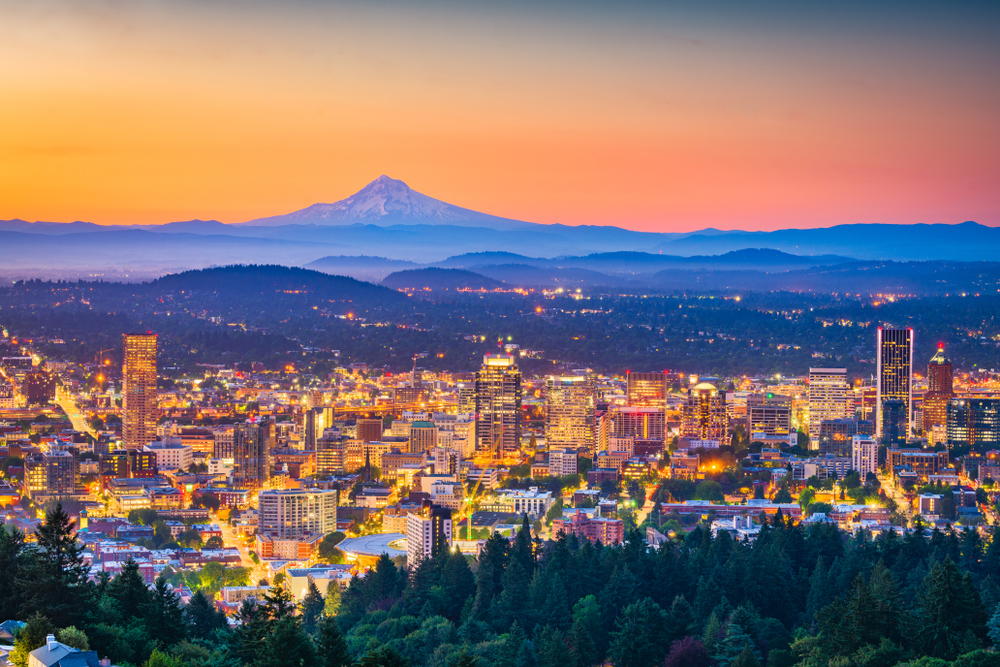
10. Portland, Oregon
Portland, Oregon makes the list for different reasons than its Maine namesake. Where Portland, ME benefits from a quiet northeastern geography, Portland, OR has done the institutional work to get here, and has been doing it for longer than almost any other American city.
Portland unveiled its Global Warming Reduction Strategy in 1993, making it the first of its kind in the country, and in the years since, the city has continued to stand out for sustainability and climate-focused urban planning. Public officials have prioritized a transition toward decarbonization, actively seeking energy resources and urban planning strategies that minimize the importance of fossil fuels, with targets including phasing out gas-powered leaf blowers, transitioning away from traditional gasoline-powered vehicles, and pursuing sustainable deconstruction rather than standard demolition.
The city’s location in the Pacific Northwest gives it natural advantages too. Oregon is advantageously positioned to avoid issues like frequent extreme heat, tornadoes, and hurricanes, and greenspace is abundant throughout Portland and its surrounding suburban landscapes. The primary risks are wildfire smoke from surrounding regions and a long-term trajectory of warming summers – issues Portland is actively addressing, but ones that distinguish it from the Great Lakes cities on this list.
11. Seattle, Washington
Seattle closes the list as one of the Pacific Northwest’s most credentialed climate cities – not just because of its natural position, but because of the specific investments it’s making to back that position up.
Seattle has committed to improving greenspaces throughout the city, particularly in lower-income areas most dramatically affected by urban heat islands that trap higher temperatures, and it is investing in seawall and storm drainage improvements with a particular focus on climate justice that brings lower-income areas up to standard alongside more affluent neighborhoods. The city is aiming to become carbon neutral by 2050 and is installing electric vehicle chargers around the community while electrifying buildings.
Like Portland, Oregon, Seattle’s main vulnerabilities involve wildfire smoke from surrounding regions and longer-term warming trends. But Seattle is named among the top American cities in terms of climate resiliency as a result of all these initiatives – and its combination of strong institutional capacity, economic depth, and genuine policy commitment makes it a city that’s actively earning its place on this list rather than simply inheriting it by geography.
Read More: 45 Countries Where Americans Say They Felt the Least Welcome
What the “Climate Safe” Label Actually Means
The phrase “climate safe” – well, it’s worth being honest about what it does and doesn’t mean. A climate refuge is not an oasis. It is not a place that won’t see extreme weather or won’t feel the effects of a warming planet. What these eleven cities share is a combination of geographic luck and deliberate preparation – they sit in regions likely to face less severe disruption than the coasts, the Southwest, and the Gulf states. Not no disruption. Just less.
The scale of what’s already happening is useful context here. According to Climate Central, the past three years rank highest on record for annual billion-dollar weather and climate disasters in the United States: 28 events in 2023, 27 in 2024, and 23 in 2025 – with the average time between billion-dollar disasters falling to just 10 days last year. That drumbeat is reshaping the map of where people and companies want to be. The cities on this list are betting they can absorb that migration while building the kind of resilient infrastructure that makes them worth moving to.
That’s the real measure of a climate-safe city: not whether it can promise sunshine and dry basements forever, but whether it has the water, the planning, the political will, and the economic base to keep adapting as conditions change. Most of the cities on this list are still works in progress. But they’re working in the right direction – and right now, that distinction matters more than most people realize.
AI Disclaimer: This article was created with the assistance of AI tools and reviewed by a human editor.