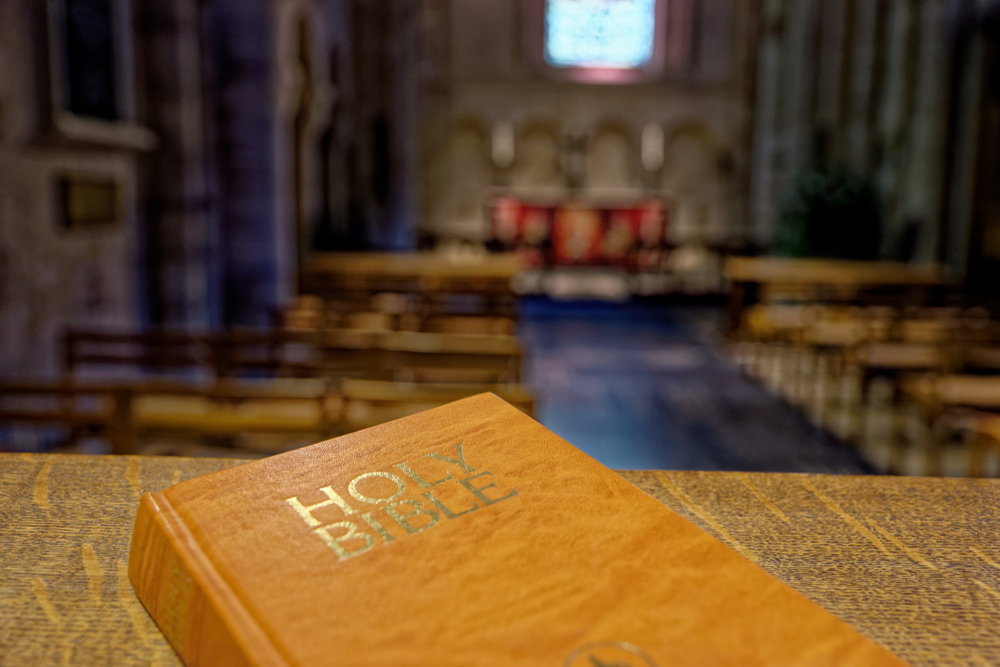

Most of us grow up absorbing the beliefs of our faith communities without ever questioning where those ideas came from. They’re in the air at Sunday school, woven into sermons, sung in hymns. If enough people repeat them with enough conviction, they start to feel ancient and authoritative, and eventually, they feel biblical. The trouble is that a belief feeling biblical and a belief actually appearing in the Bible are two very different things.
This isn’t an attack on Christianity or faith. Plenty of the beliefs below are held by sincere, thoughtful people, and some of them have been defended by theologians for centuries. Does the Bible actually say this? For several of the most widely repeated ideas in churches around the world, the honest answer is no. The ideas came from somewhere else: from tradition, from medieval poetry, from 19th-century evangelism, from councils of bishops arguing in smoky rooms. When you trace them back, the Bible turns out to be conspicuously quiet.
Some of what follows may be familiar. Other items on this list might genuinely surprise you. Either way, the point isn’t to unsettle anyone’s faith. It’s to hand you a clearer picture of what’s actually on the page.
1. The Trinity
This one lands first because it’s so foundational to mainstream Christianity that many people assume the word must be plastered all over scripture. The word “trinity” appears nowhere in the Bible; the concept was finalized at the First Council of Nicaea in 325 CE after years of debate. The idea of God existing as three distinct persons – Father, Son, and Holy Spirit – took shape over time as early Christians wrestled with how to understand the relationship between Jesus and God.
Tertullian, writing around 155 – 200 CE, was the first to use the Latin term “trinity,” describing it as a kind of divine household or economy of God. That’s more than a century after the last books of the New Testament were written. As the New Bible Dictionary acknowledges: “The term ‘Trinity’ is not itself found in the Bible. It was first used by Tertullian at the close of the 2nd century, but received wide currency and formal elucidation only in the 4th and 5th centuries.”
Most mainstream Christian denominations hold that the concept of the Trinity is implied by scripture even if the word isn’t there. They’re not wrong that the Bible contains references to the Father, the Son, and the Holy Spirit. But the specific theological doctrine – that these three are co-equal, co-eternal persons sharing one divine substance – is a church formulation, not a biblical statement. The Nicene Creed is where the doctrine lives. The Bible is where people went searching for something to support it.
2. Going to Heaven When You Die
The mental image is vivid and almost universal: the moment a believer dies, their soul drifts upward to a cloudlit paradise where they’ll spend eternity with God. Pastors say it at funerals. Children are taught it from their earliest years. Many people believe righteous souls will end up in heaven, a spiritual realm, but the Bible doesn’t explicitly say that human souls go there upon death. The concept appears to be a later development, particularly popularized in the Middle Ages.
What the New Testament actually emphasizes is resurrection – a future, bodily rising from the dead – rather than the immediate departure of the soul to a heavenly realm. Biblical scholar J. Richard Middleton, professor of biblical worldview at Northeastern Seminary, argues in his book A New Heaven and a New Earth that “the Bible nowhere claims that ‘heaven’ is the final home of the redeemed,” and that the New Testament’s vision is one of a bodily resurrection and a renewed earth, not souls floating in an ethereal paradise.
That gap matters more than it might seem. The idea that people become angels or drift off to paradise the moment they die is more Platonic than biblical, rooted in ancient Greek ideas about the immortal soul separating from the body at death. The biblical picture is different: the dead rest and await a resurrection at the end of time. Whether that changes anything for your personal faith is your call, but the instant-departure-to-heaven story is not what scripture teaches.
3. The Sinner’s Prayer
Millions of people have been told that to be saved, they must repeat a specific prayer asking Jesus into their heart. The words of the Sinner’s Prayer do not appear anywhere in the Bible, and there is no biblical record of anyone praying this exact prayer. Historians say the simple prayer we know today originated no earlier than the Protestant Reformation, and more likely in the first part of the 20th century.
The prayer is largely attributed to 19th-century evangelist Dwight L. Moody, and later evangelicals – particularly crusade preachers like Billy Graham – popularized it through altar calls. It’s a product of American revival culture, not ancient scripture. The book of Acts documents how the early church operated, and it contains no example of anything resembling a sinner’s prayer. The practice doesn’t appear in church history until the 19th century.
That doesn’t make the prayer meaningless or harmful. Many people have found it a genuinely useful framework for committing to their faith. The problem arrives when it gets treated as the mandatory, scripturally required gateway to salvation, because at that point, you’re leaning on a 19th-century American invention and calling it a biblical requirement.
4. Purgatory
For Catholics, purgatory – the idea that souls undergo a period of purification after death before entering heaven – is a serious and carefully developed doctrine. For Protestants, it’s a belief to be rejected. And it also doesn’t appear in scripture. The Bible does not contain the word “purgatory,” nor does it teach that the souls of those who have died are purified in a post-death holding state.
The book Orpheus: A General History of Religions by Salomon Reinach states flatly that “there is not a word about it in the Gospels.” The New Catholic Encyclopedia itself states: “In the final analysis, the Catholic doctrine on purgatory is based on tradition, not Sacred Scripture.” This isn’t a Protestant attack on Catholicism – it’s the Catholic Church’s own scholarly reference work being candid about the origins of its teaching.
The doctrine took shape gradually through church tradition and was formally defined at the Council of Trent in its twenty-fifth session in December 1563. It may have deep roots in Catholic practice, but scripture is not where those roots reach.
5. The Serpent in Eden Was Satan
Ask almost anyone who grew up in a Christian household who tempted Eve in the garden, and they’ll say the devil without hesitation. It’s one of the most embedded assumptions in all of Christian thought. Most Christians believe the serpent in Genesis was none other than Satan. There is nothing in the Bible to back this up. The snake is simply a snake in Genesis – a crafty creature who causes a great deal of trouble, but never described as the Devil.
The belief that it was Satan came later. In Genesis 3:14, God addresses the snake as simply a snake, cursing it to “crawl on its belly” and “eat dust all the days of its life.” God gives no hint that the serpent was ever more than a reptilian trickster. There is no identification of the Genesis serpent with Satan anywhere in the Old Testament.
Much of the idea that Satan was once an angel called Lucifer who tempted humanity comes from Milton’s Paradise Lost rather than from the Bible itself. That’s a 1667 English epic poem, not scripture. People have been reading Milton’s theological imagination back into Genesis for centuries, and the line between the two has almost completely disappeared. To clarify, Genesis does not identify the serpent as Satan, but later Jewish, intertestamental, and New Testament texts (e.g., Revelation) make the identification; Milton popularized but did not originate the idea.
6. There Were Three Wise Men
Every nativity scene has exactly three of them, usually depicted as kings on camels, arriving at the stable on Christmas night to present their famous gifts. Although the gospel of Matthew records the story of baby Jesus being visited by wise men from the East, the Bible never says they are kings, that they rode camels, or even that there were three of them. The number three is often assumed because the wise men presented three gifts, but the text says nothing about how many men brought them.
And as for the stable itself, that’s another assumption layered onto a vague text. Only Matthew and Luke mention Jesus’s birth, and neither specifies a stable. All we really know is that when the time came for Mary to give birth, there was no room in the kataluma – a word often translated as “inn,” but which more likely means “guest room.”
The tidy Christmas nativity is a beautiful tradition, layered and cherished. But the Bible gives far fewer details than the scene on your mantelpiece suggests. The three bearded kings on their camels are a tradition assembled over centuries from a text that’s genuinely vague about most of it.
7. Original Sin as Inherited Guilt
The idea that every human being is born already guilty because of Adam and Eve’s disobedience is so central to many Christian theologies that it feels primitive and essential. But the earliest understanding of original sin focused on the human inclination toward wrongdoing rather than the belief that all people are born legally guilty for what Adam and Eve did. That later idea – inherited guilt passed from generation to generation – was developed by Augustine in the 4th century. For over 300 years, including during the lifetimes of the early Christians and the twelve apostles, no such doctrine existed.
Augustine’s formulation, built partly on a misreading of Romans 5, reshaped Western Christianity in a way that has no clear parallel in the early church. The concept of prayers could deepen the picture here. The idea that humans have a tendency toward sin is ancient and widely attested across religious traditions. The idea that a newborn baby is already guilty of a specific act committed thousands of years ago by a different person is a 4th-century theological invention.
The practical consequences of that gap are significant. A faith built on the first idea leads toward concepts like discipline, growth, and humility. A faith built on the second can veer toward a darker view of human nature that has historically been used to justify some troubling things.
8. God Has a Specific Plan for Your Life
“God has a plan for your life” might be the single most repeated phrase in contemporary Christian culture. It’s stitched on throw pillows. It’s the centerpiece of graduation speeches. The Bible doesn’t consistently speak of individualized divine plans for each person. Jeremiah 29:11 mentions “plans,” but this passage is God speaking to the nation of Israel during the Babylonian exile – a message about their eventual return to their homeland, not a promise about individual career paths.
The verse was written to a specific people in a specific crisis. Lifting it out of that context and applying it to whether you should take the job offer in Denver is a significant stretch.
That doesn’t mean the Bible offers no guidance for navigating life. It has plenty. But the idea that God has pre-scripted every detail of your personal life – the right career, the right spouse, the right city – and that your job is simply to decode it, is more self-help seminar than scripture.
9. “God Won’t Give You More Than You Can Handle”
This phrase gets pulled out at funerals, in hospital waiting rooms, in moments of grief so heavy that people are desperately reaching for something to hold onto. The problem is that it’s a misreading of 1 Corinthians 10:13, and the actual promise in that verse is something quite different.
What 1 Corinthians 10:13 actually says is that God will not allow you to face a temptation so overwhelming that you absolutely must sin – that there is always a way out of sinful behavior. That’s a promise about moral capacity, not about the upper limit of suffering. God, in practice, regularly gives people more than they can cope with. What he promises is not protection from unbearable circumstances, but that there will never be a situation in which sin is your only option.
The phrase survives because it comforts people, and on a human level that’s understandable. But it also sets people up for a faith crisis when life does become genuinely unbearable. If the Bible had promised an upper limit on suffering, the book of Job would make no sense at all.
10. The Forbidden Fruit Was an Apple
This one is more cultural than theological, but it’s deeply embedded. The fruit Eve ate in the Garden of Eden has been depicted as a red apple in Western art for so long that most people would struggle to imagine it any other way. The Bible never specifies that the fruit was an apple. Genesis 1:29 specifies that Adam and Eve were permitted to eat from any fruit that bears seeds – the forbidden fruit is identified only by the tree it came from, not its variety.
The apple association crept in through a linguistic coincidence. In Latin, the word for “apple” and the word for “evil” are both malum. Because the Bible was read across Europe for centuries in Latin translation, the visual connection settled in. By the time Renaissance painters got to work on Genesis, the apple was already fixed iconography – not because of anything in the text, but because of a pun in a translation.
The fruit in the story is simply called the fruit of the tree of the knowledge of good and evil. No variety specified.
11. Drinking Alcohol Is a Sin
Many churches, particularly evangelical and Baptist congregations, treat any consumption of alcohol as straightforwardly sinful. Members are sometimes expected to sign pledges of total abstinence as a condition of membership. The Bible doesn’t teach this. It does not prohibit alcohol consumption except for those taking a specific vow – Samson and John the Baptist being the clearest examples.
The Bible does warn against drunkenness and calls on elders, deacons, and older women to avoid drinking too much wine. But those are calls for moderation, not abstinence. Jesus turned water into wine at a wedding. The Last Supper involved wine. Paul told Timothy to drink a little wine for his stomach’s sake.
Total abstinence as a Christian moral requirement is largely a product of the 19th-century temperance movement, which wielded significant influence in American Protestant churches and shaped those denominations far more than the text of scripture did.
12. People Become Angels After Death
Humans are humans, and angels are angels – and scripture maintains that distinction into eternity. In the New Testament, angels are described as beings who observe God’s relationship with humanity with curiosity: beings who “long to look” at what God does with people. They are a distinct category of created being, not a rank that humans graduate into.
The idea that a grandmother who has died becomes a guardian angel watching over the family is genuinely touching and deeply rooted in popular culture. It also has no biblical foundation. The book of Revelation, which contains the most vivid descriptions of the afterlife in the New Testament, shows the redeemed as resurrected people, not winged celestial beings.
The confusion probably arises from the fact that angels often appear in scripture as messengers delivering protection and comfort – roles we naturally want to imagine our loved ones playing from beyond. That’s an emotional projection onto the text, not something the text itself teaches.
What to Do With All of This
None of this requires you to throw anything out. Tradition matters. The accumulated weight of how communities have interpreted and practiced their faith over centuries is real, and it shapes meaning in ways that raw text cannot always do on its own. The Trinity doctrine, even if the word isn’t in the Bible, was worked out by people who had read scripture deeply and were genuinely trying to understand something difficult. Purgatory reflects real human intuitions about justice and mercy. The nativity scene, apple and all, carries something that straightforward historical accuracy can’t replace.
But there’s a difference between holding a tradition and insisting it’s biblical when it isn’t. The honest move is to know which is which: to say “this is what my church has taught for centuries” rather than “this is what scripture says,” when those are not the same thing. That kind of intellectual honesty doesn’t weaken faith. For a lot of people, it actually deepens it, because it frees you from defending things that were never yours to defend in the first place. The beliefs that survive that kind of scrutiny tend to be the ones worth keeping.
AI Disclaimer: This article was created with the assistance of AI tools and reviewed by a human editor.