
Most people who grow up Catholic can point to a specific Sunday when a priest said something in a homily that landed, or a nun who terrified them in second grade. Plenty of kids go through a phase of wondering whether they’re called to something greater. But for a surprising number of the world’s most recognizable faces, the celebrities priesthood path wasn’t just a passing childhood thought. It was a real, committed chapter of their lives – seminary enrollment, convent schools, genuine deliberation about vows of poverty and celibacy – before something redirected them toward stages, film sets, and sold-out arenas.
The pull toward religious vocation and the pull toward performance are closer than they look. Both demand a kind of surrender. Both ask you to stand before an audience and mean it completely. Several of the people on this list have drawn that connection themselves, noting that the intensity of devotion required to be a priest or a nun isn’t entirely unlike what it takes to be a great artist. And the part that tends to surprise people isn’t that they considered it. It’s how far some of them actually got.
Here are twelve famous people who came remarkably close to a life of religious service, and the stories of how they ended up somewhere else entirely.
1. Tom Cruise and the Celebrities Priesthood Path That Started It All

Tom Cruise, who grew up Catholic, made a surprising pivot at age 14 when he thought seriously about becoming a priest. He met Father Ric Schneider, who urged him to enroll at a Franciscan seminary in Cincinnati. His close friend at the time, Shane Dempler, later recalled the experience with clarity, telling a New York Daily News feature: “He had a very strong Catholic faith. We went to Mass, spent time in the chapel and enjoyed hearing stories from the priests. We thought the priests had a great lifestyle and we were really interested in priesthood.”
What ended his time at the seminary came down to a rule-breaking incident. According to Dempler, the two would often sneak out to smoke cigarettes, before one night deciding to steal alcohol – Dempler broke into the room where it was stored and threw bottles out the window to Cruise standing below. The school subsequently wrote to their parents suggesting they not return. Cruise was also candid about a more personal reason: he had realized he loved women too much to give them up.
When he was 16, a teacher encouraged Cruise to participate in his high school’s production of the musical Guys and Dolls. He won the lead role, found himself surprisingly at home on the stage, and a career was born.
2. Martin Scorsese
Few directors carry their Catholic upbringing as visibly through their work as Martin Scorsese. Guilt, redemption, violence, and grace – the recurring textures of his films aren’t accidental. They go back directly to a young man from a devout Sicilian Catholic family in New York who was seriously considering the priesthood.
His Roman Catholic education and positive experience in the Church led him to seriously consider a priesthood vocation. Surrounded by priests he wanted to emulate, he enrolled in Cathedral Prep, a preparatory seminary, at 15. In Mr. Scorsese, the 2025 Apple TV+ documentary series directed by Rebecca Miller, Scorsese explained what happened next in his own words: “Falling in love or being attracted to girls, not that you’re acting out on it, but there were these feelings, and I suddenly realized it’s much more complicated than this. You can’t shut yourself off.” He eventually realized the priesthood was not for him. “The idea of priesthood, to devote yourself to others, really, that’s what it’s about. I realized I don’t belong there,” he remembered, “And I tried to stay, but they got my father in there, and they told him, ‘Get him out of here.’ Because I behaved badly.”
Scorsese’s fascination with religion remained a constant throughout his life and career, even after he left seminary. He made multiple films concerning Catholicism, including 1988’s The Last Temptation of Christ and 2017’s Silence. That last one – a brutal meditation on faith, doubt, and what a vocation actually costs – is probably his most direct reckoning with the question he never fully resolved.
3. Gabriel Byrne
Gabriel Byrne was raised by devoutly Catholic parents in Ireland and spent five years in the seminary – a serious commitment by any measure. He came to the conclusion that the vocation simply wasn’t his. Five years is a long time to figure that out, but it clearly pointed him toward a very different kind of life.
The Irish actor, best known internationally for The Usual Suspects and the acclaimed television drama In Treatment, has spoken directly about the weight those years placed on his understanding of the world. As he put it in one interview: “I spent five years in the seminary and I suppose it was assumed that one had a vocation. I realized subsequently that I didn’t.” Mid-twentieth century Ireland was a country where the Church didn’t just shape spiritual life – it shaped what questions were appropriate, what ambitions were respectable, and what kind of man a boy was expected to become. Spending five years inside that system as a serious ordination candidate, not just a Catholic schoolboy, leaves a particular kind of mark.
There was no dramatic exit, no single crisis of faith. Just a gradual recognition that the calling he’d been pursuing wasn’t his. What followed was theater, and eventually a career that made him one of the most respected character actors in both European and American cinema. His best roles tend to carry moral complexity and internal contradiction that doesn’t feel performed. Five years in a seminary probably has something to do with that.
4. Jack White
Jack White had been accepted to a seminary in Wisconsin and was fully prepared to pursue the priesthood before making a last-minute change of heart. Throughout White’s upbringing, his parents worked at the Archdiocese of Detroit, and he was raised staunchly Catholic alongside his nine older siblings. Faith was an important, all-encompassing aspect of his life throughout childhood, and he became an altar boy during the mid-1980s.
In a 2005 interview with 60 Minutes, White told Mike Wallace exactly how close the call was: “I’d got accepted to a seminary in Wisconsin, and I was gonna become a priest, but at the last second I thought, ‘I’ll just go to public school.’ I had just gotten a new amplifier in my bedroom, and I didn’t think I was allowed to take it with me.” He also told BBC Radio 4: “I was thinking at 14 that possibly I might have had the calling to be a priest…Blues singers sort of have the same feelings as someone who’s called to be a priest might have.”
That’s not a throwaway line. It’s a clear-eyed observation about what both vocations share: standing in front of people with nothing to hide behind, performing something that genuinely means something. White chose the guitar over the seminary, but the almost monastic discipline he brought to his craft – the ascetic commitment to analog recording, the rejection of shortcuts, the Third Man Records empire he built in Nashville – suggests the impulse never fully went away. It just found a different outlet.
5. Carson Daly
Carson Daly built his public persona as the affable, camera-ready host of TRL and later The Voice, but the version of himself he came closest to becoming was considerably more solemn. Daly told Hoda Kotb on the Today show: “I was willing to take an oath of poverty. I almost was gonna become a priest. I really was. I really thought about it.” Carson, who has often spoken of the importance of faith in his life, genuinely considered the priesthood before he became a radio DJ, which led to his breakthrough job as the host of Total Request Live on MTV in the late ’90s.
The pull toward priesthood wasn’t simply a devout child’s fantasy. He explained: “In a little bit of that, whatever your faith is, there was a part of me that was really willing to take an oath of celibacy and an oath of faith.” The entertainment industry eventually won out, but the same combination of sincerity and the desire to connect with large numbers of people that would have made him a good priest probably did make him a good television host.
6. Danny Boyle
Danny Boyle grew up in a devout Catholic family, served as an altar boy for eight years, and had a mother who genuinely hoped he would become a priest. The director of Trainspotting, Slumdog Millionaire, and the 2012 London Olympics opening ceremony came so close to a religious life that it took an intervention from a priest himself to steer him away.
Boyle has spoken about the priest who persuaded him otherwise: “Whether he was saving me from the priesthood or the priesthood from me, I don’t know. But quite soon after, I started doing drama.” It’s one of the more wryly funny origin stories in cinema – a priest talked the future director out of ordination, effectively giving the world Trainspotting in the process.
Eight years as an altar boy is not a casual commitment. That’s a childhood shaped by ritual, by the relationship between performer and congregation, by the power of a ceremony to move people and shift the atmosphere of a room. Every one of Boyle’s films carries some trace of that formation – the sense that what you’re watching isn’t just entertainment but something that’s supposed to mean something.
7. Dan Aykroyd
Dan Aykroyd was raised Catholic and had every intention of becoming a priest up until he was 17. He ended up going to university to study criminology and sociology instead, then dropped out before finishing his degree. From almost-priest to Ghostbusters and Saturday Night Live is quite the career pivot.
Aykroyd’s relationship with the spiritual didn’t disappear when he left the path to priesthood – it just took stranger and more entertaining forms. His lifelong fascination with the paranormal, with genuine belief in forces beyond the material world, runs directly through his creative work. Ghostbusters wasn’t just a comedy. It came from a man who actually believed in what he was writing about.
He has also been characteristically self-deprecating about the priesthood chapter, suggesting in public comments that his Catholic education at the hands of great priests and teachers still shaped him deeply – even if the calling turned out to be somewhere else entirely. The emphasis on community, on ritual, on the moral weight of what you put into the world isn’t hard to find in the career that followed.
8. Michael Moore
Growing up in Michigan, Michael Moore attended parochial school and intended to go into seminary, inspired by the priests and nuns who had inherited a long tradition of social justice and activism in the American Church. He enrolled in seminary at the age of 14, but instead of ordination, he became a filmmaker and activist.
Moore has been candid about the fact that the two paths aren’t as different as they look. The impulse behind films like Roger & Me, Bowling for Columbine, and Fahrenheit 9/11 – a deep, sometimes furious conviction that the world should be more just, combined with a willingness to be loudly and publicly inconvenient about it – has strong roots in the social justice Catholic tradition that drew him to seminary in the first place. He found a pulpit, just not the one he originally had in mind.
9. Eva Mendes
Eva Mendes wanted to be a nun. Not in the way that some children briefly want to be astronauts and forget about it by Tuesday. She was serious enough about it that the dream had to be actively dismantled by her older sister.
Eva Mendes spoke to the Daily Mail about how her first ambition in life was to be a nun – but her sister informed her that nuns didn’t get paid, so she soon went off that idea. Then she wanted to be an opera singer and an astronaut. Her family didn’t grow up with much money, and she had promised her mother she would one day buy her a big house. When you’re 10 years old and someone explains that nuns take a vow of poverty, the convent dream tends to evaporate fast.
It’s a disarmingly practical reason to abandon a religious vocation, but it speaks to something real about how faith and circumstance interact. The desire to serve was genuine. So was the desire to take care of her family. She chose the path that let her do both – and then some.
10. Anjelica Huston
Anjelica Huston attended convent school as a child and genuinely wanted to become a nun, even though her father was an atheist who specifically instructed the nuns not to indoctrinate her. She has said the restriction only made her want it more – the one kid in school being shielded from religious influence turned out to be the one who wanted it most.
The image of a young Anjelica Huston – daughter of the legendary atheist director John Huston – pressing toward religious devotion against her father’s explicit wishes is a specific kind of irony. She described longing for the convent life with characteristic directness, saying she used to dress up in her mother’s old tutus and pretend she was at her First Communion.
Her acting career, spanning decades and anchored by an Oscar-winning performance in Prizzi’s Honor, ultimately became the life she lived. But the early hunger for something transcendent, for a life organized around devotion and meaning rather than ambition and applause, is not hard to see in the intensity she brings to her best roles. You don’t spend your childhood wanting to become a nun and come out of it without some residual sense of the sacred.
11. Anne Hathaway
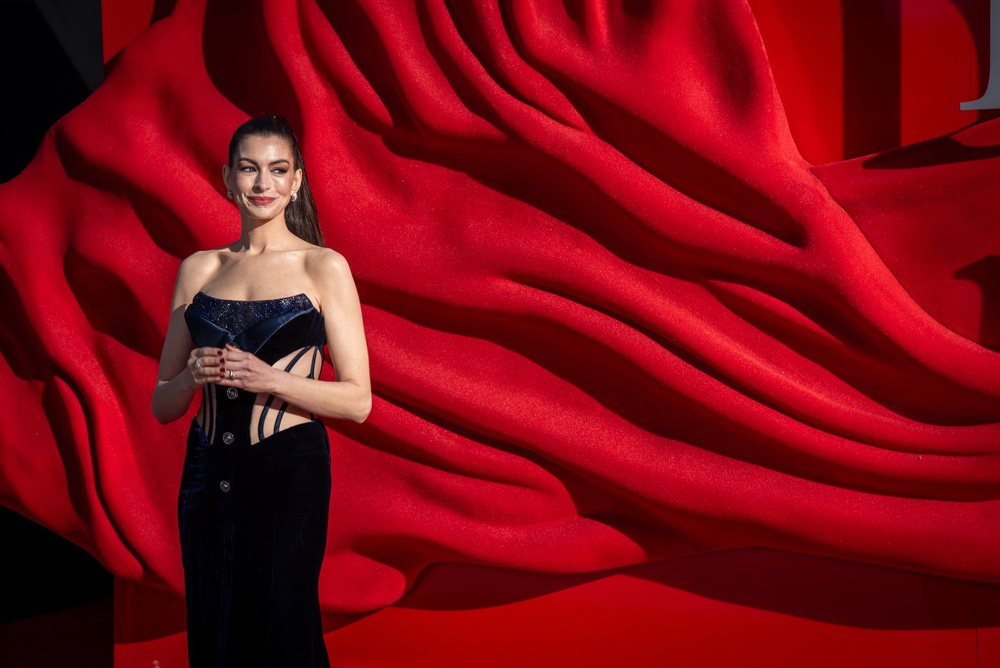
Anne Hathaway grew up Roman Catholic and has spoken about wanting to become a nun as a child. Hathaway, whose films include The Princess Diaries and Alice in Wonderland, was raised Roman Catholic, but she prioritized acting and her relationship with the Church changed somewhat when her brother came out as gay.
She couldn’t reconcile her love for her brother with an institution that didn’t fully include him, and that was that. What’s worth noting about Hathaway’s arc is that it reflects something many people of her generation went through – a genuine, sincere faith that ran into a specific moment of institutional failure and had to sit with the gap between the two. She has remained publicly supportive of LGBTQ rights throughout her career, and the through-line from her early religious sincerity to her later advocacy is clearer than it might initially seem.
12. Dolores Hart
Every name on this list describes someone who considered a religious vocation and chose the world instead. Dolores Hart is the one who did the opposite – and her story remains one of the most genuinely startling in Hollywood history.
Hart was signed to play the love interest of Elvis Presley in the 1957 release Loving You, and appeared with Presley again in 1958’s King Creole. In 1960, she starred in Where the Boys Are. By any measure, she was a rising star. Then, at 24, she became a Roman Catholic nun at the Benedictine Abbey of Regina Laudis in Bethlehem, Connecticut.
She broke off her engagement and walked away from Hollywood entirely. She had starred in Francis of Assisi in 1961, in which she played Saint Clare of Assisi – a role that, by her own account, deepened her already growing pull toward the convent. Her friends were bewildered, some of them furious. Even people close to her couldn’t understand why she would walk away from a career and a fiancé she loved.
She didn’t walk away from anything, by her own reckoning. Hart was named prioress of the monastery in 2001 and held that office until 2015. She remains a member of the Academy of Motion Picture Arts and Sciences – the only voting member living as a cloistered nun. A documentary about her life, God Is the Bigger Elvis, was nominated for the 2012 Academy Award for Best Documentary Short Subject and was shown on HBO in April 2012. Her story isn’t about nearly becoming a nun. It’s about actually doing it, fully, and never looking back.
The Calling That Stayed With Them
What runs through all of these stories is something harder to name than religion or career ambition. It’s the question of what kind of life you’re actually supposed to be living – the one the world seems to expect, or the one that pulls at you from somewhere less explainable. For most of the people on this list, a period of genuine religious questioning didn’t disappear when they chose acting, filmmaking, or music. It went underground and came back out through the work.
Martin Scorsese’s obsession with sin and redemption. Jack White’s almost monastic discipline. Danny Boyle’s conviction that art should make people feel something real. Michael Moore’s relentless social conscience. These aren’t just aesthetic preferences – they’re the residue of a time when each of these people seriously asked themselves whether they were called to serve something larger than themselves. They answered that question differently than they originally planned. Most of them would probably tell you they answered it honestly.
Dolores Hart is the outlier, and maybe the most honest case of all. She didn’t redirect the impulse into art or activism. She followed it all the way to a Benedictine abbey in Connecticut and never left. For everyone else on this list, the seminary or the convent was a road not taken. For her, it was the only road that ever made sense.
AI Disclaimer: This article was created with the assistance of AI tools and reviewed by a human editor.