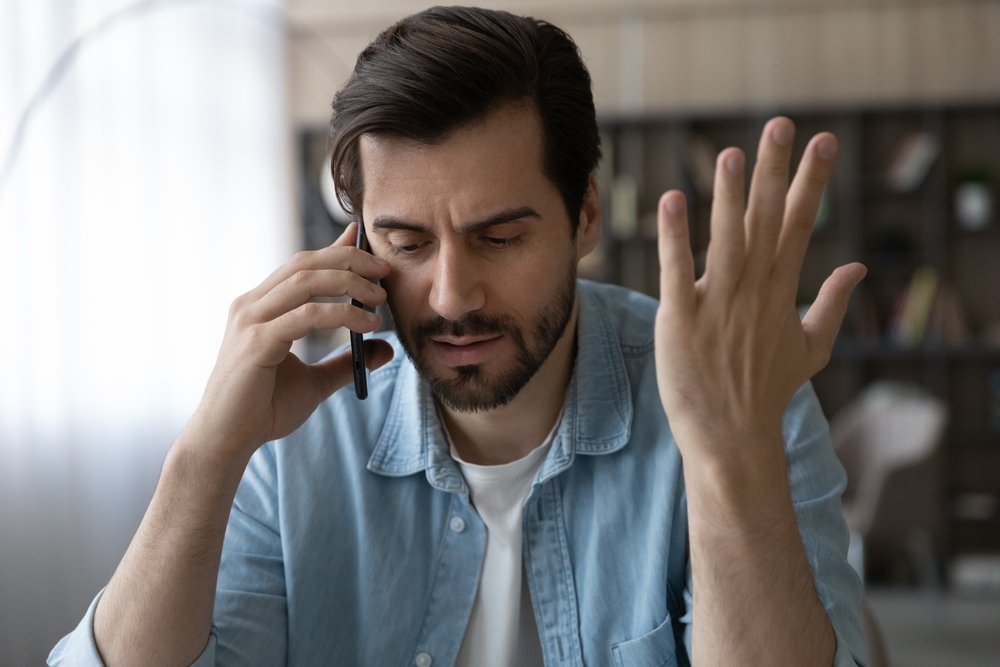

You pick up a call from a number you don’t recognize. The voice on the other end sounds a little garbled, a little uncertain. “Hello?” it says. “Can you hear me?” Your brain has already started forming the polite response before you’ve even thought about it. Of course you can hear them. So you say it: “Yes.” That one word is all they needed.
The “Can You Hear Me?” scam has been circulating for years, but reports show it is actively targeting consumers right now, and the tactics have evolved in ways that make it harder to spot and easier to fall for. If you haven’t heard about this one yet, or if you brushed it off as something that happens to other people, it’s worth a few minutes of your attention.
What the Scam Actually Is
The scam begins when you answer a call and the person on the other end asks, “Can you hear me?” The caller then records your “yes” response, obtaining what amounts to a voice signature. That signature can later be used to pretend to be you and authorize fraudulent charges.
The call may have some fumbling around it. The person might even say something like, “I’m having trouble with my headset.” But in fact the “person” may be a robocall recording your conversation, and that “yes” answer you gave could later be edited to make it sound like you authorized a major purchase.
These calls are the signs of a fast-growing scam, according to an alert from the Better Business Bureau. Since mid-March 2024, there has been an uptick in people reporting concern about this scam. It’s not new, but it is persistent, and it has picked up new tricks along the way.
The fraudulent callers may imitate companies that the people receiving the calls are already familiar with, such as a mortgage lender or utility company. That familiarity is part of the design. When someone calls claiming to be from your bank or your insurance provider, the instinct to confirm you’re listening feels completely natural. That’s exactly what makes the opening question so effective.
The Different Versions You Might Encounter
In other variations of the scam, the caller may say, “Is this [your name]?” or some other question where the answer will be “yes.” The caller may not hang up right away and may continue the conversation in an attempt to steal your personal information or record more of your voice.
Some consumers report that the calls are about banking, vacation packages, warranties, and even Medicare cards. The callers may be impersonating a business like your bank or another financial institution, a government agency, an insurance company, or others.
So the opening line isn’t always “Can you hear me?” It could be your name turned into a question. It could be a cheerful opener about a cruise package you supposedly won. Scammers change their tactics as the public catches on, so being alert for other questions designed to solicit a simple “yes” answer is important. The through-line is always the same: they need an affirmative on tape before anything else happens.
Your “yes” could also confirm to the scammer that the phone number they dialed is a real number, enabling future targeting of phone call scams. Even if nothing financially damaging happens immediately, you’ve just flagged yourself as someone who picks up and responds. Expect more calls.
What They Do With Your “Yes”
Here’s where things get a little more nuanced, and it’s worth being honest about what the evidence actually shows.
In a worst-case scenario, according to the BBB, scammers may use a recording of you saying “yes” to authorize charges on your phone. This is known as a cramming scam, where a bad actor “crams” unauthorized service charges onto your bills once they have your information.
Scam artists may be able to use a recorded “yes” to claim that the person authorized charges to their credit card or account. Some companies share their customers’ information with third-party companies or allow third parties to charge customers’ accounts, a practice called “cramming,” in exchange for payment.
The more alarming potential, though, connects to where scam technology is heading. Cases of imposter scams jumped about 19% to roughly 1 million in 2025, while losses have climbed to more than $3.5 billion. As scammers adopt tools that can mimic voices and carry out conversations in real time, even picking up the phone carries new risks, according to a 2025 CNBC investigation.
A voice recording of you confirming your own name and saying “yes” is no longer just a crude clip to splice into a conversation. It’s raw material. Scammers use AI-generated or altered voices for phone-based scams. Some AI tools can even mimic real accents. The potential to create a voice of someone can make many existing scams more believable, and it opens up new opportunities for scammers.
The honest counterpoint: Amy Nofziger, the director of victim support for the AARP Fraud Watch Network, said that the “Can you hear me?” question on its own does not warrant significant panic. She stressed that there has been no evidence from AARP databases tying a response to the question to cramming or monetary fraud. “Nobody in here is saying, ‘I lost $50,000,’ in a supposed ‘can you hear me?’ scam,” she noted.
That’s reassuring, to a point. But “no documented losses yet” and “completely harmless” are not the same thing, especially as AI voice tools get cheaper and more accessible.
Why It Still Works
You’d think that by now, with all the coverage this scam has gotten, people would simply refuse to answer. But the psychology of it is well-designed.
A stranger starts the call asking, “Can you hear me?” to get you to respond “yes.” They may keep you on the line by pretending to be a government official or a bank representative, but often they hang up shortly after you confirm that you are listening, because their goal is simply to get you to say “yes” so they know there is a person on the other line.
The question exploits two deeply ingrained social habits: the reflex to confirm you can hear someone when they ask, and the instinct to be polite. Add in caller ID spoofing, one increasingly common technique scam artists use to falsify their caller ID information with local phone numbers to make it look like the calls are from a nearby person or business when in fact the calls are often placed by scam artists located outside the state or country, and you have a setup that can fool almost anyone who isn’t actively on guard.
A lot of information can be gleaned from public records and social media. Scammers will want to establish familiarity with you so that you give up even more information than you normally would. This is why the calls sometimes open with your name, your city, or a reference to a company you actually use. It’s not random guessing. Your information is out there, and they’ve done some homework.
What to Do If You Get One of These Calls
The FTC’s consumer advice on phone scams is straightforward: if someone is already breaking the law by calling you illegally, whatever they’re calling about is probably a scam. The practical advice from multiple federal agencies and consumer organizations lines up around the same core actions.
Don’t say “yes.” If you answer and the first question is some variation of “Can you hear me?” or “Is this [your name]?”, don’t answer it directly. Instead of answering “yes,” turn the question back on them and say, “Why do you ask?” That way, you take control back of your phone and your device. It’s a small move, but it works, because a legitimate caller will explain why they’re calling, and a scammer will likely hang up.
Another way to stop yourself from saying more than you should is to simply let a phone call from an unknown number go to voicemail. That way, you have more time to assess whether it’s legitimate. Real people leave messages. Robocalls and scammers rarely do, and if they do, the message usually gives them away within a few seconds.
The BBB’s director of public relations does not recommend trying to talk with someone you suspect is a scammer. If you do, “they’re going to keep calling you because they know you’re a live number.”
If you’ve already answered one of these calls and said “yes,” don’t spiral. Review all of your financial statements, from your bank, credit card lender, or telephone company, for unauthorized charges. If you notice unauthorized charges, you have likely been a victim of cramming. Check your phone bill too, not just your bank and credit cards, since cramming can appear as unfamiliar charges from third-party services on your monthly phone bill.
Check your bank and credit card statements regularly for unauthorized charges. Checking your telephone and cell phone bills is also a good idea. Scammers may use your voice’s “yes” recording to authorize charges on your phone. This is called “cramming,” and it’s illegal. If you spot something, dispute it immediately with your carrier or financial institution.
Read More: The 10 Most Common Phone Scams and How to Protect Yourself
The Bigger Picture
Imposter scams, the category this phone tactic falls into, have been the number one fraud complaint for nine consecutive years, according to a 2026 FTC consumer alert. In 2025 alone, losses reached $3.5 billion across more than 1 million reports. The “Can You Hear Me?” scam is, on its own, a fairly low-tech piece of a much larger and rapidly evolving machine.
The AI angle is what changes the stakes. When a voice recording could theoretically be used to generate a convincing imitation of you, one that could call your bank, your family, or your employer, the calculus around what to protect shifts. A 2025 study from Rutgers University saw a researcher build an AI system capable of carrying out scam phone calls end to end, operating autonomously, with “no humans involved in the interaction loop.” The technology is still developing, but it’s developing fast.
None of this means you need to stop answering your phone. It means that a single reflex, the polite, automatic “yes” to a stranger’s question, is worth pausing on. Scammers don’t need much. They’re patient, they’re systematic, and they’ve had years to optimize this particular trap.
What to Actually Take Away From This
The “Can You Hear Me?” scam works because it asks nothing complicated of you. It just wants a word. And if that word also turns out to be legally meaningless as a voice authorization, the scammer still wins something: confirmation that your number is active, that you’ll pick up, that you’ll respond. They now know you’re worth calling again.
The best version of protecting yourself here isn’t paranoia. It’s a small habit adjustment: unknown number calls go to voicemail first. If the call seems suspicious, you don’t owe the person on the other end a “yes” or a “no” or anything at all. You are fully allowed to just hang up.
And if you’ve already said “yes” on a call like this, the honest answer is: you’re probably fine, but it’s smart to spend ten minutes scanning your recent bills. Not because disaster is certain, but because catching unauthorized charges early is always easier than untangling them months later. That’s not panic, that’s just being practical.
AI Disclaimer: This article was created with the assistance of AI tools and reviewed by a human editor.