
A Reuters/Ipsos poll conducted nationwide April 15-20, 2026 among 4,557 U.S. adults found that 64 percent of respondents opposed ending birthright citizenship, compared to 32 percent who supported it. Congress passing legislation to narrow citizenship by statute would face an immediate legal challenge under the very ruling just issued, which affirmed the 14th Amendment’s protection as constitutional rather than merely statutory.
On June 30, 2026, a birth certificate was still enough. The Supreme Court upheld birthright citizenship, the principle that children born in the United States are automatically U.S. citizens regardless of their parents’ immigration status, rejecting an executive order by President Donald Trump that sought to undo that long-standing constitutional principle. The ruling settled 17 months of uncertainty for hundreds of thousands of families who had wondered whether a baby born in an American hospital would be a citizen or a stateless person.
The 6-3 ruling in Trump v. Barbara was lopsided in outcome and unambiguous in language. The dispute centered on whether a president can reinterpret the Constitution’s guarantee of birthright citizenship through executive action alone, with no vote in Congress and without amending the 14th Amendment. The Court’s answer was no.
The ruling followed other significant Supreme Court losses for Trump in recent months, including the February ruling that invalidated his sweeping tariffs and Monday’s decision that barred him from immediately firing Lisa Cook from the Federal Reserve — separate constitutional flashpoints that have repeatedly defined the outer limit of executive authority.
What Trump’s Executive Order Actually Said

On the day after his inauguration, January 20, 2025, Trump signed Executive Order 14160, “Protecting the Meaning and Value of American Citizenship,” which ordered all departments of the executive branch to refuse to recognize children born to illegal immigrants or visa holders as citizens. Trump claimed that children born to noncitizen parents who are either unlawfully in the country or who possess temporary legal status, such as tourists or foreign students, are not “subject to the jurisdiction” of the U.S. and therefore ineligible for citizenship. That four-word phrase, “subject to the jurisdiction thereof,” is the pivot the entire legal argument rested on. The administration’s position was that those words had always meant something narrower than a century of court rulings had recognized.
Under Trump’s proposal, birthright citizenship would have been limited to those with at least one parent who is a U.S. citizen or permanent resident. Babies born to temporary visitors or people who entered the country illegally would not be citizens at birth. In practical terms, that would have affected not just the children of undocumented immigrants but also those of international students, foreign workers on temporary visas, and tourists. The scope was far broader than public debate often acknowledged.
Several U.S. district court judges ruled that Trump’s order violated the Constitution, and two federal appellate circuit courts upheld injunctions blocking the order from taking effect. The executive order has never been in effect; lower courts blocked it quickly after Trump signed it.
The Road to the Supreme Court

The litigation moved fast. Multiple district court judges issued universal injunctions, and the cases were consolidated into Trump v. CASA. The Trump administration asked the Supreme Court to limit the injunctions to the plaintiffs who were suing. On June 27, 2025, the Supreme Court ruled 6-3 that federal district courts generally cannot issue nationwide injunctions, but made no decision on the underlying birthright citizenship question.
That procedural ruling left a gap in coverage. The day of the court’s ruling in Trump v. CASA, the ACLU filed Barbara v. Trump, asking the U.S. District Court for the District of New Hampshire to grant a class-wide injunction covering those who would not qualify for birthright citizenship under the executive order. The Trump administration petitioned the Supreme Court in September 2025, challenging the district court’s injunction in Barbara. The Supreme Court granted certiorari before judgment in December 2025, meaning it agreed to take the case before a lower appellate court had ruled, signaling how urgently the justices wanted to settle it.
Trump attended the oral arguments on April 1, 2026, the first sitting president ever to do so. Presidents do not attend Supreme Court arguments. Trump’s presence underscored how central this fight was to his second-term agenda and how much political weight his administration had placed on the outcome.
How the Court Voted, and Why It Matters
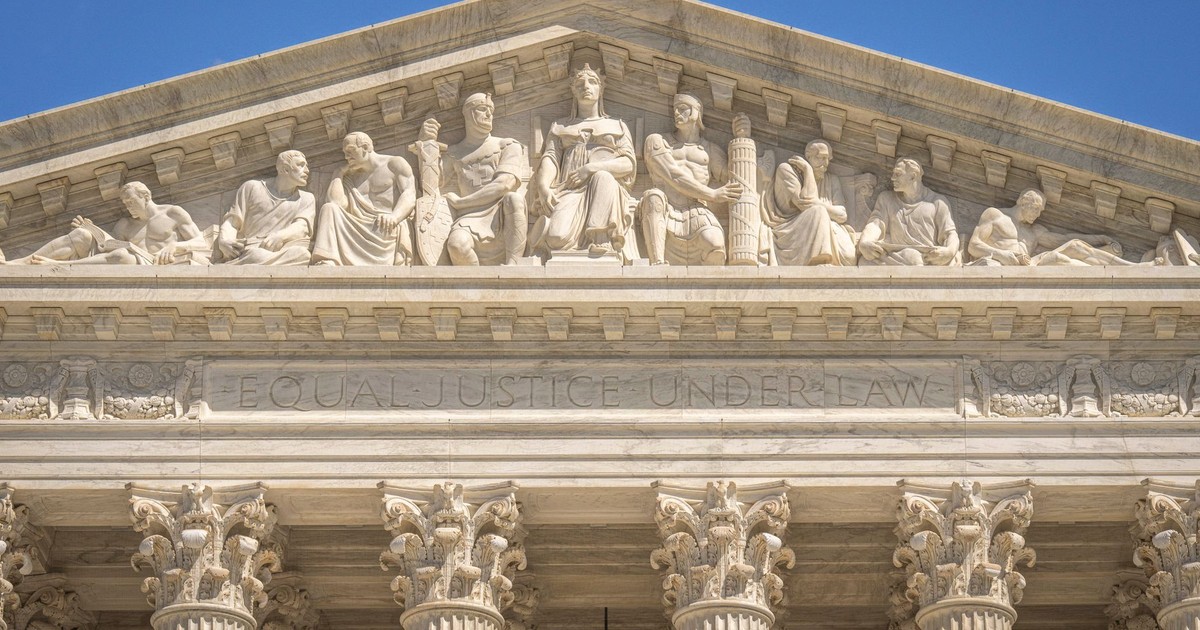
The 6-3 decision in Trump v. Barbara, authored by Chief Justice John Roberts, marked a significant check on presidential power and reaffirmed long-standing interpretations of the 14th Amendment. The Supreme Court’s 194-page decision broke down into a 5-1-3 vote to affirm birthright citizenship under the 14th Amendment. Roberts authored the majority opinion, joined by liberal Justices Sonia Sotomayor, Elena Kagan, and Ketanji Brown Jackson, though Jackson also wrote a separate concurring opinion. Conservative Justice Amy Coney Barrett, appointed by Trump, also joined the majority.
For a broader look at how presidential emergency powers and executive orders have historically tested constitutional limits, the TAT piece on secret presidential powers is worth reading alongside this ruling.
Justice Brett Kavanaugh wrote that he did not believe Trump’s executive order violated the 14th Amendment, but that it “does contravene a federal statute” adopted in 1940 that addresses the citizenship of people born in the U.S. That one-justice middle ground is legally significant: only five justices said the order was unconstitutional on its face. The result was the same either way; the order is gone.
The other three conservatives, Clarence Thomas, Samuel Alito, and Neil Gorsuch, all wrote dissenting opinions. “The Court has made a serious mistake,” Alito wrote. Justice Thomas wrote a 91-page dissent that agreed with Trump’s assertion that the 14th Amendment only applied to former slaves and their descendants, adding that he “was not sure that today’s” majority opinion would stand the test of time.
Justice Ketanji Brown Jackson, who, like Thomas, is African American, responded to some of the themes in the Thomas dissent. “Despite his longstanding endorsement of a colorblind society, Justice Thomas now surprisingly suggests that the citizenship clause was a race-conscious remedial measure relating only to freed slaves,” she wrote.
The 14th Amendment’s 128-Year Precedent
Writing for the majority, Chief Justice Roberts said there was “scant evidence” for the Trump administration’s reimagining of how the law has been understood for decades. That reading ran into precedent established in 1898.
The Supreme Court’s 1898 decision in United States v. Wong Kim Ark cemented the broad interpretation of birthright citizenship, affirming that children born in the U.S. to immigrant parents are citizens. In that case, a man born in San Francisco to Chinese parents was detained at the border on his return from a visit to China and denied re-entry. The court ruled he was an American citizen. The decision was so widely accepted that even in periods of great hostility to immigrants, birthright citizenship remained untouched. During World War II, when Japanese citizens were held as enemy aliens in detention camps, their newborn children were automatically granted American citizenship because they were born on U.S. soil.
The administration’s counter-argument leaned on a narrow reading of post-Civil War legislative history. The Trump administration argued that the language of the 14th Amendment was only meant to apply to the newly emancipated slaves and their children, not to those from other countries. They cited statements of late-19th century writers Alexander Porter Morse, Francis Wharton, and George D. Collins, all of whom proposed narrower interpretations of the 14th Amendment. Roberts, in the majority opinion, found that line of reasoning historically thin.
The framers wrote the citizenship clause broadly for a specific reason. The Supreme Court had ruled in Dred Scott v. Sandford in 1857 that citizenship did not extend to children of former slaves. Part of the goal in enacting the Fourteenth Amendment was to extend birthright citizenship to those children, overruling Dred Scott. Having just seen what a narrow definition of “citizen” looked like in practice, the framers chose deliberately expansive language.
The Real-World Stakes for Children and Families
If Trump’s order had been upheld, it would have left tens of thousands of babies born in the U.S. each month to undocumented immigrants or visitors without American citizenship. A 2025 joint analysis by the Migration Policy Institute and Penn State’s Population Research Institute found that roughly 255,000 babies born on U.S. soil each year would have started life without citizenship under the policy.
The same analysis found that ending birthright citizenship would increase the unauthorized population by an additional 2.7 million by 2045 and by 5.4 million by 2075. Beyond adding to the unauthorized immigrant population, ending birthright citizenship would create a self-perpetuating, multi-generational underclass. By 2075, there would be 1.7 million U.S.-born people who were the children of two parents who had themselves been born in the United States, yet would nonetheless lack legal status.
Some affected children may have faced difficulty establishing citizenship in any country, effectively being born stateless. Statelessness means no passport, no right to work legally, no access to federal student aid, and in many countries no right to public education. It amounts to a permanent disadvantage handed to a child at birth for circumstances entirely outside their control.
Read More: The Secret Presidential Powers That Could Suspend Your Constitutional Rights
What Comes Next, and What Can’t
Within hours of the ruling, Trump posted on Truth Social urging Congress to pass legislation to end birthright citizenship, arguing that “no long and unwieldy Constitutional Amendment is necessary.” The legal reality is more complicated. Birthright citizenship is enshrined in the Fourteenth Amendment itself, not just in federal statute. Removing it entirely would require amending the U.S. Constitution, which requires two-thirds of both the House and Senate, plus ratification by three-quarters of the nation’s state legislatures. That threshold has been cleared only 17 times in American history since the Bill of Rights was ratified in 1791.
A Reuters/Ipsos poll conducted nationwide April 15-20, 2026 among 4,557 U.S. adults found that 64 percent of respondents opposed ending birthright citizenship, compared to 32 percent who supported it. Congress passing legislation to narrow citizenship by statute would face an immediate legal challenge under the very ruling just issued, which affirmed the 14th Amendment’s protection as constitutional rather than merely statutory.
Cecillia Wang of the ACLU, herself a birthright citizen born to Chinese parents, argued the birthright case before the Supreme Court in April. As she put it, the men who wrote the Fourteenth Amendment deliberately chose to confer automatic citizenship on the child, not the parent, the idea being that “in America we do not punish children for the sins of their fathers, but instead we wipe the slate clean.”
Where This Actually Leaves Us

The decision in Trump v. Barbara is not just about immigration. It defines the outer limit of what a president can accomplish through executive action when that action runs directly into the text of the Constitution. The administration tried to redefine a constitutional term, “subject to the jurisdiction thereof,” in a way that would have effectively rewritten who is an American, without a single vote in Congress and without amending the 14th Amendment itself.
The Court’s majority rejected that claim of executive power. The decision states that children born of parents unlawfully or temporarily present in the United States are “subject to the jurisdiction thereof” as stated in the Fourteenth Amendment, and rejects the government’s argument that citizenship is predominantly tied to a person’s domicile. The domicile argument, had it succeeded, would have introduced an entirely new test for citizenship that no administration, court, or Congress had ever applied in the 158-year history of the amendment.
For millions of families, the ruling is a relief. For the administration, it is a limit. The three dissenting justices who would have ruled the other way are a reminder that the result was closer than the 6-3 headline suggests. Congress may test what legislation can do. Future administrations will draw their own lines. The argument over what the 14th Amendment means has not ended – it has simply moved to a different arena, and the people most affected by wherever it lands next had no say in writing the rule to begin with.
AI Disclaimer: This article was created with the assistance of AI tools and reviewed by a human editor.