

Every spring, the same scene plays out across backyards in North America. You fill the feeder, pull up a lawn chair, and wait for the cardinals and chickadees. Then something else arrives first. Maybe a hundred of them. Maybe they’ve already stripped the feeder bare and are standing on your lawn looking entirely too comfortable. Not all birds are welcome guests, and a handful of problematic backyard bird species have made that case repeatedly, with feathers, droppings, and the occasional divebomb to prove it.
The good news is that understanding these birds makes managing them far more straightforward. The important legal question, though, is that most of them, including many you’d expect to handle however you like, are actually shielded by one of the oldest wildlife protection laws in the United States. Knowing what you can and can’t do is half the battle.
Here are nine problematic backyard bird species that have earned their reputation, along with what the law says about each of them.
The Migratory Bird Treaty Act: What Backyard Birders Need to Know
Before we get to the birds, a quick primer on the law most homeowners don’t know applies to them. The Migratory Bird Treaty Act of 1918 (MBTA), codified at 16 U.S.C. §§ 703, 712, is a United States federal law first enacted to implement the convention for the protection of migratory birds between the United States and Canada. The statute makes it unlawful without a waiver to pursue, hunt, take, capture, kill, or sell nearly 1,100 species of birds listed as migratory birds. The statute does not discriminate between live or dead birds and also grants full protection to any bird parts, including feathers, eggs, and nests. A March 2020 update of the list decreased the number of covered species to 1,093.
In plain terms: if a bird bothers you, the legal response is deterrence, not harm. For most of the species below, trapping, poisoning, or destroying active nests without a permit is a federal offense. There are limited exceptions, and those are noted where relevant. The practical takeaway is simple: use physical barriers, feeder design, and habitat modification to discourage nuisance birds, not anything that crosses the line from deterrence into harm.
1. Common Grackle
The Common Grackle is a striking bird, all iridescent black with pale yellow eyes, and it would make a better impression if it arrived alone. It rarely does. Common Grackles transform from scattered pairs into massive traveling groups once breeding season ends, with fall roost peaks exceeding 100,000 grackles at single sites during October and November. At a backyard feeder, they’re loud, aggressive, and relentless. For those who feed birds, there’s nothing more frustrating than a flock of so-called bully birds descending on backyard feeders, not only do they eat feeders clean in minutes, but their aggressive behavior can discourage songbirds.
The damage goes beyond the feeder. Grackles may kill the eggs and nestlings of other bird species, and have been observed raiding nests for eggs and baby birds when parents are away. They’re also known to deposit waste from their nestlings into nearby swimming pools, a habit researchers believe mimics natural water sources to mask nest locations from predators.
The Common Grackle is protected under the Migratory Bird Treaty Act. That means trapping or harming them without a federal permit is illegal. The most effective legal approaches are cage-style feeders that physically exclude larger birds, and switching to seed types like nyjer (thistle) that grackles tend to leave alone.
2. Canada Goose
Few bird-human conflicts in North America have escalated as dramatically as the one with Canada Geese. Once a cherished sight in flight, they’ve settled into suburban neighborhoods and parks in numbers that cause real problems. A single Canada goose can eat up to four pounds of grass per day, and multiply that by the dozens of geese that usually gather together and you have a recipe for destruction. The high-nutrient feces from large flocks can degrade water quality, cause fish deaths, and create significant aquatic weed problems, while overgrazing of manicured turf grass causes dead spots in lawns and golf courses.
The health dimension is serious. A 2022 NIH peer-reviewed study collected 204 fecal samples from Canada geese at 11 locations in North-Central Oklahoma and evaluated the prevalence of zoonotic microorganisms, diseases transmissible from animals to humans, including Campylobacter, Cryptosporidium, Giardia, Salmonella, and antimicrobial-resistant E. coli. The study notes that as non-migratory Canada goose populations have grown in residential and recreational areas, public concerns about acquiring zoonotic pathogens from geese and their fecal deposits have been increasing.
Canada Geese are protected under the MBTA, but a specific federal depredation order exists for resident (non-migratory) subspecies. A depredation order means you do not need to apply for permission to destroy eggs and nests of resident Canada Geese, however you will need to register and report your activities. The order only applies to management practices in the lower 48 contiguous states. Landowners can register for federal authorization to destroy resident Canada goose nests and eggs on property they own or manage. For day-to-day deterrence, allowing lawn grass to grow taller, planting dense vegetation along water edges, and using reflective deterrents are all legal and moderately effective.
3. House Sparrow
The House Sparrow arrived in the United States not by accident but by deliberate human decision. The American Bird Conservancy reports that House Sparrows were introduced in Brooklyn in 1851 as a means of controlling caterpillar populations, and after several subsequent releases, they colonized the entire continental U.S. in less than 50 years, with a U.S. population now exceeding 7 million. They arrive at feeders in large numbers and don’t share well. Introduced House Sparrows will drive out and even kill native species such as Eastern Bluebirds when competing for nest boxes.
This is one of the few bird species on this list that is explicitly excluded from Migratory Bird Treaty Act protection. Under U.S. federal law, House Sparrow nests, eggs, young, and adults may be legally removed or destroyed, though state or local laws may vary. Because of that status, many bluebird trail monitors and wildlife managers actively remove House Sparrow nests from nest boxes to protect native cavity-nesting species. If you’re managing nest boxes, removing a House Sparrow nest is legal at the federal level, just confirm your state’s regulations first.
4. European Starling
Introduced to Central Park around 1890 as part of a project to bring all birds mentioned in Shakespeare’s writings to North America, the European Starling has not been subtle about making itself at home. Originally brought to North America in the late 19th century, the starling has since exploded in population and range, now numbering over 200 million individuals in North America alone.
The damage they cause is considerable. According to the American Bird Conservancy, European Starlings are estimated to cause more than $800 million in crop damage each year in the United States, and their droppings provide a growth medium for Histoplasma capsulatum, a fungus that causes lung infections in humans. They are cavity nesters that seek out holes and crevices to build their nests, often invading vents, gutters, and eaves of homes, sometimes clogging these systems and leading to water damage, and creating fire hazards if nesting material is placed near electrical wiring.
Starlings are cavity nesters, putting them in direct competition with native cavity-nesting birds such as bluebirds, woodpeckers, purple martins, and even owls. Because starlings are larger and more aggressive, they frequently displace these birds from their nests, reducing their breeding success.
Like House Sparrows, European Starlings are a non-native introduced species and are not protected under the MBTA at the federal level. Introduced bird species like House Sparrows, European Starlings, Rock Pigeons, and Mute Swans are not protected by federal law. Sealing openings larger than an inch and a half in your roofline, removing suet feeders during peak activity, and installing upside-down suet feeders (which starlings tend to avoid) are all practical legal deterrents.
5. Brown-headed Cowbird
The Brown-headed Cowbird is the most disliked bird in many birding circles, and not without reason. The Brown-headed Cowbird is a brood parasite, meaning it lays its eggs in the nests of other species. This is the only way they breed, cowbirds do not build their own nests. A single female is capable of laying nearly one egg per day at the peak of the breeding season, producing a total of 30 to 40 eggs over the 2 to 3 month breeding period, which translates to 30 to 40 nests parasitized, often of at least several different species, per female in one season.
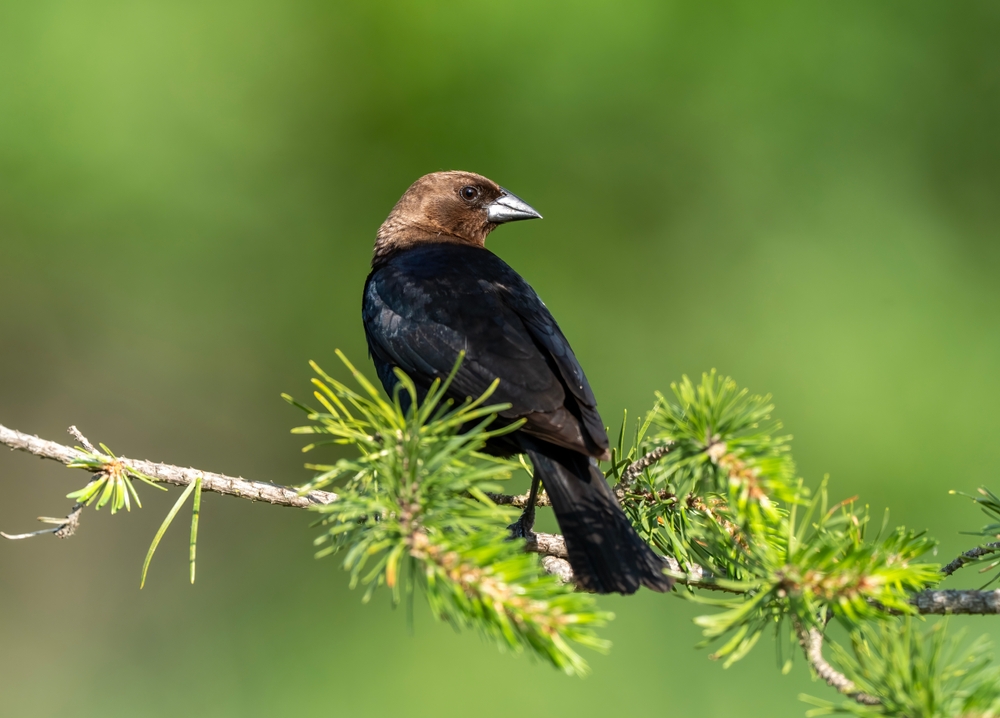
The mechanics are straightforward and grim. Cowbird eggs require an incubation period of only 11 to 12 days, whereas most host species require 12 to 14 days. Consequently, cowbird young hatch earlier, affording the parasite a distinct advantage in competing for food with its younger foster siblings. Young cowbirds also develop at a faster pace than their nest mates, and they sometimes toss out eggs and young nestlings or smother them in the bottom of the nest.
The cowbird has been known to parasitize over 220 different species of North American birds, spreading its impact across many populations. Despite their destructive nesting strategy, cowbirds are a native species and fully protected. Because cowbirds are native to the U.S., they are protected under the Migratory Bird Treaty Act and in most instances it is unlawful to use lethal control without a permit, including the removal of their eggs from a nest. The best practical step is using nest boxes with entrance holes sized for your target species, a smaller entrance physically prevents cowbird access.
6. Red-winged Blackbird
Ask anyone who’s been dive-bombed on a summer morning walk and they’ll know exactly which bird you’re talking about. The Red-winged Blackbird is unmistakable, jet black with vivid red and yellow shoulder patches, and during nesting season, it is aggressively territorial. Adults are very aggressive in their nesting territory, attacking larger birds that approach, and they are notably bold, with several often attacking a larger bird such as a hawk or crow that flies over their nesting area.
Humans are not exempt. It’s the time of year for local walkers, joggers, and strollers to keep an eye out for the red-winged blackbird, a hyper-protective parent that dive-bombs anyone who may come too close to their nest. At least one municipality posts signage at known nesting locations each year to warn residents, with the engineering director noting that a handful of residents report blackbird attacks annually. The eggs take up to two weeks to hatch, and in another two weeks or so, the chicks are mature enough to leave the nest, making the timeframe the birds are most aggressive between late May and early July.
As native migrants, red-winged blackbirds and their nests are protected by the Migratory Bird Treaty Act of 1918, and cannot be harmed in any way. If a nesting pair sets up near a high-traffic area of your yard, the practical approach is simply to give them space until the chicks fledge. It takes a few weeks. Wearing a hat while outdoors near the nest site helps, and as one avian ecologist put it, “avoidance is the easiest.”
7. American Crow
Crows are genuinely intelligent birds, problem-solvers, tool users, and capable of recognizing individual human faces. That intelligence is also a significant part of why they’re difficult to deter once they’ve decided your yard is worth visiting. Flocks of crows create a lot of noise, leave messy droppings that can spread disease, strew garbage around, and cause property damage to buildings and landscaping. They often peck holes in ripe fruits, pull out young plants while searching for insects, and scratch the soil in ways that harm root systems.
The complexity with crows is that they play a meaningful role in the ecosystem. They eat large quantities of insect pests, clean up carrion, and spread seeds. The problem arises when a murder (the collective noun for a group of crows) decides to roost consistently in one location, the noise, droppings, and competition with smaller songbirds becomes a real headache. American Crows are native birds and are protected under the MBTA. Keeping garbage containers secure, removing spilled seed from the ground, trimming tall roosting trees, and using weight-sensitive feeders that close under a crow’s heavier frame are the most effective deterrent strategies.
8. Mourning Dove
Mourning Doves might seem like an unlikely entry on a list of problematic backyard birds, they’re gentle, quiet, and widely considered beautiful. The issue is almost entirely about numbers. According to Wikipedia, citing U.S. Fish and Wildlife Service data, there were approximately 337 million mourning doves in the U.S. as of September 2024. When they find a feeder they like, they arrive in groups and stay. At bird feeders, mourning doves are attracted to one of the largest ranges of seed types of any North American bird, with preferences including rapeseed, corn, millet, safflower, and sunflower seeds. A flock of 20 doves on a tray feeder will burn through seed at a rate that makes the hobby expensive, and their sheer presence tends to displace smaller, more colorful birds that backyard watchers are typically hoping to attract.
The mourning dove is one of the most abundant bird species in North America, and authority and responsibility for management of this species in the United States is vested in the Secretary of the Interior, a responsibility conferred by the Migratory Bird Treaty Act of 1918. Mourning doves are fully protected, and while they are legal game birds in many states during hunting season, backyard deterrence is the only lawful option for homeowners. Switching from flat tray feeders (which doves dominate easily) to tube feeders with small perches is the most effective approach, since mourning doves struggle to hold onto narrow perches.
9. Feral Rock Pigeon
The feral pigeon, the bird you know from city squares, parking structures, and everywhere with a flat ledge, occupies a different legal category from most birds on this list. Introduced bird species including Rock Pigeons are not protected by federal law under the Migratory Bird Treaty Act. That means homeowners have more legal flexibility in managing them, though local and state ordinances may still apply.
The health concerns with pigeons are real. Pigeons have been associated with a variety of diseases, including histoplasmosis and cryptococcosis. Histoplasmosis is caused by a fungus that grows in pigeon droppings and can also be found in bat droppings or soil, and is carried by the wind. The biggest problem they cause is the volume of feces they produce, which builds up on buildings and structures, is visually unappealing, is acidic, and erodes metal and stonework. More importantly, pigeon droppings may pose a health hazard to the general public.
Pigeons average about five droppings per hour per bird. A roosting colony of any size accumulates waste quickly. Because they are not MBTA-protected, homeowners can legally use exclusion netting, bird spikes on ledges, and removal of nesting material to manage them. Sealing openings, removing food sources, and installing anti-perch devices are the most effective long-term strategies.
What to Do Now
The honest answer to “can you legally remove nuisance birds from your backyard” is: it depends entirely on which bird you’re dealing with. The Migratory Bird Treaty Act makes it unlawful without a waiver to pursue, hunt, take, capture, kill, or sell nearly 1,100 species of birds listed as migratory birds, and that covers most of the native birds described here, including grackles, Canada Geese (with limited egg-oiling exceptions for resident populations), Red-winged Blackbirds, Mourning Doves, American Crows, and Brown-headed Cowbirds. Non-native introduced species, House Sparrows, European Starlings, and feral Rock Pigeons, sit outside MBTA protection at the federal level, giving homeowners more legal room to act.
The consistent thread across all nine species is that physical deterrence works better than any reactive measure. Feeder design is often the most immediate lever: cage-style feeders with openings sized for the birds you want block out most larger nuisance species. Habitat modification, longer grass near water, removing ground-level seed spills, sealing building entry points, reduces the attractiveness of your property without raising any legal concerns. And when a protected species like a Red-winged Blackbird nests near a footpath, patience is genuinely the right answer. The aggression lasts a few weeks at most, and then it’s over until next spring.
Knowing which birds you’re dealing with, what drives their behavior, and where the legal lines are drawn is more useful than any spray or deterrent gadget. The birds listed here are doing exactly what birds do. Managing them well is just a matter of working with that reality rather than against it.
A.I. Disclaimer: This article was created with AI assistance and edited by a human for accuracy and clarity.