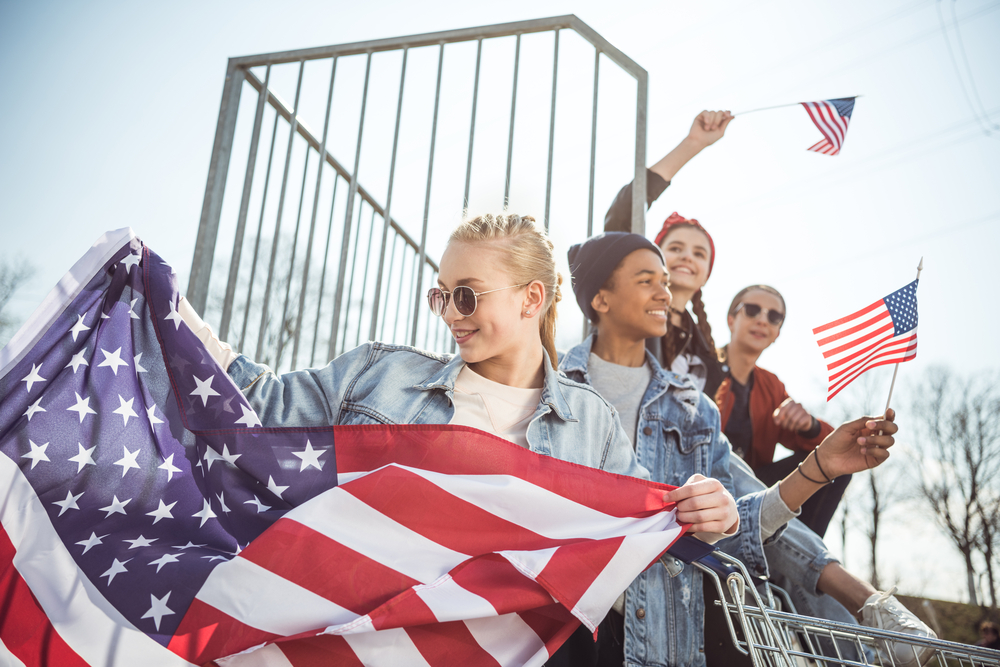
One American in five. That’s where the number sits right now, weeks before the country throws a party for its 250th birthday. Roughly one in five adults, asked a question that might once have felt almost too obvious to bother asking, gave an answer that would have surprised most pollsters a generation ago. Not angry. Not complicated. Just: not proud.
The timing sits oddly. The bunting is going up. The fireworks are ordered. The ceremonies are planned on a scale matching the milestone. And yet the surveys keep coming back with the same story, told in different ways by different polling organizations, adding up to something that can’t be dismissed as a bad sample or a fluke week. American pride, as a measurable fact, is at or near historic lows in 2025 and 2026. The question isn’t whether that’s true. The question is who stopped feeling it, and why.
The fault lines run along the places you’d expect – party, age, economics – but they run deeper than most coverage suggests. The gap between the oldest Americans and the youngest isn’t a few percentage points. It’s a canyon. The gap between Republicans and Democrats isn’t partisan bickering. It’s two groups reporting fundamentally different emotional relationships to the same country. Here’s what the data actually shows.
1. The Basic Numbers: 73 Percent Say Yes, 22 Percent Say No
A Quinnipiac University poll found that 22 percent of Americans surveyed do not consider themselves “proud Americans,” while 73 percent said they do. On the surface, that looks like a clear majority on the patriotic side. And it is. But 22 percent of the adult U.S. population is not a rounding error – it represents tens of millions of people, and it’s a figure that deserves more than a shrug.
The Quinnipiac survey was conducted among 1,316 U.S. adults from May 14 to 18 with a margin of error of approximately 3.4 percentage points. It’s a well-constructed national snapshot, not an outlier.
What makes the number more striking is its timing. This wasn’t a poll taken during a national crisis or a moment of acute political turmoil – or at least, not more so than usual. It was taken in an ordinary week in May, asking ordinary Americans a question that previous generations might have found almost too obvious to bother asking. The survey finds low levels of patriotism among Americans ahead of the 250th anniversary of the nation’s founding – a milestone that will draw fireworks and ceremonies across the country this summer.
2. The Partisan Gap Is Enormous – but Not Equally Distributed
The poll displayed significant age and partisan gaps on the issue of national pride. Nearly all of the GOP respondents said they considered themselves “proud Americans,” and 71 percent of independents and 61 percent of Democrats said the same. That means roughly four in ten Democrats in the survey either said they were not proud Americans or didn’t answer in the affirmative – a figure that would have been nearly unimaginable two decades ago.
The partisan split on patriotism is not new, but its scale has grown dramatically. Democrats are mostly responsible for the drop in U.S. pride this year, with 36% saying they are extremely or very proud, down from 62% a year ago. This is only the second time Democrats’ pride has fallen below the majority level, along with a 42% reading in 2020, the last year of the first Trump administration.
Republicans’ level of national pride has been much steadier, typically registering above 90%, including 92% this year, up from 85% in 2024. The only years in which fewer than nine in ten Republicans were proud were 2016 and 2020 through 2024. All but 2020 were when a Democratic president was in office. So the two parties are not just disagreeing about policy – they are operating with fundamentally different emotional relationships to the country itself. One side’s pride is near its peak; the other’s is at a historic low.
3. The Age Gap Is Even Starker Than the Party Gap

A higher percentage of younger respondents reported a negative view of the country, while older Americans expressed more positive views about their national pride. Thirty-seven percent of respondents in the 18 to 34 age range said they did not consider themselves “proud Americans,” compared to only 7 percent of those older than 64.
That’s a 30-percentage-point gap between the youngest and oldest cohorts on a single yes-or-no question about national pride. Nothing else in the poll comes close to that spread. The oldest Americans – those who lived through World War II’s aftermath, the moon landing, the Cold War – are still deeply attached to the country. The youngest adults, who grew up post-9/11, through two financial crises, a pandemic, and the most polarized political environment in living memory, see things very differently.
This isn’t a generational quirk. It reflects lived experience. Today, cohorts of younger Americans have come of age in an era of institutional failure: endless wars, a housing crisis, mounting student debt, and public trust in government at near-record lows. Pride tends to follow experience, and the experience of many younger Americans has been one of systems that promised more than they delivered.
4. Gen Z’s Relationship With National Pride Is in a Category of Its Own
There are clear generational differences in American pride, with each new generation significantly less likely than the previous one to say they are extremely or very proud to be an American. This finding is based on the average level of pride expressed by various generational groups across five 5-year periods since 2001. The youngest two generations, millennials (born between 1980 and 1996) and Generation Z (born after 1996), are the most distinct. From 2021 to 2025, less than half (41%) of adults who belong to Generation Z have been extremely or very proud to be Americans. Among millennials, the rate is higher at 58%, but still notably lower than older cohorts. Pride increases with age: 71% of Generation X, 75% of baby boomers, and 83% of the Silent Generation express high levels of pride.
The generational ladder is almost perfectly linear – each successive generation reports lower national pride than the one before it. But the drop accelerates sharply at the Gen Z level. All generations, from millennials to the Silent Generation, have seen double-digit declines in national pride since the early 2000s. Most of that drop has occurred since 2016.
A new national poll from the Institute of Politics at Harvard Kennedy School finds young Americans under intense economic pressure and increasingly losing faith in the political system. The 52nd Harvard Youth Poll shows that for many 18- to 29-year-olds, the cost of living – especially inflation and housing – defines what they see as a true crisis, while trust in government, elections, and national leadership remains strikingly low. Only 13 percent of young people said the U.S. is headed in the right direction, while 59 percent said it’s on the wrong track. When fewer than one in seven young adults thinks the country is heading in the right direction, the number saying they’re not proud of it starts to feel less surprising.
5. The Democracy Question: Most Americans Think the System Isn’t Working
National pride and confidence in democratic institutions tend to travel together, and the Quinnipiac american pride poll captured both. The poll’s respondents also cited concerns about the state of America’s political system. Fifty-seven percent of Americans in the survey said the democratic system “is not working,” while 37 percent said it is functioning appropriately. A majority of 65 percent of Republicans said U.S. democracy is working, and a majority of 74 percent of Democrats said the system is not working.
Republicans, whose party controls the White House and Congress, largely feel the system is functioning. Democrats, who are out of power federally, largely feel it is broken. Your view of the country’s health is heavily shaped by who is currently running it – but the scale of the divergence in 2025 is historically wide.
Three-quarters of Americans consider themselves either very or somewhat patriotic, but more Republicans than Democrats say they are very patriotic (54% versus 27%). Americans’ perceptions of their fellow Americans’ patriotism are also lower than their assessment of their own – meaning most people think they’re more patriotic than the people around them. That gap between self-image and collective trust makes shared national projects harder to pull off.
6. The Context Behind the Numbers: A Nation Under Economic and Political Strain
Poll numbers don’t exist in a vacuum. Jeffrey Jones, a senior editor at Gallup, wrote that “each generation is less patriotic than the prior generation, and Gen Z is definitely much lower than anybody else.” “But even among the older generations, we see that they’re less patriotic than the ones before them, and they’ve become less patriotic over time. That’s primarily driven by Democrats within those generations,” Jones wrote.
These changes have occurred mostly over the past decade, and have done so amid greater pessimism about the economic prospects for young people, widespread dissatisfaction with the state of the nation, greater ideological divides between the parties, unfavorable images of both parties, and intense partisan rancor during the Trump and Biden administrations. Economic pressure has a documented effect on how people feel about their country. When groceries, rent, and gas are all taking a larger share of take-home pay, the abstract question of national pride becomes harder to answer with a cheerful yes.
Trust in the federal government has fallen to 15 percent among young Americans, the lowest level ever recorded by the Harvard Youth Poll. Half of respondents said people like them have no real say in what the government does – up 15 percentage points from 2017. That sentiment cut across party lines, with 53 percent of Democrats, 52 percent of independents, and 48 percent of Republicans all saying they feel voiceless, even as Republicans control the White House and Congress. Pride in a country and faith in it as a place that works for you are not quite the same thing – but they tend to move in the same direction.
The combined 20% on the lower end of the pride scale essentially ties the record 21% measured in 2020. Until 2018, less than 10% of U.S. adults had consistently said they had little or no national pride. That’s a doubling of low-pride sentiment in roughly seven years. Whatever is driving it, it isn’t a blip.
Read More: What Are Americans Most Worried About?
What the Numbers Don’t Say

The one thing these polls can’t tell you is what “not proud” actually means to the 22 percent who said it. For some, it likely reflects a specific political frustration – with the current administration, with polarization, with a democratic system they feel has stopped representing them. For others, it may be something older and harder to name: a sense that the country they were promised and the country they actually inhabit don’t quite match up. The two things can coexist in the same person, and probably do for a lot of the people who checked that box.
The 250th anniversary will proceed with ceremonies and celebrations. The flags will go up. The fireworks will happen. And somewhere in the crowd will be the roughly one in five Americans who answered a polling question in May with two words that, in another era, might have seemed almost impossible to say: not proud. The gap between the country’s official self-image and the feelings of a significant slice of its own people isn’t an emergency – but it is a real number, arrived at in an ordinary week, by ordinary people who weren’t asked to explain themselves further. That’s usually where the more honest conversation starts.
AI Disclaimer: This article was created with the assistance of AI tools and reviewed by a human editor.