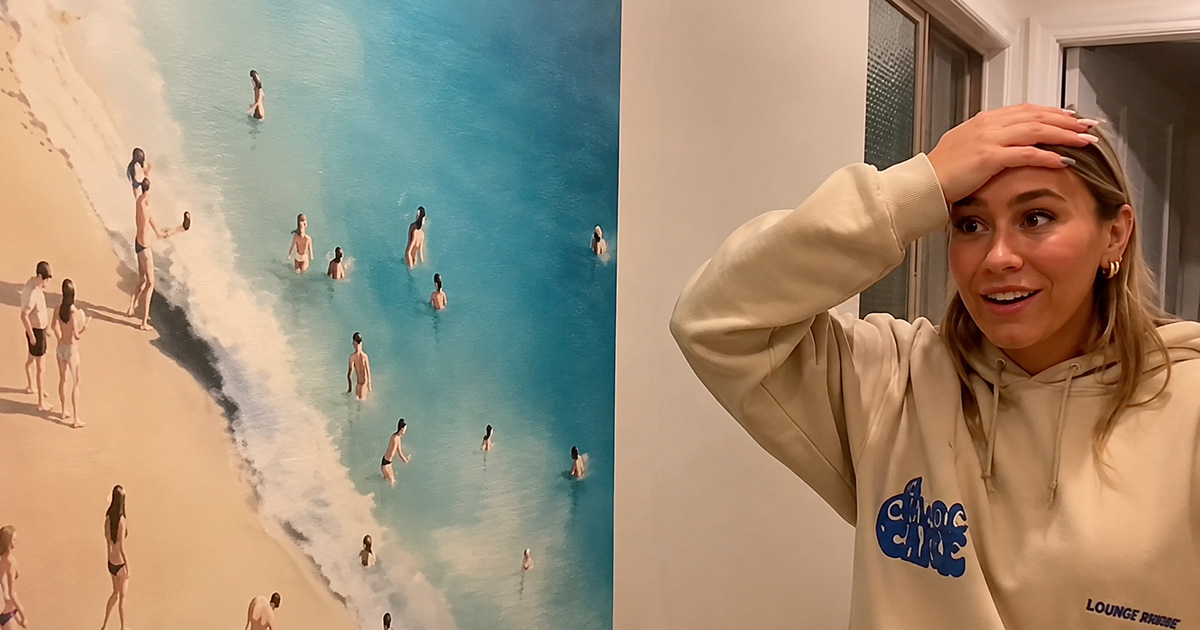

A father stood in the hallway of a San Diego Airbnb he’d never visited before and pointed at a large framed canvas on the wall. “This looks like me,” he said. His daughter Aubrey laughed it off. Then she looked closer.
Sisters Libby and Aubrey Birrell were settling into their vacation rental on July 2 when they noticed a large beach canvas hanging in the hallway. On closer inspection, they realized that the tiny figures in the ocean were themselves, captured during a seaside trip roughly ten years earlier. Sister Libby provided the detail that left no room for doubt. “We have those swimsuits,” she said. “We are literally in this picture. We are on our Airbnb wall.” They matched their faces and the exact bathing suits they’d been wearing that day.
The clip, posted by Aubrey through her TikTok account @aubsbirrell on July 2, accumulated millions of views. Comments ranged from existential dread to conspiracy theory. One TikTok user wrote “It’s because of CERN,” referring to the European Organization for Nuclear Research, which operates the Large Hadron Collider. The comment referenced a popular online conspiracy theory claiming the particle accelerator’s June 29 shutdown triggered a “timeline shift.” Others were more succinct: “Literally sounds like the start of a horror movie,” one person wrote. “Proof we live in a simulation,” said another.
How a Stranger’s Wall Ended Up With Your Face On It
According to Fox News, the family had never stayed at the property before and had no known connection to the home or its owners. They were exploring the rental after checking in when her father noticed something unusual.
Photographers regularly capture crowded beach scenes and license them to agencies, which in turn sell print rights to interior designers, rental owners, and décor companies. A photographer likely captured the Birrell family on a public San Diego beach a decade ago as part of a wider beach scene shoot, then licensed the image for commercial use as wall art.
San Diego’s beaches are among the most photographed destinations in Southern California. Countless photographers capture candid shoreline scenes that are later licensed, printed, and sold as decorative artwork. The kind of large-format canvas print that fills the hallway of a coastal rental is almost always sourced from stock libraries. A photographer walks a busy public beach with a wide lens, captures a hundred frames, uploads the best ones, and never thinks about where they end up. The family in the water is just texture. They are background. They are, in the parlance of commercial photography, “lifestyle content.”
Others in the comments shared similarly improbable stories of unexpectedly discovering themselves or family members in old postcards, newspapers, and photographs years after the images were taken. One commenter remarked that the experience made them wonder how many vacation photos taken by strangers over the years might unknowingly include them in the background. Every crowded beach day you’ve ever had, every boardwalk stroll, every moment you were standing in front of someone else’s shot without knowing it could be hanging in a rental hallway somewhere.
The sisters never discovered exactly how the photo made it into the rental home. Airbnb did not respond to press inquiries about the incident.
What Guests Don’t Know About Airbnb and Privacy

The Birrell story triggered nerves because it touched something people were already anxious about: who actually controls the space you’re sleeping in when you rent it from a stranger.
Hidden cameras in short-term rentals have been a persistent and documented problem for years. A CNN investigation found that Airbnb consistently fails to protect its guests despite knowing hidden cameras are a persistent concern within its industry. Thousands of images have been recovered from short-term rental hosts by law enforcement. Hidden cameras placed in bedrooms and bathrooms captured guests during their most private moments, including changing clothes and being with their children, according to a review of court and police records.
The platform did eventually respond with a policy change. According to Airbnb’s official newsroom, the company announced it was banning the use of indoor security cameras in listings globally. Historically, Airbnb had allowed indoor cameras in common areas like hallways and living rooms as long as they were disclosed before booking. The updated policy makes clear that cameras are not allowed inside listings, regardless of their location, purpose, or prior disclosure. That ban took effect on April 30, 2024.
Enforcement of that ban remains an open question. A 2025 survey of more than 1,000 Americans by IPX1031 found that 58% of Americans are worried about hidden cameras in rentals. Nearly half (47%) of respondents said they’ve discovered a camera in a rental property, a significant increase from just 25% in the firm’s 2023 study. Alarmingly, 55% of Airbnb hosts admitted to still using surveillance cameras indoors even after the company’s 2024 indoor camera ban.
These traveler safety concerns extend well beyond rental properties. But the short-term rental space is a particular pressure point because, unlike a hotel, there’s no front desk, no management company on call, no consistent brand standard. You’re sleeping in someone else’s home. The house rules and the camera rules are whatever the host decides to make them, regardless of what the platform says.
Nearly two-thirds of Americans (64%) admit they don’t know how to detect a hidden camera in a rental property. That gap between concern and capability is where things get genuinely worrying. Most guests check for cameras the same way they’d check for ghosts: uneasily, briefly, and without any real method.
What You Can Actually Do When You Check In

Turn off the lights and close the curtains. Then look for any small, steady lights, particularly red or infrared glows in corners, on shelves, or inside objects like smoke detectors, clocks, charging docks, and wall ornaments. Smoke detectors are a documented favorite for concealment, as are items that are typically mounted high on a wall and pointing downward. If a device looks out of place, or if there’s a piece of décor that doesn’t quite fit the rest of the room, examine it more closely.
A camera detection app or a dedicated RF (radio frequency) scanner will pick up signals from devices connected to a WiFi network, which covers most modern hidden cameras. These are available for under $40 and take about five minutes to run. They’re not foolproof. A camera that stores footage locally rather than transmitting it live won’t register on a signal scan. But they catch most of the common cases.
Hidden cameras in rental properties are criminal offenses in most states. In Florida, adults 19 and older who place hidden cameras face third-degree felony charges, while California imposes up to six months in jail. Guests who discover a hidden camera should document the device, call local police before contacting Airbnb, and report to the platform within 72 hours to preserve refund eligibility.
Read More: Only in America: 17 Solo Travel Destinations Too Strange to Skip
What the Birrell Story Actually Asks of Us

The CERN timeline shift theory, the horror movie comparisons, the simulation discourse: all of that noise is people trying to metabolize something genuinely disorienting. Not because an Airbnb hidden camera was involved, but because it wasn’t. The Birrells found themselves on a stranger’s wall, and the most honest explanation is that a photographer captured them in public a decade ago and sold the image to someone who printed it on canvas without knowing anyone in the frame.
Nobody did anything wrong. A photographer has every right to photograph a public beach. A stock agency has every right to license what they receive. A rental host has every right to buy affordable wall art. A family can check into a rental they’ve never been to and find themselves looking back from the hallway. The whole chain of events is completely legal, completely unremarkable at every individual step, and collectively bizarre.
How much of our image exists in places we have no knowledge of and no control over? Every beach photo, every background appearance, every candid someone snapped in a crowded place. If the Birrells hadn’t looked closely at what they assumed was generic décor, they’d never have known. How many other families have walked past their own faces on someone else’s wall and just kept going?
Disclaimer: This article was created with AI assistance and edited by a human for accuracy and clarity.