
Every American president since George H.W. Bush has boarded the same two planes. The same carpet, the same wood paneling, the same shade of blue on the tail – for 35 years, the visual identity of the U.S. presidency in the air barely changed. Then, on June 19, 2026, a converted Qatari 747 rolled into a hangar at Joint Base Andrews with a waving American flag on its tail, and “God Bless the USA” playing through the speakers.
President Trump walked down the steps in a dark blue suit. Several hundred Air Force personnel watched from the hangar floor. He called it a flying White House unlike anything the world has seen. Whether you find that thrilling or uncomfortable probably depends on where you already stood before you walked in.
But strip the ceremony down, and what actually happened is genuinely odd in the best sense. A Boeing 747 built for a Gulf royal family landed in Texas, got stripped and rebuilt for a different kind of head of state, and is now set to lead the largest Independence Day celebration America has staged in 250 years. That is not a normal sequence of events.
What the New Plane Actually Is
The newly unveiled aircraft, officially designated the “VC-25B Bridge,” is a heavily modified Boeing 747-8i originally configured as a VVIP business liner for the Qatari royal family. According to NBC News, the administration formally accepted the luxury Boeing 747 from Qatar despite questions about the ethics and legality of accepting such an expensive gift from a foreign government. The aircraft started life as a Boeing 747-8KB, the business jet variant of the 747-8 Intercontinental, delivered to Qatar Amiri Flight in April 2012. It spent over a decade carrying royalty before landing in San Antonio, Texas, where U.S. defense contractors began the work of turning it into something very different.
The “Bridge” designation is deliberate: this plane is not the permanent replacement for the aging presidential fleet. It is a stopgap, intended to carry Trump until the purpose-built VC-25B aircraft that Boeing contracted to deliver years ago finally arrive. Boeing’s primary contract to deliver two purpose-built, next-generation Air Force One planes is heavily delayed and not expected to be completed until 2028. The overhaul of the aircraft, including security upgrades, could cost more than $1 billion, NBC News reports, with the confirmed military conversion cost alone at $400 million.
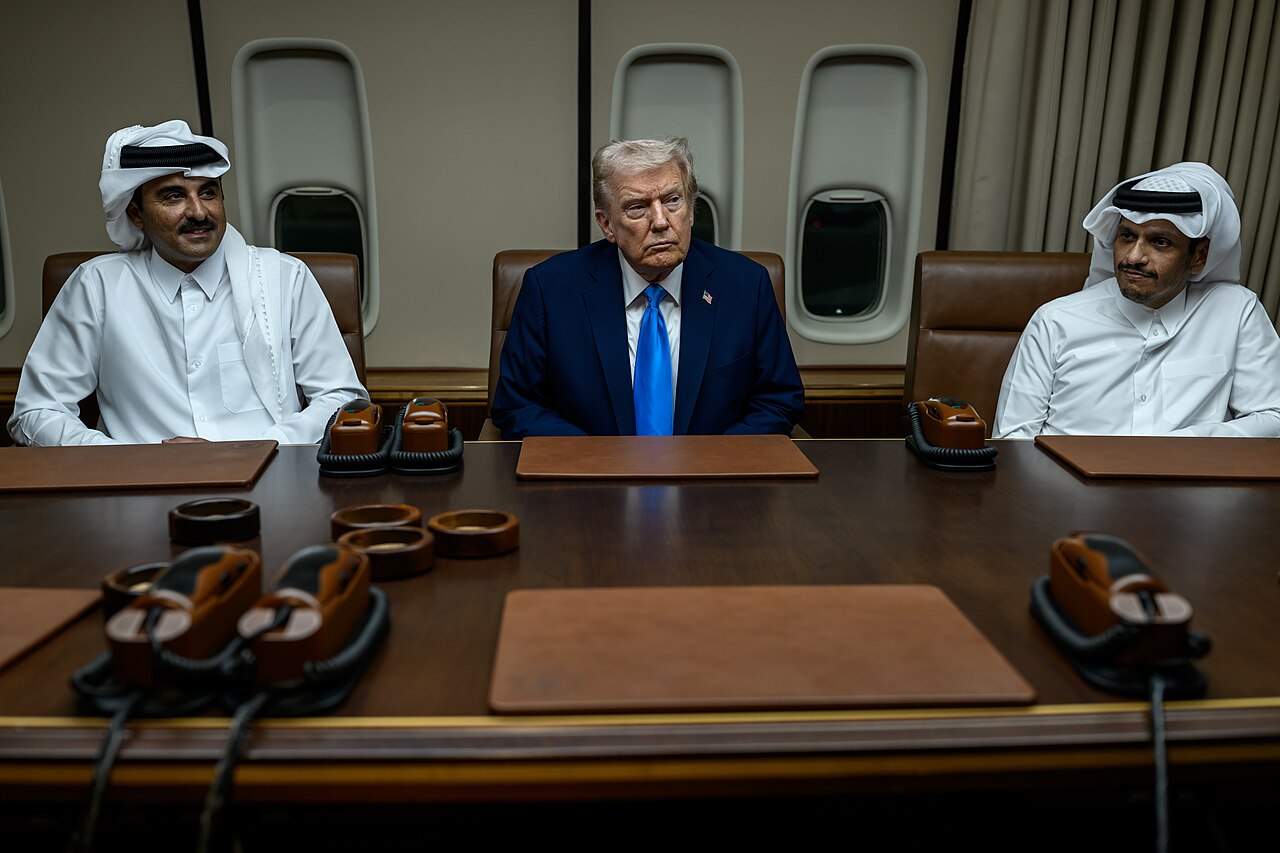
Unlike the highly customized models traditionally built from scratch for the presidency, the Air Force prioritized rapid delivery by leaving the jet’s existing interior layout minimally changed. This fast-track strategy allows the president and traveling party to fly surrounded by Qatar’s original ultra-luxury finishes, including high-end wood paneling, premium leather lounges, and master bedrooms, while avoiding the billions required to custom-build a fresh cabin framework. The modification process focused heavily on security, flight testing, and installing top-secret military communications equipment.
The Look: Goodbye, Kennedy Blue
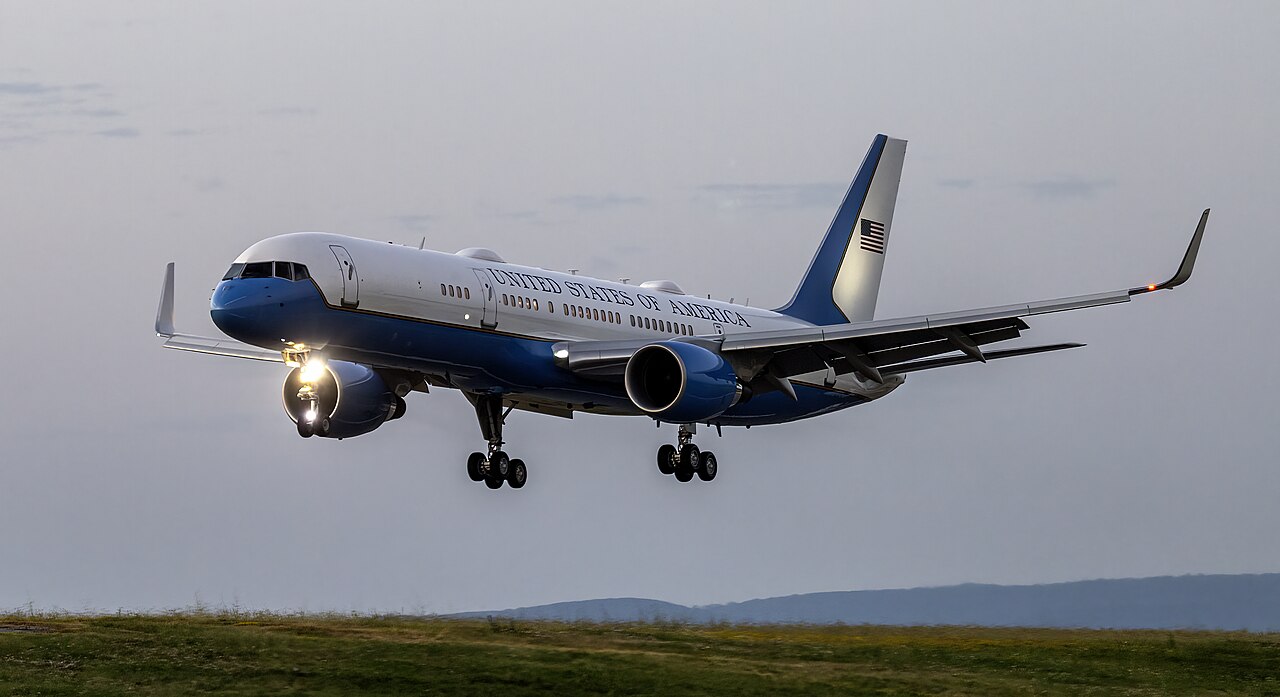
Few paint schemes in aviation history have been as immediately recognizable as the original Air Force One livery – a design that outlasted every administration it served until now. The original color scheme was created in 1962 by industrial designer Raymond Loewy, working directly with President Kennedy and First Lady Jackie Kennedy, who reportedly sat on the Oval Office floor drawing with crayons. Loewy settled on “luminous ultramarine blue” as the defining color, paired with white and polished aluminum. The design debuted on SAM 26000, a Boeing 707, and served across three generations of presidential aircraft for more than six decades.
Trump had announced back in 2018 that he wanted to replace what he called “Jackie Kennedy blue” with bolder colors. Biden reversed the decision during his term. Trump reinstated it upon returning to office. The aircraft that emerged from a secure facility in Waco, Texas, wears a bold red, white, and blue livery designed by the president himself: a white upper fuselage, red and gold accent lines, a dark blue undercarriage, and a waving American flag on the tail. Other government jets carrying senior administration officials will adopt the same color scheme, the Air Force confirmed.
Trump made no apologies for the personal nature of the choice. “Now, when we land at airports in London and in Germany and different places, nobody tops this one, and that’s the way we have to have it for our country,” he said, noting that the colors were “to my taste, I will say.”
The Qatar Question
No account of this Air Force One debut is complete without the controversy that shadowed every step of the plane’s journey from Doha to Maryland. The military acquired the aircraft as an “unconditional donation” from Qatar in mid-2025 to address severe logistical strains facing the current executive fleet. The timing was striking: the announcement of the gift came during Trump’s Middle East trip, which included a stop in Doha.
“It’s hard to imagine more brazen corruption or a clearer violation of our Constitution’s Emoluments Clause,” one critic said in May 2025, adding that the arrangement “puts our country’s national security at risk.” The Emoluments Clause, in plain terms, is the constitutional provision that prohibits U.S. officials from accepting gifts from foreign governments without congressional consent.
Trump shrugged off the criticism, labeling it “stupid” to decline the high-value asset, while White House legal counsel and former Attorney General Pam Bondi issued guidance clearing the deal. Under the approved legal framework, the aircraft is technically gifted on the condition that its ownership will ultimately be transferred to Trump’s future presidential library foundation upon the conclusion of his term.
The two existing VC-25As are not going away just yet. The War Zone reported that an Air Force spokesperson confirmed the VC-25B Bridge aircraft “will soon join the active executive airlift fleet alongside the VC-25A and C-32,” and that both of the older VC-25As would remain active. The Presidential Airlift Group will select the appropriate aircraft for each mission based on operational requirements.
Leading the July 4th Flyover
Trump confirmed the new Air Force One will lead a flyover above Washington, D.C., on July 4. “This will be a flyover, on July 4th, I think I can say the likes of which we’ve never seen before,” he said. He described the display as potentially including F-22s, F-35s, and aircraft from across the branches of the U.S. military, calling it “a flyover like no flyover.”
The backdrop to all of this is a milestone America has been building toward for years. The White House’s Task Force 250 was established to plan a full year of festivities running from Memorial Day 2025 through July 4, 2026, the nation’s 250th birthday. The scale of what is planned for Washington that day is substantial: more than a million people are expected to gather on the National Mall for ceremonies honoring service members, a reading of the Declaration of Independence at the National Archives, an expanded Independence Day Parade along Constitution Avenue, and an evening fireworks celebration billed as the largest pyrotechnics display ever staged in Washington.
Trump confirmed he would be taking the new jet to the NATO summit in Ankara, Turkey, the following month, and said his return from the Group of 7 summit in France was the last planned trip aboard the old Air Force One.
What Comes After This
The VC-25B Bridge is, by design, a temporary fix. Boeing holds a contract worth billions of dollars to build two purpose-built successors, originally due for delivery in 2024. That date slipped to 2028 by the time of the unveiling. The two VC-25As, for their part, entered service in 1990 and were designed for roughly 30 years of use. The program has overrun its original timeline by years, which is how a converted Gulf royal family jet ended up becoming an interim presidential aircraft.
What the new plane does change is the immediate image of American presidential travel. Trump’s point about landing in London or Berlin with a plane that “nobody tops” is not purely vanity, even if it sounds like it. The aircraft a head of state arrives in carries real symbolic weight in diplomacy. Whether the Qatari origins of this particular jet complicate that symbolism rather than enhance it is a question that won’t be settled by the Air Force One debut flyover, however spectacular it turns out to be.
Read More: Trump Just Did The Strange Handshake Thing (Twice) With the Macrons at G7
What Stays With You
Stripped of the politics, what happened at Joint Base Andrews on June 19, 2026 was a genuine change in the visual identity of American presidential power. The Kennedy-era blue had been on every Air Force One for 64 years. It was on the plane that carried Kennedy’s body back from Dallas. It was on the plane Nixon took to Beijing. Reagan, Clinton, Obama – the same blue, the same lines, decade after decade. That shade became so synonymous with the presidency that most Americans probably never thought of it as a design choice at all. It seemed less like a paint job and more like a fact.
It wasn’t. Raymond Loewy designed it during one presidential administration, and every administration that followed kept it – until now. The new design is bolder, louder, and unmistakably tied to one president’s personal taste. Depending on your politics, that either reads as a statement of renewed American confidence or as something more personal than a plane designed to outlast any single administration probably should be. Those two reactions can sit next to each other without either one being wrong.
What is harder to argue with is the scale of the moment the plane is flying into. More than a million people on the National Mall on the country’s 250th birthday, with a converted Qatari 747 in red, white, and blue at the front of the formation overhead. Whatever you make of the path it took to get there, it is not a small scene.
AI Disclaimer: This article was created with the assistance of AI tools and reviewed by a human editor.