
If you ask retirees who’ve moved to small-town Illinois how they found the place, a surprising number say the same thing: someone they knew had done it first, and the numbers turned out to be real. Not a catch, not a compromise disguised as a deal. The money genuinely goes further. The groceries cost less. The mortgage or rent doesn’t consume the whole check. And the towns themselves, the ones outside the orbit of Chicago, turn out to have actual life in them.
Most retirement coverage focuses on the Sun Belt or coastal destinations that look appealing in photos but require more income than Social Security provides. Illinois almost never comes up. That’s partly reputation and partly geography. But in the right pockets of the state, the math for a Social Security-funded retirement works in a way it doesn’t work in most of the country.
The towns worth knowing about aren’t interchangeable. Each one has its own character, its own mix of things to do, its own strengths and honest trade-offs. The reason they keep appearing on every credible affordability list isn’t a coincidence, and it’s worth understanding why.
The Social Security Math That Makes This Work
The Social Security Administration puts the estimated average monthly retirement benefit at $2,071 for January 2026. That number is the starting point for understanding why this conversation is even worth having. For most American cities, $2,071 a month is not a retirement budget. It’s a partial rent payment in a two-bedroom apartment.
But cost of living is not uniform across the country, and it’s not uniform across a single state either. According to a 2026 SoFi affordability analysis, of all the cities on their list, Danville has the lowest cost of living in Illinois, with a cost of living that is 80% of the U.S. average. A town where your dollar goes 20% further than it does in the average American city is not a small thing when you’re living on a fixed income. It’s the difference between managing and thriving.
The state-level tax picture makes it even more compelling. According to Kiplinger’s 2026 guide to state retirement taxes, Illinois has a flat income tax rate of 4.95%, but the state doesn’t tax retirement income, meaning Social Security benefits, pensions, IRA, and 401(k) distributions are state tax-exempt. In practical terms, that means a retiree living in one of Illinois’s affordable small towns could receive their Social Security check, a pension, and IRA withdrawals, and owe nothing to the state on any of it. That’s a meaningful structural advantage that compounds over years.
The honest caveat is that Illinois property taxes run high. The state charges a 6.25% sales tax, while the median effective property tax rate is around 1.83%. That’s worth factoring in, especially for anyone planning to buy. But in towns where the median home price sits around $100,000 to $120,000, even that effective rate translates to a property tax bill that most fixed-income budgets can absorb. Illinois also offers a homestead exemption of up to $5,000 for residents 65 and older, and seniors with household income of $65,000 or less can have their property’s assessed value frozen.
The Towns Retirees Are Actually Talking About
Illinois has a few standout towns that keep appearing on every credible affordability list, and they’re worth looking at one by one.
Danville is the one that makes financial analysts do a double-take. In east-central Illinois near the Indiana border, Danville has built a reputation as one of the most affordable places to retire in the state, with a cost of living nearly 20 percent below the national average and median home listing prices around $98,000. A town of nearly 28,000 people, it has the infrastructure of a real community without the price tag that usually comes with it. The Heron County Park Boardwalk winds through wetlands along Lake Vermilion, offering peaceful walking paths and birdwatching spots, while Kennekuk County Park covers more than 3,000 acres of woodlands, lakes, and prairie trails. For retirees who want outdoor life, a low grocery bill, and room to breathe, Danville keeps showing up at the top of the list for good reason.
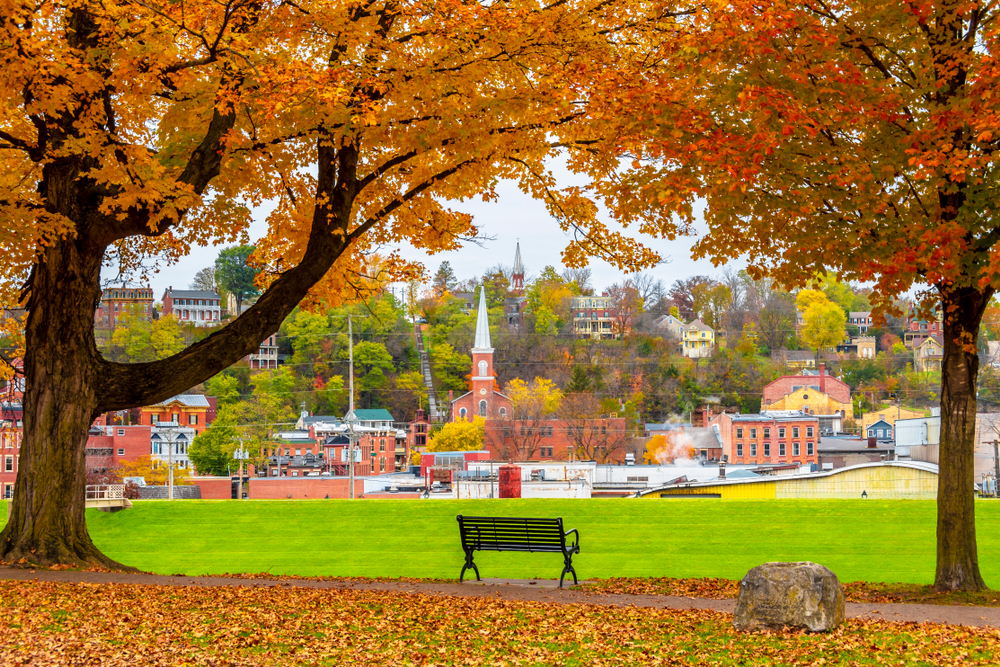
Galena is the one that surprises people who expect affordable to mean dull. A picturesque town in northwestern Illinois, Galena looks like it belongs on a postcard, with its historic main street, brick buildings, and Victorian architecture transporting you to another era. The town has a well-established retiree community, with U.S. News data showing about 31% of Galena’s population is over the age of 65. While tourist areas can sometimes mean higher prices, the overall cost of living in Galena remains reasonable, with housing options in the surrounding areas quite affordable compared to bigger cities, many under $150,000. Healthcare is covered by Midwest Medical Center right in town. As of mid-2025, the average rent in Galena was $635 per month, which is 61% lower than the national average of $1,628. On an average Social Security check, that leaves over $1,400 for everything else.
Streator doesn’t get as much attention but deserves a look. According to WorldAtlas’s January 2026 guide to affordable Illinois retirement towns, Streator’s average home value of $120,000 makes it one of the more affordable towns to retire in Illinois, and beyond its low cost of living, the community caters to the entertainment needs of seniors with venues including the Engle Lane Theatre, a 247-seat performance stage that fosters creativity and invites the public to catch live theater by local talent.
Princeton sits in north-central Illinois and has built what feels like a genuinely retirement-ready community from the ground up. The Owen Lovejoy Homestead, a beautifully preserved 1838 residence, stands as a landmark of Princeton’s role in the Underground Railroad, while downtown has restored brick storefronts housing antique shops, cafés, and family-run boutiques. With 27.8% of its residents already enjoying retirement, Princeton’s blend of history, affordability, and neighborly warmth makes it an easy place to call home.
What “Affordable” Actually Looks Like Month to Month
It’s one thing to say a town is affordable. It’s another to sketch out what the month actually looks like.
Take a retiree receiving close to the national average Social Security benefit, roughly $2,071 a month. In Galena, rent for a one-bedroom apartment runs around $635. That leaves around $1,436 for utilities, food, healthcare copays, transportation, and the occasional dinner at one of the restaurants on Main Street. Food expenses in Galena run about 25.9% below the national average at roughly $296 monthly for a single person, while energy, transportation, and healthcare costs come in about 16.5% lower. It’s tight, but it works. And if a retiree owns a modest home outright, or qualifies for one of the state’s senior property tax relief programs, the budget loosens considerably.
For a couple where both partners receive Social Security, the picture improves substantially. Two checks, a paid-off $100,000 house in Danville, and Illinois’s retirement income exemption is a retirement plan that doesn’t require a financial advisor to stress-test. It just requires choosing the right zip code.
The state-level tax advantage is something retirees from higher-tax states particularly notice. Someone moving from a state that partially taxes Social Security benefits can see a real increase in their effective take-home income simply by relocating, even before accounting for the lower housing costs.
You might also want to look at 10 Mountain Towns That Are as Affordable as They Are Beautiful if Illinois winters feel like a dealbreaker. Cold weather is a real consideration, and it’s worth being honest about it.
What Retirees Say They Didn’t Expect
The financial case for affordable Illinois towns is solid. But the thing retirees who’ve made the move tend to talk about most is something harder to put in a spreadsheet: the pace of life.
Downtown Danville has a creative edge thanks to its large-scale mural collection, which brings the town’s history to life on nearly every corner. Princeton has its Owen Lovejoy Underground Railroad history and a farmers market culture that keeps Saturdays genuinely busy. Galena has wine trails, hiking routes through the Driftless Zone hills, and a Main Street that draws visitors from across the Midwest without making residents feel like extras in a tourist attraction.
Riverfront communities in Illinois encourage retirees to spend their golden years appreciating the countryside, offering park networks and natural areas. Thanks to marinas and access to expansive reservoirs, the area is also well-suited for boating, picnicking, and fishing. None of that costs much. And none of it requires anything beyond the willingness to show up.
The healthcare access question, which looms large for retirees considering a small-town move, is generally answered well in these communities. The OSF Elizabeth Medical Center in nearby Ottawa serves the La Salle area and provides comprehensive primary care, focusing on senior-friendly services including extensive rehabilitation, telehealth, and palliative care within the vast OSF network. Most of the towns discussed here sit within reasonable driving distance of regional medical centers that go well beyond urgent care basics.
Read More: 8 Southwest Towns You Need To Visit This Winter
The Part Nobody Mentions
The honest version of this conversation includes something that gets left out of most retirement relocation articles. Moving to a small Illinois town on Social Security works best when your housing costs are genuinely low, which usually means either renting affordably or buying with cash or a very small mortgage. Illinois property taxes are among the highest in the country, which can offset some retirement tax advantages for homeowners, though seniors may qualify for several property tax relief programs that can help reduce long-term housing expenses.
It also helps to go in with clear expectations about what small-town Midwest life actually is. Galena’s downtown walkability is real. Its public transit is not. Danville’s cost of living advantage is substantial, but so is its distance from an international airport. These are real tradeoffs, not disqualifying ones, but they’re worth naming honestly.
What the retirees who’ve settled in places like Princeton, Galena, and Danville tend to describe is something close to the retirement they actually imagined: a manageable mortgage or no mortgage, a Social Security check that covers the basics, a community where people wave from porches, and enough to do on a Tuesday afternoon that the days don’t feel hollow. In a lot of expensive corners of this country, that sounds impossible. In the right Illinois town, it’s just Tuesday.
AI Disclaimer: This article was created with the assistance of AI tools and reviewed by a human editor.