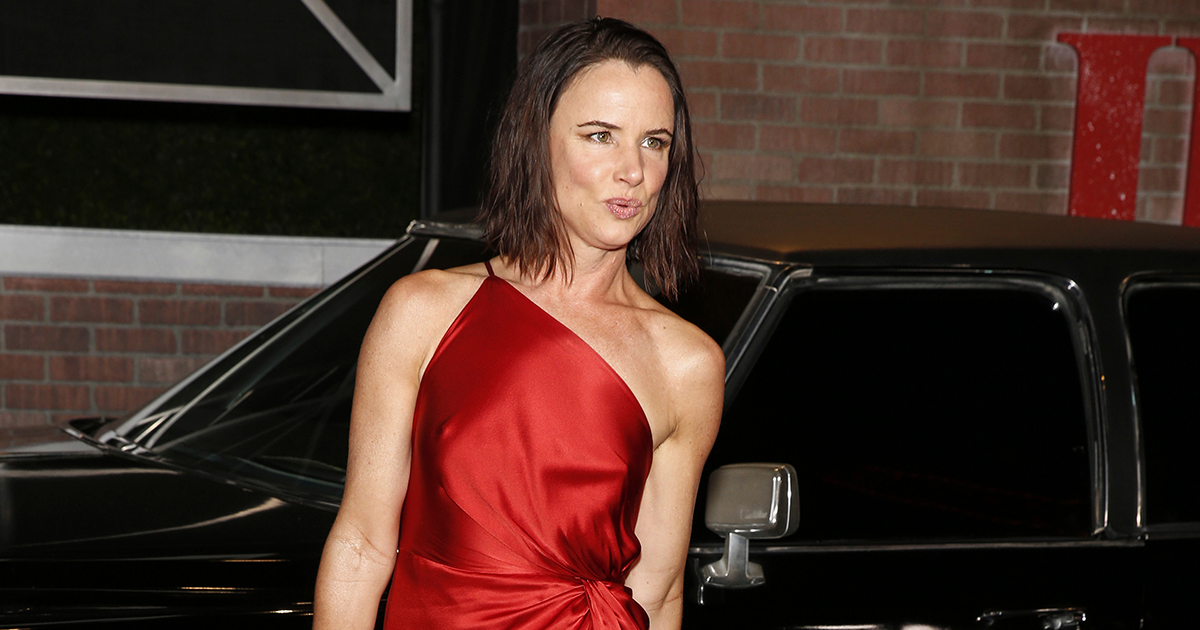
The first thing Juliette Lewis did after watching herself on screen as a teenager being terrorized by Robert De Niro was apologize to the audience. Not ironically. Not as a bit. She genuinely felt the need to say she was sorry.
“The first thing I did was apologize to the audience because it was so disturbing,” she said with a laugh, after rewatching Martin Scorsese’s 1991 Cape Fear at a recent screening and Q&A.
That instinct, spontaneous and unguarded, tells you something real about Lewis at 53. The film still has that power over her. She wasn’t performing self-deprecation. She sat with a crowd, watched what she was part of at 18, and the honest response was an apology. It’s the kind of detail that makes you want to understand how she got from there to here.
Danielle Bowden and the Role That Changed Everything
Thirty-five years ago, Lewis earned an Oscar nomination for Best Supporting Actress for her performance in Cape Fear, playing Danielle Bowden, the teenage daughter of Nick Nolte and Jessica Lange’s Sam and Leigh Bowden, who is manipulated and preyed upon by De Niro’s vengeful ex-con Max Cady. She was barely out of adolescence when she filmed those scenes, which have since become among the most studied in American cinema.
At 16, Lewis had starred opposite Brad Pitt in the critically acclaimed television movie Too Young to Die? (1990), which caught the attention of Martin Scorsese, who cast her in his thriller Cape Fear the following year. The film was a risk by any measure – a remake of a well-regarded 1962 thriller, with one of cinema’s most intimidating actors at the center of it. For a teenager with no major film credits, it was an extraordinary assignment.
The 1991 Film and Its Legacy
The drama is based on the 1957 novel The Executioners by John D. MacDonald and drew heavily from Scorsese’s interpretation for the new production. The 1991 version was both a commercial and critical landmark. It marked the seventh collaboration between Scorsese and De Niro, and became the first Scorsese film to gross more than $100 million, while Lewis’s work earned her nominations not just from the Academy and the Golden Globes, but from the Chicago Film Critics Association, the National Society of Film Critics, and the New York Film Critics Circle.
For Lewis, the film has always been what she calls her creative origin point. She has described Scorsese as one of her “first and most important teachers” – someone who recognized early that she had strong instincts even when she couldn’t yet articulate her process, and who gave her the encouragement she needed at exactly the right moment. That trust, extended to a teenager on a major studio film opposite De Niro, shaped everything that came after. Lewis has returned to that story repeatedly as the foundation of how she learned to be a performer.
The Return: Crystal and the New Series
How the Role Came Together
In a conversation with Entertainment Weekly published on August 2, 2026, Lewis described how the new series came about. She had worked with showrunner Nick Antosca on one episode of The Act and knew immediately she liked him. “I knew he was smart and I knew he was a great writer,” she said. “And we had a general meeting around 2019. And that’s when he first pitched the idea of Cape Fear as a possible series. And I knew if it was Nick, he was gonna make something special and unpredictable and super entertaining.”
It was around that same time that Antosca first started thinking about re-adapting Cape Fear. He already knew how good a performer Lewis was and wanted her in the series because, as Screen Rant reports, he really “wanted to work with her again.” Getting the project off the ground took years. “It took years for the rights and stuff..to come together,” Antosca admitted.
Lewis recalled watching the series take shape from the outside: “And so then some years went by and I saw that Amy Adams and Javier were cast. And I was like, ‘What? Is he not gonna call me? Does he not remember our meeting?'” She sent Antosca an email “very graciously just checking it out.” He offered her a role two days later.
The Character: Crystal
When Lewis agreed to return to the world of Cape Fear, she had one condition: she didn’t want audiences to recognize her. More than three decades after earning an Academy Award nomination for playing Danielle Bowden in the 1991 thriller, Lewis came back in Apple TV+’s reimagining as Crystal, an enigmatic woman whose connection to Javier Bardem’s Max Cady becomes one of the season’s biggest mysteries.
In the series, Crystal is Cady’s half-sister, sharing his traumatic childhood. She haunts him, sending a self-taped video welcoming him home after prison, but she also has her own agenda with the Bowdens.
The push-pull between Lewis and Bardem became one of the most talked-about elements of the series. As Lewis told Latin Times in July 2026: “It’s a cat-and-mouse game. Who’s the cat? Who’s the mouse?” That uncertainty, she said, was what made the writing so good – you switch roles, and the audience can never be sure who has the upper hand.
On filming with Bardem, Lewis described him as possessing everything needed for the role: “seductive, charismatic, dangerous and enticing.” She noted that when he “puts that veil over his eyes, a veil of darkness, it’s something to behold. It’s really powerful, and so it was really exciting for me to work with him.”
Keeping the Secret
The reveal of Lewis as Crystal, when it came in episode three, landed as a genuine shock for viewers. That outcome required sustained, deliberate effort. From the same Entertainment Weekly conversation, Lewis said keeping her appearance a secret proved to be one of the biggest challenges. “Very difficult. We worked hard. They left my name off the credits.” She also altered her voice for the role and appeared behind a mask during Crystal’s early scenes to preserve the surprise.
The character appears erratic in her first scene, raising immediate red flags for the other characters and for viewers. The episode later reveals that she is played by Lewis, a callback to the 1991 film and a reminder that nobody does “unsettling” quite like her.
Showrunner Antosca was deliberate about making the appearance substantial rather than a fan-service cameo. He said the creative team didn’t want to “just do a cameo for one scene” and have it feel like a distraction. The goal was to make it meaningful without pulling focus from the main story.
The New Series: Cast, Structure, and Scale
A Different Kind of Cape Fear
The 10-episode limited series premiered on June 5, 2026, with its first two episodes, with new installments released weekly every Friday through the season finale on July 31.
The classic thriller was reimagined for television with executive producers Martin Scorsese and Steven Spielberg. Amy Adams plays Anna Bowden and Patrick Wilson plays Tom Bowden, a married couple who work as attorneys. Their lives take a dark turn when Max Cady, a dangerous criminal they helped convict, leaves prison and pursues revenge. Javier Bardem takes on the role of Max Cady.
The show updates the 1991 premise in one significant structural way. In the two previous films, the Bowden family was targeted by Cady purely to get revenge on Bowden himself. In this new story, Bowden’s wife Anna was Cady’s defense attorney, and Tom was the prosecutor. That change puts Adams at the narrative center rather than the margins, and it pays off. Adams and Wilson play their parts with shifting layers of innocence and guilt.
The series is set in the present day, incorporating cell phones, podcasters, rideshares, catfishing, and public shaming – all of which figure into the plot. Scorsese and Spielberg, who produced the 1991 film, both executive produce on the new series alongside Antosca.
A Season Two?
An official second season has not been announced. The show was originally billed as a limited series. As Max does not die at the end, and the final moments are left open to interpretation, particularly given the lingering mystery surrounding Natalie’s parentage and Anna’s obvious unease, there is certainly room for a second season if Apple TV+ chooses to continue. Lewis addressed the question directly. Asked about Season 2, she simply said, “We will see.”
Juliette Lewis at 53: A Performer in Full
What the Original Film Still Does to Her
Rewatching Cape Fear alongside an audience clearly stirred something in Lewis that went beyond professional reflection. The apology she offered was reflexive and spontaneous – the kind of thing you say when you’ve just been through something alongside people and feel the need to acknowledge it. The film’s violence, particularly the scenes involving her teenage character, is not softened by time or familiarity.
Lewis has described how she has changed since the original film, admitting she is “more lighthearted” and “more serious about my peace of mind and my joyful outlook.” The woman who played Danielle Bowden was by her own account more willing to sit in dark material, less concerned with protecting herself from the psychological weight of a role.
She put it plainly: “I was very serious and now I’m a bit more serious about my peace of mind and my joyful outlook. When you’re younger you can sit in the darkness because it’s all new to you.” It’s not that the darkness doesn’t interest her. The new series is evidence that it still does. She just no longer carries it home.
From Danielle Bowden to Crystal: The Arc of a Career
Lewis’s breakthrough came with her Academy Award-nominated performance in Scorsese’s 1991 thriller. She went on to portray the free-spirited Becky in What’s Eating Gilbert Grape (1993), and later delivered an iconic performance as Mallory Knox in Oliver Stone’s Natural Born Killers (1994). Those three roles, in quick succession, showed an actress willing to go further than almost anyone else of her generation into uncomfortable, psychologically demanding territory.
The invitation to return to the franchise that first defined her, but as an entirely new character rather than a reprisal of Danielle Bowden, is the kind of creative proposition that could have gone sideways easily. Lewis clearly understood the difference between a meaningful return and a nostalgia loop. In interviews about the new series, she noted that she tried to “lead by example, because that’s what Robert De Niro, Jessica Lange and Nick Nolte did for me” – bringing the same preparation and presence to a supporting role in 2026 that those actors brought to a studio film in 1991.
What She’s Actually Saying
The apology Lewis offered at that screening is easy to read as self-deprecation, and it was partly that. But it also described something accurate: the 1991 Cape Fear remains one of the more genuinely disturbing mainstream films of its era, and her performance is inseparable from why. She was not, at 18, playing at being frightened. The material was real and the camera caught it. Watching it 35 years later with the audience is a different experience when you know what was happening on the other side of it.
There is something worth sitting with in the fact that the character she plays now, Crystal, is not a victim of Max Cady but someone who matches him, who gets under his skin, who the audience can’t quite read until well into the season. She built her career in the 1990s playing characters with their guard completely down. Crystal keeps hers up. That is either art reflecting life, or Lewis simply knowing by now what she wants to bring to a role and what she chooses to leave behind.