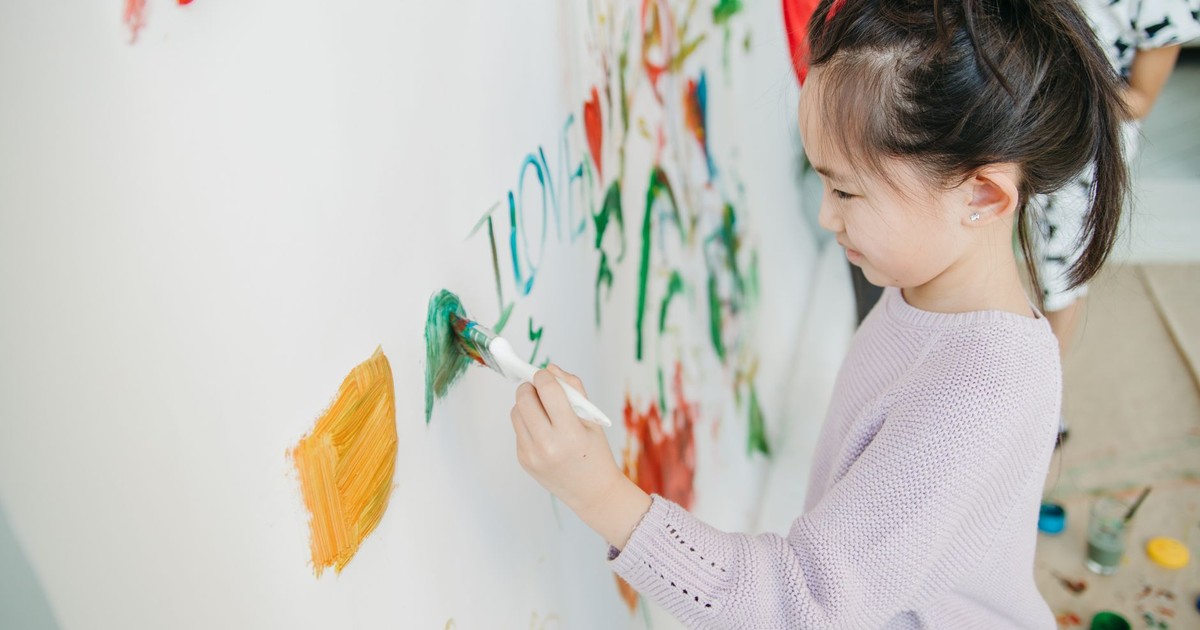

At age eight, Autumn de Forest sold more than $100,000 in paintings in 16 minutes at auction. One of those individual canvases sold for $25,000. She was not yet old enough to drive. By fourteen, her art prodigy paintings had generated more than $7 million in total sales at auction, and a significant share of that money went directly to disaster relief funds and charitable organizations.
Child prodigies appear in every generation, in music, mathematics, chess. But the fine art market is particularly resistant to youth. Collectors buy work, not potential. Autumn de Forest, born in Las Vegas in October 2001, produced work that cleared the bar on its own merits, long before her age became part of the conversation.
A Las Vegas Garage and the Beginning of Everything
De Forest began experimenting with a paintbrush at age five when her father was staining wooden furniture. He let her help. She painted a design that her parents felt surpassed the average child’s artistic ability, and they responded by providing her with brushes, canvases, and acrylic paint. The family repurposed their music studio into an art studio.
At five, de Forest’s inaugural wood-stain improvisation so mirrored Mark Rothko’s color fields that her father likened it to the abstract expressionist’s work. This was not the exuberant mess of a child who loves to paint. It was compositionally deliberate in a way that experienced eyes noticed immediately.
De Forest descends from an artistic family heritage that includes recognized and collected American painters such as Roy de Forest (1930-2007), Lockwood de Forest (1850-1932), and George de Forest Brush (1855-1941). Lockwood de Forest trained under Hudson River School figures and became a prominent figure in the Aesthetic Movement. Roy de Forest began as a second-generation Abstract Expressionist before rejecting that tradition and emerging as a pioneer of Funk Art. She is also related to Robert W. de Forest, who served as president of the Board of Trustees of the Metropolitan Museum of Art in New York City from 1913 to 1931. The lineage explains why a family of non-painters recognized what they were looking at and responded with professional seriousness rather than dismissal.
At seven, Autumn entered her artwork at the 2009 Spring ArtFest in Boulder City, Nevada, where she received an honorable mention. A month later, she won Best in Show at an Art in the Park event. Following this debut, de Forest continued creating art, adding a narrative element to each of her works. “By then I knew that art was my passion, I wanted to do it for the rest of my life,” she said.
The $100,000 Auction at Age Eight
At age eight, she sold more than $100,000 in paintings in 16 minutes during an auction held in February 2010. One of those individual canvases sold for $25,000. That is not an amateur collector picking up a curiosity. That is a serious buyer making a considered acquisition.
Shortly after this auction, de Forest was dubbed an “artistic genius” by the Discovery Channel and an “advanced child prodigy” by experts who assessed her work. The television exposure brought appearances on the Today Show, Disney programming, and a string of national interviews. She said that most days she’d wake up in her parents’ Las Vegas home at 7:30 a.m., and after breakfast break out her supplies for a one- or two-hour painting session before diving into schoolwork. Most brick-and-mortar schools couldn’t accommodate her travel schedule, so she did the majority of her schooling online. Before dinner, it was back into the studio. “That session can last much longer, that can be three or four hours when I really get into it,” she said.
De Forest was putting in five or six hours of painting on a typical day at an age when most children are in after-school activities for ninety minutes.
The Art Itself: Techniques, Influences, and a Self-Taught Method
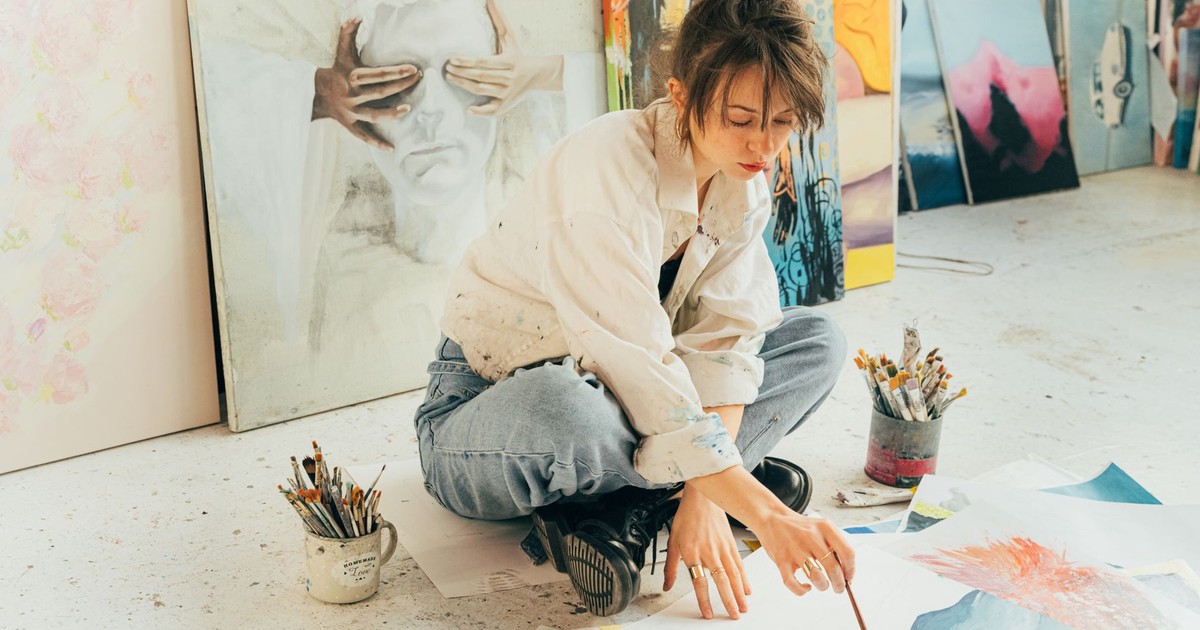
As a self-taught artist, de Forest developed multiple techniques in addition to more traditional painting methods. Her innovative “pull painting” method involves dragging paint across a canvas with a wire, while her “wind painting” method makes use of an air compressor and diluted acrylic paint.
She cites Andy Warhol, Pablo Picasso, Georgia O’Keeffe, Grant Wood, Henri Matisse, Jackson Pollock, Roy Lichtenstein, and Jasper Johns as inspirations. The influence shows up in the work in specific, identifiable ways. Her early “Barbie Marilyn” painting draws a direct line from Warhol’s commercial-icon aesthetic. The painting is about Marilyn Monroe, Andy Warhol, and Barbie. “I like Andy Warhol because of his ideas about art,” she explained. “I like the idea that whatever I put a frame around could be art, even ordinary things like soup and soap. By painting Marilyn Monroe like those things, she became a brand of merchandise too.” That is not a child parroting something she was told. That is a genuine aesthetic argument made by an eight-year-old.
Created between the ages of eight to ten, her earliest works demonstrate creativity and imagination flourishing at a time when most of her peers were attending elementary school. Her subjects ranged from iconic cultural figures to abstract color-field compositions, and the body of work was consistent enough that collectors continued buying without the novelty of her age as the primary driver. Her self-taught style blends abstract expressionism with influences from the American West, evolving over time to address global themes like humanitarian crises through large-scale acrylic canvases.
The $7 Million Figure and What Happened to the Money

By age fourteen, de Forest had sold more than $7 million in artwork. Her paintings fetched as much as $25,000 each, and much of the auction proceeds went directly to charities and disaster relief funds.
She began her charitable efforts at the age of six, donating several large paintings to Opportunity Village, a charity near her Las Vegas home that helps people with intellectual disabilities. Her broader charitable contributions have included arts education, the Red Cross, Habitat for Humanity, and relief efforts in Haiti, Japan, and the United States. She auctioned off artwork and directed 100 percent of the proceeds to the Hurricane Sandy NJ Relief Fund.
Her paintings grossed about $7 million in sales according to her father Doug, who set aside funds for college (Autumn had her eye on Yale) and put structures in place to protect the earnings.
Auction records at Invaluable list individual works by de Forest selling across multiple years and dates.
Recognition, Skepticism, and the Critics
Being called an artistic genius by the Discovery Channel at age eight is, by most measures, a gift. It is also a target. Some people in the art world had questions: was her work being inflated in value because of her age? Were her parents manufacturing the narrative? Was any of it independently verifiable as good art, stripped of the biographical hook?
Autumn ignored her critics and kept painting. As the focus on her age began to wear off, her work ethic and art only grew stronger. The skepticism largely dissipated as the body of work accumulated across styles, scales, and subjects that showed consistent development.
Dr. Lou Zona, the museum director at the Butler Institute of American Art, called Autumn “by any measure a child prodigy.” That is an assessment from an institution whose permanent collection includes work by her own ancestors.
Museum Exhibitions and Institutional Recognition
De Forest is the youngest artist ever to hold a solo exhibition at the Butler Institute of American Art in Youngstown, Ohio. The exhibition, “Autumn de Forest: The Tradition Continues,” ran from April 9 to October 10, 2016. She was fourteen. The museum’s permanent collection contains work by her ancestor George de Forest Brush, making the generational thread literal and visible.
De Forest’s solo exhibitions also include “Autumn de Forest: Selected Works” at the LeRoy Neiman Art Center in Harlem, as well as “Her White Room: The Art of Autumn de Forest” at the Monthaven Arts and Cultural Center in Hendersonville, Tennessee.
On November 7, 2015, de Forest received the International Giuseppe Sciacca Award for Painting and Art from the Vatican, an award given to talented young individuals in the field of art and knowledge who also serve as positive role models. After receiving the award, de Forest presented Pope Francis with four of her works. She had a private audience with Pope Francis and presented him with “Resurrection,” a work that now hangs in the Vatican Collection. At the time of the award, she was the youngest honoree in the award’s history.
She was also the youngest artist to be invited to speak at the National Art Education Association’s annual convention, where she appeared alongside internationally renowned artists Peter Max and Chuck Close.
The Turnaround Arts Program and Arts Advocacy
De Forest partnered with Turnaround Arts, a national program of the Kennedy Center that sends artists, celebrities, and other talented individuals to underperforming schools around the United States to inspire creativity in students. She became the youngest person ever appointed to the President’s Committee of the Arts and Humanities Turnaround Arts Program.
She served on the President’s Committee for The Arts and Humanities, created under the leadership of Michelle Obama, which brought remarkable figures including Yo-Yo Ma, Elton John, Kerry Washington, Misty Copeland, and Usher to underprivileged schools to talk about the importance of what they loved to do.
“In disadvantaged schools, they consider the arts an extracurricular activity,” she told Teen Vogue. “It’s devastating, as there could be child prodigies in these schools, but they don’t know that they have this God-given gift because they’re not given the opportunity.”
She created the Autumn de Forest Foundation with the goal of building an online platform for young artists. A portion of the foundation’s money goes to a 529 college savings account set up for students, while 10% goes to them directly. “A lot of these kids that I work with, they’re not very old, they’re in second grade, third grade, fourth grade. Maybe in 10 years, they may only have four or five thousand dollars, but that could be the difference between them going to college or not,” Autumn told Teen Vogue.
Pop Culture, Teen Vogue, and a Shawn Mendes Video
In 2018, de Forest was featured in the music video for Shawn Mendes and Khalid’s song “Youth,” a video highlighting exceptional young people working to change the world, including de Forest, Emma González, and Elias and Zion Phoenix. Throughout the seven-minute video, she is seen intensely creating a new work of art, covered in paint, making big, bold brushstrokes and throwing colors across an oversized canvas.
In 2017, the Monthaven Arts and Cultural Center in Hendersonville, Tennessee hosted a major solo exhibition for de Forest, and that same year she was named one of Teen Vogue’s “21 Under 21.” The New York Observer also listed her as one of the “10 Chicest Teens to Follow on Instagram.”
In 2013, at the age of 11, Autumn received a commission from Disney to create several paintings for the company’s headquarters. A major corporation with its own creative department decided a child’s original work was the right thing for their walls, not a print, not a reproduction.
What the Money Bought
The $7 million figure is the detail that travels, and it should. It is genuinely extraordinary. But there is something underneath the number. Most people, given access to a platform at fourteen that most artists never reach at fifty, would be excused for focusing on the career. De Forest focused on the pipeline.
The foundation, the workshops in underfunded schools, the Turnaround Arts appointments built on the argument that a kid in a second-grade classroom in a district that has already cut its arts budget might be carrying the same gift she was carrying, except no one will hand them a brush and a canvas and take them seriously. De Forest knows, from personal experience, what the first serious encounter with making art actually does to a child.
“I have always wanted to change the world for the better with my art,” she has said. “If my paintings and work with the Park West Foundation can help other young people express themselves by providing funding for musical instruments, arts education, or art materials, that’s an honor.”
The art prodigy paintings bought more than recognition. They funded a position from which a teenager could argue, credibly and with evidence, that the children no one was watching might matter just as much as the ones everyone already knew about.
Disclaimer: This information is not intended to be a substitute for professional medical advice, diagnosis, or treatment and is for information only. Always seek the advice of your physician or another qualified health provider with any questions about your medical condition and/or current medication. Do not disregard professional medical advice or delay seeking advice or treatment because of something you have read here.
AI Disclaimer: This article was created with the assistance of AI tools and reviewed by a human editor.