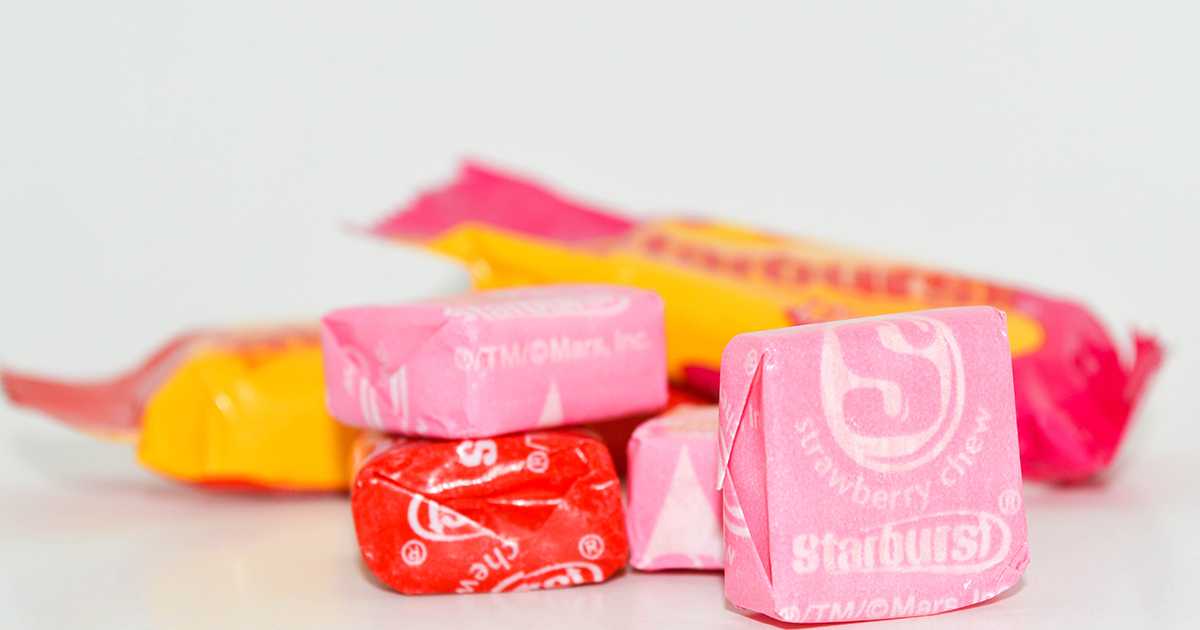

The candy sitting in the bowl at the front desk of every dentist’s office in America, the little square wrapped in wax paper, the one where everyone agrees the pink ones are the best, was not always called Starburst. For the first several years of its life, it didn’t even exist in the United States. When it finally did arrive, it went through two completely different names before anyone settled on the one we know today.
That’s three names for a single piece of fruit-flavored taffy. The story behind each one involves a corporate naming contest, relentless monthly product quotas, and one food scientist’s firm opinion about chocolate.
It started in Britain in the late 1950s.
Born in Britain: The Opal Fruits Years
In 1960, Mars, Inc. introduced the candy in the UK. Mars held a naming contest for the new product, and Peter Pfeffer, a copywriter working for a London advertising agency, won with the name Opal Fruits. He took home £5 for it.
The candy was produced at the Mars factory in Slough, Berkshire. The four original flavors were strawberry, lemon, orange, and lime. Opal Fruits caught on fast in the UK. The British advertising slogan was “made to make your mouth water,” and commercials emphasized the candy’s refreshing tanginess.
The name had a certain visual logic. Opals shift color depending on how the light hits them. Each individually wrapped piece in the pack was a different color. Whether or not that was the conscious thinking behind Peter Pfeffer’s entry, it worked.
Crossing the Atlantic With the Wrong Name
The candies were introduced to the United States in 1967.
Aaron Brody, who would later become a faculty member at the University of Georgia, was on the product development team for M&M’s Candies, then part of Mars. According to UGA Online, that team had a specific mandate: introduce a new candy every single month. The product development team had to develop, produce, and package a new candy each month, then place it in test locations across around a dozen retail stores to see whether consumers picked it up. If the candy sold, it went into regular production. If it didn’t, it disappeared. Brody later said the system meant he had “more product failures than anyone.”
For one of those monthly slots, the team adapted the Opal Fruits formula. They took the recipe from their sister company in England and reformulated it as a chewy, fruit-flavored candy for the American market, giving it the name “Starburst” and designing packaging with images of a strawberry, lemon, lime, and orange. The team believed the fruit imagery “makes you feel like you are tasting the real fruit,” but that’s also exactly why it had to go. There was no real fruit in the candy, so fruit on the package wasn’t allowed.
The name problem was even more abrupt. When they were about to print the packaging with “Starburst” on it, a call came in from corporate: Mars wanted the name changed to “M&M’s Fruit Chewies.” They had to redesign the package that day and still managed to get the candy out on time.
The reasoning behind the M&M’s rebrand was the kind of logic that sounds sensible in a boardroom and doesn’t survive first contact with a customer. M&M’s were a hit. If the name M&M’s was on it, wouldn’t that make people more likely to buy it? M&M’s had been a success for Mars since 1941, so the thinking was that name recognition would help the new candy along. What nobody fully accounted for was what M&M’s actually meant to consumers: chocolate. Round, candy-coated chocolate. Selling a fruit-flavored, chewy, square piece of taffy under that name was confusing.
The Man Who Gave It the Right Name

Aaron Brody successfully advocated for the candy’s name to be changed back to Starburst. The food scientist, then a Mars employee, argued that the M&M name was too synonymous with chocolate and that the fruit chews deserved their own identity.
He was right, and Mars eventually agreed. The company rebranded M&M’s Fruit Chewies as “Starburst” in 1968. According to History Oasis, the name was inspired in part by the Space Race and the idea of conveying a “burst of flavor” in every piece. The late 1960s were a moment when anything with “star” in the name felt current, forward-looking, and American. Apollo 8 orbited the Moon in December 1968, the same year the candy got its new label.
The candy sold well. It went from a test product into permanent production and, over the following decade, became a staple of the American candy aisle.
What the British Thought of All This

Back in the UK, none of this American naming drama applied. The candy kept its original name. Opal Fruits continued to be sold in Britain throughout the 1970s and 1980s, running its own advertising campaigns and building its own generational loyalty entirely separate from whatever Starburst was doing in the US. In the 1970s, Opal Fruits were well known for the tagline “Opal Fruits, made to make your mouth water!”
The name Opal Fruits wasn’t just a label in Britain. It was a genuine piece of cultural shorthand, the kind of thing that gets associated with a specific era of childhood, with road trips and school tuck shops and arguments about who ate all the orange ones. For a significant portion of the British population, Opal Fruits were simply what the candy was called. Not a previous name. The name.
That loyalty collided with corporate strategy in 1998.
The 1998 Merger: One Name to Rule Them All
In 1998, despite protests from the British public, Mars changed the name of the candies in the UK to Starburst in order to unify the brand for the global marketplace. The logic was straightforward from a business perspective: one name, one brand identity, one packaging system, one global campaign. No more maintaining two separate names for the same product. No more British consumers looking for Opal Fruits while traveling in the US and finding nothing.
Many UK consumers were genuinely cross about the change, and some nostalgic candy lovers still call them Opal Fruits today, not Starburst. The British relationship with brand names and food nostalgia is its own well-documented phenomenon. Marathons became Snickers, Opal Fruits became Starburst, and a certain percentage of the population decided to be annoyed about it forever.
The 1998 switch also completed a global unification that had taken nearly three decades from the candy’s original launch. What started as a British confection in 1960, traveled to the US in 1967, was briefly saddled with a name that associated it with chocolate, rescued by a food scientist with a clear opinion, and then finally brought back under one roof internationally in 1998.
How the Flavors Changed Along the Way
The original lineup of strawberry, lemon, orange, and lime held across both the UK and US versions of the candy for a significant run. In the US, lime was replaced by cherry in the early 1980s. That swap altered the fundamental character of the classic pack in a way that still prompts occasional debate: lime was tart, genuinely sour in a way that cut through the sweetness. Cherry is sweeter, softer, and less polarizing, which is probably why it won.
The candy’s varieties expanded well beyond the original four. Starburst now comes in Tropical, Sour, FaveReds, Very Berry, Superfruit Flavor, Summer Blast, and Original varieties. The “FaveREDs” pack, which contains only the red and pink flavors, exists because of a widely understood truth: a disproportionate number of people eat around the yellow ones.
In March 2020, the Opal Fruits name was revived again for a limited period in the UK, with a 152g bag available in Poundland and Dealz stores. It wasn’t a permanent return, more a nostalgia play, acknowledging that the original name still means something to a generation of British consumers who never quite made peace with the rebrand. It sold.
Mars, Wrigley, and Who Actually Makes It Now
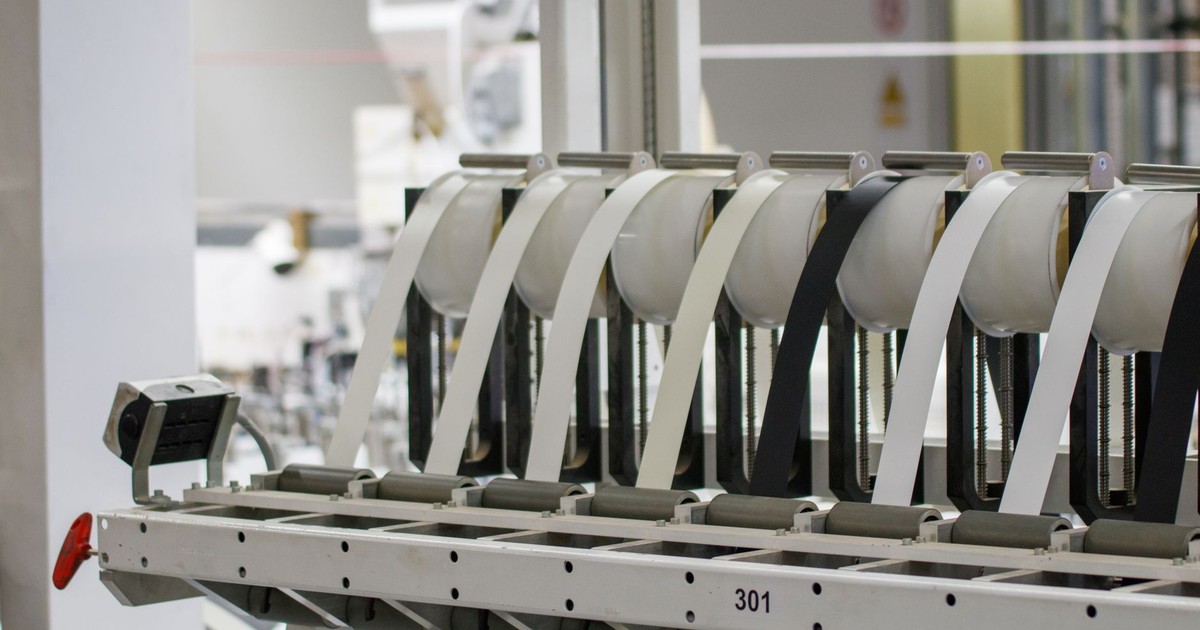
In October 2008, Mars acquired the Wrigley Company. After the acquisition, all non-chocolate candy brands from Mars were transferred to Wrigley as a subsidiary. That means Starburst is now technically a Wrigley product, even though Wrigley itself is owned by Mars. The candy that started as an M&M’s project is now housed in a completely different part of the same parent company.
What’s stayed consistent across all of it is the formula. The basic construction of Starburst, a chewy, fruit-flavored, individually wrapped square, hasn’t fundamentally changed since Peter Pfeffer named it Opal Fruits in 1960. Different names, different flavor lineups in different markets, different ownership structures. Same satisfying chew.
The Starburst Name Stuck for a Reason
The original name was chosen by a copywriter who won a contest and pocketed £5. The American name was chosen by a team under pressure to launch a new candy every thirty days. The name that stuck globally was saved by a food scientist who didn’t think fruit candy should share a name with chocolate. None of this was the product of a grand strategic vision. It was a series of decisions, arguments, and compromises made by people solving immediate problems.
The Starburst name wasn’t inevitable. M&M’s Fruit Chewies could have found its audience. Opal Fruits could have stayed Opal Fruits everywhere, forever. The version of this candy that exists now is the result of one person in a product development meeting being right about something and being persistent enough to get the right outcome.
The pink ones are still the best. That part was never in dispute.
Disclaimer: This information is not intended to be a substitute for professional medical advice, diagnosis, or treatment and is for information only. Always seek the advice of your physician or another qualified health provider with any questions about your medical condition and/or current medication. Do not disregard professional medical advice or delay seeking advice or treatment because of something you have read here.
AI Disclaimer: This article was created with the assistance of AI tools and reviewed by a human editor.